
One Apparatus, Every Role
Rethinking the Fire-Based EMS Transverse Apparatus in California
In most California communities, the fire department is the first medical provider on scene for the overwhelming majority of 911 calls. Engines arrive, paramedics begin care, and the patient is stabilized long before a transport ambulance shows up. Yet in county after county, those same departments seem to conclude that they “can’t do EMS transport” — and so they under-invest in the medical side of a mission they already run every single day.
The reason is structural, not operational. In most of California, ambulance transport is run by private services. Local EMS agencies designate exclusive operating areas, and unless your agency holds the transport contract or has retained transport rights of its own, you can’t bill for the transport. A traditional ambulance, evaluated purely as a revenue unit, doesn’t pencil out. So, the conversation ends there.
I’d argue we’re asking the wrong question. The question isn’t “should we run an ambulance?” It’s “what is the right apparatus for the fire-based medical mission we already perform?” And once you frame it that way, a fire-based transverse apparatus starts to look less like a luxury and more like a model of efficiency.
What a Transverse Apparatus Is
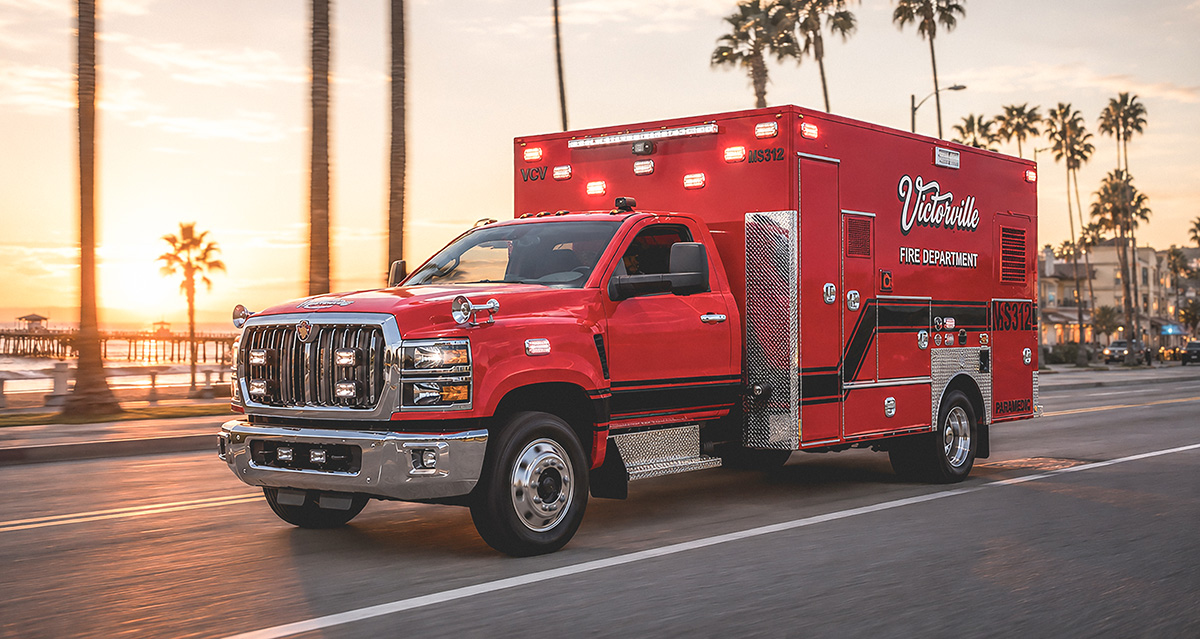
A fire-based EMS transverse apparatus is a single, heavy-chassis vehicle — typically a medium-duty 4×4 — built around a transverse compartment: a crosswise storage and equipment space, usually set between the cab and the patient module. That compartment is what sets it apart from a standard ambulance. It gives the unit room to carry fire and rescue equipment without sacrificing the patient-care area. The result is one apparatus that does three jobs a department is already responsible for: it functions as a fire-rescue rig, it serves as a rolling ALS treatment and rehabilitation station, and it retains the ability to transport when transport is the right call.
That last capability is the one that gets debated, so let’s be precise about it. The point of a transverse apparatus is not to win the transport franchise or to compete with the contracted provider. The point is that the unit earns its place in the fleet on the first two missions alone — and the transport capability is there for the moments when the system can’t deliver. It’s a safety net, not a business model.
The Case You Can Make Today
The strongest argument for a transverse apparatus has nothing to do with billing. It’s firefighter safety.
NFPA 1584 calls for rehabilitation of members during emergency operations and training. On a working structure fire, an extended wildland assignment, or a hot-weather incident, crews need active cooling, hydration, vitals monitoring, and medical evaluation. A transverse apparatus is purpose-built to provide that on scene. For a chief and a board, “this apparatus protects our own people on every working incident” is often the easiest yes in the building — and it’s true on day one, regardless of who holds the transport contract.
The second argument is surge and saturation. California’s transport system faces unique challenges: long rural distances, wildfire deployments that pull units out of the area, mass-casualty potential, and hospital offload delays that strand ambulances at the wall for hours. When the contracted unit is thirty minutes out and your patient is critical, a fire-based unit that can move the patient is often the difference between policy and outcome. You hope you rarely use it; you’re very glad it’s there when you do.
The Funding Math
Because a transverse apparatus serves multiple missions, its capital cost can be spread across more than one budget justification — fire apparatus, EMS capability, and firefighter health and safety. That matters when you’re competing for dollars.
On the federal side, the Assistance to Firefighters Grant (AFG) program funds vehicle acquisition, and a transverse apparatus fits squarely within that category. State EMS grant programs and regional funding can layer in as well. (A note for clarity: SAFER grants fund staffing, not vehicles, so if your program needs people as well as apparatus, that’s a separate but complementary application.) The through-line is simple: one platform, several missions, multiple funding doors.
This is also a timely moment to make the argument. There is an active statewide conversation about the true cost of ambulance service and the role of fire-based EMS in California’s system. Departments that can document their actual response data, their costs, and their capabilities are far better positioned in that conversation than those working from assumptions. A transverse apparatus is, among other things, a way to put real capability behind the numbers you bring to the table.
From Concept to Fleet
Departments are already making this choice. Victorville Fire Department, for example, specified exactly this kind of configuration — a fire-based EMS transverse apparatus on a heavy-duty chassis — to fit the way it responds. The configuration isn’t theoretical; it’s in service.
If your department is weighing it, the path is straightforward. Start with your own call data: how often are you first on scene medically, how long are your transport waits, and how many working incidents would benefit from on-scene rehab? Have a candid conversation about your county’s exclusive operating area and any transport rights your agency may hold. Scope the build around your real missions rather than a generic spec. And line up the funding case — AFG and state EMS grants — before the budget cycle, not during it.
None of this requires winning the transport franchise. It requires matching your apparatus to the mission you already run. For a lot of California departments, that mission is medical first, fire second by volume — and the apparatus hasn’t caught up to that reality yet.
The transverse apparatus is a great way to start catching up.
Rob Sparks is Director of Sales at Frazer, Ltd., a custom emergency-vehicle manufacturer based in Sugar Land, Texas. He works with fire and EMS agencies across California, Arizona, and Nevada on apparatus strategy and grant-funded acquisition.