Ambulance Replacement Recommendation

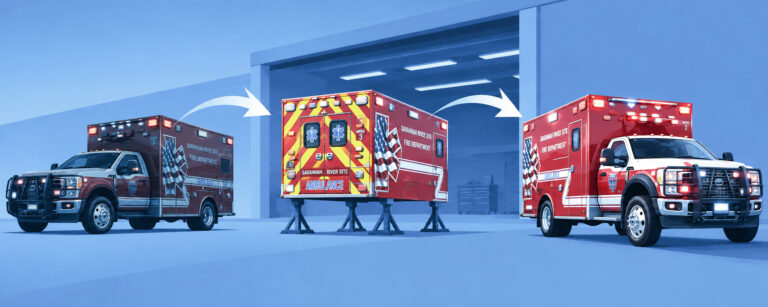
When it comes to replacing an ambulance, there isnโt a single federal law that sets a hard retirement date. Instead, most agencies follow industry averages and safety standards to guide smart, responsible decisions. At Frazer, we believe replacement decisions should be practical, data-driven, and focused on reliability because uptime matters. Industry Replacement Guidelines 1. Standard Front-Line Replacement Cycle Most EMS agencies replace front-line units every 5 to 7 years, which has become the most common benchmark for front-line service, or at approximately 250,000 miles. Current data shows the average replacement mileage trending downwards to approximately 150,000 miles, more closely aligning with most chassis powertrain warranty coverage plans. 2. Front-Line vs. Reserve Strategy Many departments use a staggered approach, placing units in primary response service for five years before transitioning them to ready reserve status for an additional 3 to 5 years. This strategy helps balance compatible budgets while preserving operational readiness. For further insight into determining the appropriate fleet size, refer to our blog outlining this approach. Why Age and Mileage Matter 1. Reliability Vehicle age and mileage are two of the most important indicators of reliability in an EMS fleet. National data shows that after 10 years of service, maintenance costs and the risk of mechanical failure during emergency responses increase significantly. At that stage, downtime shifts from an operational inconvenience to a measurable liability. 2. Mileage: The 250,000-Mile Rule Mileage remains a widely accepted benchmark for replacement. Industry experts commonly cite the 250,000-mile standard, and for many departments, mileage provides a more accurate measure of vehicle condition than age alone. 3. Idle Hours: The Hidden Wear Factor Idle time is an often-overlooked contributor to engine wear, particularly in diesel engines. Extended idling can lead to incomplete combustion, carbon buildup, fuel dilution, and additional strain on emissions components. Ambulances frequently idle to power medical equipment and maintain climate control, creating engine wear that does not appear on the odometer. These unrecorded miles are often referred to as โGhost Miles,โ which explains why two units with identical mileage can present very different mechanical conditions. Fleet maintenance guides and engine-hour conversion tools generally estimate that one hour of diesel engine idling equates to approximately 25 to 35 miles of driving in terms of wear. Many fleets apply a standard conversion of about 30 equivalent miles per idle hour. Some telematics platforms, including Geotab, commonly reference a conversation factor of approximately 33 miles per idle hour. At a 33-mile conversion factor, 1,500 idle hours equate to roughly 49,500 additional โGhost Milesโ of engine wear that are not reflected on the odometer. What This Means For a diesel-chassis ambulance, one hour of idling can represent approximately 25 to 35 miles of engine wear, even though the odometer remains unchanged. In practical terms, the engine continues accumulating wear despite the vehicle not moving. To account for this, many fleet managers incorporate equivalent โidle milesโ into total mileage when scheduling preventive maintenance, planning oil change intervals, or evaluating overall engine life. This approach provides a more accurate representation of true engine usage. Why This Conversion Exists Diesel engines continue to experience revolutions, thermal stress, fuel consumption, and component wear while idling. Over time, this operating condition contributes to long-term degradation similar to low-speed driving. Because odometer readings capture only distance traveled and not total run time, fleets apply idle-to-mile equivalency calculations to more accurately measure engine wear and support informed replacement planning. Remounting as a Cost Strategy Ambulance patient modules are engineered for long service life and represent a substantial capital investment. As a result, many agencies incorporate remounting into their fleet lifecycle strategy. How Remounting Works Remounting involves removing the existing patient module from a high-mileage or aging chassis and installing it onto a new chassis. This approach retains the value of the original module while renewing the vehicleโs drivetrain and mechanical systems. Cost Savings Remounting generally delivers a savings of 20 to 30 percent compared to purchasing a completely new vehicle in the same budget year. At the same time, it effectively resets the mechanical service life of the unit. For many departments, remounting offers a practical and financially responsible method for extending asset value while maintaining operational reliability. Red Flags: When Replacement Should Happen Immediately Certain conditions warrant immediate replacement, regardless of a vehicleโs age or mileage. 1. Frequent Breakdowns More than two critical failures per 100,000 miles signals a growing reliability concern. At this rate, the vehicle presents an operational risk and increases the likelihood of service disruption during emergency response. 2. Technological Limitations An inability to support modern equipment, including power-load cot systems and advanced telemetry, restricts clinical capability and may hinder compliance with current safety standards. 3. Structural Corrosion Significant chassis rust, particularly in salt belt states, can compromise crashworthiness and overall structural integrity. Once corrosion begins affecting load-bearing components, the safety of both patients and crew is at risk. An Analytical Approach to Replacement Replacement decisions should be deliberate and data-driven rather than reactive. A structured evaluation model allows agencies to assess risk, cost, and operational impact with greater clarity. Frazer recommends a weighted scoring methodology that adapts to varying operational environments, whether supporting high-utilization urban systems or rural agencies where reliability risk carries heightened consequences. Use the calculator below to evaluate your fleetโs replacement readiness. Final Thoughts These metrics are not rigid mandates, but they provide a structured framework for informed decision-making. The objective is to maintain flexibility while applying disciplined evaluation standards. Urban agencies may justify replacement based on high utilization and accelerated wear. Rural agencies can take a proactive approach, addressing reliability risks before a failure compromises response capabilities. Ultimately, replacement decisions extend beyond age alone. The priority is protecting uptime, managing long-term costs, and ensuring crews operate equipment they can rely on when it matters most.
Right Size It! Optimize Your Fleet Size with a Vehicle Replacement Strategy.

Over the last 18 months, nearly every aspect of local government has been dramatically impacted by the COVID-19 pandemic. During these times, our local emergency medical services (EMS) systems are one of our most affected entities. We’ve heard from many EMS leaders that have seen call volumes double or even triple overnight! Many departments have not planned for a dramatic increase in demand like this, and are now dealing with shortages of vehicles, equipment, and staff. Today, fleet planning and implementation have taken on a new level of importance, here’s whyโฆ Vehicle Replacement Strategy Today’s reality is, past experience may not be as reliable in predicting tomorrowโs needs as it once was. A replacement plan is deliberate and should be in place before that shiny new unit is ordered. It’s essential that agencies create an Apparatus Replacement Strategy that focuses on balancing equipment needs with your present and anticipated future demands for service. Achieving an optimal Vehicle Replacement Strategy considers multiple factors and is revisited often. Some factors may include current and future Peak Staffing Levels, unit hour utilization, anticipated population growth, shifting demographics, transport distances, opening or closing of facilities, shifting weather patterns, etc. Of these factors, Peak Staffing Level is one of the most straightforward but misunderstood planning elements. Peak Staffing Level is defined as the highest concurrent number of staffed units on duty on a regular / planned basis. Many agencies consider an optimal fleet size as 1.5 fully equipped and mission capable units per Peak Staffing Level. Equation: Peak # of units x 1.5 = X, then round up. A rural community, for example, has three units in its fleet. They run approximately 400 calls per year, and usually, transport 2 miles into their local small hospital, or 12 miles into the larger community’s Hospital with a Level III trauma center. They have mutual aid available with an average response time of 30 minutes as needed. They occasionally need to transport to the larger city 35 miles away for specialty care. Since the time on task is lengthy they try to use on-call crews to backfill or handle the transport. They also regularly schedule and staff a dedicated unit at most high school athletic events, the annual county fair, and the Labor Day town festival. This does not include any unusual surges due to an unplanned natural disaster or the occasional unplanned busy day. With this schedule, their Peak Staffing Level is three. With only three units, routine maintenance is often delayed or cut short during busy times or special events season. Crews are reluctant to switch out of the โprimaryโ unit because both โreservesโ are unreliable, uncomfortable, or have suboptimal performance. The situation festers until the primary unit suffers a catastrophic transmission failure, and is intensified when the second unit has a deer strike that took out the radiator. In the blink of an eye, the community is in an equipment crisis. Using the equation of 1.5 units per Peak Staffed Unit (rounded up), the community would have avoided this crisis and may have even avoided the costly and lengthy transmission replacement by comfortably having all units inspected and serviced prior to the failure. Eddie Calendar knows the importance of fleet size and staffing. What About Reserve Units? Many EMS agencies are stuck in the traditional โfront lineโ and โreserveโ fleet management, which has been in use for as long as there has been fire apparatus. The fundamental difference between Fire and EMS apparatus is that EMS apparatus will often โwear outโ based on mileage, where many Fire apparatus (especially support and specialty apparatus) will โage outโ. A 20-year-old Type 6 Engine with 40,000 miles is usually far more serviceable and reliable than a 15-year-old ambulance with 300,000 miles. A more successful and cost-effective fleet strategy for EMS is to maintain a fleet where ANY unit is fully mission-capable and all units are regularly rotated into service on a regular basis. Using a strategy like this will balance out fleet mileage, allow for regular equipment inspection and when surges hit, EVERY unit will be ready to respond. Does your agency use Reserve Units? How has that practice evolved over time to influence your Fleet Size? We’d love to hear your thoughts. New vs Remounting If you’ve needed to replace an EMS vehicle in your fleet over the last year and a half, then you may have considered remounting. Remounting is where we remove your Frazer module from the existing chassis and mount it onto a newer chassis. If chassis procurement is not an issue, then remounting may be a better use of funds during times where materials and equipment costs are increased. It also may be a good option if your department uses Reserve Units as they can be great candidates for remounting. More on Fleet Sizes Determining the right number of fleet vehicles requires analyzing multiple potential factors. To learn more about our thoughts on Fleet Size, read our Fleet Size Matters article.
New Product – Sentinel Vehicle Disinfection System

Throughout this past year, we have learned a lot about vehicle sanitization and we have found that there is no one thing that makes your vehicle invincible. We have found that the most effective solution is to use multiple systems of disinfection to ensure the safety of your first responders and of course your patients. What is it? NBPI Technology. This stands for Needlepoint Bipolar Ionization. How it Works? This technology works to safely clean the air of your emergency vehicle by releasing positive and negative ions. These ions go into the air of your Frazer unit and attach to particle, pathogens and gas molecules. After they attach, the ions suck them of their life-sustaining hydrogen ultimately killing the pathogen. Learn More Want to learn more? Watch as our Vice President of Sales & Marketing, Adam Fischer explains the new NBPI technology on our YouTube Chanel! Or Check out Sentinel’s Webpage here. Key Features Or give us a call at 888-372-9371 and ask for a sales member.
Better Brain Health : How to take care of your brain as you age
Learn how to have better brain health! This May is Stroke Awareness month. Not only is it important to recognize the signs of stroke, but also ways we can make healthy decisions toward stroke prevention. The American Stroke Association has a video with steps for achieving better brain health!
The Frazer History Timeline
Driving down memory lane with Frazer Ltd. Frazer products have evolved significantly since the mid 1950s. Prior to our work in mobile healthcare, our early years were spent fabricating steel equipment for seismic exploration(as seen above). Visit the Frazer history timeline on our website to follow the long journey that our company has been on through the years!
The Many Uses of Generator Power
Generators are everywhere. They can power a job site, a residential building, or a recreational vehicle. A generator can serve as the main source of power or as a backup option. Generators come in a variety of wattages and prices, and their benefits are vast and varied. Here’s a quick rundown on the merits and applications of generator power. 1. Campers Portable power allows you to bring the comforts of home to the campground. 2. Tailgate Parties Compact generators have been providing tailgaters with hot plates and cold drinks for decades. 3. Food Trucks Mobile kitchens rely on generators to power essential appliances. 4. EMS Fire, rescue, 911 and various emergency services rely on generators to run critical devices, from life support to communication devices. These are typically heavy duty generators designed to run for long hours without interruption. 5. RVs Gasoline, diesel, and propane generators are viable options when it comes to powering your home away from home. 6. Marine Rugged marine generators power military and recreational boats. 7. Mobile Clinics Generators enable mobile health clinics to provide preventive care and education to those who need them. 8. Tactical Operations Tactical units find generator power useful. For example, the Allen Police Department houses a complex, tactical SWAT robot named HAL in an ultracool Frazer generator-powered EMS module. 9. Residential Emergency generators, with their large engines and efficient design, are capable of restoring power to critical appliances in the event of a blackout. 10. Geophysical Onboard generators help power geophysical equipment used in mining and seismic exploration. 11. Repair trucks Your neighborhood cable trucks employ generator power to keep repair equipment running. 12. News trucks Ever wonder what’s in the back of a news truck? The contents of your average news truck — tape decks, editing bay, vectorscopes, assorted light and camera equipment — require reliable electricity. Onboard generators power the various equipment necessary for live broadcast. Can you think of any other industry that uses generator power? Join the conversation on Facebook.
The Lowdown on DEF
What is DEF? Diesel Exhaust Fluid (DEF) is a chemical compound that combines high purity urea with deionized water. DEF is basically an industry term for aqueous urea. Some prefer the term “DEF” because urea sounds like a different type of fluid — the stinky kind. Diesel exhaust fluid, however, is odorless and colorless. It’s used in Selective Catalytic Reduction (SCR) to help lower diesel exhaust emissions. How DEF Works Diesel engines create soot during the combustion process. Soot is a harmful air pollutant, so modern diesels are designed to run lean. This gives them a high air-to-fuel ratio. The excess oxygen creates more heat, which burns the soot. But it also combines with nitrogen in the exhaust stream to create nitrogen oxides. Nitrogen oxides are harmful air pollutants. This is where the aforementioned selective catalytic reduction comes into play. SCR is a process that uses DEF to reduce emissions by cutting down on the amount of nitrogen oxides released into the air. Got all that? Good. This is where it gets interesting. In January 2010, the Environmental Protection Agency (EPA) introduced a DEF requirement for most diesel vehicles. Consequently, several engine manufacturers adopted selective catalytic reduction technology, which uses DEF to convert toxic nitrogen oxides into harmless nitrogen gas. What Happens if the DEF Runs Out? Diesel exhaust fluid is stored in a special tank on board the chassis. Having an appropriate supply reduces emissions and extends refill intervals. It should be extremely difficult to run out of DEF, given the ample warning strategies utilized in a modern fleet. Most vehicles will show several warnings to signal a low DEF tank. If the messages are ignored, a speed restriction protocol kicks in. This speed limit can vary from chassis to chassis. In a Chrysler product, such as a Dodge Ram, the speed drops to 5 MPH. A Chevrolet vehicle will be limited to 55 MPH at first and ultimately to 4 MPH. Ford will be reduced to 50 MPH, but tampering with or disabling the exhaust system will cause the speed to dip to 5 MPH. Chassis Warning Signal / Range Speed Limit Ford A message is displayed in the message center when DEF level is low. 50 MPH and, ultimately, 5 MPH Chevrolet Warnings at 1000 and 300 mile range 55 MPH and, ultimately, 4 MPH Dodge Ram Warning at 200 mile range 5 MPH on restart, long idle, or refuel Freightliner DEF warning bar illuminates amber when DEF tank is very low 5 MPH on restart Regardless of the chassis, an empty DEF tank can activate the service mode and slow you down. So you should always maintain a proper DEF level in your vehicle. If you do happen to run out of DEF while driving a Frazer, the good news is that you’ll still have access to independent, unrestrained generator power. With a Frazer, you’ll still be able to run your emergency systems, radios, and ultra-cool air conditioner, while you wait for backup. Plus, you can always carry two or three gallons of DEF in one of our numerous exterior storage compartments. There’s no guessing game when it comes to maintaining a proper DEF level. Check your fluids regularly, pay attention to the warning messages, and always maintain a full tank of DEF. Any questions? Give us a call or send us a message on Facebook.