How to Start a Mobile Stroke Unit Program: The 5-Pillar Logistical Roadmap
Securing funding for a Mobile Stroke Unit can be a major milestone. Turning that funding into an operational program is a different challenge.
Hospital administrators and medical specialists have to consider more than the clinical side of stroke care. An MSU brings together departments that may not normally work side by side, including EMS, IT, Radiology, fleet operations, clinical leadership, and hospital administration. Each team brings its own requirements, and those requirements need to work together inside one highly specialized mobile healthcare unit.
This guide focuses on that operational challenge. We have organized the process into five practical pillars to help your team ask the right questions, involve the right people, and plan for what happens after your MSU enters service.
Pillar 1: Bring the Right Teams Together Early
An important first step is getting the departments involved in the MSU program into the same conversation. Radiology may be thinking about the CT scanner and radiation requirements. IT may be focused on secure connectivity and telemedicine. EMS Operations may be thinking about vehicle size, weight, drivability, maintenance, and dispatch.
None of these concerns exists on its own. Bringing stakeholders together early gives your team a chance to identify competing requirements and solve problems before the vehicle specification is finalized.
Align Radiology and IT
IT and Telemedicine teams should be part of the planning process early. An MSU is a mobile clinical environment, so secure and reliable data transmission needs to be considered alongside the physical vehicle design. Your team should determine how remote neurologists will communicate with the onboard crew and how the system will support your selected telemedicine platform.
Radiology also needs a seat at the table. Integrating a CT scanner affects the layout, weight, power requirements, and other elements of the unit. For example, the Siemens SOMATOM On.site portable head CT scanner uses internally lead-lined gantry covers and radiation shields at the front and back bore openings. Understanding requirements like these early helps the vehicle team design around the medical equipment instead of trying to accommodate it later.
Include EMS and Fleet Operations
Your municipal or contracted EMS fleet team may ultimately be responsible for driving requirements, chassis maintenance, and routine vehicle service. Involving them early creates an opportunity to talk about weight, drivability, maintenance access, and how the vehicle will fit into the existing fleet.
Frazer uses a KISS Principle, or “Keep It Super Simple,” approach to electrical architecture. Point-to-point wiring and standard automotive relays are designed to make many module components easier for local fleet mechanics to service without proprietary computer diagnostics. For an MSU program, easier access to service can matter because the vehicle only helps patients when it is available and ready to respond.
Pillar 2: Plan the Real-World Workflow and 911 Integration
A Mobile Stroke Unit can have advanced clinical capabilities, but your team still needs a clear plan for getting it to the right patient. Before go-live, program leaders should define how the MSU fits into local 911 response, how crews will interact with municipal EMS resources, and what happens after the initial patient assessment.
Build a Dispatch Strategy
One approach is concurrent dispatch. When a 911 call center identifies a potential stroke based on established screening criteria, dispatch can send both a standard EMS unit and the MSU. The first arriving crew can begin assessment and triage according to the program’s protocols while the MSU responds.
The right approach depends on your local EMS system, geography, clinical protocols, and available resources. The important part is deciding how the MSU will fit into the system before the program launches.
Plan the Patient’s Next Step
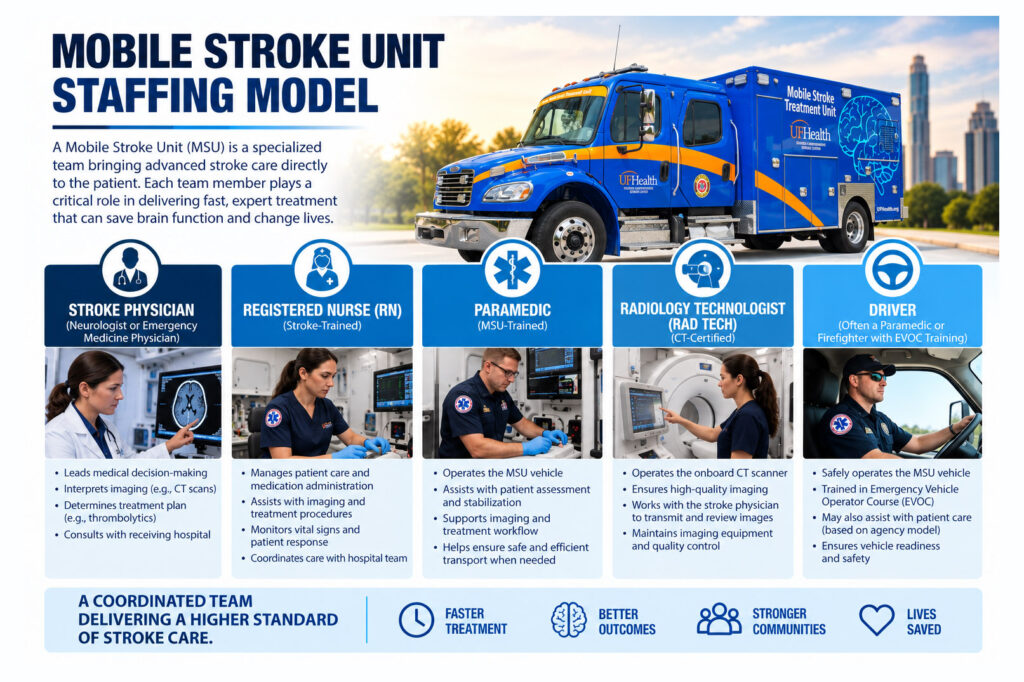
An MSU program may be designed to reduce the time between patient contact, diagnostic imaging, and appropriate treatment. An onboard team can include a critical care nurse, CT technologist, paramedic, and remote neurologist who work together to assess and scan the patient near the point of contact.
If the clinical team confirms an ischemic stroke and the patient meets the program’s treatment criteria, medications such as TPA or TNK may be administered in the field under established clinical protocols. From there, the patient’s condition, local protocols, and receiving hospital capabilities can help determine the appropriate destination and next level of care.
Pillar 3: Plan for Power and Climate Control
A Mobile Stroke Unit carries sensitive medical and communications technology into an environment that moves, vibrates, and operates in changing weather conditions. That makes reliable power and climate control important parts of the vehicle design.
Why Independent Power Matters
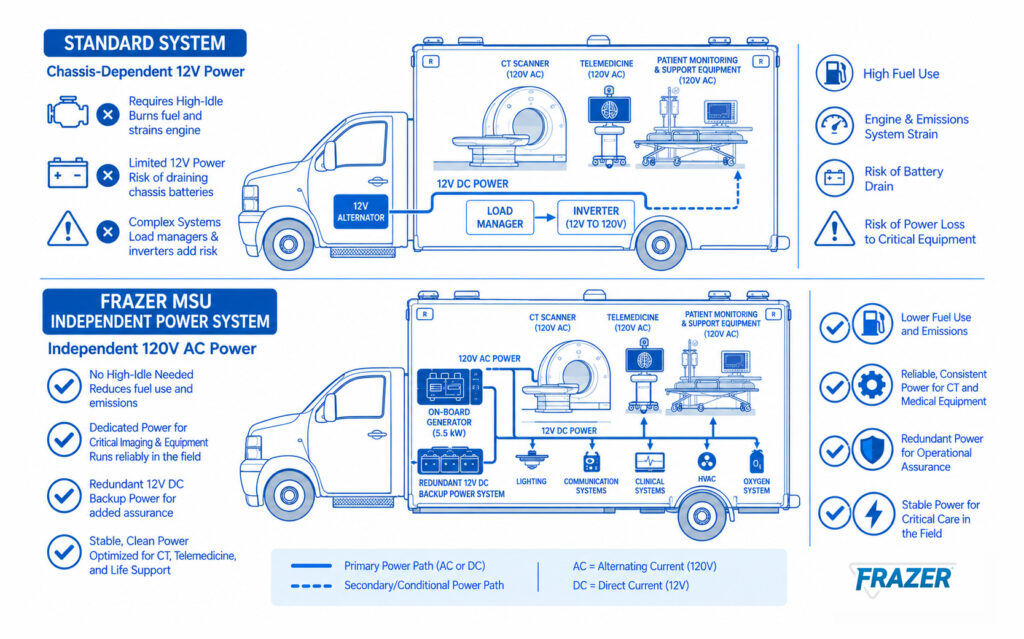
A CT scanner, telemedicine equipment, and heavy-duty air conditioning can require substantial electrical power. Trying to support those loads through the chassis electrical system introduces questions about voltage demand, battery capacity, and equipment performance.
Frazer addresses these needs with independent power systems. Depending on the configuration, the module can use a dedicated 120V AC power source such as a Cummins Onan generator or MEPS system. Because module power is independent from the chassis electrical system, critical module systems can operate without depending on the truck engine, subject to the requirements and condition of the installed equipment.
Protect the Environment Around Your Equipment
Temperature and humidity matter when you are carrying sensitive medical technology. Frazer uses a self-contained 120V AC air conditioning system designed for the operating environment of emergency medical vehicles.
The system is designed to maintain a minimum cooling differential of 25 to 30 degrees under applicable operating conditions. That cooling capacity helps manage patient-compartment temperatures in hot environments while supporting the environmental needs of onboard medical equipment.
Pillar 4: Ask for the Safety Data
Heavy medical equipment inside a moving vehicle deserves careful attention. Hospital Risk Management, Legal, clinical leaders, and fleet teams should understand how equipment is mounted and what testing supports the design.
Securing the CT Scanner
Frazer developed an SAE J3043-compliant CT scanner mounting system for its Mobile Stroke Units. The specialized retention system was voluntarily tested beyond 50,000 pounds of force, with zero damage reported during that testing.
Frazer’s fixed-mounted design for the SOMATOM On.site also eliminates the need for floor rails and is designed to support CT image acquisition while the vehicle is parked on an incline of up to 5 degrees.
Frazer records also show zero recorded module detachments in collisions across more than 4,500 EMS modules built since 1984. Testing documentation and operating history give hospital teams additional information they can review as part of their own risk-management process.
Pillar 5: Build a Procurement and Lifecycle Plan
A Mobile Stroke Unit is a significant investment, with units often costing between $900,000 and $1 million. That makes it important to look beyond the initial purchase price. Program leaders should also consider service, maintenance, future chassis replacement, and how long the module may remain useful.
Look at the Overall Cost of Ownership
One way to evaluate the investment is to consider the module separately from the chassis. Frazer uses all-aluminum, wood-free construction, and its custom modules are designed for long-term service and remounting.
When the chassis reaches the point where replacement makes sense, the hospital may be able to refurbish the existing module and move it to a new chassis instead of replacing the complete MSU. Frazer modules are designed to be remounted up to four times.
Remounting can help lower the Lowest Overall Cost of Ownership (LOCO) by spreading the module investment across multiple chassis lifecycles. The actual service life will depend on vehicle use, condition, maintenance, remount decisions, and other operating factors.
Understand the Frazer 6-Step Partnership
An MSU project brings together clinical, technical, fleet, and administrative teams. Frazer’s consultative process is designed to help those teams move from the first conversation through delivery and go-live.
- Information Request: We start by learning about your program, clinical goals, and operational needs.
- Kick-Off Meeting: Your key stakeholders come together to align expectations and requirements.
- Spec Review: We work through the details, including power, HVAC, equipment integration, and mounting requirements.
- Order Placed: Once the specifications are approved, the project moves into Frazer’s production process.
- Unit Delivery: Your team receives the completed vehicle and works through applicable delivery and punch-list items.
- Go-Live: The vehicle enters service, but the relationship with Frazer continues.
That last step matters. A Mobile Stroke Unit is a long-term operational asset, and questions do not stop after delivery. The Frazer Family Experience is built around continued access to support so your team has a partner to call as the program grows and the vehicle remains in service.
Ready to Map Out Your Mobile Stroke Unit Program?
Building a Mobile Stroke Unit is about more than selecting a vehicle. Your team needs to connect clinical workflows, technology, vehicle design, EMS operations, maintenance, and long-term support into one workable program.
Frazer has worked with healthcare systems on Mobile Stroke Unit projects and can help your team understand the vehicle and integration requirements involved in bringing a program from concept to the road.
If you are exploring Frazer Mobile Stroke Units for your organization, talk with our team about your goals, your operational requirements, and the steps involved in moving from initial planning to go-live.
How do you power a CT scanner in a Mobile Stroke Unit?
Frazer Mobile Stroke Units can use an independent 120V AC power system, such as a Cummins Onan generator or MEPS system. This allows the CT scanner, telemedicine equipment, and air conditioning to operate independently of the chassis electrical system, including when the truck engine is turned off, subject to the requirements of the installed equipment.