

“You Can’t Put a CT Scanner in a Mobile Unit.” How Frazer Engineered a First
One of the biggest engineering challenges was putting a roughly 1,000-pound mobile CT scanner inside a moving emergency vehicle. Frazer developed an SAE J3043-compliant scanner mount and successfully tested the system with more than 50,000 pounds of force. The goal was simple: securely mount the scanner while supporting the safety of the people working around it.
For hospitals developing a Mobile Stroke Unit program, the vehicle is only one part of the equation. A key clinical goal may be reducing “onset-to-needle” times by bringing parts of stroke assessment and treatment closer to the patient. Once a program moves forward, hospital leaders also have to answer a very practical question: How do you safely put hospital-grade imaging equipment into a vehicle and make it work in the field?
That question affects everything from structural engineering and electrical power to equipment mounting, climate control, and crew safety. This article looks at how Frazer approached those challenges and how those lessons continue to shape our Mobile Stroke Unit projects today.
2014: Building the Nation’s First Mobile Stroke Unit
Building a first-of-its-kind mobile healthcare program comes with plenty of unknowns. Hospitals have to bring clinical, technical, financial, and operational teams together around a vehicle that may need to perform jobs normally handled inside a hospital.
Frazer’s Mobile Stroke Unit experience began in 2014, when we partnered with UTHealth to engineer and build the nation’s first Mobile Stroke Unit. Frazer later built five of the first seven MSUs in the United States.
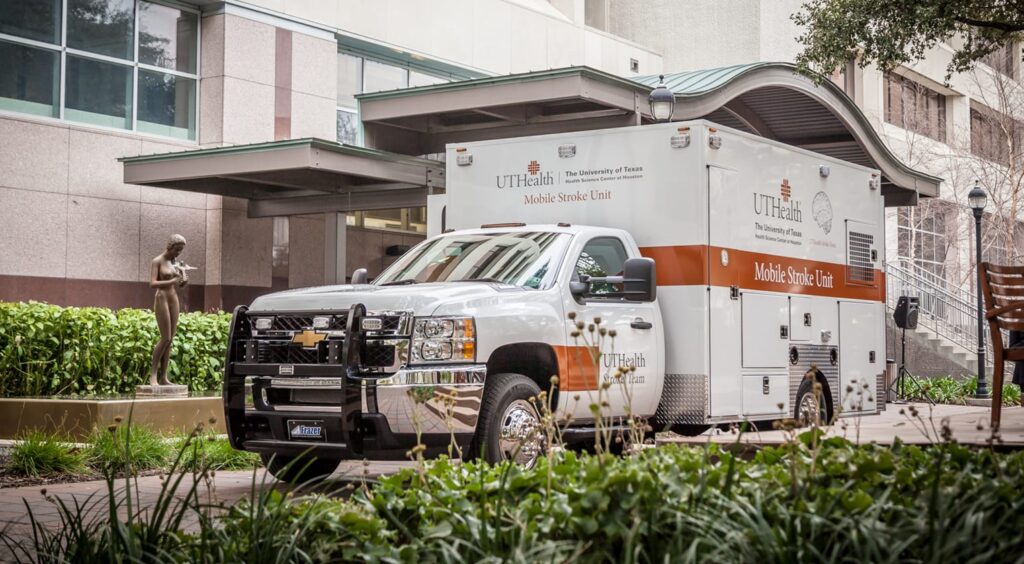
That work involved more than building the vehicle. Mobile CT integration can require coordination among hospital IT teams, radiology departments, telemedicine providers, vehicle engineers, and partner EMS agencies. Bringing those groups together early can help hospitals identify requirements before they become problems later in the project.
Want to see more of Frazer’s experience in this space? Explore our Frazer Mobile Stroke Units.
Securing a 1,000-Pound CT Scanner in a Moving Vehicle
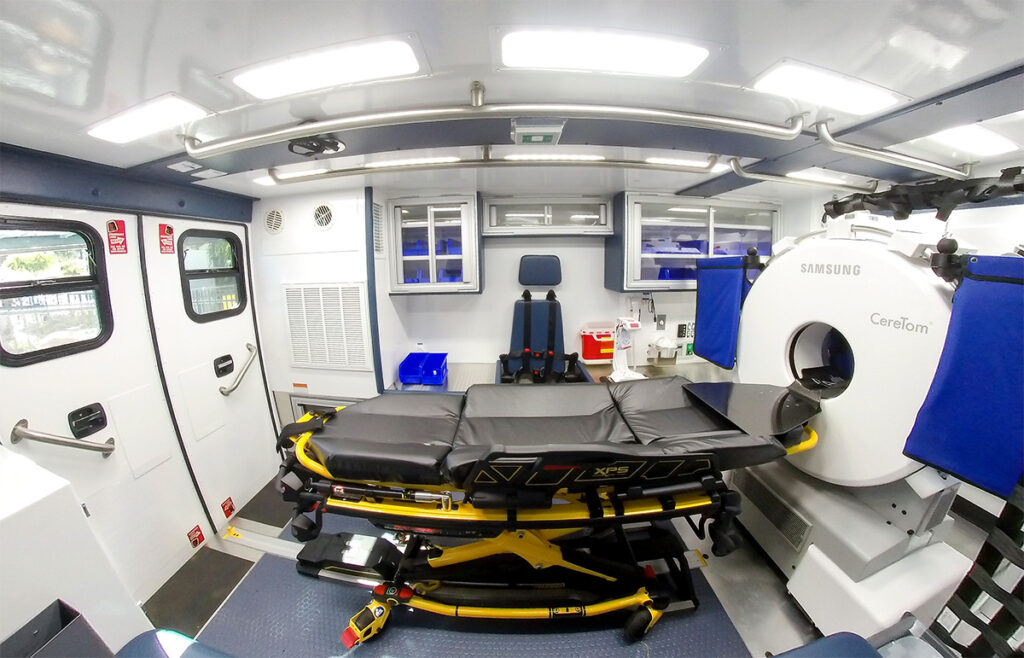
A CT scanner is a serious piece of equipment. At roughly 1,000 pounds, its weight and mounting requirements have to be considered as part of the vehicle’s overall design. The mounting system also has to account for the forces the vehicle and its equipment could experience during a collision.
Frazer builds its modules using 6061 T-6 structural aluminum tubing, with no wood used in the framing. For a Mobile Stroke Unit, that structure becomes the foundation for integrating the scanner and the other systems needed to support it.
The scanner itself also needs a mounting system designed for its weight and application. A mount intended for typical equipment may not be suited for a payload this heavy.
How does SAE J3043 apply to Mobile Stroke Unit equipment?
SAE J3043 addresses the securement of equipment in an emergency medical vehicle and includes requirements related to 26 G forces. With a mobile CT scanner weighing roughly 1,000 pounds, Frazer needed a mounting solution built for the application.
Frazer engineered an SAE J3043-compliant CT Scanner Mounting & Retention System and successfully tested it with more than 50,000 pounds of force.
That testing provides documented performance data for the mounting system under the tested conditions. It is one example of how we approach equipment integration in a Mobile Stroke Unit. Learn more about Frazer’s approach to safety and crash compliance standards.
Managing Radiation, Power, and a Tight Workspace
Putting imaging equipment inside a vehicle creates challenges you do not have in a traditional hospital room. Space is limited. Vehicle weight matters. The equipment needs dependable power and cooling. Clinical teams also have to consider radiation exposure and the working environment around the scanner.
That means the CT scanner cannot be treated like another piece of equipment added after the vehicle is designed. The scanner, power system, HVAC, suspension, available payload, and interior layout all have to work together.
How is radiation scatter managed in a Mobile Stroke Unit?
Frazer integrates the SOMATOM On.site portable head CT scanner by Siemens Healthineers into its Mobile Stroke Unit design. As detailed in the Siemens Brochure, the scanner features a self-shielding radiation system. This includes internally lead-lined gantry covers and radiation shields on the front and back bore openings, which minimize scatter radiation to enhance safety for onboard staff.
By relying on this integrated shielding, clinical staff can confidently capture vital 32-slice imaging right in the patient’s driveway. The SOMATOM On.site also features a first-of-its-kind telescopic gantry. Because the radiation source moves away from the patient during scanning while the base remains stationary, it simplifies patient positioning in the tight confines of a mobile unit and minimizes motion artifacts. Furthermore, the CARE 2D Camera allows technologists to maintain continuous visual contact with the patient from the touch interface, even when radiation shield covers are in place.
Capturing high-quality diagnostic images also requires a stable platform. Vehicle position matters. Frazer uses a LiquidSpring™ suspension system with ride-control features and automatic leveling. When the vehicle is parked on an uneven or sloped surface, the system is designed to help provide an appropriate operating position for the imaging equipment, ensuring accurate calibration. Frazer’s fixed mounting enables reliable CT image acquisition even on vehicle inclines of up to 5°.
How do you power a CT scanner in a Mobile Stroke Unit?
Hospital-grade imaging equipment needs a power source that can support its electrical requirements. Frazer Mobile Stroke Units use a primary 120V AC generator that operates independently of the truck chassis. The system is designed to power the mobile CT scanner, telemedicine equipment, and dedicated HVAC without depending on the chassis alternator as the primary source for those module loads.
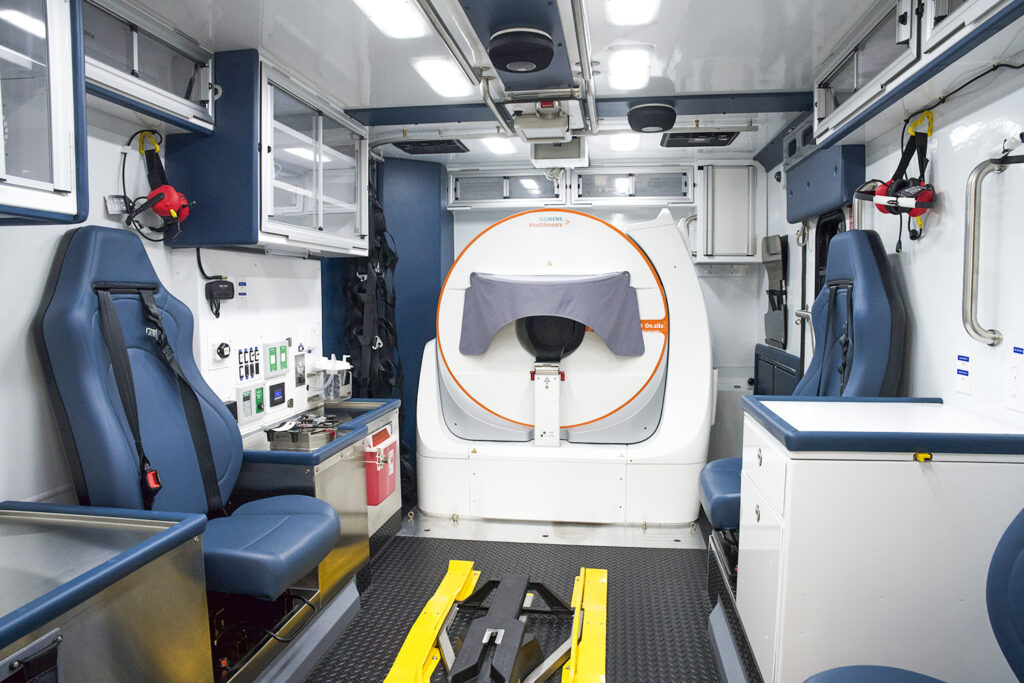
This independent approach separates the module’s primary AC power needs from the chassis electrical system. It gives the specialized equipment inside the module its own source of power while the unit is in service.
The same system supports the module’s HVAC. Medical imaging equipment produces heat and needs to operate within specified temperature ranges. Frazer’s self-contained 120V AC air conditioner is designed to maintain a 35°F temperature difference from the outside temperature, helping manage the environment for both equipment and crew.
Planning for the Long Term: Why Remountability Matters
A Mobile Stroke Unit can represent a major capital investment, so the first chassis should not be the only thing considered. Hospital and fleet leaders also need to think about the service life of the module, scanner, and other major systems.
Frazer builds structural aluminum modules with remountability in mind. When the truck chassis reaches the point where replacement makes sense, a hospital may be able to keep its existing stroke module and mobile CT scanner instead of replacing the complete unit.
Frazer can remove a compatible module and remount it onto a new truck chassis when the module, equipment, and new chassis are suitable for the process. Customers have remounted Frazer modules multiple times, and some Frazer modules have accumulated more than 1 million miles over 20 years of service.
For a qualifying module, remounting can help extend the value of the original investment across more than one chassis. Actual service life and lifecycle costs will depend on use, maintenance, module condition, equipment configuration, and chassis compatibility.
The Build Is Only Part of the Project
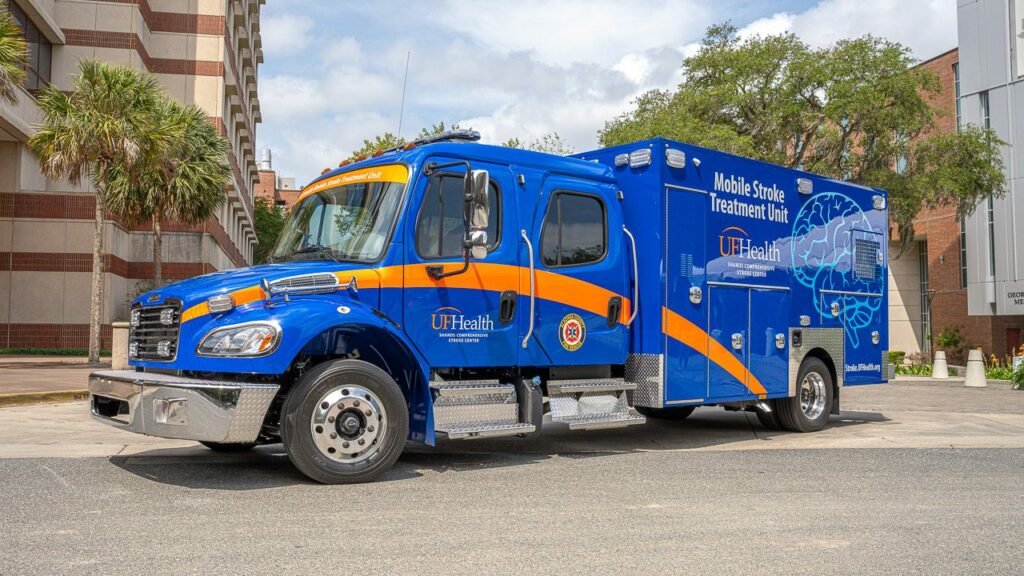
A Mobile Stroke Unit is more than a vehicle purchase. It is a systems-integration project that brings together vehicle systems, medical equipment, communications technology, and hospital workflows. Depending on the program, that may include data connections for telemedicine platforms such as Teledoc, MaxLife, or EMS XR, along with coordination between the hospital, local 911 dispatch centers, and partner EMS agencies.
Frazer works with customers through these conversations as part of the MSU planning process. Drawing from our experience with early and current Mobile Stroke Unit projects, we can help teams think through staffing models, dispatch workflows, IT requirements, and vehicle integration. We can also help connect customers with members of the broader MSU community so they can learn from programs already operating in the field.
That relationship does not have to stop when the vehicle leaves our facility. Frazer provides support after the sale for maintenance and operational teams. Depending on the need and service arrangement, customers can work with Frazer team members who understand the vehicle and its systems.
Planning a Mobile Stroke Program?
There is a lot to consider before a Mobile Stroke Unit ever hits the road. Clinical needs, imaging equipment, electrical power, communications, vehicle design, weight distribution, and safety requirements all have to come together in one working system.
If your hospital is exploring a mobile CT program, Frazer can help your team understand the vehicle side of the equation. We can talk through power requirements, weight distribution, equipment integration, project timelines, and the lessons we have learned from pioneering the field.
Talk with Frazer’s Mobile Stroke Unit team about your clinical goals, telemedicine needs, and applicable safety and compliance requirements. We’ll help you understand the vehicle and systems considerations involved so your team can make informed decisions about the right approach for your community.
How does the SAE J3043 standard protect Mobile Stroke Unit crews?
SAE J3043 addresses the securement of equipment in an emergency medical vehicle and includes requirements related to 26 G forces. With a mobile CT scanner weighing roughly 1,000 pounds, Frazer engineered an SAE J3043-compliant CT Scanner Mounting & Retention System for the application. The system was successfully tested with more than 50,000 pounds of force, providing documented performance data under the tested conditions.