
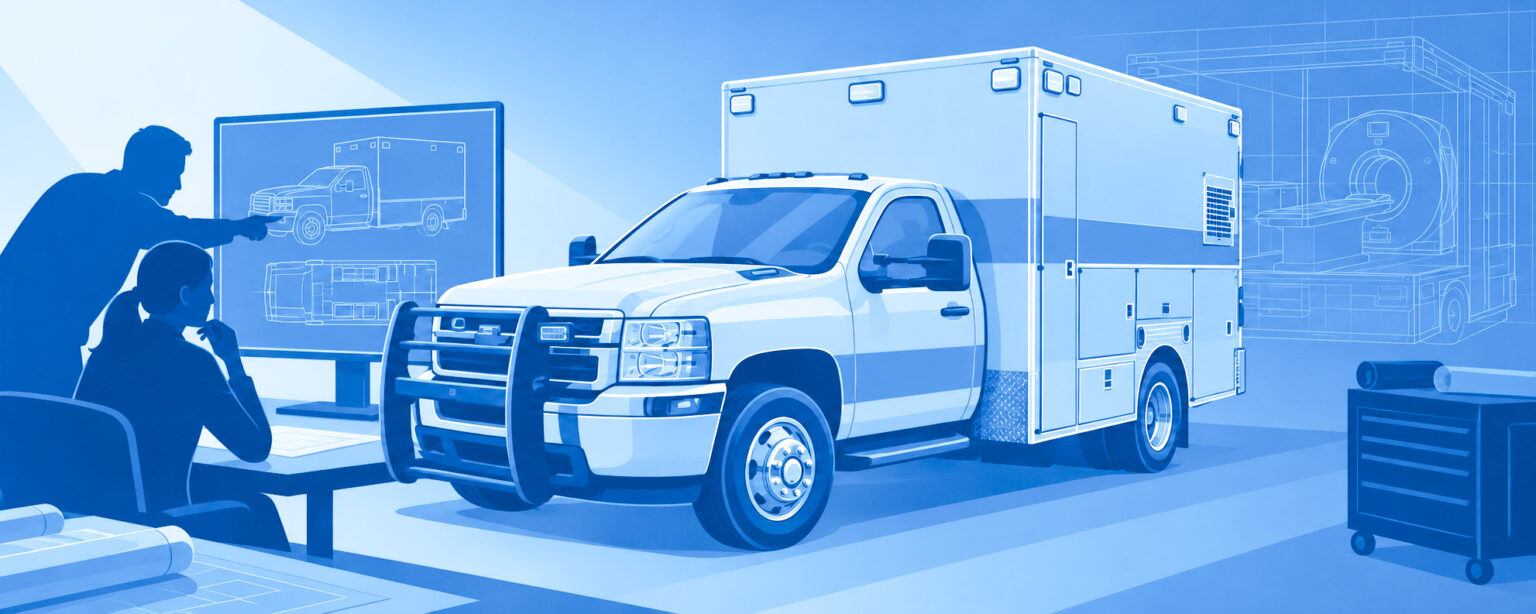
Pioneering the Mobile Stroke Unit: How Frazer Changed Prehospital Care
During an acute ischemic stroke, every minute matters. Clinical research indicates that approximately 1.9 million neurons can be lost for every minute blood flow is not restored. For decades, stroke care focused heavily on the “door-to-needle” timeline: get the patient to the hospital, move through emergency department triage, complete CT imaging, and then determine whether clot-busting medication such as tPA can be administered.
Mobile Stroke Units bring diagnostic and treatment capabilities closer to the patient. Clinical data indicates this approach can reduce treatment times and may improve outcomes while reducing long-term disability. But taking hospital-level stroke care into the field creates a major engineering challenge. How do you safely transport and power a roughly 1,000-pound hospital-grade CT scanner inside a moving emergency vehicle while supporting diagnostic quality and crew safety?
In 2014, Frazer helped address that challenge by engineering a Mobile Stroke Unit from the ground up. Today, Mobile Stroke Units are moving beyond early clinical trials and becoming part of the stroke-care model in a growing number of communities. Here’s a closer look at the clinical history, safety considerations, power systems, and vehicle infrastructure behind a field-ready Mobile Stroke Unit.
The Origin of the Mobile Stroke Unit: Pushing the Limits of Mobile Healthcare
The idea behind the Mobile Stroke Unit is straightforward: reduce the time between the onset of a stroke and treatment by bringing critical diagnostic capabilities closer to the patient.
In early 2014, Dr. James C. Grotta, then-director of stroke research at the Clinical Institute for Research & Innovation at Memorial Hermann-Texas Medical Center, introduced the idea of a specialized stroke vehicle to the UTHealth Development Board. After seeing a similar concept in Germany, Dr. Grotta recognized the potential impact of eliminating time normally spent transporting and moving a patient through the hospital before treatment could begin.
Turning that idea into a working vehicle in the United States required specialized engineering and a willingness to rethink traditional emergency vehicle design. John and Janice Griffin, owners of Frazer, stepped forward to help fund and build the project.
“Our company likes to push the limits and this had never been done before,” noted Laura Griffin, CEO and president of Frazer, during the launch of the unit. “Once everyone sees the possibility of putting a CT scanner in an emergency vehicle, the question is what else can we do?”
The partnership between UTHealth, Memorial Hermann, and Frazer helped advance prehospital stroke care. By bringing CT imaging to the patient, Mobile Stroke Units can reduce reliance on standard hospital emergency department workflows before imaging and support field triage. Studies have shown that Mobile Stroke Units typically reduce onset-to-needle times by 20 to 41 minutes. They can also increase “golden hour” treatment rates, with tPA administered within the first 60 minutes after symptom onset, from less than 5% with standard transport to as high as 33%.
Giving thrombolytics in the field requires clinicians to have the information needed to distinguish an ischemic stroke from a hemorrhagic stroke. That makes reliable mobile imaging a critical part of the care model.
Diagnostic Imaging on the Go: The Siemens SOMATOM On.site
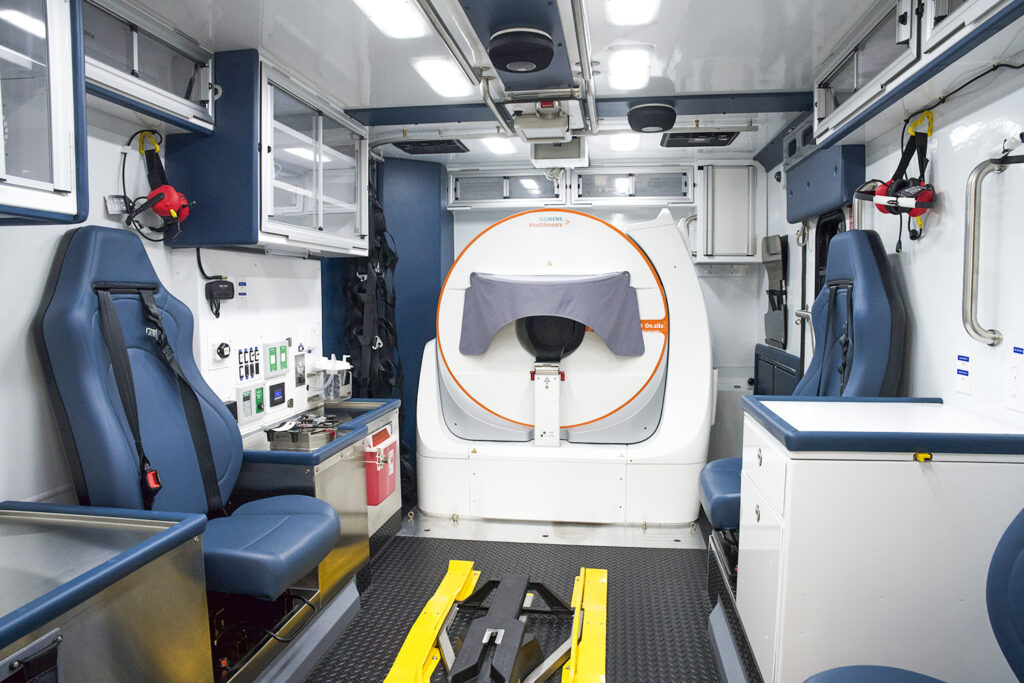
When a neurologist evaluates a patient through telemedicine in the field, diagnostic imaging provides important information that can support treatment decisions. To help clinicians detect or rule out bleeding, Frazer integrates advanced imaging systems such as the Siemens SOMATOM On.site, a 32-slice portable head CT scanner designed for point-of-care neuroimaging.
How do Mobile Stroke Units support diagnostic image quality?
Mobile Stroke Units can support diagnostic image quality through specialized CT equipment and engineered vehicle mounting systems. Frazer integrates scanners such as the Siemens SOMATOM On.site, which uses a telescopic gantry that moves the radiation source while the base remains stationary. Paired with a fixed-mount design, the configuration is designed to reduce the effects of vehicle movement and support image acquisition on inclines up to 5°.
Because the heavy rotating components move internally, the entire machine does not need to travel along floor rails during imaging. This approach can help reduce vibration-related movement that could affect imaging, giving specialists the information they need to evaluate the patient and determine an appropriate treatment plan in the field.
How Do You Mount a CT Scanner in a Moving Emergency Vehicle?
Clinical teams are focused on patient outcomes, but Risk Management and Fleet Operations have another important concern: keeping people and equipment secure inside the vehicle. A heavy, active CT scanner requires specialized engineering designed to retain the equipment during severe vehicle events.
A roughly 1,000-pound piece of medical equipment can create significant forces during a major collision. Equipment retention therefore has to be considered alongside clinical capability when developing a Mobile Stroke Unit.
What safety considerations apply when putting a CT scanner in an EMS vehicle?
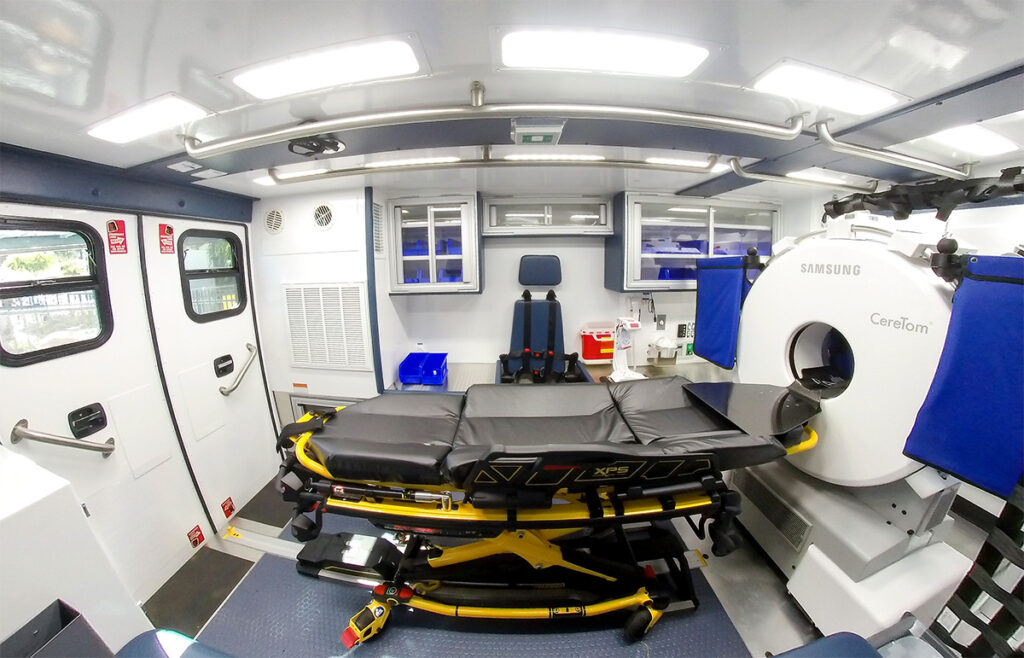
Integrating a CT scanner into an EMS vehicle requires mounting engineering appropriate for the equipment’s size and weight. Frazer developed an SAE J3043-compliant fixed-mounting system for the CT scanner and tested the retention system beyond 50,000 pounds of force to support crew and equipment protection during severe collisions.
The mobile environment also requires measures designed to manage scatter radiation during image acquisition. Frazer’s Mobile Stroke Unit integration incorporates safety features such as the internally lead-lined gantry covers and front and back bore shields found on the Siemens SOMATOM On.site. A CARE 2D Camera and bore lighting allow the technologist to maintain visual contact with the patient through the touch interface, supporting patient monitoring while staff remain behind radiation shielding.
Supporting the Golden Hour: Independent Power and High-Performance HVAC
Advanced medical equipment needs vehicle infrastructure designed around its operating requirements. For clinical operations and fleet teams, two major considerations are electrical stability and temperature management. The power system needs to support the CT scanner and other equipment during emergency response, while the HVAC system needs to manage both outside temperatures and the heat generated by sensitive electronics.
How do you power a CT scanner in a Mobile Stroke Unit?
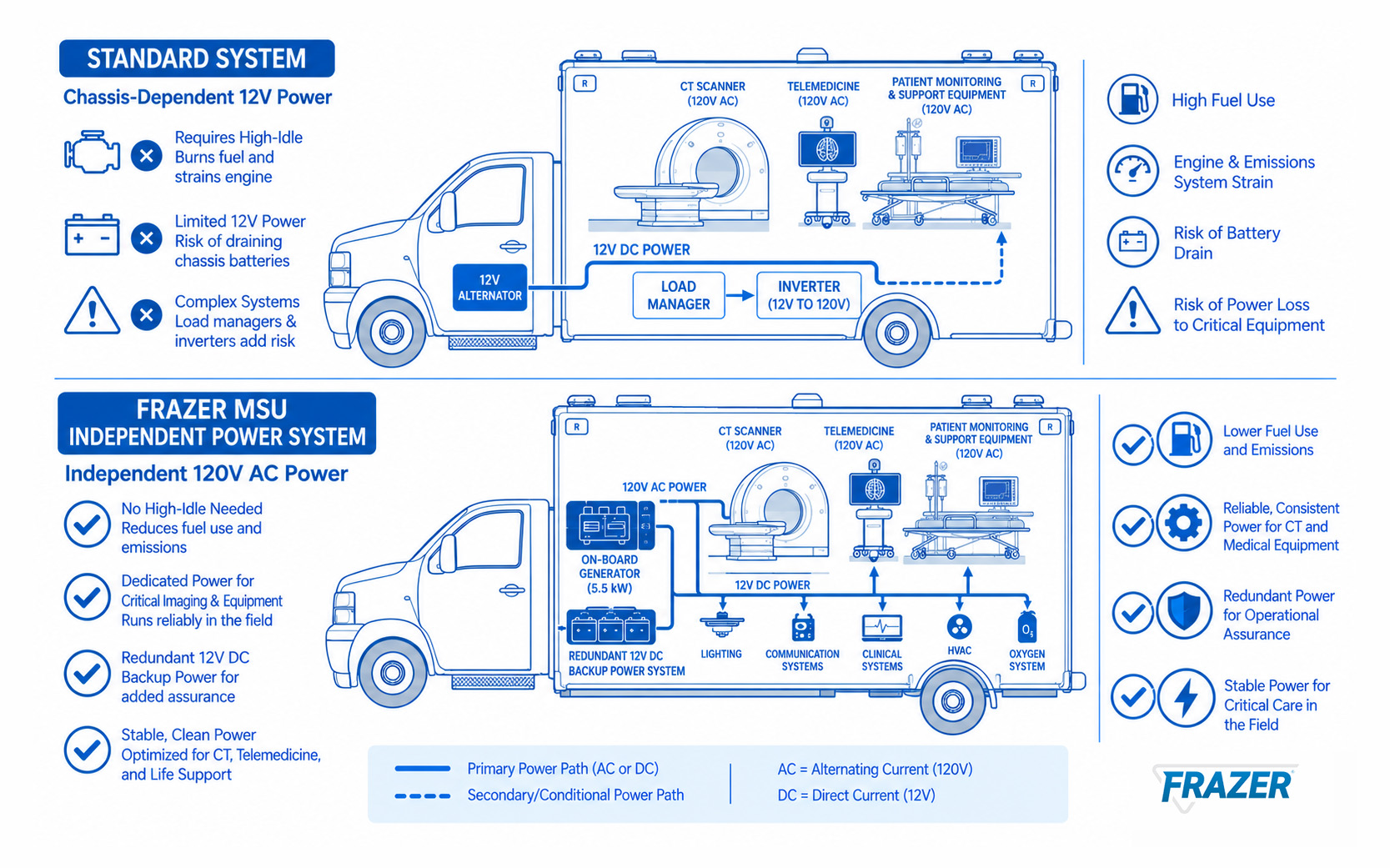
A Mobile Stroke Unit can use a power source that operates separately from the truck’s chassis batteries. Frazer vehicles use independent 120V AC power systems, including options such as MEPS, Cummins Onan, or hPower, to provide dedicated power for the module. Separating medical and IT electrical loads from the chassis electrical system is designed to reduce the potential for voltage fluctuations that could affect CT scanner operation.
With a chassis-independent power source, the module can operate more like a standard building electrical system. This supports Frazer’s KISS electrical principle, or “Keep It Super Simple.” Fleet mechanics can troubleshoot many electrical issues using point-to-point wiring and standard automotive relays instead of relying on complex proprietary multiplex printed circuit boards that may require specialized service.
Independent power also supports a specialized 115V AC air-conditioning system designed to manage the heat generated by imaging equipment. Frazer’s HVAC system delivers a minimum cooling differential of 25 to 30 degrees and is engineered to maintain a temperature differential of up to 35°F from the outside climate. In 105°F outside temperatures, for example, the system is designed to maintain an interior temperature approximately 35°F lower, helping provide an appropriate operating environment for sensitive electronics.
The HVAC system also pairs standard physical media filtration with the Dometic BreatheEasy active UV and ionization purification plenum. This system is designed to help manage airborne contaminants in the patient compartment, which uses an air-handling configuration separate from the driver’s cab.
The LOCO Approach: Considering Long-Term Cost of Ownership
A Mobile Stroke Unit program can require a significant capital investment, which makes lifecycle planning an important part of the decision. EMS vehicles operate in demanding conditions, accumulating mileage, idle hours, and the wear that comes with emergency response. The chassis may eventually reach the end of its useful service life even when the patient module remains serviceable.
Frazer addresses this challenge through its Lowest Overall Cost of Ownership, or LOCO, approach. Frazer modules use aluminum construction and a wood-free design, with the module engineered to support service beyond the useful life of the original truck chassis.
When the chassis reaches the end of its service life, the module, CT mounting system, and interior clinical configuration may be removed, refurbished, and remounted onto a new chassis when appropriate. Frazer units are frequently remounted up to four times, with units reaching more than 260,000 miles per chassis and potentially surpassing 1,000,000 miles of total service.
This approach gives organizations the option to treat the module as a longer-term asset instead of automatically replacing the complete vehicle when the chassis reaches the end of its service life. Actual results depend on the vehicle, operating conditions, maintenance, remount schedule, and other factors, but remounting may help reduce capital costs over the life of a stroke program.
From Concept to Go-Live: Supporting Mobile Healthcare Programs
Moving care from a traditional hospital environment into the field involves much more than choosing a vehicle. Clinical workflows, fleet requirements, technology, safety, communications, and day-to-day operations all need to work together. Hospital administrators and Stroke Program Directors may need specialized vehicle expertise to turn clinical requirements into a practical mobile environment.
Since launching a U.S. Mobile Stroke Unit alongside UTHealth in 2014, Frazer has developed a “Concept-to-Go-Live” approach to help hospital teams work through these considerations. Support can include staffing and workflow planning for specialized crews, telemedicine connectivity using the hospital’s preferred technology, and planning for how the Mobile Stroke Unit will operate within the local 911 and field triage system.
A typical program may involve paramedics, CT technologists, critical care nurses, neurologists, hospital IT teams, fleet professionals, and EMS partners. Frazer works with the people involved in the program to help translate those needs into a mobile healthcare solution designed for real-world operations.
Building a Mobile Stroke Unit program is about more than the vehicle itself. Clinical workflows, safety engineering, electrical infrastructure, IT integration, fleet operations, and lifecycle planning can all affect how the program comes together and performs in the field.
If your organization is exploring a move from door-to-needle toward on-scene-to-needle stroke care, contact the Frazer team to learn how our Concept-to-Go-Live approach can support the planning and development of a Mobile Stroke Unit program for your community.
How do Mobile Stroke Units support diagnostic image quality?
Mobile Stroke Units can support diagnostic image quality through specialized CT scanners and engineered vehicle mounting systems. Frazer integrates scanners such as the Siemens SOMATOM On.site, which features a telescopic gantry that moves the radiation source while the base remains stationary. Combined with a fixed-mount design, this configuration is designed to reduce the effects of vehicle movement and support image acquisition on inclines up to 5°.