

EMS Vehicle Air Circulation: How High-Capacity HVAC Supports Crews on Challenging Calls
Anyone who has worked in EMS knows how quickly the back of a unit can heat up on a summer afternoon. Add a difficult patient care situation, a long transport, or strong odors, and the environment inside the module can become another challenge for the crew. That is why EMS vehicle air circulation and cooling performance deserve attention when departments evaluate their next vehicle.
Climate control also matters beyond crew comfort. Maintenance teams have to consider how the HVAC system is powered, how much the chassis must idle, and how quickly components can be serviced when something goes wrong. In double-blind industry research conducted by Smart Advantage, 76% of emergency vehicle procurement professionals ranked HVAC and air filtration as their top safety and cab-environment priority. Crash-test results were selected by 70%, while infection-control isolation was selected by 56%.
So, what should an apparatus committee look for? This guide explains what 450 CFM airflow means, why HVAC performance can vary with some chassis-dependent systems, and which specifications can help departments compare their options.
The Frontline Reality: Managing Challenging Calls in the Patient Compartment
In some emergency vehicle configurations, crews may have to balance ventilation with cooling. An exhaust blower can remove air from the module, but replacement air coming from outside may be hot and humid. That creates another load for the HVAC system. If crews rely mostly on recirculation instead, strong odors may remain in the patient compartment longer.
The goal is simple: keep air moving while maintaining a comfortable working temperature. Doing both requires enough airflow, cooling capacity, and power to support the system under real operating conditions.
Heat, Odors, and the Clinical Working Environment
Extreme heat and strong odors can add to the physical and sensory demands crews already face during patient care. Maintaining a more comfortable patient compartment gives crews one less environmental challenge to manage during difficult calls and extended shifts – especially when navigating demanding regional terrain and rural response corridors where travel times are extended.
The 450 CFM Equation: What Airflow Means Inside the Module
HVAC performance is about more than the temperature coming from a vent. Air also needs to move through the patient compartment. Looking at the module’s interior volume and the blower’s airflow rating provides a useful way to understand how frequently air can move through the system.
How Often Should Air Circulate in an EMS Vehicle?
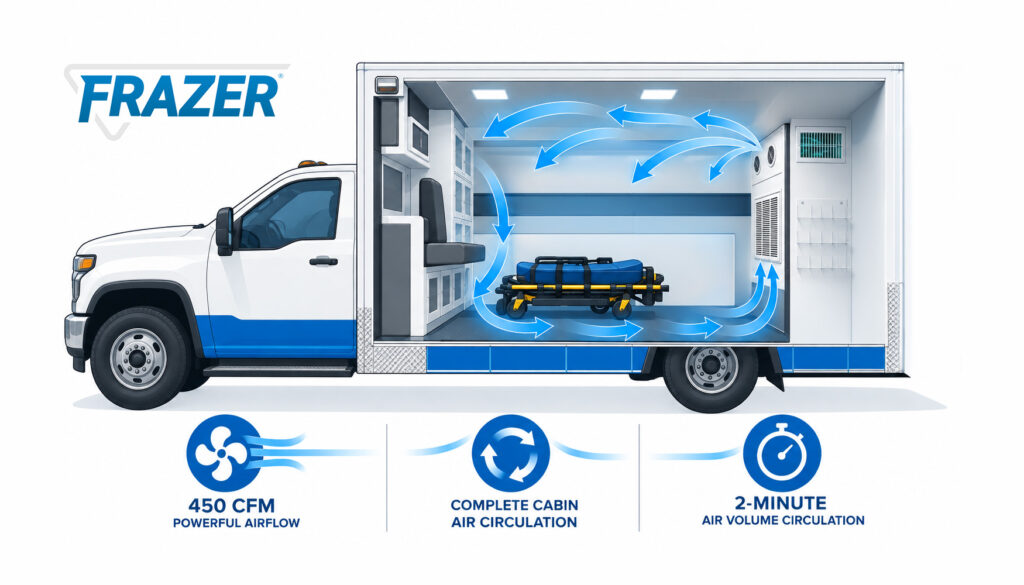
Frequent air movement can help reduce stagnant air and lingering odors inside the patient compartment. Frazer’s 450 CFM circulation fan is designed to move an air volume comparable to a typical patient compartment through the system about every two minutes. The HVAC system is also designed to maintain up to a 35°F difference from the outside temperature under applicable operating conditions.
The Math Behind 450 CFM
A 700-cubic-foot patient compartment paired with a 450 CFM fan gives us a simple example. When used with Frazer’s dedicated, self-contained 120V AC heating, ventilating, and air conditioning system, the calculation looks like this:
Air Volume ÷ Airflow = 700 ft³ ÷ 450 CFM ≈ 1.55 minutes
This calculation represents how long it takes the blower to move an air volume equal to a 700-cubic-foot compartment through the system. It should not be confused with replacing every bit of cabin air with fresh outside air. In practical terms, higher circulation helps keep conditioned air moving and can reduce stagnant areas and uneven temperatures inside the module.
What the Specifications Mean in the Field
| Technical Specification | What It Means for Your Department |
|---|---|
| 450 CFM circulation blower | The blower can move an air volume comparable to the patient compartment through the system about every two minutes, helping keep conditioned air moving throughout the module. |
| Independent 120V AC power | The module HVAC can run from an independent power source instead of depending only on chassis-driven HVAC components. This can reduce the need for chassis high-idle solely to power module climate control. |
| Self-contained, side-mounted HVAC | The HVAC unit is located in an exterior compartment instead of on the roof. The design provides direct service access and allows modular replacement. |
| Point-to-point 12V and 120V wiring | The electrical architecture uses conventional wiring, relays, and fuses, allowing qualified technicians to troubleshoot many circuits with common diagnostic equipment. |
Isolated Cab Ducting and Air-Treatment Options
Frazer separates patient-compartment airflow from the chassis cab HVAC configuration. This isolated ducting helps limit the movement of odors and airborne particles between the patient compartment and driver cab.
Departments can also evaluate additional air-treatment equipment based on their needs. Available technologies may supplement physical filtration by treating air as it moves through the system. Because performance varies by equipment and operating conditions, departments should review the manufacturer’s documentation for any selected air-treatment system before including specific performance requirements in a vehicle specification.
In-Plenum UV Air Purification: Active Neutralization vs. Passive Trapping
Standard emergency vehicle climate systems rely on passive media filters that simply catch particulate matter until saturated. Frazer’s HVAC architecture pairs physical filtration with an active UV and photocatalytic purification plenum.
Utilizing systems like the Dometic BreatheEasy™ platform, ultraviolet light works with nano-mesh filters and ionization directly inside the airflow stream. Instead of waiting between calls for a static cleanup, module air is dynamically treated as it circulates during patient transport. This design helps neutralize airborne biological contaminants, volatile organic compounds, and foul odors before they can settle in the compartment.
Field Service and Cab Isolation
This purification assembly is engineered directly into Frazer’s independent 120V AC system. Because patient compartment ducting does not connect to the driver cab, treated module air remains completely isolated from the front seats, protecting driving personnel from unwanted cross-exposures.
For fleet maintenance teams, keeping the system running requires no specialized contractor teardowns. The physical filter media (Frazer Part No. 35901) and active UV bulbs are designed to be fully field-replaceable by in-house technicians using basic hand tools, protecting vehicle uptime while supporting clean air for your crews.
Why HVAC Performance Can Change at Curb Idle
A system that cools well while driving may not perform the same way while the vehicle is parked. The reason can come down to how that HVAC system gets its power.
Why Can Emergency Vehicle Air-Conditioning Performance Change at Idle?
Some emergency vehicle HVAC systems depend on chassis-driven components, including engine-driven compressors or electrical systems. Engine speed changes between driving and curb idle, so available HVAC performance may also change depending on the system design.
Frazer takes a different approach. Its independently powered 120V module HVAC system does not depend on chassis engine RPM as its primary power source. That separation allows the module HVAC to operate from its independent power system while the vehicle is parked.
High Idle, DPF Loading, and Diesel Emissions Systems
Some fleet operators use high-idle settings to support chassis-dependent electrical and HVAC loads while a vehicle is stationary. That adds engine idle hours and can affect the operating conditions of modern diesel emissions systems, including Diesel Particulate Filters, or DPFs.
The exact effect depends on the engine, duty cycle, exhaust temperature, maintenance practices, and other factors. Fleet managers should always follow the chassis manufacturer’s operating and maintenance guidance for their specific engine and emissions system.
Independent Power Separates Module HVAC from Chassis RPM
Frazer separates the module’s primary environmental system from the chassis drivetrain. Independent generator power options supply 120V AC power to the self-contained module HVAC system, allowing module climate control to operate without depending on chassis RPM as its primary power source.
Comparing HVAC and Power System Architecture
| Performance Feature | Chassis-Dependent Configuration | Frazer Independent 120V Configuration |
|---|---|---|
| Cooling at idle | Performance may vary with chassis RPM and system design. | Designed to provide module cooling independent of chassis RPM. |
| Dependence on chassis operation | May require the chassis to remain running, depending on the configuration. | Module HVAC can operate from its independent power source. |
| Temperature differential | Depends on system capacity and operating conditions. | Designed for up to a 35°F difference from outside temperature under applicable conditions. |
| Chassis idling | Using high-idle for HVAC loads can add engine idle hours. | Can reduce the need for chassis high-idle solely to support module HVAC. |
| HVAC service | Repair time depends on system design, installation, and the work required. | Side-mounted modular architecture is designed for direct service access and unit replacement. |
Frazer’s HVAC system is designed to maintain up to a 35°F difference from the outside temperature under applicable conditions. For example, a 35°F differential would mean a 71°F interior temperature when the outside temperature is 106°F. Actual performance depends on operating conditions and vehicle configuration.
Supporting Fleet Uptime with Serviceable HVAC Design
HVAC design also affects the maintenance team. When a cooling system needs service in the middle of summer, access to the equipment and the time required to repair or replace it can make a real difference for a busy fleet.
How Can Independent Module HVAC Help with Fleet Uptime?
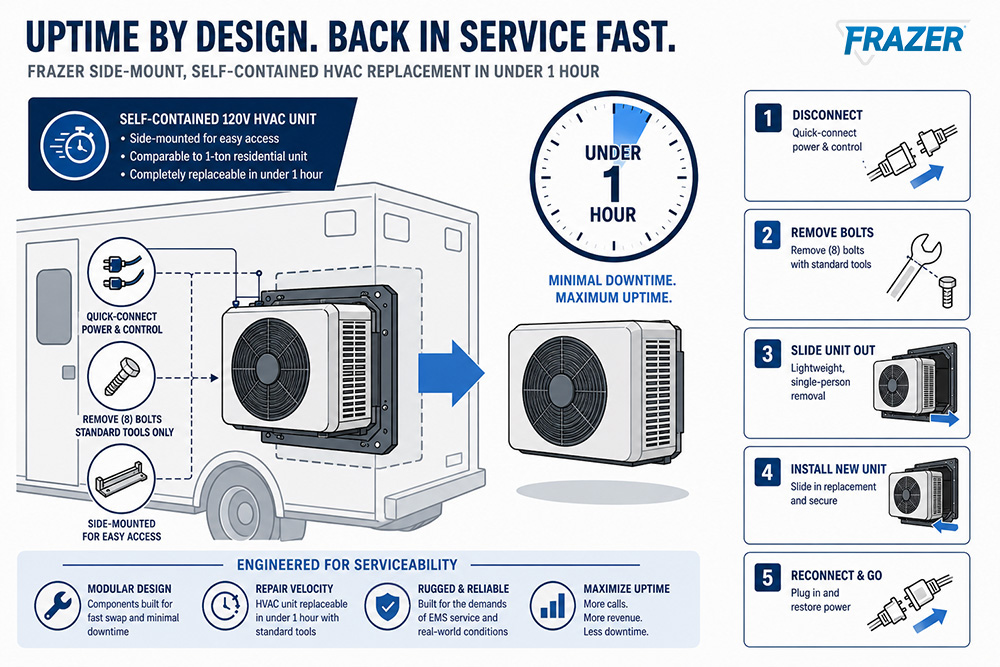
Frazer’s self-contained HVAC system is mounted in an exterior side compartment. This gives technicians direct access to the unit without requiring a rooftop HVAC installation. The modular design also allows the complete HVAC unit to be removed and replaced rather than keeping the vehicle tied up while every component is serviced in place.
Side-Mounted Access Without a Rooftop HVAC Unit
Depending on their design, other HVAC configurations may route components through the roof, headliner, walls, dashboard, or underbody. That can mean technicians need access to several parts of the vehicle to complete certain repairs.
Frazer’s HVAC unit is self-contained and mounted in an exterior compartment. If replacement is needed, a qualified technician can access the unit, disconnect the required fittings, and install another unit. Under applicable service conditions, the complete HVAC unit is engineered to be replaced in under 60 minutes using standard shop tools. The removed unit can then be diagnosed or repaired separately.
Looking at Overall Cost of Ownership
This serviceable architecture is one part of Frazer’s Lower Overall Cost of Ownership (LOCO) approach. Because primary module HVAC power is independent of the chassis, fleet managers may be able to reduce chassis high-idle hours used specifically for module climate control. Actual maintenance costs and operating results depend on vehicle configuration, fleet duty cycle, maintenance practices, and chassis requirements.
Customer-reported fleet data has documented maintenance cost reductions ranging from 42% to 60% in applicable fleet comparisons. Frazer also provides a written four-year parts and labor warranty on its self-contained climate system. In double-blind Smart Advantage research, 39% of respondents identified Frazer when asked which manufacturer spent the least time in the shop, compared with 7% for the closest named competitors in that study.
What Should Your Committee Consider in Its Next Vehicle Specification?
Terms such as “heavy-duty climate package” do not tell an apparatus committee much about how a system will perform or how it will be serviced. Measurable requirements make it easier to compare proposals and understand what your department is really buying.
- Air movement: Consider a dedicated 450 CFM circulation fan and documented air-volume circulation performance.
- Cooling: Ask for documented temperature-differential performance under defined operating conditions.
- Power: Determine whether primary module HVAC depends on the chassis engine or has an independent 120V AC power source.
- Ducting: Ask how patient-compartment airflow is separated from the driver cab.
- Service access: Look at where the HVAC equipment is mounted and what technicians must remove to service or replace it.
- Electrical troubleshooting: Understand whether qualified technicians can diagnose the system with common electrical tools.
- Warranty: Compare the written parts and labor coverage included with each HVAC system.
These questions help move the conversation from broad marketing terms to specifications your committee can compare. The right requirements will depend on your climate, call volume, maintenance resources, duty cycle, and operating needs.
Build Around the Way Your Crews Actually Work
Environmental control is easy to overlook when a committee is comparing layouts, chassis, lighting, medical equipment, and dozens of other choices. But crews work in the patient compartment every day, and maintenance teams have to keep those systems working long after delivery.
A system built around 450 CFM circulation, independent power, isolated ducting, and accessible HVAC components gives departments a different way to approach climate control. Whether specifying frontline 911 response units or deploying dedicated mobile clinics and community outreach units for stationary field medicine, ask how the system performs when parked, how the air moves through the module, what powers it, and what happens when it needs service.
Get Clear Specifications Before Your Next Purchase
If your department is planning its next emergency vehicle purchase, start with the conditions your crews and maintenance team deal with every day. The Frazer Sales Team can help you review available configurations, CFM information, and specification considerations. You can also explore Frazer’s Type I 14-foot standard configuration as you begin planning your next unit.
Why does an ambulance air conditioner lose cooling power at idle?
Conventional emergency vehicle air conditioning systems may rely on the chassis engine, belts, and 12V electrical system to support cooling. At curb idle, lower engine speed can reduce the available output for some system configurations. A climate control system powered by an independent 120V generator can provide cooling without relying directly on chassis engine speed.