
Navigating California’s Diverse Geography: EMS Durability Across Demanding Terrain
If your shop has ever pulled back commercial flooring during an inspection and found damaged plywood underneath, you know how frustrating hidden damage can be. In California, routine washdowns, marine air, heat, rough roads, and long periods of operation can all affect an emergency vehicle over time.
That is why California EMS durability is about more than choosing a tough-looking vehicle. Fleet managers and specification committees need to consider how materials, structural design, power systems, and service access fit the conditions their crews face every day.
Capital costs are also rising, budgets remain tight, and chassis lead times can make downtime harder to absorb. Depending on vehicle design, use, and maintenance history, fleets may deal with problems such as stressed joints, exterior corrosion, alternator wear, HVAC repairs, or other maintenance concerns. This guide looks at several California operating environments and explains what agencies may want to consider when specifying a vehicle for a long service life.
The California Operating Reality: One Fleet, Four Demanding Terrains
California agencies can operate across very different environments. A regional fire district or county EMS system may see coastal moisture, steep mountain roads, dry agricultural regions, and temperatures above 100°F, sometimes within the same fleet.
Coastal Salt Fog and Decontamination Washdowns
From San Diego to the Redwood Coast, salt-laden air and marine moisture can create a demanding environment for emergency vehicles. Add routine disinfectant washdowns inside the patient compartment, and moisture may find its way toward flooring, seams, and other construction materials.
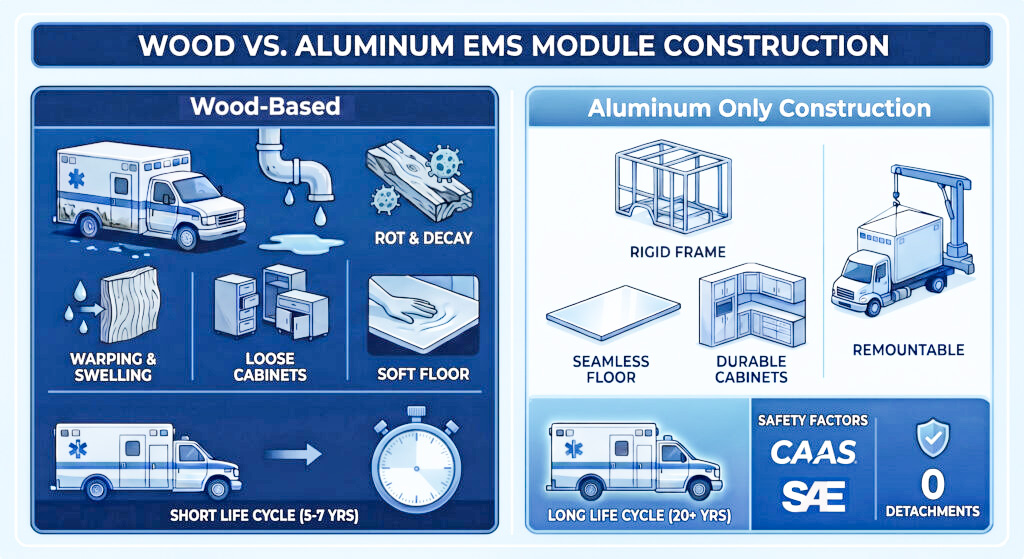
Some emergency vehicle designs use plywood beneath finished flooring or wood blocking behind interior components. If moisture reaches those materials and stays trapped, deterioration can develop over time. Depending on the location and severity, that damage may affect floor rigidity or attachment points.
Mountain Switchbacks and Repeated Road Flex
Agencies working in the Sierra Nevada, Coast Ranges, and canyon corridors regularly travel steep grades, switchbacks, and uneven roads. As the chassis moves over those surfaces, its frame can twist. Some of that movement can transfer into the module, placing repeated loads on corners, doors, exterior skin connections, and interior components.
Over time, technicians may see door alignment change, cabinet latches require adjustment, or stress appear around structural joints. Road conditions, mileage, construction method, maintenance, and vehicle use all play a role in how these issues develop.
Central Valley Heat and Extended Idling
Summer temperatures in the Central Valley and Inland Empire can climb well above 100°F. During long incidents or extended waits outside emergency departments, crews still need climate control, lighting, and electrical power inside the patient compartment.
When those systems depend heavily on the chassis, extended idling can increase demands on electrical, cooling, emissions, and powertrain components. Depending on the chassis and operating conditions, this may add maintenance requirements for alternators, diesel particulate filters, and related systems.

The Hidden Weakness: Plywood Subfloors in Moisture-Prone Environments
An emergency vehicle described as having an “all-aluminum body” may still contain other materials inside the finished structure. Depending on the manufacturer and specification, that can include plywood or composite wood panels beneath the floor.
What Makes an Emergency Vehicle Subfloor Wood-Free?
A wood-free emergency vehicle subfloor can use welded structural aluminum tubing, aluminum sheet decking, and welded bulkheads without plywood, OSB, or organic composite backers in the specified assembly. This removes the moisture absorption concern associated with wood-based subfloor materials and is designed to help maintain floor rigidity and cot-anchor support over time.
When cleaning liquids or other moisture move through flooring seams or penetrations, plywood can absorb that moisture. Repeated exposure can cause wood fibers to swell or deteriorate, and because the damage is below the finished floor, crews may not know it is there until an inspection or repair exposes it.
When significant floor damage is found, repairs may require removing interior components and replacing sections of decking. Depending on the amount of work required, repairs can cost more than $15,000 and may keep a vehicle out of frontline service for weeks.
Reducing Exterior Fastener Penetrations
Moisture is not only a flooring concern. Exterior panel construction also matters. Mechanical fasteners placed through exterior panels create penetrations, and certain combinations of dissimilar metals and moisture can contribute to galvanic corrosion.
Frazer bonds .080-inch 5052-H32 aluminum exterior skin to structural tubing using full-length 3M VHB tape. This reduces the need for rows of mechanical fasteners through the exterior skin. The continuous bond also creates another barrier at the connection and is designed to accommodate vibration between joined surfaces.
For agencies operating in humid or coastal areas, reducing exterior penetrations can help limit some of the conditions associated with moisture intrusion and galvanic corrosion while maintaining panel attachment.
Managing Mountain Roads with Structural Unibody Design
Steep passes, canyon roads, and uneven surfaces place twisting loads on an emergency vehicle body. How the structural frame is designed affects the way those forces move through the module.
How Does Structural Unibody Framing Help Manage Corner Stress?
Structural unibody framing is designed to spread loads through an integrated structure rather than concentrating them at a few points. Frazer’s construction includes a heavy 6061-T6 aluminum tube-and-channel base frame, laminated tube-in-tube corner columns, and welded roof framing.
Laminated Tube-in-Tube Corners
Emergency vehicle modules can use several types of framing and construction. Under repeated twisting, localized areas may experience fatigue depending on the material, geometry, weld design, road conditions, and how the vehicle is used.
Frazer uses 6061-T6 structural aluminum square tubing, a heat-treated alloy used in structural and marine applications. The base of the module uses a 3″ x 1½″ x 3/16″ structural tube-and-channel frame. At each corner, Frazer laminates two structural tubes together to create a double-walled column measuring at least 3″ x 1½″ x ⅛″ to ¼″ thick.
The roof uses 2″ x 1½″ x ⅛″ structural tubing with perimeter framing measuring 2″ x 2½″ x ⅛″. The perimeter is joined with 6-inch welds on 8-inch centers. Together, these components are designed to work as an integrated structure and spread torsional forces through the frame instead of concentrating them around openings and corners.
Static Roof Strength and AMD 001 Testing
Rollover protection is another factor specification committees may want to review. AMD Standard 001 uses a static roof load test based on the vehicle’s curb weight while limiting allowable roof deflection.
During independent third-party AMD 001 testing performed to KKK-A-1822F requirements, a Frazer module was loaded with 70,000 pounds on the roof and 55,000 pounds on the side wall. Under the 70,000-pound roof load, the recorded maximum deflection was 3/4 of an inch. After the test load was removed, recorded results showed the structure returning to its original form without permanent deformation, and the module entry doors remained operational.
Module Attachment History
Structure also depends on how the module is mounted to the chassis. Frazer uses engineered mounting channels secured to the chassis frame as part of its mounting system.
According to Frazer records covering over 4,500 emergency vehicle builds since 1984, there have been zero recorded module detachments from the chassis in collisions or rollovers. Those records include documented rollover incidents involving agencies such as Jackson County Fire Rescue, CareFlite, and Gadsden County Emergency Services.
Central Valley Heat: Reducing Chassis Loads with Independent Module Power
High temperatures often arrive at the same time as heavy call volumes and long staging periods. In 105°F heat, crews still need reliable cooling and electrical power even when the vehicle is sitting for an extended period.
How Can Independent Module Power Reduce Chassis Demand?
Some emergency vehicle designs rely on chassis-driven alternators, refrigerant compressors, or other underhood systems to support the patient compartment. During long periods of idling in high temperatures, those components can operate under added load.
Frazer separates many patient-module demands from the chassis through an independent 120V AC power system. Depending on the configuration, this may use Cummins Onan, MEPS, or Harrison hPower. The system powers functions such as heating, cooling, interior lighting, and 120V hospital-grade outlets.
Reducing patient-module demand on the chassis alternator is designed to limit added load on factory electrical systems. Warranty coverage still depends on the applicable OEM warranty terms and the final vehicle configuration. Frazer also incorporates a 12V chassis backup power source intended to support essential safety lighting if primary auxiliary power is interrupted.
106°F Outside, 71°F Inside
Patient-compartment temperature matters for crews, patients, medications, and temperature-sensitive supplies. Frazer’s self-contained 120V HVAC system operates independently from the chassis cooling circuit.
The system uses a 450 CFM blower to recirculate the module air volume about every two minutes. Testing has demonstrated a 35°F temperature difference between outside conditions and the patient compartment, including maintaining 71°F inside when the outside temperature reached 106°F.
The patient-compartment system is also separate from the cab ductwork, so patient-area airflow does not share the same duct path as the driver compartment. Integrated UV and ionization options are available to support patient-compartment air treatment.
Serviceable HVAC Designed to Reduce Downtime
Air-conditioning repairs can take a vehicle out of service, especially when technicians must reach equipment on the roof or evacuate long refrigerant lines routed through the vehicle.
Frazer places its HVAC assembly in a slide-accessible exterior side compartment. The design does not require a roof-mounted HVAC unit or associated rooftop plumbing. When major HVAC service is required, appropriately trained technicians can remove the self-contained cassette and install a spare. The system is designed to support a module exchange in under 60 minutes.
Easier component access can help shorten service time and reduce pressure on a reserve fleet, especially during hot weather when air conditioning is essential.
Municipal Fleet Economics: Planning Beyond the First Chassis
Initial purchase price matters, but it is only one part of the cost of operating a fleet. Municipal finance teams may also consider maintenance, downtime, module life, remount potential, and the cost of replacing a complete vehicle.
In independent double-blind market research conducted by Smart Advantage, 25% of emergency vehicle buyers initially identified purchase price as their main selection factor. After respondents evaluated the full set of operating attributes, that figure fell to 9%.
Remounting and Customer-Reported Maintenance Savings
A wood-free aluminum module is designed to avoid wood rot and support long-term structural use. When a chassis reaches the end of its planned service life, an agency may be able to place a suitable existing module on a new chassis instead of replacing the complete unit.
Through Frazer’s modular emergency vehicle remount process, the existing patient module is removed, inspected, updated as needed, and installed on a new factory chassis cab when the module and configuration are suitable for remounting.
| Operational Attribute | Common Commercial-Body Configuration | Frazer All-Aluminum Unibody |
|---|---|---|
| Subfloor Material | May include marine plywood or composite backers, depending on manufacturer and specification | 100% welded structural aluminum |
| Corner Frame Architecture | Designs may include single-wall tube or brake-formed sheet construction | Laminated tube-in-tube columns |
| Exterior Skin Adhesion | Some designs use mechanical through-sheet fasteners | Full-length 3M VHB bonding tape |
| Primary Auxiliary Power | Configurations may use chassis-driven charging and high-idle systems | Independent 120V AC generator |
| HVAC Service Location | Varies by configuration and may include rooftop components or chassis-routed plumbing | Slide-accessible side compartment |
| Remount Capability | Varies by construction, condition, manufacturer, and configuration | Designed to support multiple cycles, with examples of up to 3 to 4 chassis remounts |
| Structural Warranty | Terms vary by manufacturer | Lifetime module structural warranty to the original owner, subject to applicable warranty terms |
This approach supports Frazer’s Lower Overall Cost of Ownership (LOCO) philosophy. Customer-reported fleet data has shown maintenance cost reductions ranging from 42% to 60% after transitioning to Frazer vehicles.
Long-standing customer fleets, including Houston Fire Department and Marble Falls Area EMS, have operated modules approaching 20 years of active service, with examples involving up to four chassis remounts and individual units exceeding one million total miles. Actual service life and remount suitability depend on use, maintenance, condition, chassis compatibility, and inspection.
Frazer backs remounted modules with a 2-year factory construction warranty and provides a lifetime module structural warranty to the original owner on new builds, subject to applicable warranty terms. In the same Smart Advantage research, 39% of respondents identified Frazer as spending the least amount of time in the shop, a response rate more than five times higher than any individual competitor included in that study.
Evaluating BuyBoard and HGACBuy
Public agencies often have specific competitive purchasing requirements for major capital equipment. Writing specifications, publishing notices, evaluating proposals, and completing a standalone procurement can take months.
California fire districts and municipalities may want to evaluate cooperative purchasing programs such as BuyBoard and HGACBuy when those programs are allowed under their purchasing rules. Frazer provides information about available contracts through its cooperative purchasing schedules.
A cooperative contract may reduce some of the administrative work involved in running a separate solicitation, but each agency should confirm that the specific contract and purchasing method meet its own legal, funding, regulatory, and internal requirements.
California EMS Durability Checklist: What to Consider in Your Next RFP
Every agency has different operating needs, so there is no single specification that fits every California fleet. The items below can help start the conversation as your team develops an RFP. Final requirements should reflect your operating environment, maintenance capabilities, applicable standards, and purchasing rules.
- Subfloor and bulkhead construction: If your agency wants a wood-free design, consider specifying welded aluminum tubing and sheet construction without plywood, OSB, particle board, or organic wood fillers beneath the finished flooring.
- Structural framing: Consider defining aluminum alloy, base-frame dimensions, and corner construction where those details are important to your durability requirements.
- Roof strength: Ask for applicable third-party AMD test documentation and review both the applied test load and recorded deflection.
- Exterior panel attachment: If minimizing exterior penetrations is important, consider specifications that address panel bonding methods and through-sheet fasteners.
- Independent auxiliary power: Consider whether patient-compartment HVAC and 120V electrical systems should operate independently from the chassis, and verify any chassis or OEM warranty requirements.
- HVAC service access: Think about how quickly technicians can reach, remove, and replace major HVAC components when the vehicle is needed back in service.
- Electrical serviceability: If your team performs repairs in-house, consider specifying an electrical architecture that matches your technicians’ diagnostic tools and training.
Build for the Conditions Your Fleet Actually Faces
California fleets do not operate in a controlled environment. Coastal air, mountain roads, extreme heat, extended idling, and frequent washdowns can all influence maintenance needs and long-term vehicle condition.
Construction decisions such as wood-free aluminum subfloors, 6061-T6 structural framing, independent 120V auxiliary power, and accessible HVAC components are designed to address several of those operating demands. Whether deploying frontline 911 emergency response units across rough mountain passes or establishing dedicated mobile clinics and outreach units in underserved agricultural corridors, these foundations support a longer-term fleet strategy that includes remounting a suitable patient module onto future chassis..
Is your fleet spec ready for California’s response demands? Talk with a Frazer fleet specialist about your terrain, operating conditions, current fleet, and purchasing requirements. We can help you review possible specifications, discuss remount feasibility, and explain available cooperative purchasing options through BuyBoard and HGACBuy.
What makes an emergency vehicle subfloor truly wood-free, and why does it matter for coastal fleets?
A truly wood-free emergency vehicle subfloor utilizes 100% welded structural aluminum tubing, aluminum sheet decking, and welded bulkheads, completely excluding plywood, OSB, and organic composite backers. In coastal response corridors subject to salt fog and frequent interior biohazard washdowns, eliminating organic wood backers prevents subfloor rot, stops water absorption, and preserves the mechanical integrity of cot retention fastener tracks across decades of frontline service.