Looking to Trade In Your Vehicle?

We take trade-ins – including both Frazer units and other vehicles. If youโre planning your next purchase, start by completing the Trade-In Evaluation form below. Once submitted, youโll receive an email prompting you to provide detailed information about your vehicle – including VIN, mileage, chassis specs, and overall condition. From there, our team will review the information and follow up with next steps. Simple. Straightforward. Built to help you plan your upgrade with clarity.
Frazer Shore Power – Setup Guide

Your Frazer unit is designed to connect to facility power through Shore Power, but getting that setup right requires a few important steps. This page will walk you through what Shore Power is, what your facility needs to provide, how to choose the correct configuration, and what common mistakes to avoid. Youโll also be able to download a free setup guide to share with your team or electrician. Download the full Frazer Shore Power – Customer Setup Guide for free. DOWNLOAD THE GUIDE Whatโs in the Setup Guide This free PDF breaks down the essentials in just a few pages: Shore Power Cable OptionsUnderstand the differences between 20A, 30A, and 50A connections โ and which cable setups are available during your build. Facility Power RequirementsKnow what your electrician needs to install before your unit arrives. Configuration GuidanceUse a simple chart to match your vehicleโs onboard equipment with the right shore power connection. Common Pitfalls to AvoidGet clear instructions on what not to do โ like using extension cords, coiled cables, or shared circuits. Common Setup Mistakes to Avoid Even small oversights during setup can lead to equipment damage or power failure. Take a moment to double-check your plan and share this with your facility team if needed. Planning Ahead Helps You Avoid These Issues: Who Should Use This? Whether you’re preparing for delivery or sorting out a power issue after the fact, this guide gives you a clear starting point. This guide supports your safety, your equipment, and your operation. If youโre preparing to accept delivery or looking to verify your facility, this is the place to start. Need Additional Support? Your Frazer Regional Sales Manager can help with diagrams, spec reviews, or setup questions. You can also: Explore Related Topics
How Frazer EMS Vehicles Are Built to Reduce Downtime

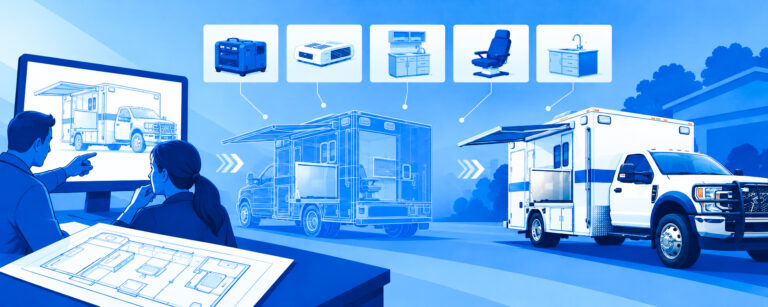
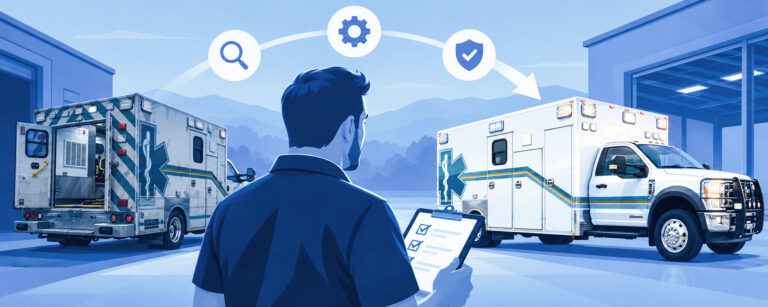
In EMS, every minute your vehicle isnโt ready can delay critical care. Thatโs why many departments choose EMS vehicles designed to minimize downtime and simplify maintenance. At Frazer, we build with a clear goal: keep your unit on the road, ready for every call. Hereโs how our approach helps your team spend more time saving lives – and less time waiting on repairs. 1. Built for Durability from the Start Durability doesnโt happen by accident. It starts with intentional design and continues through every detail of construction. Frazer uses all-aluminum construction for its modules, providing strength without added weight and resisting corrosion over time. By focusing on structural integrity and long-term performance, we help keep your EMS vehicle reliable shift after shift. Key design features: 2. Designed with Longevity in Mind We donโt just build vehicles to get through the next year – we build with long-term use in mind. 3. Maintenance Made Easier Every minute a unit is down matters. So weโve built in features that help you diagnose and fix issues faster. 4. Tested for Real-World Use Every Frazer vehicle undergoes a detailed quality check before delivery. We test HVAC, electrical systems, lighting, and other key module functions to ensure everything is operating as designed. Our goal is to deliver a vehicle thatโs ready to go to work on day one. We also listen. Your feedback helps us refine our process, update designs, and solve the real challenges your team faces. 5. Support That Stays with You We donโt disappear after delivery. Our team remains available to help you keep your fleet running smoothly. Keeping You on the Road When your EMS vehicle is easy to maintain and built to last, it means more uptime, fewer surprises, and less stress for your team. Thatโs what we aim for with every unit we build. Want to learn how Frazer can help your department keep moving? Letโs talk.
Whatโs the Real Cost of EMS Vehicle Downtime, and How Does Frazer Keep Your Fleet Running?

For EMS agencies, fire departments, and mobile healthcare providers, even a single emergency vehicle out of service can create operational and financial challenges. Downtime may lead to delayed response times, increased costs, and added pressure on field personnel. Understanding the impact of EMS vehicle downtime can help agencies make informed decisions when selecting an emergency response vehicle. Choosing a durable, serviceable vehicle may help minimize interruptions and keep more units in service. The Impact of EMS Vehicle Downtime Lost Revenue and Increased Expenses Longer Response Times and Reduced Coverage Higher Maintenance and Repair Costs Crew Fatigue and Morale Issues How Frazer Vehicles Support Fleet Uptime Frazer designs EMS vehicles with a focus on accessibility, serviceability, and operational readiness. Extended Durability for Long-Term Performance Independent A/C System for Fewer Breakdowns Easier Maintenance and Repairs Responsive Service and Support Rethinking Downtime EMS vehicle downtime can lead to service disruptions, increased costs, and operational strain. Vehicles that are easier to maintain and designed for longevity may help reduce the frequency and impact of these challenges. If downtime has become a concern, it may be time to re-evaluate your fleet approach. Reach out to Frazer to explore how our vehicle options may align with your goals for operational continuity and crew readiness.
How Frazer Ensures Quality in Every EMS Vehicle Delivery

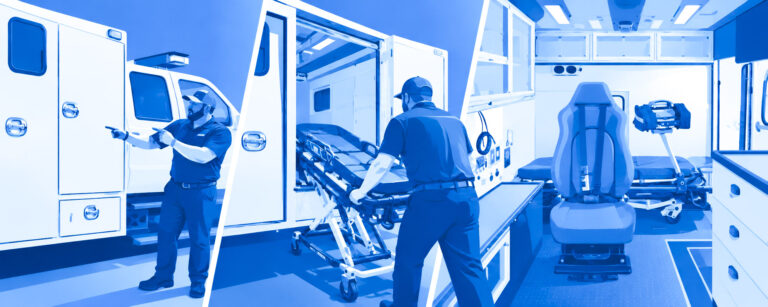
When it comes to emergency medical services (EMS), reliability is everything. EMS professionals need vehicles they can depend on in life-or-death situations. At Frazer, our commitment to delivering defect-free EMS vehicles isnโt just a goalโitโs a promise. Our rigorous quality control processes, testing procedures, and commitment to continuous improvement ensure that every vehicle we deliver meets advanced standards of safety and performance. Independent Quality Control Team At Frazer, quality control operates as a completely independent entity, separate from the production team. This independence ensures an objective review of every vehicle before it leaves our facility. Our quality inspectors focus solely on defect detection, process improvement, and ensuring compliance with our high internal standards. Precision Manufacturing and In-House Fabrication Frazer ensures quality by maintaining complete control over our manufacturing process. Digitally Tracked Quality Defects All quality defects are recorded digitally, allowing for easy analysis and real-time reporting. This digital tracking enables us to identify trends, address recurring issues, and continuously refine our processes for maximum efficiency. Weekly Corrective Action Meetings To maintain our high standards, our team conducts a weekly corrective action meeting to review specific defects, identify root causes, and implement solutions. This proactive approach ensures continuous quality improvement and prevents repeat issues. Comprehensive Vehicle Testing Procedures To guarantee performance, every Frazer EMS vehicle undergoes a series of rigorous tests before leaving our facility. Here are a few examples: Final Inspection and Quick Reaction Team Before any vehicle leaves our facility, customers have the opportunity to conduct a final inspection to record any defects. Our Quick Reaction Team immediately addresses any concerns before the unit ships, ensuring that no issues are passed along to dealers or service partners. At Frazer, we donโt believe in “kicking the can down the road”โwe solve problems before they leave our factory. The Frazer Difference: Built for Reliability Frazerโs commitment to quality translates into real benefits for our customers: At Frazer, weโre not just delivering vehiclesโweโre delivering confidence. If youโre ready to learn more about how our quality control processes can benefit your EMS fleet, contact us today to explore our solutions.
Power Options Comparison

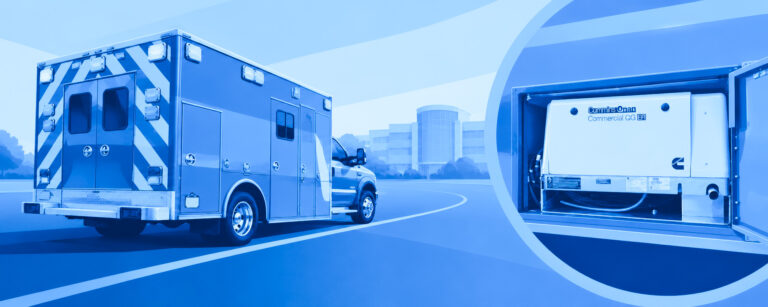
Not all power options are created equal! You may have asked yourself… “Which power option is right for my ambulance?” Typically the answer to that question is a combination of cost, maintenance, and more important than ever… environmental footprint. We highly recommend taking a look at your vehicle replacement policy, service resources, and county policies to determine the best power option for your service. Giving more power options allows for flexibility and scalability of your fleets. This article gives you deeper insights into each power option and how each one can enhance your service. LEARN MORE A Side-by-Side Comparison of Power Options Onan MEPS hPower MEPS PMI Option Type Gasoline Powered Generator Under Hood Belt Driven Generator Lithium Iron Phosphate Battery Pack System with Idle Mitigation Lithium Ion BatteryPack System withIdle Mitigation Independent from Chassis Engine (*Requires Chassis Engine for Battery Charging) Yes No *Yes *Yes Provides Idle Reduction Yes No Yes Yes Cost Comparison Onan MEPS hPower MEPS PMI Upfront Cost $ 11,000.00 $ 16,500.00 $39,000 – $49,000 Dependant on the number of batteries. $ 35,000.00 Spare Equipment Cost (Not Required, Recommended: 1 Spare per 4 Vehicles) $ 5,350.00 $ 2,600.00 $ 0 $ 2,600.00 Annual Estimated Fuel Cost (Based on National Average: $3.88/Gallon) $ 4,850.00 Negligible 40-50% reduction per year 40-50% reduction per year Annual Preventative Maintenance Cost (Labor Not Included) $ 1,000.00 Approx. $ 400.00 $ 0 Approx. $ 400.00 Maintenance Comparison Onan MEPS hPower MEPS PMI Preventative Maintenance Intervals Every 150 Onan Hours Every 2,500 Engine Hours None Every 2,500 Engine Hours Annual Preventative Maintenance Downtime ~8 Hours 2-5 Hours None 2-5 Hours Frazer 12 VDC Fail-safe Backup Yes Yes Yes Yes Installation Space Large Small Large Large Average Lifespan 7-10k Onan Hours Up to 16k Engine Hours Minimum of 5,000 Charging Cycles 100-50% to maintain 80% of day 1 (new) capacity. 5,000 Charging Cycles Install Complexity Easy Easy Easy (Less Labor for Install) Moderate Further Comparing Battery Systems & Idle Reduction Idle Reduction technology allows for intelligent switching between the generator and stored battery power. When your onboard batteries are charged and providing power, the chassis remains off. The system senses when the batteries need to charge and automatically starts the chassis to begin recharging the batteries. Below is a comparison of our Idle Reduction options. hPower MEPS PMI Battery Capacity Options 8.4 kWh, or 12.7 kWh 8.4 kWh # of Batteries 2 + (Dependent on Available Space) 2 + (Dependent on Available Space) Battery Run Time (Dependent on # of Batteries and Load) 2-4 Hours 1 1/2 – 2 Hours System Startup Automatic, with automatic restart after system shutdown. Automatic Battery Voltage 12V 24V Battery Amperage 660-990 Ah 300 Ah Inverter 5000W 12V-Sine Wave Inverter 5000W 12V-Sine Wave Inverter Display Cerbo Touchscreen Display Color Control Button Display ACU (Alternating Current Unit) Heat No Heat From ACU ACU Heat Alternators No Extra Alternators โ OEM Replacement 3rd Alternator Cooling Thematically controlled fan system. Constant Fan Pulling AC from Box Temperature Monitoring Yes No Extra Belts No Extra Belts โ Factory OEM Belt Loop Extra Belt Line Cutting Hoses/Lines No Cutting or Moving Hoses Cutting Hoses/Lines Power Option Videos
Trade-Ins, Pre-Owned Vehicles, Rentals and Loaners

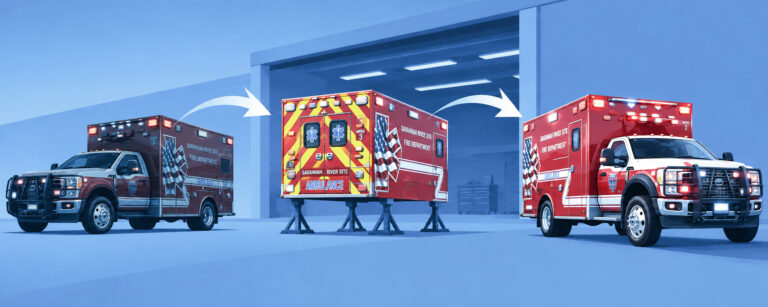
Trade-Ins, We Take โEm! Pre-Owned, We Got โEm! One of the questions we hear more and more regards whether or not Frazer will take a trade-in. The super short answer is โYes!โ we absolutely do. While itโs true weโve always been willing to work with customers on trade-ins, in reality it was never our first choice. For many years we just didnโt have the available personnel to deal with what can be a highly variable situation. Early on we rarely got our own vehicles as trades. We werenโt particularly confident in our ability to value vehicles we didnโt build and, as a result, we typically recommended our customers try to sell the vehicle at auction or re-purpose what could be salvaged. Over the last few years weโve added to our sales staff allowing us to make far more trade-in offers to our customers. After more than 30 years of building EMS vehicles, we now see some of our own considered for trading in. Adding to that, just over a year ago our special projects guru, Herb Brady, took on the pre-owned vehicle process and does a great job keeping in touch with a host of people looking for solid options of that type. If youโre in the market for a pre-owned vehicle, please reach out to Herb at 888-372-9371. Other Trade-In Considerations A municipality trading in an item is a valid option for asset liquidation in most states. A number of organizations opt to auction off their vehicles as a standard process. But some entities believe they MUST offer the item at auction. Unless there is some local rule for asset disposal that supersedes state regulations, you should be able to take advantage of a trade-in. The amount offered for the used vehicle comes straight off the bottom line of your purchase price and is clean and transparent for your balance sheet. As with any decision governed by a set of statutes, make sure to verify your own state codes. We love the opportunity to get some of our own equipment back during the upgrade cycle, and we have a healthy list of customers who love to find those. But we take other manufacturerโs vehicles as well. Valuations and offers will always be contingent on mileage and condition of the truck and module. If you would like to consider combining a trade-in with your next vehicle purchase, please give one of our sales team a call at 888-372-9371. Rentals Frazer is happy to offer some of our pre-owned vehicles for rent. Unexpected issues happen and we want to be able to help when needed. All vehicles have to pass a Texas State Inspection and we go over them extensively in our service shop before releasing them for use. Though these vehicles are subject to availability, when we have them we can work with both short term and longer term rentals. Our book rate for rentals is $150.00 per day. Anything at or over 7 days bills at $700.00 per week. Loaners If youโre having a warranty issue we need to take care of for you, we can offer the same fleet of rental vehicles on loan while the work is in progress. As with rentals, loaners are subject to availability. You can call 888-372-9371 and direct your inquiries to Herb Brady in Sales or to Bert Jones, our VP of Service.
Ambulance Module Construction – Framing

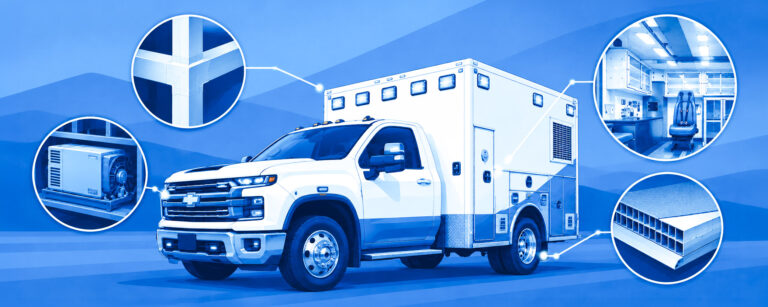
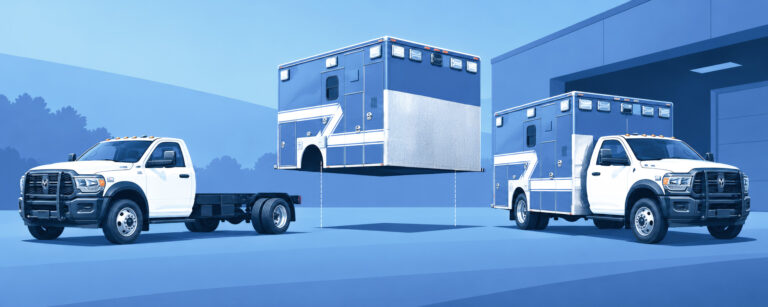
Over the years weโve heard a lot of different questions surrounding our construction methods. Why the square corners? Do your modules hold up? How do you mount the module to the truck? Is it safe? In this episode weโll tackle some of these questions and maybe even answer some you didnโt know you should be asking. The Modular Body From the time we started building truck mounted modular vehicles, Frazer has needed to design for extremely harsh environments, frequently the kinds without roads. So we were ready for the transition to the rigors of the EMS industry. As with any structure, strength comes from a solid foundation and a Frazer EMS vehicle is no exception. Base Frame The strength of your Frazer module begins with an extraordinarily beefy base frame. Letโs take a look at some of the specs: So what do all those numbers mean? The heat treated 6061-T6 alloy tubing provides a Frazer module with an excellent strength (20,000 – 40,000 psi tensile) to weight ratio, excellent weldability, and advanced corrosion resistance. This particular alloy represents a typical first choice for architectural and structural applications and we appreciate the durability and strength it has provided us and our customers over the years. Construction Our 3โ x 1.5โ base frame tubing represents a 12.5% increase over the 2โ x 2โ tubing commonly used in base frame throughout the rest of the industry. And our intricate frame design features shorter spans of 3โ x 1.5โ channel reinforcing the longer 3โ x 1.5โ tubing lengths in parallel with the chassis frame for maximum strength along that axis. All of this tubing receives additional support from .250โ and .375โ plate welded throughout the frame. These plates provide a solid surface for cot and captainโs chair retention, as well as O2 bottle holders, and other optional features. They simultaneously create extremely strong corner gussets at key locations. And there wouldnโt be any point in designing and fabricating a ridiculously strong base frame if we didnโt attach it to the truck in the strongest way possible. For that we take eight (ten on a 14โ module) 4โ x 10โ x .250โ steel shear plates and bolt them to both the chassis frame and the base frame with .5โ Grade 8 bolts. Each plate uses 4 bolts, 2 in the chassis frame and 2 in channels on the module frame. The module bolts are insulated with rubber to avoid electrolysis. Each bolt carries a tensile strength of 150,000 psi. This attachment method is the primary reason weโve NEVER had a base frame detach from its chassis during a violent collision. Side and Front Wall Frames So you put all that structure in your base frame, why wouldnโt you do the same for the side walls? 34 years of both building EMS vehicles and repairing them after major wrecks have given us a much greater sense of where most impacts occur than we could get from simple controlled destructive testing. And weโve found that side wall impacts most commonly occur at or below module floor level. Once again, the beefy base frame helps out in those circumstances, but the side wall frames take very little impact. Using 1.5โ x 1.5โ x .125โ square tubing through the side walls allows us to maintain necessary structural strength for things like mounting cabinets and compartments, seat belt plates, grab rail plates, and more, without adding unnecessary weight to your module. New cot retention systems, upgraded medical devices, bariatric requirements and more have increased the empty weight of the modern EMS module. This tubing dimension also yields extra space throughout the interior of the module resulting in more room to move and work on your patients. Where the driver and passenger side walls meet the front wall results in a corner structure that, like the strongest portions of the base frame, ends up at 3โ x 1.5โ. This welded, โlaminatedโ corner piece is also bolted together to create an extremely strong leading edge of the module. Front corner impacts happen very frequently and the Frazer design provides strength where you need it. Some folks complain about the looks of the โsquare corners.โ But we know how important they are to your safety, so we think theyโre kind of awesome. Rear Walls The rear corner impact is kind of the gold standard for how an ambulance gets in a wreck. So common, in fact, that Frazer has made these two corners the focal point of some serious strength. Our rear walls feature 2โ x 2.5โ rectangular tubing, a 25% increase over industry standard. Again, we know where crashes occur. And we know where you need strength and durability. So if weโre going to add the weight associated with a larger extrusion, weโre going to apply it where it makes sense for your safety. Plates for grab handles, door hold opens, and other options provide structural reinforcement throughout. Roof If your vehicle rolls over, and we know they do, youโd better have a solid roof. Consequently, Frazer views the roof construction in much the same way as our base frame, it needs to be as sturdy as the foundation. Accordingly, we use the same 2โ x 2.5โ rectangular tubing as the rear wall around the perimeter of the roof, where that structure will be welded to the supporting side walls. The resulting corner piece ends up with an effective 3.5โ side and of course there is .250โ plate throughout for overhead grab bars and other optional equipment. Durability Everything we learned about building vehicles for the extreme environments found in the oil fields around the world found its way directly into our EMS vehicles. Some seismic recording modules we built well over 40 years ago are still in use. If you saw our last post maybe you noticed the Bellaire Fire Department still runs a module we built 26 years ago. And theyโve remounted it twice. So yeah, we know a thing or twenty about durability. Testing Testing And not only
Air Conditioning in Your Ambulance – A Discussion

Air conditioning is essential to a safe environment for you and especially your patients. Along with fancy electrical systems, ambulance air conditioning usually sounds great during the sales pitch, but frequently doesnโt perform as advertised. Hereโs how you can avoid โdrip air.โ Automotive vs. Self-Contained Applications The mechanical process of air conditioning works the same for self-contained and automotive applications. But the similarities pretty much end there. Automotive Air Conditioning The AC in your car or truck is sized to try and cool an area that can easily reach temperatures over 150 degrees on a hot and humid summer day. Thereโs a reason why we donโt leave kids and pets in hot cars; cars and trucks basically become hot houses in a very short span of time. Cooling a small passenger space down quickly from temperatures that extreme is a priority for the driver and occupants, and most vehicles can handle that job sufficiently. But that cooling capacity comes at a cost. Per the U.S. Department of Energy: Running your car’s air conditioning is the main contributor to reduced fuel economy in hot weather. Its effect depends on a number of factors, such as the outside temperature, humidity, and intensity of the sun. Under very hot conditions, AC use can reduce a conventional vehicle’s fuel economy by more than 25%, particularly on short trips.[1,2,3] The AC’s effect on hybrids, plug-in hybrids, and electric vehicles (EVs) can be even larger on a percentage basis.[2] U.S Department of Energy – Office of Energy Efficiency and Renewable Energy If it feels like your ambulance is burning through fuel at a higher than normal rate during the summer, thatโs because it is. An Ambulance is Not a Car It’s MUCH bigger! Automotive AC relies on the engine and electrical system of the vehicle to provide all required power. A conventional ambulance takes that same system, adds the massive volume of a patient compartment to the equation, and expects everything to stay cool. Since many ambulance manufacturers add an additional condensing unit to the system in an attempt to cool a much larger space, the power requirements and resulting fuel consumption start to rapidly increase. These automotive-based systems also rely upon a large amount of air to blow over the condenser as the truck moves down the road. If you have to keep your unit at high idle to provide power for the module, the extra heat generated underneath the hood impacts the AC system as well. Bottom line, it is an expensive, power hungry, inefficient, and ineffective alternative the industry has lived with for decades. The Frazer A/C Solution If you have an 1800 square foot house in the South, you generally have 3 ton air conditioner. Frazer provides a 1 ยผ ton AC for your 112 square foot patient module. That’s enough to cool a 900 square foot apartment in Houston! You win! Our air conditioner runs off 120V provided by our on-board or under hood generator. Oh, and the drivers get that truck AC all to themselves. A massive 518CFM fan cools the condenser. Humidity is extracted from the air and pours out in buckets. You set your thermostat to a comfortable temperature and forget it. Recirculated air quickly cools the interior, and recovery time from working at a scene is fast. Forward facing supply vents put the air onto the things that matter — you and your patient. When youโre done with a call, plug in at the station for year round temperature control. It works just like it would at home – set the thermostat and walk away. Youโll come back to an already cooled (or heated) module. Idling on scene (or even turning off your vehicle with the Onan application) will have no impact on the cooling capacity of a self-contained AC unit. The Numbers That Matter Delta. Like the Airline, But Different. Our self-contained units produce a 34 degree differential from outside to inside air temperature. On a hot and humid 104 degree day, that means it will be a cool and comfortable 70 degrees inside our modules. That 34 degree number, sometimes referred to as the delta, is a critical one. Of course that’s with the doors closed. What happens if someone leaves the doors open? Glad you asked! Our air conditioner can maintain a consistent 22 degree delta even with the doors wide open. Recovery Time Since you have no idea how long you’ll end up on scene, or how long someone might leave the doors open in the patient compartment, recovery time matters. And once again, the massive airflow and cooling capacity of our self contained AC system sets us apart. After the doors were closed, recovery time was 5 minutes. No “drip air” here. So we get your module cold. We keep your module cool on scene. And when you’re ready to go we’re ready to get it cold again. Warranty Our self-contained units feature our legendary 4 year warranty. Most automotive systems come with 3 yr/36,000 mile coverage. You’re likely to blow through 36,000 miles in 12-18 months at most services so forget the three years. Also, if there is an issue to contend with, troubleshooting is far easier on a self-contained unit. And, if necessary, our whole AC can be completely swapped out in about 45 minutes. Try that with a truck-based system. A Little History We did automotive based AC long ago in our oilfield equipment because thatโs what our customers knew. When big 120V generators became available they wanted 120V air conditioners. It was an amazing change in efficiency and reliability! Itโs been almost 40 years since Frazer first prototyped the self-contained air conditioning system in our EMS vehicles and close to 50 since the first time we used it in our oilfield equipment. So weโve known almost a half century that automotive AC doesnโt provide the performance our customers have grown to expect from our products. That is what we want to do for you. Please let us
Ambulance Options: Gas vs. Diesel

Coke or Pepsi? Coke. Tea or Coffee? Coffee, duh. Whataburger or In-N-Out? Whataburger. Not close. Gas or diesel? Well, that depends… All of those other choices have clear, totally objective answers. But when it comes to picking the fuel type for your new ambulance, there are a few other considerations beyond just taste. Please note, this particular post covers offerings from Ford, Chevy and Ram, as they are they only ones offering both diesel and gasoline options on ambulance prep package models. What Vehicle Do Our Customers Choose? By more than a two to one margin, Frazer customers opt for diesel power for their EMS vehicles. The splits are roughly 70% diesel to 30% gasoline. Drilling down further, for those choosing diesel, Ram leads the way by nearly 2 to 1. According to the Ambulance Manufacturerโs Division (AMD) of the National Truck Equipment Association (NTEA), those numbers flip around to Ford at a 2 to 1 pace nationwide. Diesel Options Ram, Ford, and Chevrolet all offer diesel options powerful enough to make Tim Allen happy. However, from a pure performance perspective, Ram carries the day with a whopping 1000 ft. – lb. of torque from their new Inline 6 cylinder Cummins engine. Hereโs a handy chart for your viewing pleasure. Diesel Options Ford Ram Chevy Name Ford PowerStroke Cummins Duramax L5P HP 450 HP 400 HP 445 HP Torque 935 lb. – ft. 1000 lb. – ft. 910 lb. – ft. Compression 16.2:1 16.2:1 16.0:1 Displacement 409 cu. in. – 6.7L 408 cu. in. – 6.7L 403 cu. in. – 6.6L Configuration V8 Inline 6 cylinder V8 Gasoline Options Itโs been a long time coming, but the Big 3 manufacturers all have a gasoline option available that works for Type I vehicles. (* Note – Type 3 cutaways ONLY come in gasoline configurations.) Since the mid-1980s, the Chevrolet C3500 has been the Houston Fire Departmentโs platform of choice. Consequently, Frazer has decades of experience in this area. While the power ratings donโt match up to those of the diesel engines, there are a number of factors that still make these trucks an attractive option under the right circumstances. Hereโs another nice chart. Gasoline Options Ford Ram Chevy Name FlexFuel V8 Hemi V8 6.6L V8 HP 430 HP 370 HP 401 HP Torque 475 lb. – ft. 429 lb. – ft. 464 lb. – ft. Compression 9.8:1 10:1 10.8:1 Displacement 445 cu. in. – 7.3L 392 cu. in. – 6.4L 403 cu. in. – 6.6L Configuration V8 V8 V8 A Little Vehicle History In the mid-1980s, when Frazer began building for the EMS industry, we were virtually alone among builders in using a gasoline chassis. However, our separate power source, provided by the Onan generator, made it possible to still use the Chevy 3500 without the overheating, air conditioning, and electrical problems others faced when running all the power off the chassis. Technological advances have mitigated the overheating issues to the point where the Big 3 now offer an ambulance prep package on all models, diesel or gas, but we still know the separate source of module power matters no matter what platform you choose. Pros and Cons So how does one choose from among such a wide array of options? Letโs look at some things to consider: Diesel Pros Diesel Cons Gasoline Pros Gasoline Cons Phone A Friend Frazer will build you a new or remounted EMS vehicle on whatever platform you prefer. Our main concern is that youโre happy with your new rig. If youโre considering a change to a different chassis or fuel type or both, please give our Sales Team a call at 888-372-9371 for a list of referrals. However, we find that talking to your friends or neighbors in the industry who have some experience with the model you seek is a great way to lock in a decision. If you already know what you want, or if our handy dandy charts gave you the answer you need, click here to get our latest pricing info!
Fleet Size Matters

Getting your fleet right-sized is a key consideration for any EMS leader. Learn more about what factors are important to stay ahead of the curve.
Is Your Ambulance Fleet Costing You Too Much Money?

It’s not a secret that owning and operating a modern ambulance can get very expensive. EMS agencies continue to face the challenge of keeping costs down when managing an individual unit or an entire ambulance fleet. A single emergency vehicle could cost anywhere between $120,000 and $325,000, so it’s imperative to know what you can do to save money when shopping around. It is also important to know how to keep costs down after your initial purchase. Here are 7 things to consider when trying to save money on your next ambulance: 1. Service & Maintenance You demand a lot from your vehicles, so it’s important to keep them well-serviced. A well-serviced and maintained ambulance fleet will last considerably longer and save a ton of money in the long run. If you donโt invest in maintenance early on, then you’ll surely pay for it later. Choosing a builder that is known for both durability and serviceability will lead to successful maintenance programs that cost less money. When looking for a builder, consider their ability to service your entire vehicle, including the chassis. Choose a partner that has established service centers near you and offers FREE training to your team. Otherwise you may see costs rise quickly. If your EMS agency opts to buy Factory Direct, you may see reductions anywhere from 40 to 60 percent in overall fleet maintenance costs. 2. Premium Equipment When you spec a new ambulance, you may encounter dealer networks that try to overcharge or upsell equipment that you may not need. Dealers often work on commission, so trying to sell you higher-priced options means more money in their pockets. Make sure your salesperson is more concerned about your agencyโs success and sustainability than they are with the size of their commission check. Choose a builder that works at building a long-lasting relationship with you. One that understands your service, your community and your goals. Work with a company that has a long history of incorporating popular features as STANDARD and not as expensive add-ons. This will save you a lot of money when it comes time to spec your next unit. Does your EMS vehicle provider offer a discount for choosing standard options? If so, then this may be a great way to keep your costs down. It may also make the spec process a lot less painful for you and your committee. When you have a trusted partner that puts your needs first and works hard at solving your problems, it can make all the difference in the world. 3. Ambulance Down Time Having a unit break down can be a nightmare, especially when itโs essential to get it back on the road quickly. When one of your fleet vehicles goes down and is placed out of service, the costs can be tremendous. These unplanned losses can cause logistical challenges and increased stress for EMS providers, leadership, and the community. Some EMS agencies determine fleet size based on their peak staffing needs plus additional resources for surges in call volume, special events, and scheduled and unscheduled maintenance. The additional units can vary from 140% to 200% of typical peak demand depending on multiple factors including the community risk profile, availability of service, seasonal variations, surge history, availability of mutual aid, types and frequency of special events and geographical deployment. Agencies that don’t carry additional resources find themselves in a situation of diminishing returns, where scheduled maintenance is skipped due to the lack of a backup, then much more expensive issues crop up. Choosing a vendor that uses modular components that are replaced quickly is a great way to keep your vehicles out of the shop and reduce the number of reserve units you will need. 4. Chassis Wear & Tear If you have an ambulance that relies on its chassis batteries and alternator to power the patient compartment, your unit may be gone before its time. The more wear and tear you place on your chassis, the sooner it will need to be replaced. Choosing an ambulance that features an independent power source extends the life of your chassis considerably. With an independent power source, the chassis does not need to work overtime powering the patient module and can focus on doing what it does bestโฆ getting your crew on-scene fast. 5. Remounting One of the most expensive aspects of fleet management happens when it comes time to replace one of your vehicles. Whether a unit has been in a wreck, or has simply reached the end of its life cycle, the process of replacing one of your ambulances can be quite overwhelming. EMS agencies that are interested in saving money have the option of remounting their units. Some feel that their money is better spent on chassis upgrades and much-needed unit enhancements rather than replacing a perfectly good box. If you are interested in the benefits that remounting provides, then partnering with a builder that designs modular units that can be remounted easily is a great idea. Finding a builder that also offers a lifetime warranty on structural integrity will ensure that your box will be with you for many years. 6. Structural Integrity Ambulance builds have changed a lot over the years. Of course, you want to ensure that your vehicles are built with only modern materials. Choosing a builder that uses only the strongest aluminum construction will lengthen the life of your vehicle. Be careful, thoughโฆ There are builders out there that will sneak wood products into their construction because they believe it saves them money. Are they passing those savings onto you? 7. Employee Health & Safety One thing you should never cut corners on is safety. With recent changes in safety requirements, several EMS agencies are now dealing with an increase in equipment costs. Outfitting ambulances with equipment that meets these new standards has proven to be a challenge. Crash-tested equipment mounting solutions like Technimount, cot fastener systems, and safety harnesses may seem like a large upfront cost,