
Surviving California Wall Time: Independent Power for Urban EMS Idling
Urban emergency response vehicles can spend hours parked with the chassis engine running. Those extra engine hours can add wear and may contribute to diesel particulate filter (DPF) soot buildup, even when road mileage stays relatively low. For fleets dealing with frequent hospital staging, EMS urban stationary idling is worth a closer look.
Frazer uses independent power to separate patient-compartment HVAC and electrical loads from the chassis engine. With the right operating setup, crews can shut down the chassis engine during longer staging periods while the independent power system continues to support module cooling and electrical needs. This approach can also reduce the need for added electrical connections to factory chassis systems and may help fleets lower long-term maintenance costs.
For departments in places such as Fresno, Riverside, and Los Angeles, this can matter during long hospital offload delays and other stationary operations. Some emergency vehicles may log thousands of engine hours each year while traveling fewer than 25,000 road miles, which means the hour meter can tell a very different story than the odometer.
1. Why Urban Staging Can Be Hard on Modern Drivetrains
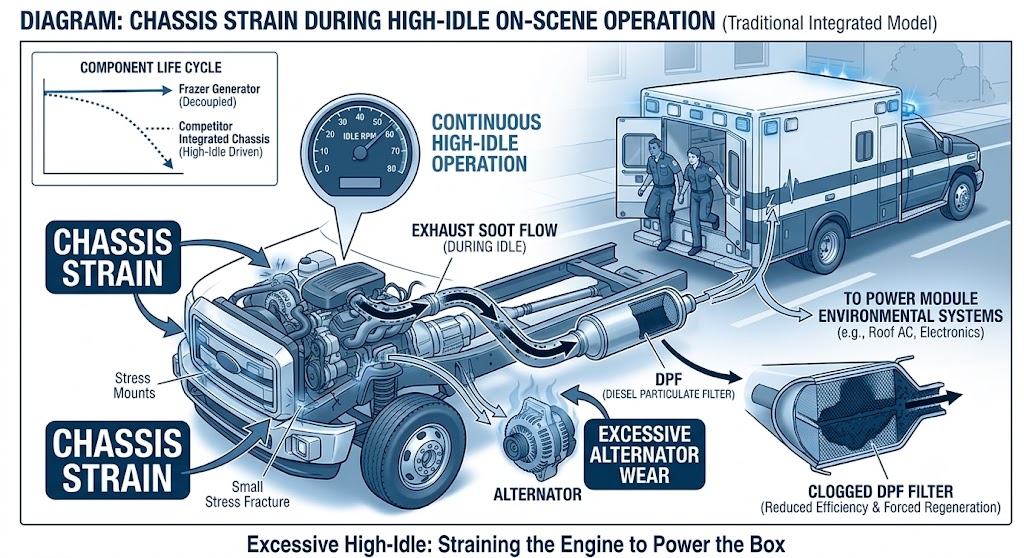
Fleet maintenance teams need emergency vehicles ready to respond. During long hospital staging periods, shutting down a traditionally configured vehicle may also remove chassis-dependent air conditioning and electrical power from the patient module. To keep the compartment cool and equipment powered, crews may leave the chassis engine running at high idle.
Engine Hours vs. Odometer Miles
Odometer mileage only shows part of a vehicle’s workload. A unit may end the year with relatively low road mileage but far more engine use than the odometer suggests because of long periods spent idling (i.e. ghost miles). Whether navigating stop-and-go metropolitan hospital staging or demanding rural and mountain transit corridors, operating conditions dictate mechanical wear across both chassis drivetrains and module structures.
Diesel engines can benefit from sustained operating loads that raise exhaust temperatures. Those higher temperatures help support passive oxidation of soot trapped in the DPF. During stationary idling, lower engine loads can produce cooler exhaust conditions, which may allow soot to accumulate and can lead to warning indicators or other concerns.
DPF, DEF, and Derate Concerns
When soot reaches programmed thresholds, the engine control module may call for an active parked regeneration. In some conditions, the vehicle may also reduce available power as part of its protection strategy. Severe faults can create a major operational problem for a frontline emergency vehicle.
Low exhaust temperatures can also affect Diesel Exhaust Fluid (DEF) system performance. Under certain conditions, deposits can form in injectors or decomposition tubes and contribute to Selective Catalytic Reduction (SCR) fault codes. When that happens, maintenance teams may need to clean filters, replace sensors, or resolve diagnostic faults while a reserve unit fills the gap.
2. Comparing Idle-Mitigation Approaches
Fleets looking to reduce stationary engine run time may consider several approaches, including automatic stop-start systems, auxiliary battery systems, and independent power. Each option has different installation requirements, electrical architecture, operating cycles, and maintenance considerations.
What is the difference between auto-stop/start and independent power?
Some auto-stop/start systems connect to chassis electrical or control systems and cycle the primary engine based on temperature, voltage, or other operating conditions. Independent power takes a different approach by placing patient-compartment HVAC, lighting, and applicable clinical loads on a dedicated 120V power source. This can allow the chassis engine to shut down when operating conditions permit without making it the primary source of module power.
| Architectural Feature | Conventional High-Idle | Aftermarket Auto-Stop Kits | Frazer Independent Power |
|---|---|---|---|
| Primary Power Source | 6.7L propulsion diesel engine | Intermittent chassis engine cycling | Dedicated 120V generator platform, including Onan, MEPS, or hPower |
| Chassis Electrical Impact | Places charging demand on chassis alternators | May require integration with factory chassis wiring or control systems, depending on configuration | Designed to keep primary module power separate from factory chassis wiring |
| Chassis OEM Warranty Considerations | Coverage depends on OEM terms and the cause of a specific failure | Aftermarket modifications may affect warranty evaluation depending on installation and the cause of a specific failure | Designed to limit aftermarket electrical modifications that could become part of a warranty evaluation |
| Starter and Battery Duty | Continuous chassis charging demand while operating | Repeated engine restarts can add starting-system cycles | Allows the chassis starting circuit to remain inactive while independent module power is in use |
| Severe Heat Performance | Depends on chassis HVAC configuration and operating conditions | Cooling may vary as the engine cycles, depending on configuration | Continuous 450 CFM cooling with a 35°F+ temperature differential |
| Backup Power | Depends on vehicle configuration | May include a secondary battery bank | Intelligent 12V DC chassis fail-safe backup |
Repeated Stop-Start Cycles
An auto-stop/start system may monitor interior temperature and battery voltage, then shut the chassis engine down when programmed conditions are met. When temperature rises or voltage drops, the system starts the engine again.
On a hot hospital apron, cabin temperature can rise quickly. That can lead to repeated starter, ring-gear, and battery cycles over the course of a shift. Fleets considering these systems should evaluate how those cycles may affect maintenance over time and whether temperature or voltage changes could matter for the equipment carried onboard.
OEM Warranty Considerations
Warranty questions can become more complex when a chassis manufacturer, dealer, and aftermarket upfitter are all involved. If a failure involves a modified engine harness or added high-output alternator, the chassis dealer may review whether that equipment contributed to the problem before deciding how warranty coverage applies.
For that reason, some fleets may prefer a design that limits changes to factory wiring and computer modules. Actual chassis warranty coverage always depends on the applicable OEM warranty terms and the facts of the specific repair.
3. How Independent Power Reduces Chassis Dependency
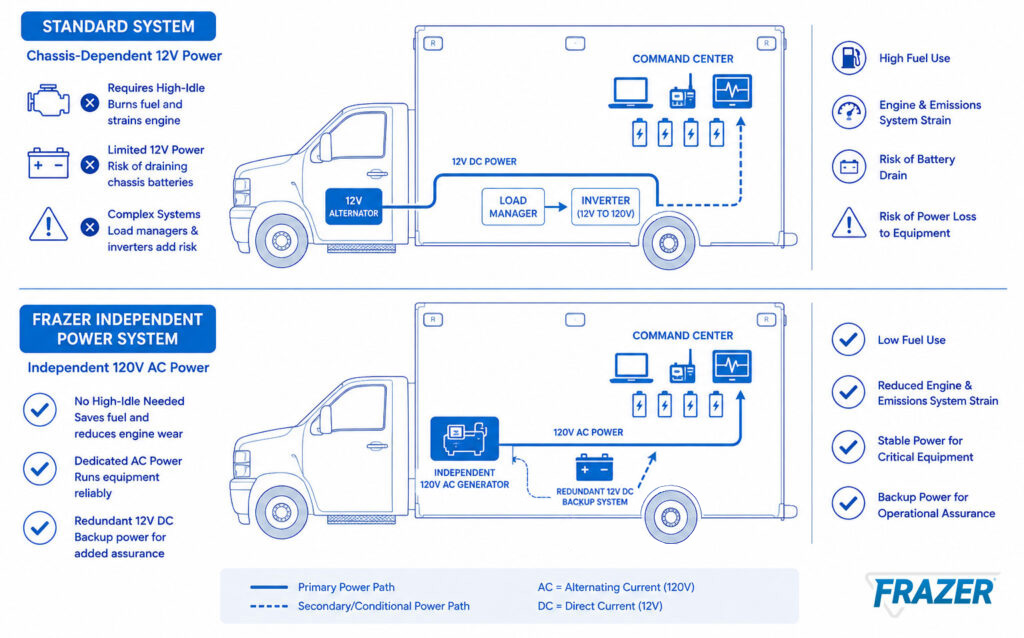
Frazer separates primary module power and climate-control loads from the truck drivetrain. Instead of using the chassis engine as the main stationary power source for the patient compartment, the module uses a dedicated 120V AC power source.
How can independent module power limit chassis electrical changes?
Independent power can supply 120V AC directly to the patient-care module through an auxiliary source, reducing reliance on secondary high-output chassis alternators and related integrations. Frazer’s approach is designed to keep primary module power separate from factory chassis systems while providing a 12V backup architecture where applicable. OEM warranty coverage remains subject to the manufacturer’s terms and the cause of any specific failure.
Three 120V AC Power Options
Frazer offers three independent 120V AC power options so departments can choose the setup that best fits their operating needs. Cummins Onan packages are self-contained generators that draw from the vehicle’s primary fuel tank. MEPS is a belt-driven underhood system that produces 120V AC power while the chassis engine is running, while Harrison hPower uses hydraulic and auxiliary electrical power for stationary operation.
Producing 120V AC at the source can reduce the need for secondary high-output 12V alternators, DC-to-AC inverters, and added load-management components used in some other designs. The chassis engine can focus on propulsion while a separate power source supports applicable module loads. During hospital staging, crews can shut down the truck engine when conditions permit and use auxiliary power for the module, which can help reduce EMS urban stationary idling.
12V DC Fail-Safe Backup
Independent operation still needs a backup plan. Frazer integrates a fail-safe architecture designed so that, if the primary generator has a fault, the vehicle can use the chassis 12V DC system for designated loads. This setup is intended to support critical warning lights, radios, and applicable patient-care equipment when the primary module power source is unavailable.
4. Climate Control and Clinical Power in the Field
For operations leaders and field crews, electrical architecture only matters if it works in real conditions. During hot-weather calls, maintaining a usable patient-compartment temperature can support both crew working conditions and patient care.
450 CFM HVAC and a 35°F+ Temperature Differential
Frazer EMS vehicles use a self-contained 120V HVAC system designed for mobile healthcare use. The system includes a 450 cubic-foot-per-minute blower designed to recirculate the air in the module about every two minutes.
The system is designed to provide up to a 35°F+ temperature differential from outside ambient conditions. Because it runs from independent module power, cooling can continue while the chassis engine is shut down and the independent power source is operating. The air-conditioning unit is backed by a four-year parts and labor warranty, subject to applicable warranty terms.
30 Amp Meltric Shore Power for Hospital Staging
When compatible building power is available, crews can connect the vehicle to an external 30 Amp Meltric shore power source. This allows module air conditioning and onboard chargers to run from building power without operating the auxiliary generator or chassis engine. During the connection period, that can reduce fuel use and tailpipe emissions while keeping onboard equipment supported.
5. Serviceability in the Fleet Shop
When a vehicle needs service, the goal is simple: find the problem and return the unit to service as efficiently as possible. Electrical design, component access, and parts availability can all affect how quickly that happens.
Point-to-Point Wiring and Service Access
Some emergency vehicles use digital multiplex networks with programmed circuit boards and microprocessors. Depending on the system and the fault, troubleshooting can require special software or manufacturer-specific diagnostic tools.
Frazer uses direct point-to-point wiring with standard automotive fuses, mechanical relays, and clearly labeled terminal strips. These parts are organized in an exterior, eye-level electrical compartment with schematics and built-in diagnostic monitoring diodes. This layout is designed to help qualified fleet technicians troubleshoot many circuits with common shop tools and source applicable replacement relays from commercial suppliers.
HVAC Replacement in Under 45 Minutes
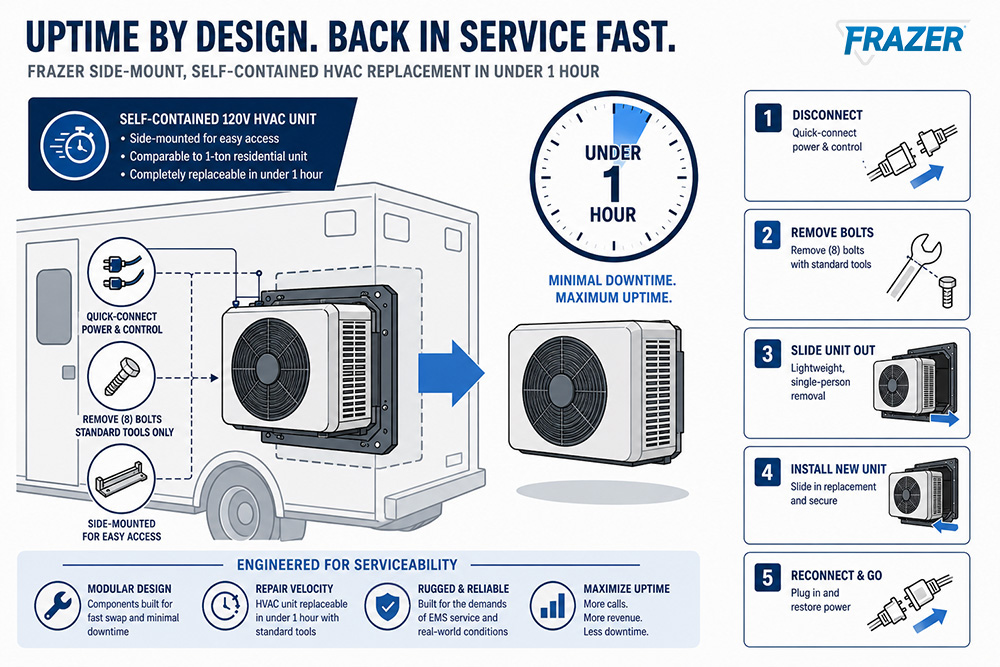
Some vehicle climate systems route refrigerant lines through the chassis firewall, which can add service steps when components need to be replaced. Frazer takes a different approach by mounting its self-contained HVAC cartridge in a lower side compartment.
The design allows technicians to remove the HVAC unit and install a replacement cartridge in under 45 minutes. Other modular electrical components are also designed for replacement in under two hours when the repair, working conditions, and parts availability allow it. The goal is to make service straightforward and help reduce avoidable downtime.
6. Lifecycle Cost and Multi-Cycle Remounting
For fire chiefs, city managers, and finance teams, vehicle cost goes beyond the purchase price. Independent power is one part of Frazer’s Lower Overall Cost of Ownership (LOCO) approach, which looks at serviceability, chassis life, module life, and remounting over time.
The 6061-T6 All-Aluminum Module
A chassis has a limited service life, but a patient module may be able to remain in service through more than one chassis cycle when its condition and applicable requirements support continued use. Frazer builds modules with 6061-T6 structural aluminum tubing, all-aluminum interior cabinets, and stainless-steel trim, with no structural wood or particleboard.
Frazer’s module design has also undergone third-party testing. In certified Ambulance Manufacturers Division (AMD) 001 testing, Frazer applied 70,000 pounds of static load to the roof. Frazer reports that the test produced 3/4-inch deflection, followed by full structural recovery, zero permanent deformation, and doors that remained operational after the load was removed.
Frazer also reports that, across nearly 2,500 EMS modules manufactured since 1984, it has no recorded module detachment from a chassis during a collision. As with any safety-related claim, customers should review the applicable test data and vehicle specifications when evaluating a configuration for their needs.
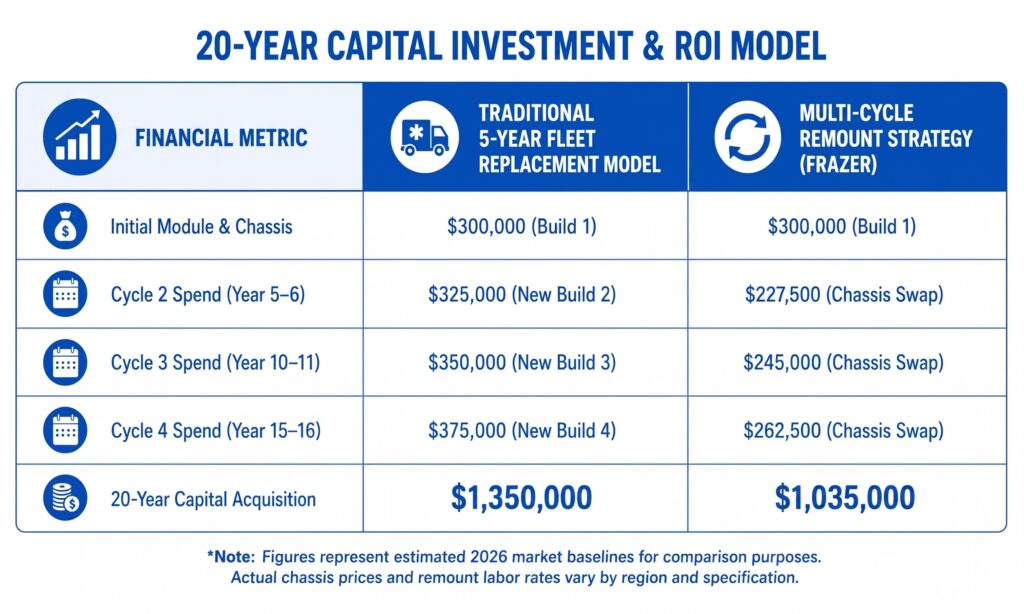
A Multi-Cycle Remount Strategy
Separating primary module systems from the chassis can also support a remount strategy. When a chassis reaches the end of its useful fleet life, an eligible Frazer module may be moved to a replacement cab and chassis if its condition, fleet requirements, and applicable standards support another service cycle.
Frazer customers have used this approach over long service periods. Houston Fire Department operates more than 120 Frazer units, and Marble Falls Area EMS has remounted units dating back to 1996. Frazer has documented modules with 15 to 20+ years of service and more than 1,000,000 cumulative miles.
Customer-reported fleet data has associated decoupled power and planned remounting with overall maintenance cost reductions ranging from 42% to 60%. In a separate independent, double-blind study conducted by Smart Advantage, 39% of industry respondents identified Frazer as the brand spending the least amount of time in the shop, compared with 7% for the next nearest competitor. These figures should be considered alongside each fleet’s operating conditions, maintenance program, vehicle configuration, and replacement strategy.
7. California Clean-Fleet Planning
California municipalities continue to work toward regional clean-air and greenhouse-gas goals. For fleet leaders, reducing unnecessary stationary chassis operation can be one practical step while they evaluate longer-term vehicle and power options.
Reducing Chassis Run Time on Hospital Ramps
Fully electric heavy commercial vehicles can bring unique operating questions for emergency services, including unpredictable call volume, extended staging, charging availability, and regional power interruptions. Independent auxiliary power offers another way to reduce chassis engine use during hospital offload delays by shifting applicable module loads to a smaller auxiliary generator or, where available, shore power.
The actual emissions impact will vary by operating time, equipment configuration, fuel source, and shore-power access. The practical goal is to give departments more options for supporting patient-compartment systems without automatically relying on the propulsion engine whenever the vehicle is parked.
Frazer’s Strategic Partnership with Harbinger
Frazer continues to invest in lower-emission commercial platforms. On March 25, 2026, Frazer announced a strategic development partnership with Harbinger to develop next-generation plug-in hybrid commercial chassis for emergency medical and mobile healthcare applications.
The collaboration is intended to combine hybrid drivetrain efficiency and extended operating range with the durability and independent-power capabilities required by emergency fleets. As development continues, the goal is to give departments more choices as they plan for changing operational and emissions requirements.
8. Taking More Control of Fleet Uptime and Lifecycle
Long periods of stationary chassis operation can add engine hours and may contribute to DPF regeneration needs, aftertreatment maintenance, and drivetrain wear. These concerns become more important when the propulsion engine is also expected to support climate control and electrical loads while the vehicle is parked.
Independent module power gives fleets another option. By separating primary module electrical loads from the chassis, departments can reduce reliance on the propulsion engine during stationary operations, limit some aftermarket chassis electrical modifications, maintain cooling when independent power is available, and support a longer-term remount strategy.
Evaluate Your Fleet’s Idle-Reduction Opportunities
Extended staging does not always have to mean extended chassis-engine run time. Your Frazer Regional Sales Manager can help you review power options, wiring architecture, and operating needs so you can decide which setup makes sense for your fleet.
Speak with a Frazer Regional Sales Manager
Why does stationary idling cause severe diesel after-treatment failures in emergency vehicles?
Extended stationary idling can keep exhaust temperatures lower than those reached during normal driving or higher-load operation. Depending on the engine, after-treatment system, duty cycle, and operating conditions, lower exhaust temperatures may make passive diesel particulate filter (DPF) regeneration less effective and contribute to soot buildup.
Frequent or extended low-load operation may also contribute to other after-treatment maintenance issues. In some cases, the vehicle may require an active or parked regeneration or may enter a reduced-power condition if the system cannot manage accumulated soot within its operating limits.