How to Keep Your Ambulance Cool in the Summer Heat

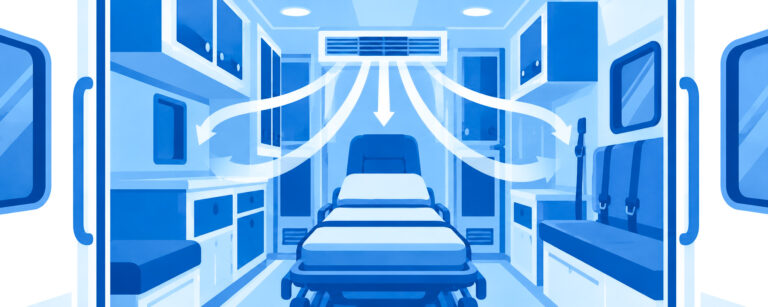
One of the most critical issues to deal with in EMS during the summertime, is the HEAT. As temperatures begin to rise, keeping your ambulance cooled in hotter climates like Texas becomes even more of a challenge.  With traditional ambulances, cooling can be difficult as most air conditioners rely on power provided by the chassis. This means that your chassis needs to be running, and usually set to high-idle in order to run your air conditioner for longer periods of time. This can cause unnecessary stress on the chassis engine and dramatically lower your air conditioner efficiency. The Solution – A Self Contained Air Conditioner A patient compartment that is powered by an independent 120V power source does not rely on the chassis power system and allows for a more powerful, more efficient cooling experience. Here are some of the benefits of having a self contained air conditioner. Maximized CoolingEvery Frazer vehicle comes standard with a self-contained 120V Dometic HVAC system. This 1 ยผ ton air conditioner is mounted in the rear of the patient compartment and delivers more efficient cooling. It features a massive 518CFM fan to blow a ton of air and the forward-facing supply vents ensure your crew and patients are getting maximum cooling at all times. More Money SavedWhen you maximize your cooling efficiency, your air conditioner doesn’t need to work overtime. This leads to more cost savings due to improved fuel consumption and decreased troubleshooting or repairs. Less Wear & TearAnother major benefit of an independently powered A/C is that it won’t put additional stress on your chassis. This can extend the life of your chassis and keep your units on the road longer. Cleaner AirMultiple ventilation options, a particulate filter, and ultraviolet light bulbs all work together to clean and decontaminate the breathable air inside your Frazer unit. Faster Cooling Times It’s important to have vehicles that will cool as quickly as possible, especially when dealing with patients suffering from heat related illness. While loading patients, hot air enters the unit very quickly. The time it takes for the air conditioner to cool back down after the doors have been closed is often referred to as “Recovery Time“. Frazer units have been recorded with recovery times as low as 5 minutes. That’s pretty fast! Idling on Scene – What if You Didn’t Have To? Another thing to think about during the hot summer months is idling on scene. A high-idling chassis can quickly add to the rising temperature on scene. In addition, chassis can often overheat in the summer and cause additional issues. With an independent power source you can easily run your air conditioner without the need of your chassis. This leads to an even higher efficiency of cooling and cuts down on emissions.  Maintenance One of the most effective ways you can keep your A/C cooling in the summer time is maintenance. Staying up-to-date on your preventative maintenance can improve your A/Cs efficiency and increase its overall lifespan. The most important maintenance task that ensures the efficiency of your air conditioner is to routinely replace your air filters. We’ve developed several easy-to-follow maintenance programs and a helpful “How To” video series that will help you get the most out of your Frazers air conditioner. Quick & Easy Repairs We know components can fail over time. Given that fact, we’ve designed your vehicle to be easy to troubleshoot, and repair. Our modular design allows for quick repairs to your A/C unit, the entire unit can even be replaced in under 45 minutes. Service & Warranty Your AAP-Dometic air conditioner/heater comes with a 4 year parts & labor warranty and our service team can help you with any warranty issues you may have. If you are in a situation where your A/C is having issues and you need repairs, schedule an appointment today with our service team! SCHEDULE SERVICE More About Your Frazer Air Conditioner Care & Maintenance of Your Frazer A/CAir Conditioning in Your Ambulance โ€“ A DiscussionWarranty Info

Free Generator and Electrical Classes

Frazer offers free classes to help you operate and maintain your EMS vehicle. Register now for generator and electrical classes. Spots are Limited!

Maintenance Tip of the Week: Re-Torque Air Suspension

Air suspension manufacturers state that certain bolts must be checked and re-torqued at certain intervals based on mileage. Reycoยฎ Granningยฎ air suspension systems have stops that allow slight side movement. Because of the slight movement, re-torquing certain bolts can be necessary and should be checked. Specs and procedures for U-Bolts and front pivot bolts are identified in both your Reycoยฎ Granningยฎ manual and your Frazer Air Suspension Maintenance Manual. Not performing this procedure at the required intervals could cause suspension problems. Here’s a video on basic routine maintenance and inspection for most air suspension systems.

Maintenance Tip: Shore Power

One of the most beneficial aspects of your Frazer is its plug-in feature to supply power for air conditioning, which helps with environmental and drug temperature control, and miscellaneous circuits, off “shore power” (not that you are in a boat). We recommend two things when taking advantage of this benefit. First, it’s best to kill the power when plugging and unplugging it. If you have an easy way to turn off power to the plug — through the breaker at your breaker box, a switch just outside your quarters, or a switch at the cord — then no arc can occur. Second, if you are unable to ensure a dead cable, then try hard to remember to turn off the generator before you plug into shore power. Avoid energizing the shore power if the generator is running. If two sources of power are vying for dominance, “chatter” can occur, depending on how fast you are at plugging, which could result in a stuck relay. Oh, and remember: When you leave the station house, unplug the cable. We don’t want cords hanging as you drive down the road.

Maintenance Tip of the Week: Tire Pressure

Proper air pressure is one of the most important things you can do to promote tire health. Avoid overinflating or underinflating your tires. You can find the chassis manufacturer’s “recommended” tire pressure on your vehicle’s side door jamb. The pressure stamped on your tire is actually the “maximum” pressure. Proper pressure is essential to tire durability. The key word here is “proper” — do not overinflate your tires. If you overinflate substantially, you’re simply asking for trouble. Underinflation can be just as bad as overinflation. Keeping your tire at the proper pressure level ensures a comfortable ride and optimum performance. Use a proper tire gauge to check your tire pressure regularly — at least once a week. Oh, and make sure you’re using a gauge that can read over 100 PSI. When in doubt, go with the manufacturer recommendation on your tire pressure placard.

Maintenance Tip: Adjusting the Valve Lash

If it ain’t broke, don’t fix it. So goes the conventional thinking. If you follow it blindly you may be taking a bigger risk than you realize. We prefer the saying, “If it ain’t broke, let’s keep it that way.” So that’s what we’re going to do with this week’s maintenance tip – show you how to keep your valve lash in tip-top shape. When should you adjust the valve lash in your Onanยฎ 5.5 kw generator? This procedure should be performed every 450 hours or when a noticeable ticking noise is coming from the V-twin engine. This is a nine-step procedure in your Cumminsยฎ Onanยฎ service manual, and it can be performed in 30 minutes. You don’t have to remove your generator to perform this task. Not performing a valve lash adjustment at the required intervals can lead to poor engine performance and/or engine damage. You can learn more about this procedure by watching the video below. For more maintenance tips, check out our service and maintenance videos.

Maintenance Tip of the Week: HVAC AIr Filter

It’s impossible to overstate the merits of preventive maintenance. It boosts efficiency, minimizes downtime, saves money, conserves the life of your emergency vehicle. The list goes on. It’s important to know when to service your equipment and why. So here’s the deal: each week we’ll share some valuable maintenance tips on our blog. Use them freely. This week’s discussion is on changing the HVAC air filter. Changing your air filter is crucial to the air quality and performance of your HVAC system. This routine can vary based on your environment. The dirtier your environment the more often you should replace your filter. Inspect your filter once a week. When to replace? You should change the filter at least every 30 days. You can change it sooner if it gets dirty quicker. Here’s a good rule of thumb: if you cannot see through the air filter, it’s past time to replace. Air gets pulled into the system through the evaporator coils (behind the air filter). If air cannot be pulled in, it will not come out. Basically, the air conditioner will not be able to breathe. It’s like placing a rag over your mouth and trying to breathe in. Signs of a filter in need of replacement? Poor performance or icing of the evaporator coils (due to the restriction). Go forth and replace an air filter. PS: Remember to close the side and rear doors at the scene. Open doors equal dirt, dust, and pollution. For more maintenance tips, check out our service and maintenance videos.

Inventory