
Transverse Loading & Dual Stretchers: Engineering for Critical Care
It started with masking tape on a conference room floor.
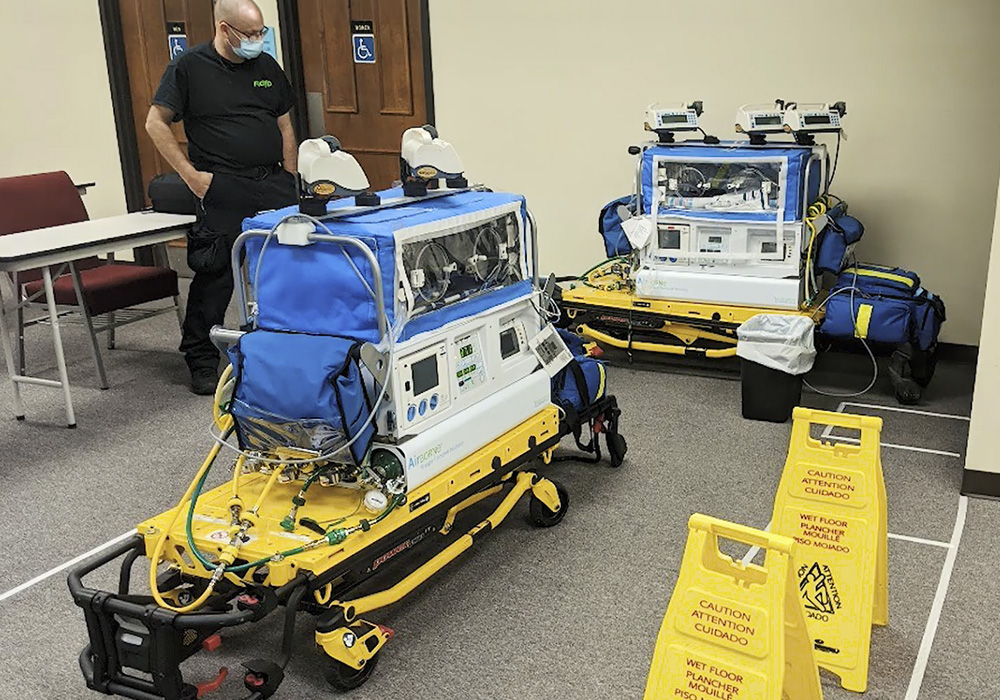
A regional EMS provider’s clinical directors and fleet managers were laying out the space they wanted inside a new critical care vehicle. Their transport teams were handling higher-acuity patients, including neonates who required large Isolette incubators. Their existing vehicles did not provide the space, power layout, or working flow they wanted for that mission.
For some transport programs, a dual stretcher configuration can create more flexibility for inter-facility transfers and other specialized operations. But adding another patient position, a large Isolette, medical equipment, and a larger clinical team changes the engineering requirements. Door openings, load heights, payload, power, seating, and equipment access all need to work together.
Here is how Frazer took Floyd EMS’s taped-out floor plan and turned it into a 15-foot custom critical care vehicle designed around the team’s equipment and workflow.
From Masking Tape to a 15-Foot Critical Care Vehicle
Customization means more than choosing cabinet colors or adding equipment. For a specialized critical care team, it can mean designing the patient compartment around how clinicians actually work.
Smart Advantage research conducted for Frazer found that a manufacturer’s willingness to customize a design to customer preferences was one of the most important factors EMS and fire professionals considered when evaluating a vehicle provider.
Working with sales partner ETA, Frazer used Floyd EMS’s taped floor plan as the starting point for the vehicle. The engineering team then translated those ideas into a buildable 15-foot module, accounting for the crew, patient positions, Isolette dimensions, equipment clearances, power requirements, and chassis capacity.
The goal was not to ask Floyd EMS to fit its clinical process into a standard layout. The goal was to understand how the team wanted to work and engineer the vehicle around those requirements wherever practical.
How Can a Dual Stretcher Layout Expand Transport Options?
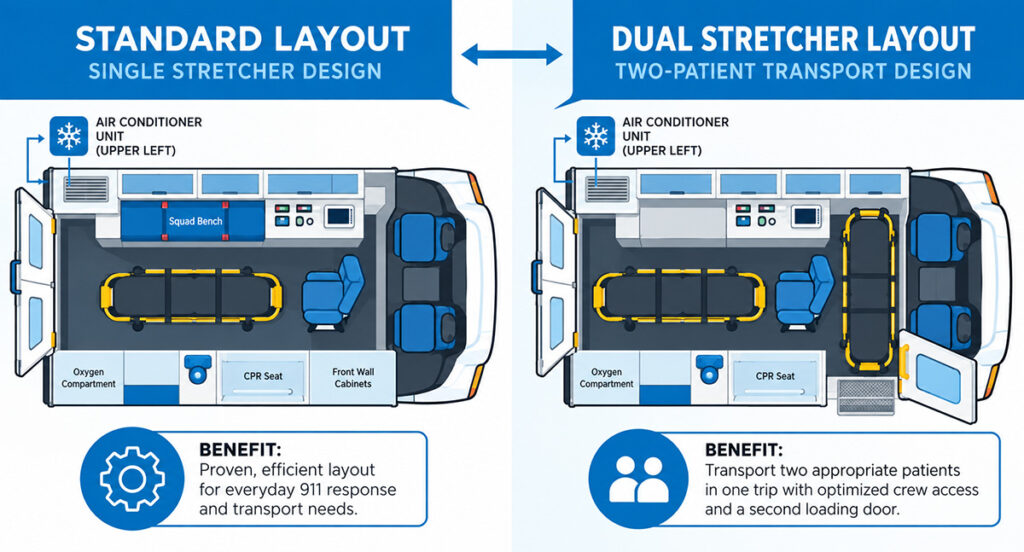
A custom dual stretcher layout can give an agency the option to carry two patients, or an Isolette and a standard stretcher, within the same 15-foot module when protocols and operating requirements allow.
For appropriate inter-facility transfers or mass-casualty operations, that additional position can give a department more flexibility in how it uses its fleet. The challenge is creating that capacity without taking away the working room clinicians need around the patient.
Why This Critical Care Build Uses an F-650
Payload becomes an important part of the conversation when a department is planning a larger module with two patient positions and specialty equipment. The chassis has to account for the completed module, crew, patients, medical equipment, fluids, supplies, and other items carried during normal operation.
For Floyd EMS, Frazer built the 15-foot module on a 2022 Ford F-650 Crew Cab. The chassis was selected around the expected weight and configuration of the completed vehicle.
A neonatal transport team may include a medic and several critical care clinicians. Add a 300-plus-pound Isolette, another stretcher, medical equipment, and the module itself, and the payload requirements can increase quickly.
What this means in the field: The medium-duty F-650 provides the Gross Vehicle Weight Rating, or GVWR, needed for the anticipated demands of this configuration. Selecting the chassis around the completed mission helps the crew carry the people and equipment they need while operating within the vehicle’s rated limits.
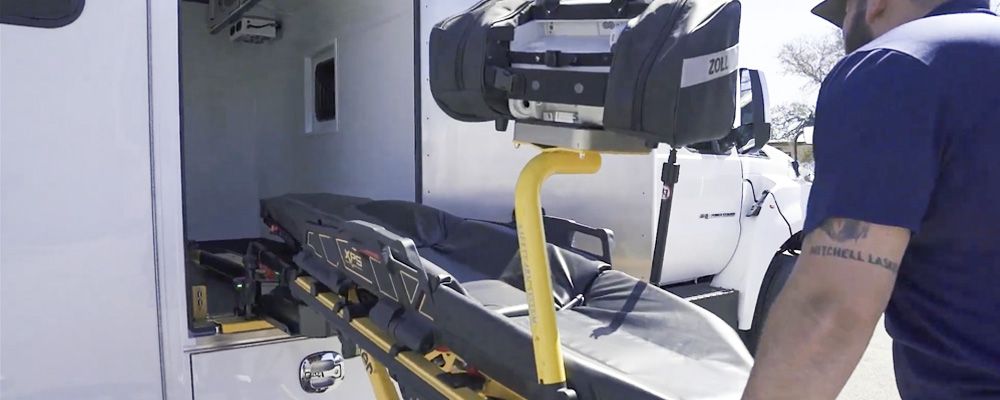
What Load Height Is Needed for a Transverse Stretcher?
Loading a stretcher or Isolette through a transverse side door requires close attention to floor height, door clearance, and the equipment’s loading geometry. On the Floyd EMS build, Frazer engineered the transverse loading area at approximately 33-34 inches.
The goal was to create a transition that worked with the compatible power stretcher and Isolette equipment identified for the vehicle, including equipment with loading heights of up to approximately 37 inches.
Engineering the Door Around the Equipment
Before building a custom side-loading configuration, there are practical questions to answer. Will the Isolette clear the opening? Is there enough room around equipment mounted to its sides? Will the floor height work with the crew’s loading process?
Floyd EMS provided Frazer with the dimensions of its Isolette, including equipment extending from both sides. Frazer used those measurements to engineer the side door opening and nearby upper cabinet clearances.
The transverse entrance also includes a custom transition plate designed around compatible power-loading equipment. With the floor height at approximately 33-34 inches, the transition is intended to help crews move compatible equipment across the threshold more smoothly.
If the primary power-load equipment cannot be used, the transition plate can also fold down to provide another way to move a compatible stretcher into the module.
Why Does Redundant Power Matter in Neonatal Transport?
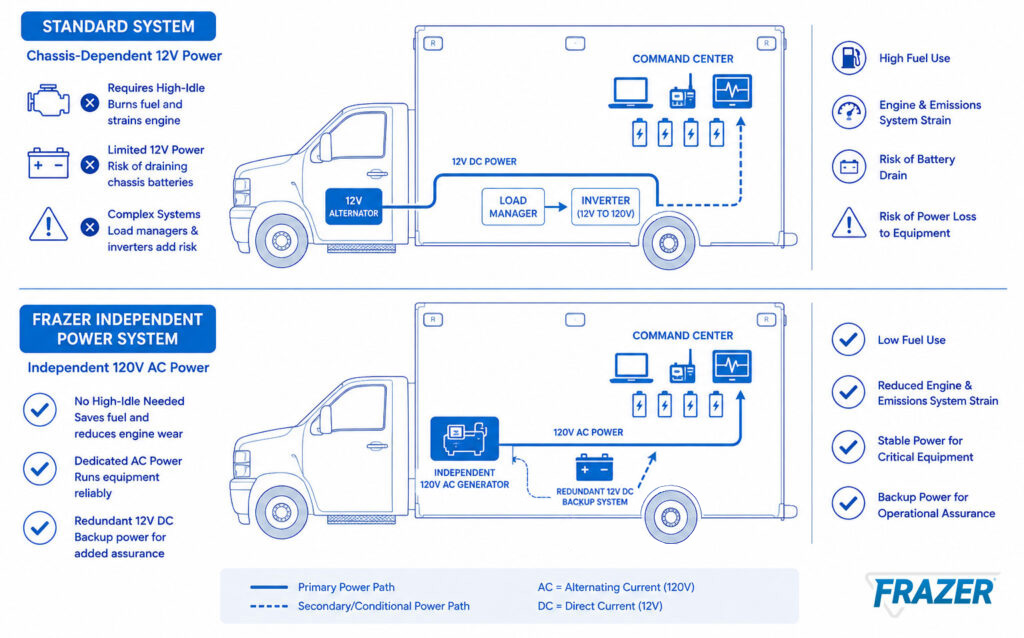
Critical care teams may depend on electrical power for equipment such as incubators, ventilators, monitors, and other devices. On a long inter-facility transport, having more than one available power source can give the crew additional options if one source becomes unavailable.
For the Floyd EMS vehicle, Frazer incorporated three power paths: a chassis-independent Cummins Onan generator, a 120V 1500W inverter, and the vehicle’s 12V electrical system.
Multiple Power Options for the Patient Module
The Cummins Onan generator supplies 120V AC power for compatible medical equipment and the module’s 15,000 BTU air-conditioning system. Because it operates independently of the Ford F-650 chassis, the module does not have to rely solely on the chassis engine for this source of electrical power.
The 1500W inverter provides another source of 120V power for compatible equipment while the vehicle is operating. Frazer’s standard 12V system provides an additional electrical path for compatible 12V accessories and module lighting.
What this means in the field: Instead of depending on a single source, the crew has several available power options for compatible systems and equipment. Frazer also uses straightforward point-to-point wiring rather than relying on a complicated multiplexed electrical architecture, which can make troubleshooting and service more direct.
Designing the Interior Around the Clinical Team
A critical care interior has to do more than hold equipment. Clinicians need to reach the patient, supplies, oxygen, medical air, and electrical connections while working within the vehicle’s seating and restraint systems.
Frazer addressed those needs in the Floyd EMS build with a sliding clinical seat, carefully placed utilities, and retention hardware selected for the application.
The primary clinical position uses a United Safety sliding captain’s chair with a four-point retractor harness. The seat can slide and swivel between the head of the standard stretcher and the transverse Isolette position. The retractor-style harness allows the clinician to lean and shift within the restraint system’s intended range of movement while accessing the patient and nearby equipment.
Frazer also placed 120V power, inverter-supplied power identified by red outlets, oxygen, and medical air directly above both Isolette locations. Putting these connections close to the equipment helps reduce unnecessary cord and hose routing through the working area.
Air Quality and HVAC for the Patient Compartment
Transporting vulnerable patients can also put additional focus on patient-compartment air quality and HVAC design.
The Floyd EMS unit includes a Sentinel clean-air system that uses NBPI technology to treat air in the patient compartment. The module also has a chassis-independent 115VAC air-conditioning system with no shared ductwork between the patient module and the driver’s cab.
This configuration keeps the patient-compartment HVAC system separate from the front cab and gives the critical care team a dedicated climate-control system for the clinical space.
Build Around the Mission, Not a Template
Specialized transport programs do not always fit neatly into a standard vehicle layout. A department may need more payload capacity, a different loading approach, additional power options, or a patient-compartment configuration built around specific equipment.
Those are the projects where early collaboration matters. Frazer works with customers to understand the equipment, workflow, clearances, and operating requirements before turning those needs into an engineered vehicle configuration.
That support also continues after delivery. Smart Advantage research identified support after the sale as the top service-related factor customers consider when evaluating a provider. At Frazer, the relationship is designed to continue throughout the life of the vehicle, with direct access to people who understand how the unit was built.
For Floyd EMS, the process began with masking tape on a conference room floor. From there, the team worked through chassis capacity, loading heights, equipment clearances, power requirements, seating, and clinical access until that idea became a working critical care vehicle.
If your transport team has a similar challenge, whether that means a dual stretcher layout, a neonatal transport configuration, or another specialized mobile healthcare application, Frazer can help you work through the requirements and develop a vehicle around your mission.
Let’s talk about your custom build today.
How does a dual stretcher EMS vehicle layout improve capacity?
A custom critical care dual stretcher layout can allow an agency to transport two patients, or an Isolette and a standard stretcher, in a single 15-foot module, depending on operational requirements and applicable protocols. For appropriate inter-facility transfers or mass-casualty response, this configuration can expand transport options and help preserve other fleet resources while maintaining dedicated clinical workspace.