
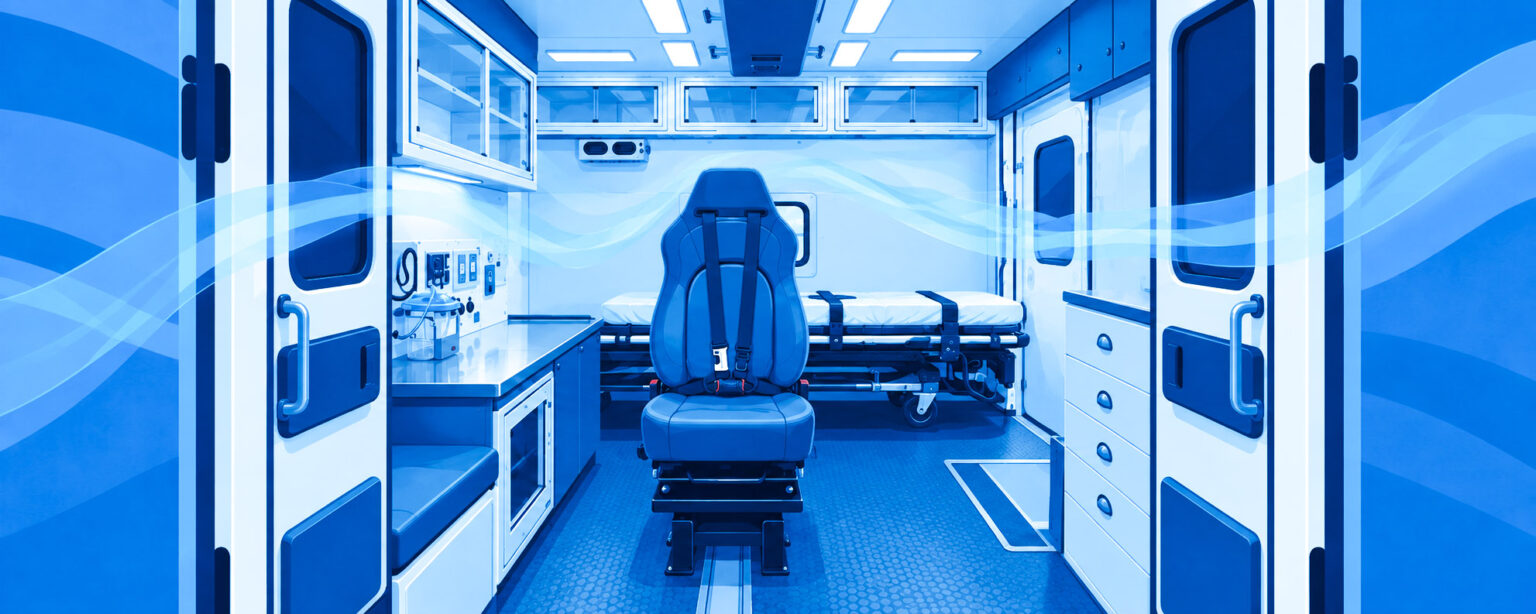
The Dual Stretcher Dilemma: Supporting High-Capacity EMS with Independent HVAC
You just won a major inter-facility transport contract. That is good news, but running back-to-back dual-stretcher transports in July can put more demand on your vehicle’s climate-control system. If units spend more time in the maintenance bay for A/C repairs or crews struggle to keep the module comfortable, fleet availability and daily operations can suffer.
A dual-stretcher configuration can help agencies increase transport capacity while preserving 911 fleet resources. It also means more patients, more crew members, and more equipment inside the module, all of which can add heat. In a double-blind industry study, 76% of surveyed professionals cited HVAC and EMS vehicle air filtration as the #1 safety feature influencing their vehicle selection.
That raises an important question: How do you keep a high-capacity patient compartment comfortable without putting even more demand on the chassis? One option is to move beyond a traditional 12V OEM cooling loop and use chassis-independent HVAC powered by a 115VAC system.
The Reality of Multi-Patient Heat Loads
A common concern we hear from EMS Operations Directors is simple: “We can’t keep our dual units cool enough in the summer. It’s just too many bodies in a small space.”
That concern makes sense. Two patients, multiple crew members, medical equipment, and frequent door openings can create a significant heat load. The HVAC configuration plays an important role in how quickly the patient compartment can respond. When module climate control relies on the chassis cooling loop, recovering after the rear doors open may take longer, which can affect crew comfort and conditions for temperature-sensitive medical cargo.
Frazer addresses these demands with a 15,000 BTU self-contained HVAC unit. The system is designed to cool the patient compartment and maintain a minimum cooling differential of 25 to 30 degrees. It can also maintain a 35°F or greater difference between outside and inside temperatures under specified operating conditions, including severe summer conditions with multiple occupants.
“Our winter put to rest any concerns regarding staying warm in a Frazer. And the A/C unit in the summer rocks. We have been between 95° and 100° many days… Good job and thanks for leading us in the right direction.” – Altoona Fire Department
Why Consider Independent Generator Power for a Dual-Stretcher EMS Vehicle?
Independent power gives the module HVAC its own source of energy instead of relying on a standard 12V OEM cooling loop for the primary patient-compartment cooling load. A 115VAC independent power system can run a 15,000 BTU A/C unit while reducing the HVAC demand placed on the truck’s chassis systems.
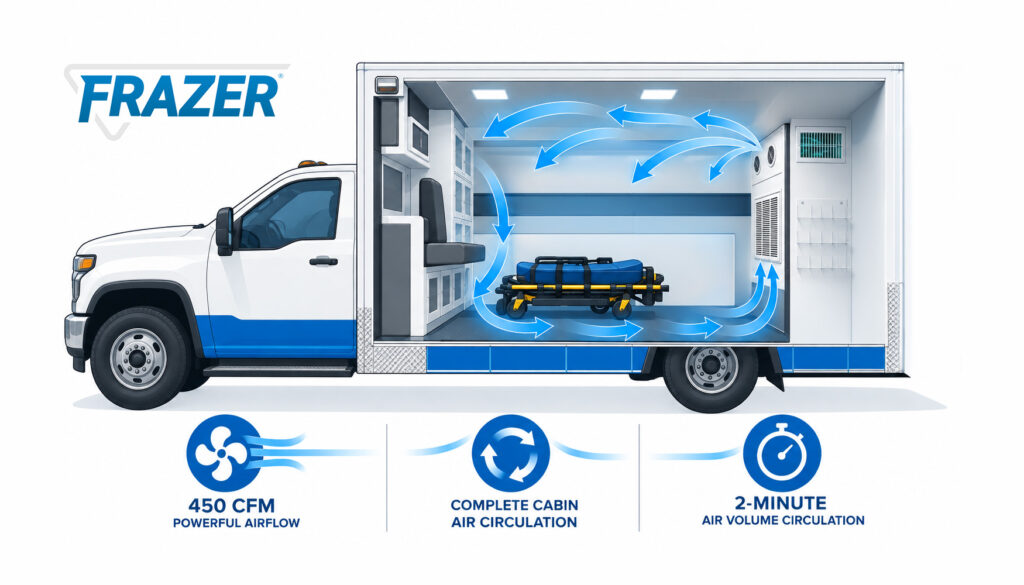
This separation can be especially useful during long inter-facility transports or other high-capacity operations. The system is designed to provide high-volume airflow and recirculate the air in the module every two minutes, helping maintain consistent air movement while crews are working.
Why Air-System Separation Matters for Infection-Control Planning
High-capacity transport also raises questions about the patient-care environment. Safety officers may ask, “How do we manage infection-control concerns when transporting two critical patients in one module?”
There is no single feature that replaces an agency’s infection-control procedures. Filtration, cleaning, PPE, clinical protocols, and vehicle design can all play a role. For agencies evaluating their options, separating the module’s airflow from the cab can provide another layer of environmental control.
Some vehicle configurations use passive filters, physical barriers, or other methods to manage airflow. When the cab and patient compartment share ductwork or air-handling components, airflow between those spaces may also be an important consideration during the specification process.
How Can Chassis-Independent HVAC Support Airflow Separation?
A chassis-independent HVAC system can support airflow separation by giving the medical module its own air-handling system. The patient compartment does not share HVAC ducting or air handling with the driver’s cab, helping limit shared airflow between the two spaces.
In practical terms, the cab has its system and the patient compartment has its own. That separation gives agencies another factor to consider when planning the patient-care environment.
What Is the Difference Between Active and Passive Air Filtration?
Passive air filtration uses physical filter media to capture airborne particles as air moves through the system. Active air-purification technologies use additional methods to address certain airborne contaminants. Their effectiveness can vary based on the technology, system configuration, maintenance, operating conditions, and the contaminants involved.
For Medical Directors and fleet teams evaluating vehicles for patient transport, filtration should be considered as part of a broader air-management strategy. Physical filters capture particles within the filter media, while active technologies provide an additional method of treating air as it circulates through the system.
Frazer’s available air-filtration systems are designed for mobile clinical environments. Depending on the selected configuration, the HVAC system can pair physical media filtration with active air-treatment technology. Available options include the Dometic BreatheEasy Ionizer package and the Sentinel clean air system. These technologies are designed to address certain pathogens, odors, and particulates as part of the module’s overall air-management system.
What Does Independent Power Mean for Long-Term Fleet Costs?
Even when an agency sees the operational benefits of a 15,000 BTU independent HVAC system, the budget team may still have a fair question: “Can we justify the upfront cost of a custom generator-powered dual-stretcher unit?”
Purchase price matters, but it is only one part of the ownership picture. Chassis replacement, engine wear, maintenance, downtime, and the ability to remount a module can also affect long-term fleet costs. Using the truck engine to support additional HVAC demands during high-idle, dual-patient transports can add operating load to chassis systems over time.
In a Frazer configuration, the truck engine drives the truck while a Cummins Onan generator or an alternative MEPS/hPower solution supplies power to the module. Separating these systems is designed to reduce HVAC-related demand on the chassis while supporting serviceability. In fact, in the 2020 Double-Blind Industry Survey, 39% of surveyed industry professionals cited Frazer as the brand that spends the least amount of time in the shop.
Remounting can also be part of the long-term ownership equation. Instead of replacing the module every time a chassis reaches the end of its service life, an eligible Frazer module can be moved to a replacement chassis. Agencies such as the Houston Fire Department have seen modules surpass 260,000 miles per chassis and have remounted modules as many as four times, resulting in more than 1,000,000 miles of cumulative service. For agencies planning around long-term capital assets, that ability can change how they evaluate the cost of a vehicle over its full service life.
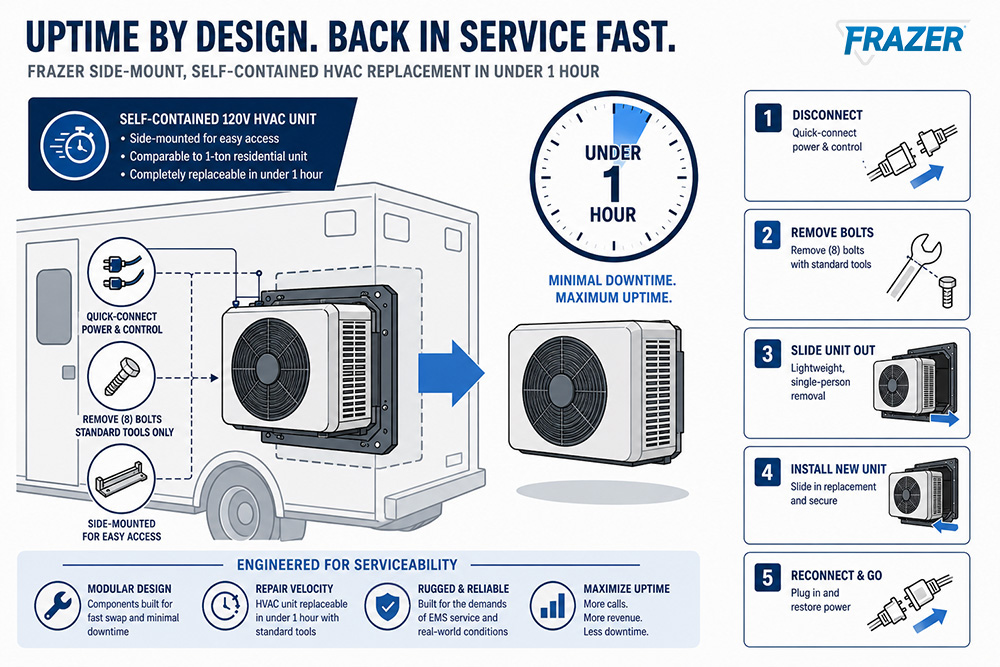
Serviceability matters, too. The electrical design uses point-to-point wiring and standard automotive relays rather than relying entirely on proprietary multiplex boards. That approach can make many routine maintenance tasks more straightforward for qualified service teams. Air-filtration components, including Dometic physical filters (Part No. 35901) and active UV bulbs, are also designed for field replacement without special factory tools.
What Should You Look for in a High-Capacity HVAC System?
If your agency is preparing an RFP for a dual-stretcher or other high-capacity transport vehicle, start with the way the unit will actually be used. Think about summer temperatures, trip length, patient load, crew size, maintenance resources, and your agency’s air-management requirements. Those answers can help you determine which specifications belong in the bid.
Chassis-independent power may be worth considering if you want a dedicated 115VAC generator or power system that moves the primary module HVAC electrical demand away from the OEM truck system. For high-capacity cooling, consider whether a self-contained 15,000 BTU system is appropriate for the thermal load created by two patients and a full crew.
Air movement matters as well. A system designed to recirculate module air every two minutes can support continuous circulation during long transports. Agencies may also want physical separation between module ductwork and the driver’s cab to limit shared airflow between those spaces.
Finally, consider whether active air-treatment technology belongs in your specification. Depending on your agency’s needs, technologies such as NBPI or UV-based purification may supplement passive filtration as part of a broader air-management strategy.
Ready to Expand Your Transport Capacity?
There is no single configuration that fits every fleet. Transport volume, budget, climate, maintenance resources, patient-care requirements, and long-term fleet plans all matter. A dual-stretcher configuration with independent HVAC gives agencies another way to address those needs while reducing reliance on chassis-powered module climate control.
Talk with the Frazer team about dual-stretcher layouts, independent HVAC options, and current build timelines. We can help you work through the requirements and determine which mobile healthcare configuration makes sense for your fleet.
Why consider independent generator power for a dual-stretcher EMS vehicle?
A dual-stretcher configuration can create greater HVAC demand because more patients, crew members, and equipment add heat to the module. An independent 115VAC power system can run a 15,000 BTU A/C unit while reducing the HVAC demand placed on the truck’s chassis systems.