The Complete Guide to Dual Stretcher EMS Vehicles
You know the scenario. A call comes in for two stable patients who need an inter-facility transfer to a hospital an hour away. Moving them separately may mean sending two vehicles and two full crews down the highway. If another 911 call comes in, your service area may suddenly have fewer resources available to respond.
Staffing challenges and growing fleet demands are pushing EMS leaders to find practical ways to make better use of the resources they already have. Sending two vehicles to the same destination can add operating costs, mileage, and wear while taking units away from other calls.
A multi-patient solution does not have to mean a large specialty vehicle that spends most of its time waiting for a major incident. A customized Type I or Type III EMS vehicle can be designed to support two-patient transport while still serving an agency’s day-to-day needs.
In this guide, we’ll look at how a custom-engineered dual stretcher EMS vehicle can expand transport capacity and what agencies should consider when planning for the additional electrical, climate-control, equipment, and workspace demands that come with transporting two patients.
When Does a Dual Stretcher EMS Vehicle Make Sense?
One of the first questions fleet managers and budget approvers may ask is simple: Will we use it enough to justify it? When configured around an agency’s actual needs, a dual stretcher EMS vehicle can support several types of everyday operations in addition to multi-patient response.
Rural and High-Mileage Areas
When the nearest definitive care facility is an hour or more away, sending two primary units to the same incident can leave fewer resources available across the county. When patient conditions, staffing, and protocols allow, a dual stretcher setup can transport two appropriate patients in one trip. Consolidating those long-distance transports may help keep another 911 resource available within the district.
Inter-Facility Transfers (IFTs)
Inter-facility transfers are a routine but resource-intensive part of the job for private EMS providers and hospital networks. Moving stable patients between hospitals, nursing homes, and specialty clinics can require significant vehicle and staffing resources.
When appropriate, a dual stretcher EMS vehicle can allow providers to combine transfers into a single trip. That can help improve fleet utilization while potentially reducing mileage and wear on other vehicles.
Mass Casualty Incidents (MCIs) and Event Standbys
Large public events, sporting events, and multi-casualty incidents can quickly create demand for additional transport capacity. Depending on patient condition, staffing, protocols, and incident requirements, a dual stretcher unit can provide another option for transporting two appropriate patients in one vehicle.
How Do You Power Two Critical Care Setups in One EMS Vehicle?
Supporting equipment for two critical-care patients can create substantial electrical demand. Two ventilators, two cardiac monitors, multiple IV pumps, and additional climate-control needs can add up quickly. Depending on the chassis, equipment, and configuration, relying primarily on the chassis electrical system may place additional demands on that system.
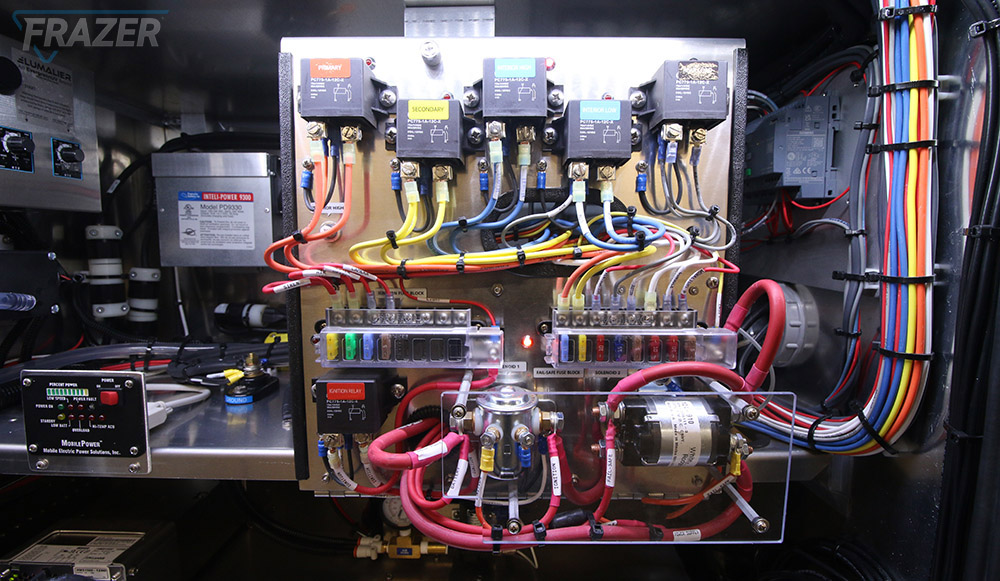
That makes electrical capacity an important part of planning a dual stretcher vehicle. Frazer offers independent power options, including Mobile Electric Power Solutions (MEPS) and Cummins Onan generators. These systems are designed to generate 120V AC power separately from the vehicle’s primary chassis electrical system.
In practical terms, an independent power configuration can help keep supported medical equipment and module air conditioning operating if chassis power becomes unavailable, depending on the vehicle configuration and operating condition of the independent system. Frazer pairs this approach with a standard 12V DC chassis fail-safe to provide additional power-system redundancy for the clinical environment.
Instead of relying heavily on proprietary multiplex computer boards, Frazer uses point-to-point wiring, standard automotive relays, and accessible terminal strips. The goal is simple: make many electrical components easier for fleet technicians to access, diagnose, and service using commonly available tools and parts.
The Engineering Behind the Interior Layout
Another common question is about space: Will a standard Type I or Type III module feel too cramped with two patients inside? The answer depends heavily on the layout.
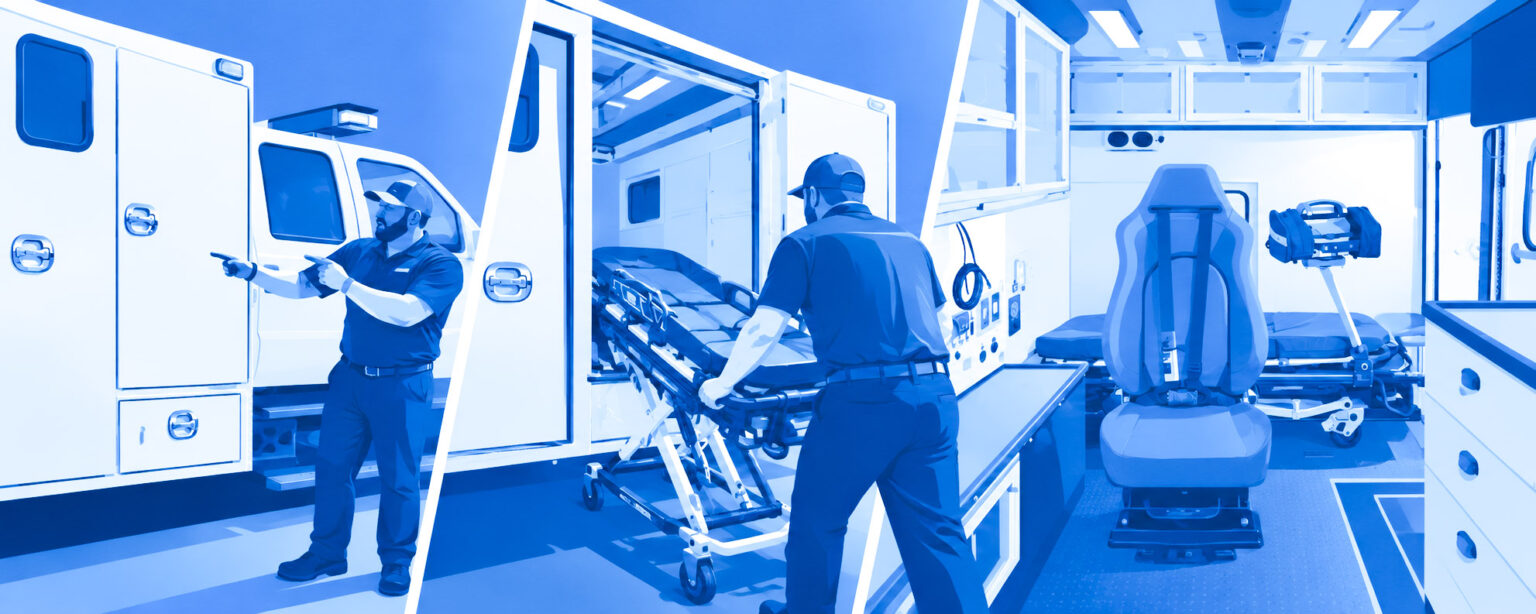
A dual stretcher EMS vehicle is more than a standard module with another cot position added. The design needs to account for patient placement, crew movement, seating, equipment access, regional protocols, and how the agency plans to use the vehicle.
At Frazer, that process starts by listening to the people who will actually work in the vehicle. When designing a custom 15-foot Type I dual stretcher unit for Floyd EMS, a specialized neonatal and critical care transport team, the collaboration began with their team laying masking tape on a conference room floor. Together, they mapped out where nurses and medics needed to sit, reach, and work.
That hands-on approach helps shape the workspace around the crew instead of asking the crew to adapt to the workspace. Strategic cabinetry, including SAE-certified Austin Hardware sliding doors, can help preserve aisle space because the doors do not swing outward. Oxygen ports, breathing air, and 120V outlets can also be positioned overhead or centrally so clinicians can reach needed connections from either patient’s side while limiting unnecessary movement around equipment.
The goal is not to fit as much as possible into the module. It is to create a practical clinical workspace that supports the crew, the patients, and the way the vehicle will actually be used.
Can Medics Treat Two Patients While Remaining Buckled In?
Thoughtful ergonomic design can help clinicians reach patients and equipment while using available restraint systems. Configurations may include 4-point retracting harnesses, such as Valor seating, along with SAE-certified cabinetry positioned within reach. The actual range of movement depends on the seating position, equipment placement, vehicle configuration, patient needs, and applicable operating protocols.
Two-patient transport can also mean more medical equipment inside the module. For medics, fleet leaders, and risk managers, occupant restraint and equipment retention are important considerations when planning for sudden stops, evasive maneuvers, and collisions.
Frazer uses all-aluminum, wood-free module construction designed with structural integrity and equipment retention in mind. Across more than 4,500 EMS modules built since 1984, Frazer has zero recorded module detachments in collisions.
Equipment retention receives the same attention. As part of work related to SAE J3043 safety standards for Frazer Mobile Stroke Units, heavy equipment mounts were voluntarily pull-tested beyond 50,000 pounds of force with zero damage. Frazer applies a similar engineering approach when designing stretcher and equipment mounting systems for dual stretcher units.
For crew seating, Frazer can integrate restraint systems such as Valor seating with integrated 4-point retracting harnesses. These systems are designed to provide movement at the shoulders and hips, helping medics reach patients and essential equipment while remaining restrained. Available movement and access will depend on the specific interior configuration and proper use of the restraint system.
How Do You Keep Multiple Patients Cool?
Two patients, two medics, and possibly a specialized transport nurse can create substantial heat inside an EMS module, especially during hot-weather operations. Add heat-producing medical equipment, and climate control becomes an important part of the vehicle’s design.
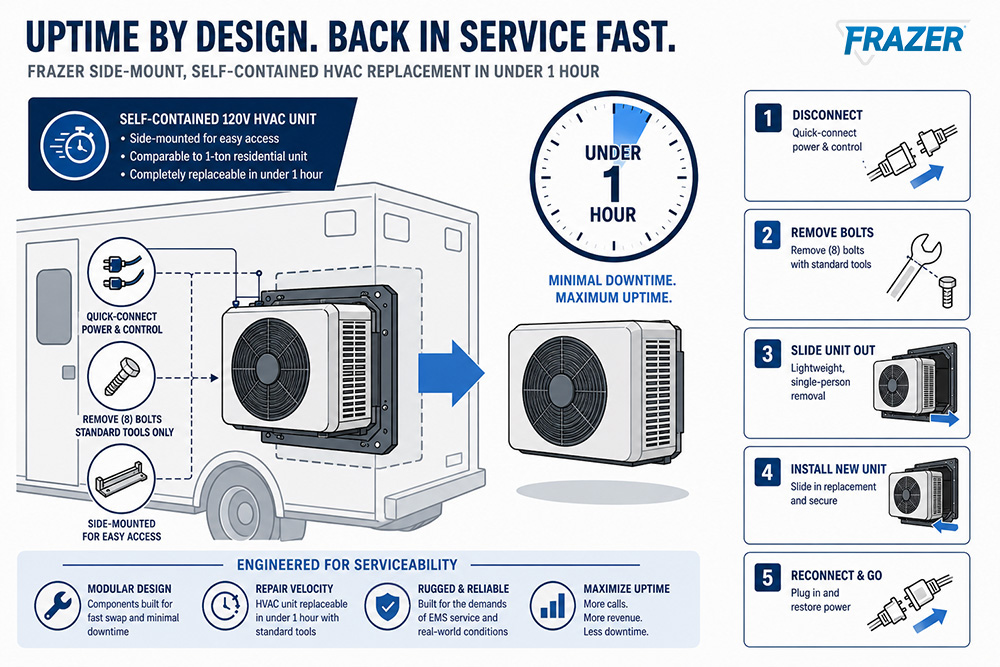
Frazer’s independent HVAC approach is designed to address those demands. A heavy-duty 115VAC air-conditioning system rated at 15,000 BTUs can cool the patient module separately from a chassis-driven air-conditioning system. Because the system uses an independent power source, it does not rely solely on a chassis-driven compressor.
The system is designed to move a high volume of conditioned air and recirculate the air in the module every two minutes. It is also designed to provide a minimum cooling differential of 25 to 30 degrees from the outside temperature. That configuration is intended to support climate control across a range of operating conditions, including highway travel and extended time at a scene.
The patient-compartment HVAC system also does not share ducting with the truck cab. That separation between module and cab airflow may be useful for certain transport applications.
Reducing Fleet Demands: The Potential ROI of a Dual Stretcher EMS Vehicle
For EMS directors, fire chiefs, VPs of Operations, and other decision-makers, the value of a dual stretcher EMS vehicle depends on more than its purchase price. The bigger question is how the vehicle will be used and how it fits into the organization’s overall fleet strategy.
Two factors worth considering are utilization and Lowest Overall Cost of Ownership (LOCO).
First, combining appropriate inter-facility transfers or rural transports can reduce the number of vehicle trips needed for certain patient movements. Depending on staffing, routing, patient condition, and operating protocols, that may help reduce fuel use, mileage, and wear on other vehicles while making better use of available fleet resources. For private operations, additional transport capacity may also support revenue-producing services. For municipal agencies, it may help keep other vehicles available for response needs.
Second, Frazer custom modules use robust, all-aluminum framing and independent power systems, and they are designed with remounting in mind. When an eligible truck chassis reaches the end of its useful service period, remounting may allow an agency to move its existing customized patient module onto a new compatible chassis instead of replacing the entire vehicle. Depending on the module, chassis, refurbishment needs, and configuration, remounting can provide another option when planning future fleet purchases.
Many Frazer modules have been remounted up to four times, with some seeing more than 1 million miles of service and lasting up to 20 years.
Maintenance history is another part of the long-term cost conversation. In a double-blind survey of 100 EMS and Fire professionals, Frazer received 39% of all mentions when respondents were asked which brand spends the least amount of time in the shop. Frazer designs its vehicles with serviceability and field use in mind, with the goal of helping agencies keep vehicles available for the work they need to do.
Is a Dual Stretcher EMS Vehicle Right for Your Fleet?
Fleet availability is a complex challenge, and there is no single configuration that works for every department. For the right operation, a custom-engineered dual stretcher EMS vehicle with independent power, heavy-duty HVAC, and an interior designed around crew and patient access can provide another way to increase transport capacity while making thoughtful use of available fleet resources.
The right configuration starts with understanding how your team works. Frazer can help you plan a custom interior around your transport protocols, equipment requirements, staffing needs, and regional requirements.
Contact a Frazer EMS Specialist today to talk through your next build and see how a dual stretcher configuration could support your response and transport needs.
How do you power two critical care setups in one ambulance?
Operating equipment for two critical-care patients can create substantial electrical demand. An independent power source, such as a dedicated generator or MEPS system, can provide 120V AC power to the medical module separately from the vehicle’s primary chassis electrical system.