Ambulance Remount Services vs. Buying New: Finding Fleet Value
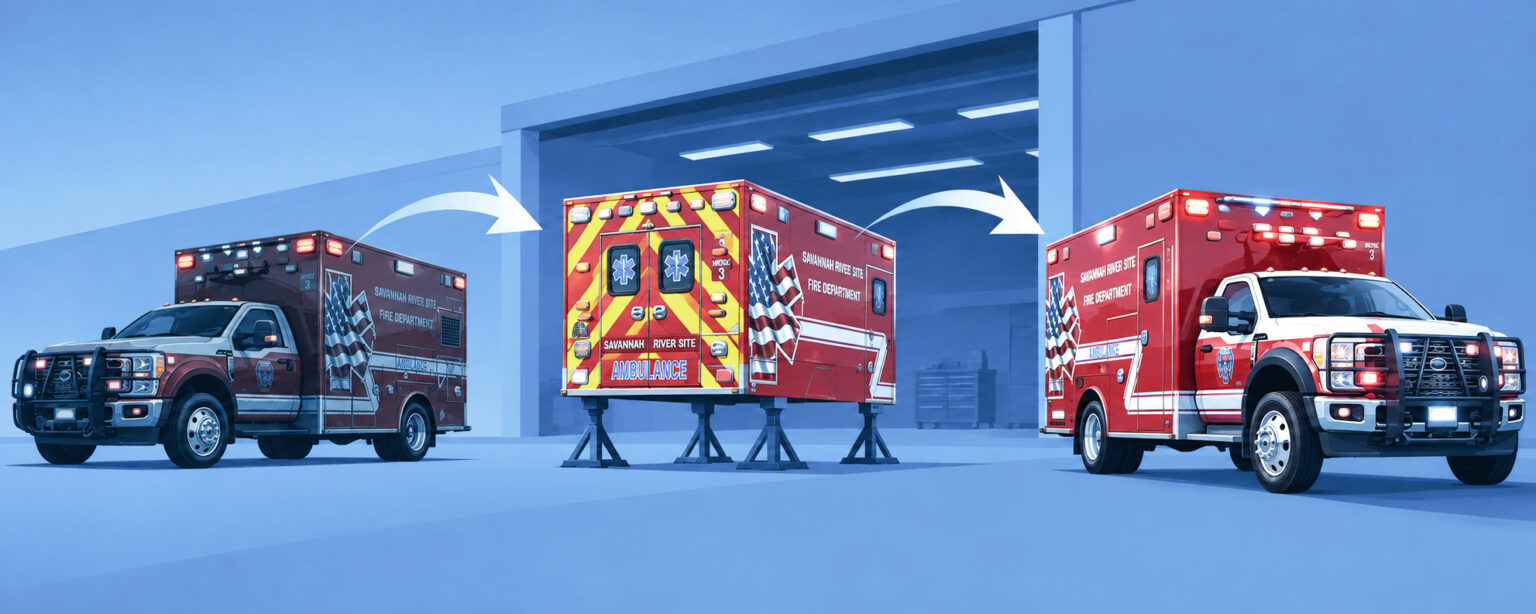
Budget season is approaching. Chassis lead times can change, and your department may need to replace aging, high-mileage vehicles while making the most of its capital budget. Remounting can lower the upfront cost, but price is only part of the decision. Fleet managers and department leaders also need to think about uptime, electrical systems, mechanical condition, service needs, and how long the vehicle needs to stay in service.
This guide gives you a practical framework for deciding when factory-direct ambulance remount services may make sense and when buying new may be the better fit. By looking at the condition of your module, your fleet needs, and the long-term costs, you can make a more informed decision while keeping crew safety and infection control in mind.
When to Remount: How to Evaluate Your EMS Module
Age and chassis mileage do not tell the whole story. The condition of the module matters, too. Before choosing a remount, your department should determine whether the existing module is in good enough condition to be installed on a new chassis.
Look for structural damage, damaged or compromised welds, moisture intrusion, and other signs of wear. These issues can affect whether keeping the existing module makes sense.
The Structural Integrity Check: Aluminum vs. Wood Construction
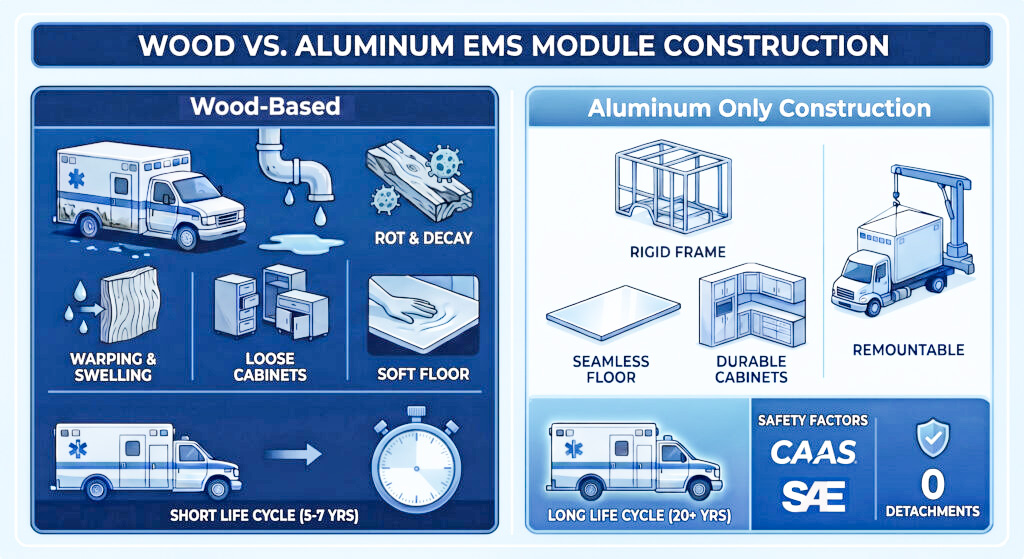
One important factor is how the module was built. Some traditional modules use wood in their subfloors or cabinetry. Over five to ten years of service, wood can be exposed to moisture, biohazards, and other conditions that may cause it to break down. A wood-based module should be carefully inspected before it is considered for a remount.
Frazer builds its patient modules with a 6061-T6 aluminum base frame and a wood-free subfloor. The floor uses a laminated construction with aluminum sheets over a polycarbonate core.
For fleet mechanics, this construction is designed to resist rot, rust, and problems associated with moisture intrusion. It is also designed to handle the vibration and twisting that come with EMS service. If your existing module has this all-aluminum, wood-free construction, it may be a good candidate for a remount, depending on its current condition and inspection results.
The Financial Math: Looking Beyond the Purchase Price
Is it more cost-effective to remount an EMS vehicle or buy new?
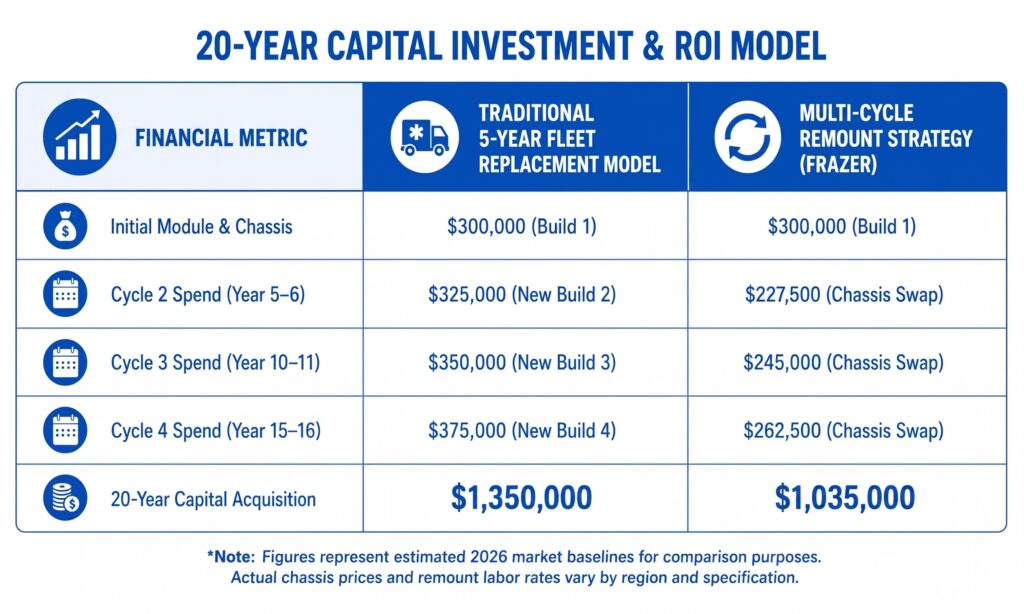
There is no single answer for every fleet. Buying new requires a larger initial investment. A remount can lower that upfront cost by keeping the existing custom module and placing it on a new chassis. The better long-term choice depends on the module’s condition, maintenance needs, chassis replacement cycle, configuration, and expected service life.
For municipal procurement teams and hospital leaders, that difference can have a major impact on capital planning. Instead of looking only at the initial invoice, Frazer encourages customers to consider the Lower Overall Cost of Ownership, or LOCO.
LOCO looks at what a vehicle costs over its useful life, not just what it costs on day one. A module designed to support multiple chassis cycles may allow a department to spread its original investment over many more years of service.
The Houston Fire Department has used Frazer remount services as part of its fleet strategy. In these applications, modules may be remounted three or four times. Some modules can see more than 260,000 miles on each chassis, allowing the module itself to surpass 1,000,000 miles and approach 20 years of service.
Why Experienced Buyers Look Beyond Initial Price
Purchase price matters, especially when a city council, board, or procurement team is working within a set budget. But Frazer’s research suggests that experienced EMS leaders consider much more than the initial bid.
According to Frazer’s independent, double-blind market research study, the Survey Results Presentation 10-30-20, fewer than 25% of respondents initially named price as an important reason for choosing a builder. When respondents were later asked to rate specific attributes, price accounted for 9% of importance.
That finding gives procurement teams another way to look at value. Initial price can be considered alongside uptime, structural life, service, reliability, and the total cost of keeping a vehicle in service.
Upgrading Technology During an EMS Vehicle Remount
Can I upgrade my EMS vehicle’s HVAC and air filtration during a remount?
Yes, depending on the module and configuration. A factory-direct remount gives your department an opportunity to evaluate systems that may need to be updated while keeping the existing module structure when its condition supports reuse.
That can include evaluating independent HVAC systems, physical air filters, and active UV purification components where applicable. It is also an opportunity to look at the patient compartment as a whole and determine whether technology, infection control features, or climate-management systems should change with your department’s needs.
Modernizing HVAC and Active Air Filtration
Frazer’s Survey Results Presentation 10-30-20 found that 76% of respondents identified HVAC and air filtration as the number one safety feature influencing vehicle selection.
During a factory-direct remount, the environmental systems can be evaluated along with the rest of the module. Frazer’s independent 115V AC system is designed to manage patient-compartment climate in demanding conditions. Depending on the vehicle’s configuration and available power system, it can provide cooling without relying on the chassis engine to remain running.
Departments can also evaluate infection control systems during the remount process. Frazer uses the Dometic BreatheEasy active photocatalytic purification system, which combines UV light and filtration technology and is designed to help address airborne contaminants in the patient compartment. The physical air filters, Part No. 35901, and active UV bulbs are field-replaceable so departments can include them in their regular maintenance program.
Factory-Direct Quality and Support After the Sale
Can third-party remount work affect warranty coverage?
It can. Warranty coverage depends on the manufacturer, the work performed, and the terms of the applicable warranty. Certain work performed outside the original builder’s process may affect coverage, so departments should review their warranty terms before authorizing a remount or major modification.
A Frazer factory-direct remount follows Frazer’s engineering and quality-control processes. Frazer factory-direct remounts typically include a renewed two-year warranty on remount module construction, subject to the applicable Frazer Warranty and Service Provisions.
When comparing remount providers, look beyond the work required to move the module to another chassis. Consider how the provider handles engineering, electrical integration, quality control, troubleshooting, warranty questions, and support after delivery. Those details can make a real difference when your vehicle is back in service and your crew depends on it.
Frazer’s survey results reinforces that point. Prospects identified “Few defects” as a leading priority. Decision Makers, including Chiefs and Directors, placed a high priority on “Service Center & Partner Expertise.”
Support After the Sale with a Renewed Module Warranty
A Frazer factory-direct remount follows established engineering, quality-control, and testing processes. Frazer also uses point-to-point electrical wiring without proprietary multiplex nodes. This approach is designed to make diagnosis and maintenance more straightforward for fleet mechanics.
Frazer also provides warranty coverage for its remount work. When you use Frazer’s factory-direct remount services, remounted module construction receives a renewed two-year warranty, subject to the Frazer Warranty and Service Provisions.
That support matters. According to survey respondents, “Support after the sale” ranked as the number one attribute driving vehicle selection.
Working directly with Frazer also gives your department access to the people who know Frazer vehicles. Our team can help with product questions, service needs, maintenance planning, and long-term fleet decisions. The goal is not simply to complete a remount. It is to help your department keep its vehicles working and get more value from its fleet over time.
Could your current fleet be a good fit for a factory-direct remount? Contact the Frazer team to evaluate your modules, discuss HVAC upgrade options, and build a LOCO plan for your next budget cycle.
Is it more cost-effective to remount an ambulance or buy new?
A remount can reduce upfront costs by preserving your existing custom module, while buying new typically requires a larger initial investment. The better long-term value depends on the module’s condition, maintenance needs, chassis replacement cycle, configuration, and expected service life. Frazer looks at this through Lowest Overall Cost of Ownership (LOCO). For an all-aluminum module designed for multiple remount cycles, extending the module’s service life across multiple chassis can significantly change the long-term financial calculation.