
Ambulance Remounting: 3 Structural Red Flags Every Fleet Tech Should Know
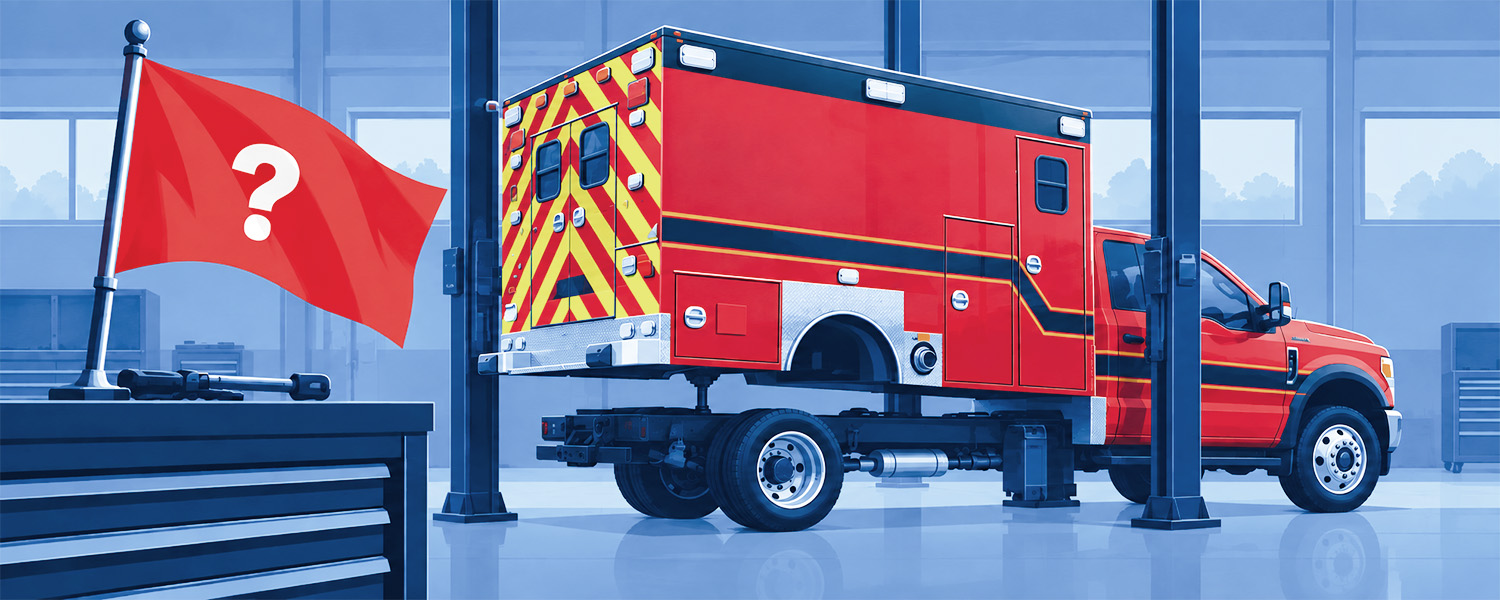
You are looking at a 10-year-old EMS module parked in the bay. Budget season is approaching, and the Fire Chief wants to know if you can put that existing module on a new chassis to help manage the department’s capital budget. On paper, the financial case for ambulance remounting can look appealing. In the shop, though, the physical condition of the module matters just as much as the numbers.
You are the one who has to pull up the floorboards, inspect the welds, and trace the wiring. Remounting an EMS module can create operational challenges if the original module was not designed with long-term service and future remounting in mind. As chassis costs rise and availability changes, extending the life of an existing module through a chassis transfer can be an attractive option. But if that module needs major structural, interior, or electrical work, those repairs can quickly reduce the financial benefits of a remount.
Before you sign off on a chassis transfer, it helps to know what to look for. Three areas deserve particular attention: the floor and interior materials, the electrical system, and the module’s structural foundation. Understanding these areas can help your department make a more informed fleet decision before committing time and money to a remount.
Evaluating Your Fleet: Not All Modules Are Built for a Second Life
Emergency vehicle teams may approach remounting with a simple assumption: “A box is a box. We can put our existing aluminum module on a new truck and save money.” For a fleet mechanic or maintenance director, that assumption can overlook some important differences in how modules are built.
A fresh coat of paint and new diamond plate can make a 10-year-old module look good again, but appearance only tells part of the story. The condition underneath the surface can play a major role in whether a remount makes financial and operational sense. Materials and construction choices made when the module was originally built can affect how well it holds up through years of service and whether it is ready for another chassis.
Thin framing materials, wood components that have been exposed to moisture, or aging proprietary electrical systems can all add cost and complexity to a remount. That is why a thorough inspection matters before making the decision.
Red Flag #1: Why Do Wood Subfloors Matter in EMS Vehicles?
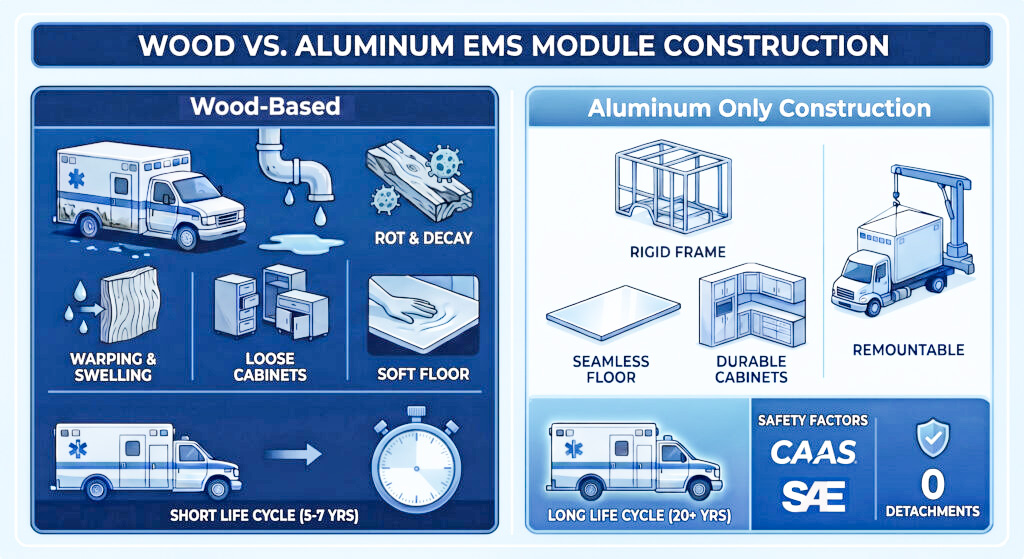
EMS vehicle interiors regularly encounter water, cleaning chemicals, and other fluids. When wood components are repeatedly exposed to moisture, they may be more susceptible to rot, warping, and deterioration. A wood-free design removes that particular concern when a module is evaluated for long-term service and future remounting.
If you have ever gutted the interior of an aging emergency vehicle, you know what deteriorated subfloor materials can mean for a repair. Over seven to ten years of daily service, the patient compartment may be exposed to bodily fluids, spilled saline, rain, and repeated cleaning and decontamination. Bleach and other cleaning chemicals can also find their way through flooring seams and into underlying materials.
Wood can absorb moisture when exposed to it repeatedly. Plywood subfloors and wood-backed cabinetry may eventually experience rot, warping, or other deterioration. For a technician evaluating a module for remounting, a soft or damaged floor should get your attention. If the interior needs extensive reconstruction before it can go back into service, those repairs need to be included in the true cost of the remount.
Frazer takes wood out of the equation in its EMS module construction. Instead of plywood, Frazer builds the patient compartment floor with aluminum sheets laminated over a polycarbonate core. Cabinetry is made from formed aluminum that is powder-coated and mechanically secured to the module structure.
For technicians in the shop, this construction is designed to eliminate maintenance concerns specifically related to wood deterioration. After years of demanding service and repeated cleaning, a module being considered for another chassis can be evaluated without the added concern of hidden wood rot in these components.
Red Flag #2: Why Consider Point-to-Point Wiring for an Ambulance Remount?
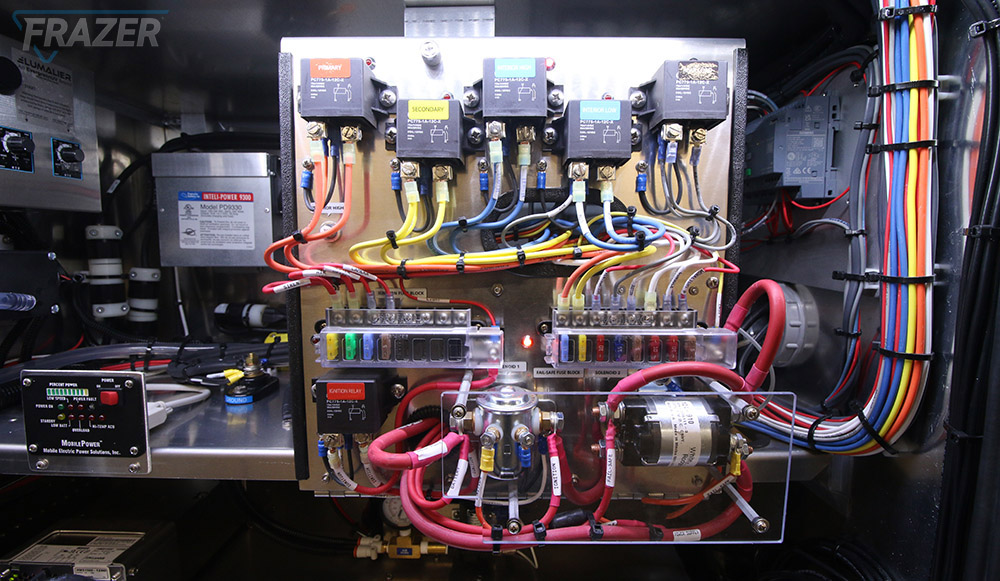
Point-to-point wiring uses standard automotive relays and accessible fuses instead of depending on proprietary multiplex nodes for these functions. The goal is simple: make the electrical system easier to understand, diagnose, service, and support over the life of the module.
The electrical system is another important part of a remount evaluation. Some emergency vehicles use multiplex systems with specialized computer nodes to control functions such as interior lighting and suction. Depending on the system’s age, manufacturer support, and parts availability, older proprietary electronics can create additional questions during a remount.
For example, a department evaluating a 10-year-old multiplexed module may need to determine whether its circuit boards and software are still supported and whether the existing system can be integrated with the replacement chassis. If components have become obsolete or are no longer compatible, additional electrical work may be necessary.
Frazer takes a different approach with its KISS Principle: Keep It Super Simple. Frazer modules use point-to-point wiring, standard automotive relays, and easily accessible fuses. This approach is intended to make common electrical components easier for technicians to find, diagnose, and replace without requiring specialized manufacturer software for routine repairs.
Think about a relay failure in the middle of a night shift. With an accessible, standard component, a technician may be able to diagnose the problem, replace the relay, and return the unit to service without waiting for proprietary diagnostic equipment or a specialized replacement part. During a remount, the same straightforward architecture can also make the electrical transfer easier to understand and service.
Frazer also renews the full construction warranty on the module after completion of a factory remount, giving the remounted module renewed warranty coverage and providing departments with additional confidence as they begin another chassis lifecycle.
Red Flag #3: What Base Frame Specs Support an Ambulance Remount?
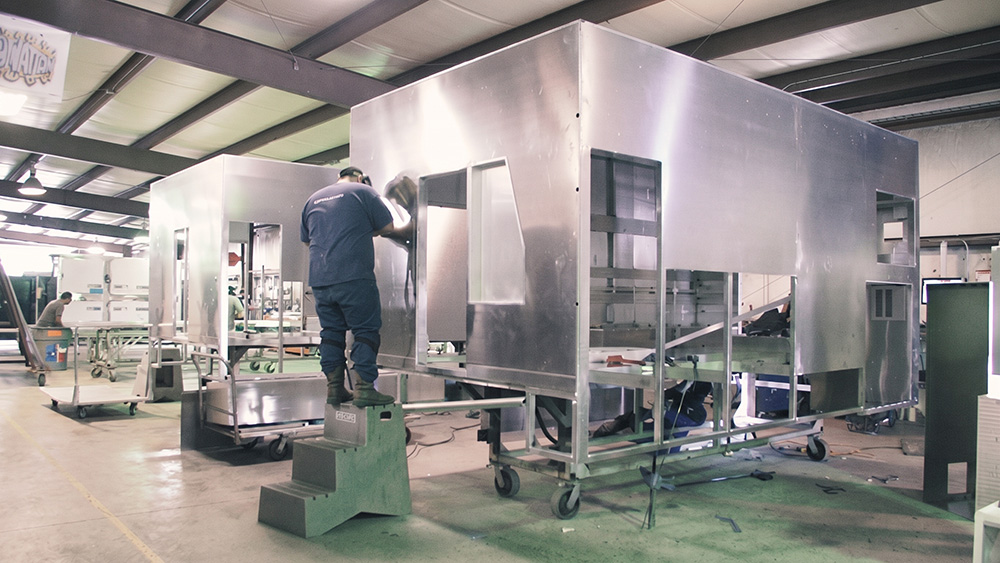
A module intended for remounting needs a solid foundation that can handle years of vibration and twisting forces. Frazer uses a 3″x1.5″x3/16″ 6061-T6 aluminum tube and channel base frame designed to help maintain structural integrity across multiple chassis lifecycles.
Two aluminum modules can look similar from the outside and still be built very differently underneath. Daily EMS response puts substantial loads on a vehicle. Potholes, curbs, uneven roads, and hard braking can place repeated stress on the module over thousands of calls and hundreds of thousands of miles.
Frame material, dimensions, weld quality, and overall construction can influence how a module responds to those loads over time. Cracks, doors that become difficult to latch, or cabinetry that begins to loosen can be signs of vibration fatigue or structural movement. Those conditions deserve careful attention before a module is removed, lifted, and secured to another chassis.
Frazer designs its base frame with long-term service and remounting in mind. The base frame uses 3″x1.5″x3/16″ 6061-T6 aluminum tube and channel. Frazer also does not use VHB (Very High Bond) tape to join primary structural members. Instead, the structural framework is fully welded to create a rigid foundation designed to manage twisting forces and help the module remain square throughout extended service.
Examining the Specs Behind Million-Mile Service
Mechanics and fleet leaders should look at more than the purchase price when evaluating a long-term vehicle investment. Construction specifications, maintenance needs, remount potential, and real-world service history can provide useful context when you are discussing a custom build with a Fire Chief, EMS Director, or purchasing team.
Frazer modules combine a 6061-T6 base frame, wood-free interiors, and point-to-point wiring with a design intended to support extended service and future remounting. The Houston Fire Department’s fleet, for example, includes 129 Frazer units. It is common for these modules to see more than 260,000 miles on a truck chassis. Modules can be remounted multiple times, and specific Frazer modules in this fleet have surpassed 1,000,000 miles of total frontline service.
That service history gives fleet leaders a real-world example of what can be possible when a module is designed from the beginning with multiple chassis lifecycles in mind. Every department’s operating environment and maintenance program is different, but documented service history can help provide useful context when evaluating long-term fleet plans.

Conclusion: Look Beyond the Initial Purchase Price
Evaluating a fleet for ambulance remounting connects what happens in the mechanic’s bay with long-term planning in the Chief’s office. Technicians need vehicles that are reliable, serviceable, and structurally durable. Fleet leaders also need to understand how those decisions affect the department’s budget and Lowest Overall Cost of Ownership (LOCO) over a 15-to-20-year period.
In a double-blind survey of 100 EMS and Fire professionals, 39% of respondents named Frazer as the brand that spends the least amount of time in the shop. That feedback is one data point departments can consider alongside their own maintenance records, operating requirements, service needs, and lifecycle plans.
A custom build may carry a higher upfront cost, so it is worth looking beyond that initial number. Ask what the module’s floor, frame, and electrical system may mean when the department is ready for its next chassis. A module that requires extensive structural or electrical repairs may not be a practical remount candidate, while replacing an entire vehicle every five to seven years can put additional pressure on a municipal capital budget.
Choosing a module designed with remounting in mind gives your department another option for the future. Depending on the module’s condition, your operational needs, and applicable purchasing or accounting requirements, replacing the chassis and updating the existing module may help extend the useful life of the patient compartment while supporting long-term fleet planning.
Are You Evaluating Your Aging Fleet for a Chassis Transfer?
Hidden deterioration, frame condition, and electrical system design can all affect the scope and cost of a remount. The earlier you understand those factors, the better equipped your department will be to compare its options. Contact the Frazer team to discuss how our wood-free, all-aluminum modules, point-to-point wiring, and remount-focused construction are designed to support long-term service, future chassis transfers, and your department’s overall cost-of-ownership goals.
Why do wood subfloors matter when evaluating an EMS vehicle for remounting?
Repeated exposure to water, cleaning chemicals, and other fluids can allow wood components to absorb moisture over time, which may contribute to rot, warping, or deterioration. Frazer uses a wood-free floor construction with aluminum sheets laminated over a polycarbonate core, eliminating concerns specifically related to wood deterioration when evaluating a module for future remounting.