

Affordable Ambulance Manufacturer Options: Streamlined Type I vs. Custom Builds
How do you find an EMS vehicle that fits your budget without giving up the workspace and systems your crews need? If you are comparing affordable ambulance manufacturer options, start with what your team needs on every shift, not just the purchase price.
The Frazer Foundation™ Series starts at $252,000 and offers a defined 12-foot Type I mobile healthcare vehicle with a 96-inch-wide module, nearly 50 inches of open aisle space, and four caregiver seats. A full custom build gives you more control over the layout and equipment integration. The right choice depends on your calls, your equipment, and your budget.
With rising equipment costs and new-build lead times often around 9 to 10 months, it pays to identify your needs early. Stock or demo units may be available sooner. This guide compares workspace, power, safety-related design features, serviceability, and long-term value to help you make a more informed purchase.
Can an Affordable EMS Vehicle Give Your Crew the Space It Needs?
A lower starting price does not tell you how much room your crew will have to work. Look at module width, cot placement, seating, and access to equipment before deciding whether a streamlined build meets your needs.
What Nearly 50 Inches of Aisle Space and Four Caregiver Seats Mean on Shift
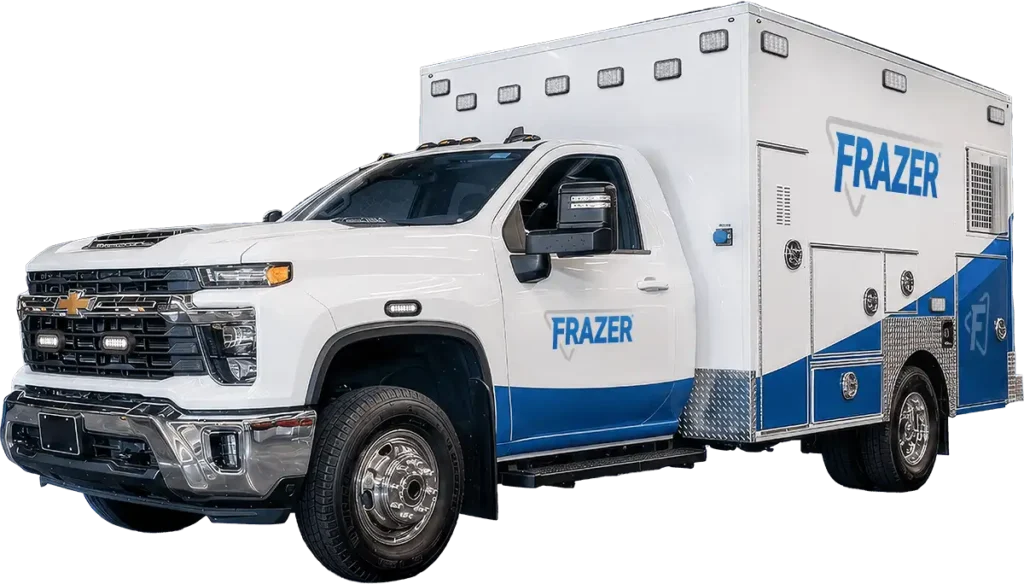
The Foundation™ Series features a 12-foot Type I module that is 96.25 inches wide, a center-mounted cot, nearly 50 inches of open aisle space, and four caregiver seating positions. The layout is designed to give caregivers access to both sides of the patient and room to reach equipment.
Four caregiver seats give your team designated places to work while using available restraints during transport, as appropriate for their duties and agency protocols. When evaluating the layout, consider how your crew moves around the patient and reaches supplies on a typical call.
How Planning Can Help Reduce Aftermarket Retrofits
When a vehicle arrives without the right equipment mounting or storage, your team may need to add brackets, holders, or dividers before putting it into service. That can add expense, delay deployment, and change how your crew uses the workspace.
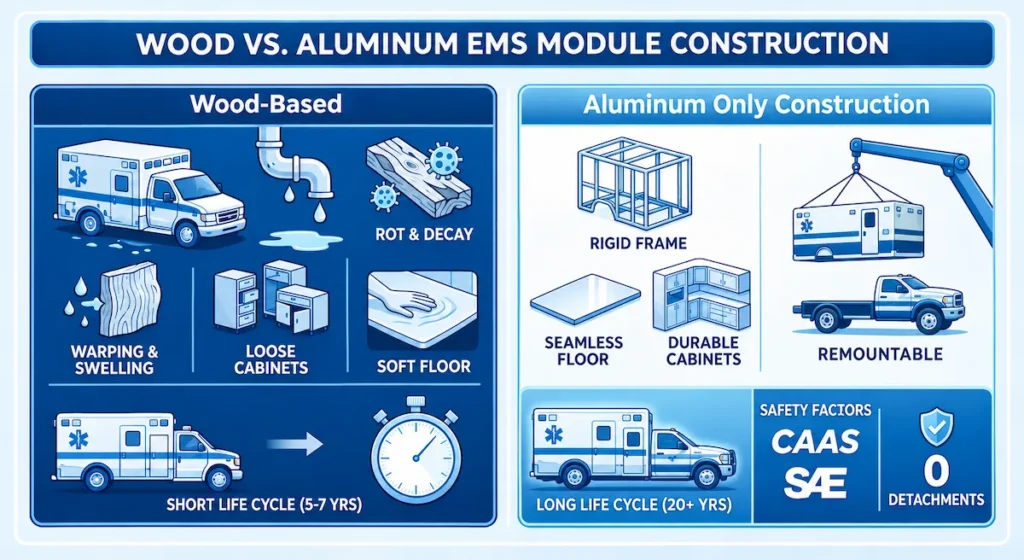
The Foundation™ Series offers one defined configuration with a focused set of options, bright white powder-coated aluminum cabinetry, and stainless steel work surfaces. The patient compartment contains no wood, MDF, or particle board. Review your equipment list against the available layout before ordering to identify any changes you may need.
How Do Streamlined Type I Builds Compare to Full Custom EMS Builds?
A streamlined build gives you a clear starting point for pricing and specifications. A full custom build gives you more flexibility to design around your agency’s unique needs. Both approaches can make sense, depending on the work your crews do.
Where the $252,000 Foundation™ Series Fits
Starting at $252,000, the Foundation™ Series is designed for providers who want a practical, repeatable 12-foot Type I configuration. It includes CenCom Core integrated vehicle controls, independent power and HVAC, a 96-inch-wide module, nearly 50 inches of open aisle space, and four caregiver seats. Standard chassis paint options are red or white. Optional equipment may increase the price.
Municipal fire and EMS departments, commercial EMS providers, and medical transport programs may find that the defined layout meets their everyday needs. It can also simplify repeat fleet orders when your crews use the same equipment and workflows. Ask about current stock and demo availability or placing a build order.
When Is a Full Custom Build Worth the Additional Investment?
A custom build may be the better fit if your agency needs a specialized clinical setup, unique equipment mounts, or a storage layout that falls outside a defined configuration. Planning those features before fabrication helps you build around the way your team delivers care.
Frazer’s 2026 Type I pricing tiers put base modules at $252,000, common custom operational configurations at $250,000 to $300,000, and highly customized specialty builds at $350,000 to $450,000. Mobile Stroke Units and mobile clinics may cost more depending on clinical equipment and engineering requirements.
Compare what each quoted price includes, not just the starting numbers. A streamlined configuration may fit your budget and workflow, while custom engineering may be worth the added investment if your crews have specific clinical or equipment needs.
| Feature / Factor | Foundation™ Series (Starting at $252,000) | Full Custom Builds (Tiered by Scope) |
|---|---|---|
| Configuration Style | One defined 12-foot Type I configuration with focused options | Tailored layouts, compartments, and specifications based on agency requirements |
| Interior & Workspace | 96-inch-wide module, nearly 50 inches of open aisle space, center-mounted cot, and 4 caregiver seats | Configurable layouts and specialized setups based on operational needs |
| Core Systems | Independent power and HVAC; CenCom Core; aluminum cabinetry with wood-free construction that excludes wood, MDF, and particle board | Engineered to accommodate agency-specific equipment, power, or specialty clinical requirements |
| Intended Applications | Value-conscious providers seeking a practical, repeatable Type I configuration | Agencies seeking specialized clinical capabilities or custom layout engineering |
How Do Budget-Conscious Builds Address Climate Control, Power, and Crash Safety?
Your crews need a vehicle that supports their work through long shifts, hot summers, cold weather, and back-to-back calls. When comparing vehicles, look closely at how the power and climate control systems work, along with documented safety-related design features.
Independent Power and Dedicated HVAC
Frazer designs its vehicles around independent 120V/115V AC power systems, such as generator systems with 12V DC chassis backup, and dedicated patient-compartment HVAC separate from the chassis system. This design reduces reliance on chassis engine speed and can help ease demand on the chassis charging system during heavy use.
Frazer reports typical cooling differentials of 25 to 30°F or more, with differentials reaching 35°F or more and an air recirculation interval of two minutes. Depending on the configuration, available features may include a Dometic BreatheEasy Ionizer and cab-to-module isolation. Actual cooling performance depends on outside temperatures, maintenance, operating conditions, and vehicle setup.
Crash Safety and Vehicle Uptime
Ask about documented engineering practices, applicable vehicle standards, and historical performance when comparing builds. Across more than 4,500 EMS modules built since 1984, Frazer reports zero recorded module detachments. Frazer also reports alignment with applicable Triple-K, CAAS GVS, and NFPA 1917 standards. Past performance does not guarantee future crash outcomes, and applicable requirements vary by configuration, model year, and purchasing specifications.
In a 2020 double-blind, anonymous survey of 100 EMS and fire professionals conducted by Smart Advantage, 39% of respondents named Frazer for spending the least amount of time in the shop (compared to 7% of our competitors). This reflects the experiences reported by survey participants, not a guarantee of uptime. Your results will depend on vehicle use, maintenance, configuration, and service history.
What About Maintenance, Serviceability, and Long-Term Value?
The purchase price is only one part of your vehicle budget. Consider how much time your vehicles spend in the shop, how easily your technicians can make repairs, and whether you can extend the useful life of your module.
Point-to-Point Wiring and Wood-Free Aluminum Construction
Frazer uses point-to-point wiring with common terminal strips, relays, and fuses as an alternative to multiplex wiring systems. Identifiable wiring paths and commonly used electrical components help technicians trace electrical issues. Frazer also uses 6061-T6 aluminum construction and wood-free patient compartments to avoid material problems associated with wood rot.
Frazer designs major assemblies with service access in mind and reports HVAC replacement times of under one hour and modular component swap times of under two hours under applicable service conditions. Actual repair times depend on technician experience, configuration, parts availability, and the work required.
Your relationship with Frazer continues after delivery. Direct factory support, access to parts, and training resources such as generator and electrical classes help your maintenance team keep your vehicles in service.
How Remounting Can Help Stretch Your Fleet Budget
When a chassis reaches the end of its useful life, you may not need to replace the entire vehicle. Frazer builds its aluminum modules with future remounting in mind. Eligible modules may support up to four chassis remounts over 15 to 20 years and more than 1 million miles, depending on condition, chassis compatibility, maintenance history, and applicable warranty guidelines.
Houston Fire Department operates 129 Frazer units with modules engineered for potential multi-chassis lifecycles exceeding 1 million miles. Marble Falls Area EMS has continued remounting a Frazer unit originally purchased in 1996. These examples show how remounting can help agencies retain a familiar patient-compartment layout while replacing an aging chassis.
Agencies have also reported fleet maintenance cost reductions of 42% to 60%. These customer-reported results illustrate Frazer’s approach to Lower Overall Cost of Ownership (LOCO). Your actual lifecycle and maintenance costs will depend on usage, operating conditions, maintenance history, remount eligibility, and fleet management practices.
How Do Pricing Tiers Fit Into Your Funding Plan?
Once you know which vehicle fits your crew’s needs, the next step is figuring out how to pay for it. A clear set of specifications and pricing options can help you build a budget request and evaluate financing, leasing, and grants.
Turning Crew Feedback Into a Budget Conversation
When you meet with your Chief, EMS Director, or apparatus committee, bring specific examples of what your crews need to do their jobs. Explain how the layout, equipment access, power systems, and seating affect daily operations. Compare the $252,000 Foundation™ Series with custom build options to show which features you need and where a custom investment may make sense.
Consider delivery timing and the cost of keeping the vehicle in service, too. If upfront capital is a concern, compare EMS vehicle leasing and capital purchase options to see which payment structure fits your budget cycle.
Exploring Financing, Leasing, and Grant Options
Our complete EMS vehicle financing and ownership guide explains funding options for municipal and commercial providers. It can help you connect your purchase price with your long-term budget and fleet goals.
Public agencies can also explore grant and cooperative purchasing pathways for EMS vehicles before finalizing their acquisition plans. Availability and eligibility vary by program and agency.
Not sure whether the Foundation™ Series or a full custom build is the right fit for your team? Explore our main financing, leasing, and grant guide, or connect with a Frazer team member. We can help you compare your options based on your crew’s workflow, equipment needs, and available budget.
Can a budget-conscious EMS vehicle provide enough workspace without costly aftermarket modifications?
Yes. Starting at $252,000, the Frazer Foundation™ Series features a 96-inch-wide module, nearly 50 inches of open aisle space, and four caregiver seats. This layout supports crew movement and can reduce the need for aftermarket modifications when it meets your agency’s equipment and patient care needs.