Ambulance Leasing vs. Buying: What Makes Sense for Your Fleet?
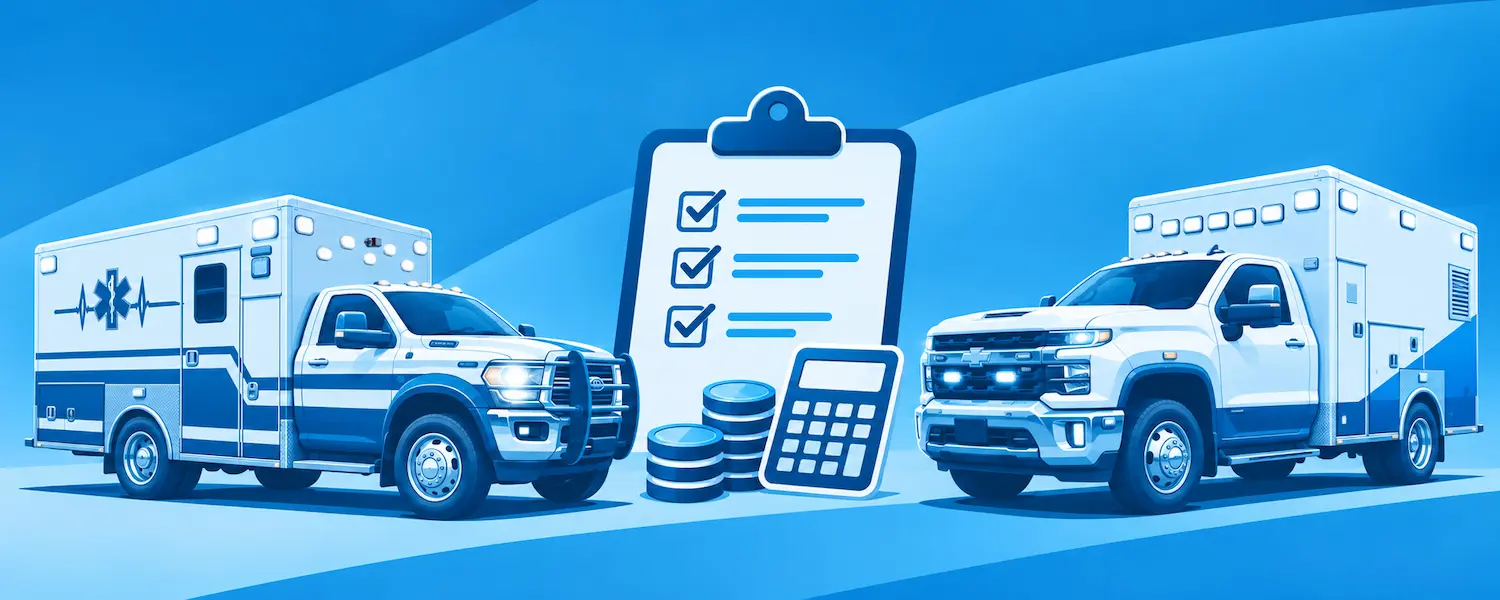
When comparing ambulance leasing with buying, consider your budget, how much you use your vehicles, and how long you plan to keep them. Buying outright can reduce financing costs, while leasing can help preserve cash. A lease with a buyout option may also help high-mileage fleets retain the long-term value of a remountable module.
Imagine three frontline units have more than 250,000 miles on them. Your call volume is growing, but your next capital budget is months away. Keeping older units in service may mean more shop time, overtime, and reliance on reserve vehicles.
With Type I emergency vehicle pricing starting at $252,000 for select Foundation Series configurations and reaching $450,000 or more for custom builds, how you pay for your next vehicle matters. So does what happens to that vehicle five, ten, or even twenty years down the road.
How Does EMS Vehicle Leasing Compare to Buying Outright?
In a double-blind survey of 100 EMS and fire professionals fewer than 25 percent identified initial price as their primary decision factor. That figure dropped to 9 percent when reliability and support after the sale were considered. Compare financing costs with the cost of keeping aging vehicles in service.
Municipal Fire and EMS: Managing Capital Budgets
Municipal fire departments, county EMS agencies, and Emergency Services Districts (ESDs) often work within tight capital budgets. Waiting for the next bond cycle or capital approval can make it harder to replace vehicles when your crews need them.
A tax-exempt municipal lease-purchase may allow eligible public agencies to spread payments across annual budgets while preserving general-fund reserves. These agreements typically include non-appropriation provisions and a path to ownership at the end of the term.
Work with your finance team, legal counsel, and financing partner to understand the agreement. Pay particular attention to when ownership transfers and whether you can retain the module for future remounting.
Private EMS and Health Systems: Matching Payments to Revenue
For private EMS providers and hospital transport programs, expanding a fleet often means investing in vehicles before a new contract generates its full revenue. Commercial ambulance leasing can help preserve working capital and credit lines for staffing, facilities, and medical equipment.
Instead of committing $252,000 to $450,000 or more upfront for each vehicle, your finance team can compare scheduled payments with expected transport revenue. This may also be useful when expanding specialized services such as Critical Care Transport, Mobile Stroke Units ($900,000 to $1,000,000), or Mobile Clinics ($1,000,000 to $1,200,000). These figures are planning estimates, not quotes.
Municipal Lease-Purchase vs. Commercial Lease vs. Buying Outright
| What to Consider | Municipal Lease-Purchase | Commercial EMS Lease | Outright Purchase |
|---|---|---|---|
| Upfront cash | May require little or no upfront cash, depending on terms. | May help preserve working capital, depending on terms. | Generally requires the full purchase price upfront. |
| Budget planning | Scheduled payments across annual budgets. | Monthly payments can be aligned with expected revenue. | Usually funded through an approved capital budget. |
| Contract considerations | Non-appropriation and ownership provisions. | Mileage allowances, return conditions, and buyout options. | Applicable grant, bid, or cooperative purchasing requirements. |
| Ownership and remounting | May provide ownership under agreed terms. | Depends on buyout rights and ownership terms. | Allows you to retain the module and evaluate future remounts. |
| When it may make sense | Public agencies with limited upfront capital. | Commercial fleets managing growth and cash flow. | Agencies with available reserves, bond funding, or grant awards. |
To better understand what may work for your department, explore Frazer’s EMS vehicle leasing and financing options and discuss your fleet timeline with our team.
How Do Residual Value and Remountability Affect EMS Lease Terms?
Residual value is the estimated value of a vehicle at the end of its lease. For an EMS vehicle with a remountable module, that value may extend beyond the useful life of its first chassis. This is why it is important to understand what you are giving up or keeping when your lease ends.
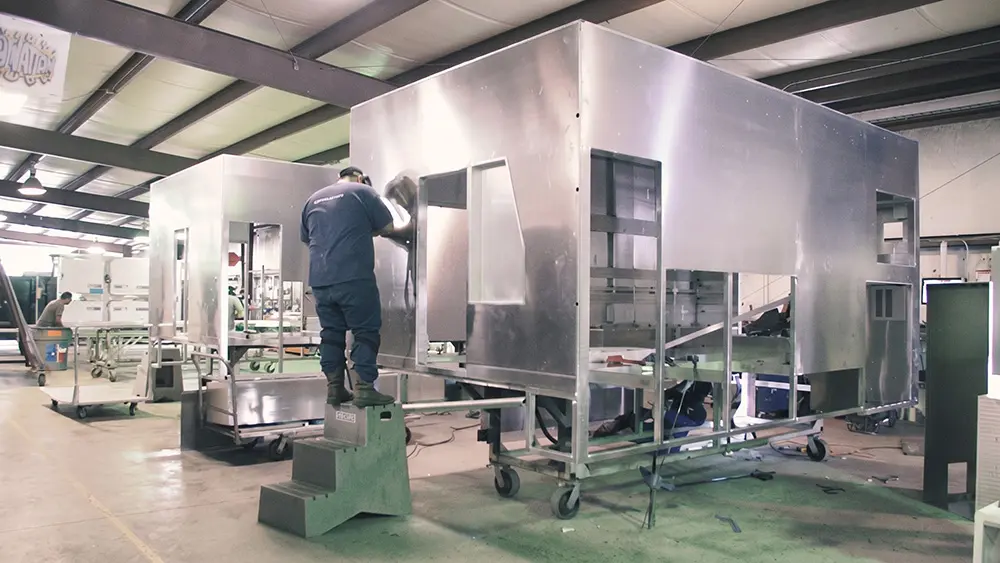
Frazer builds all-aluminum, wood-free modules designed for long-term service. Actual mileage, service life, and remount eligibility depend on vehicle configuration, operating conditions, maintenance, and module condition.
Why All-Aluminum, Wood-Free Construction Matters
Wood, MDF, and particle board can absorb moisture, swell, or loosen with repeated washdowns and road vibration. Frazer uses aluminum for its module structure and interior cabinetry, without these wood-based materials in the patient compartment.
Houston Fire Department has reported operating 129 Frazer units, with fleet experience including more than 260,000 miles per chassis, up to four remounts, and more than 1 million miles across service lives approaching 20 years. Marble Falls Area EMS has reported continuing to remount a unit purchased in 1996.
Learn more about how remounting an all-aluminum module can extend service life across multiple chassis and help you plan for future replacements.
Look Closely at Lease-End Buyout and Ownership Terms
Before signing a closed-end commercial lease, find out whether you must return the entire vehicle at the end of the term. If you cannot purchase or retain the module, you may lose the opportunity to remount it onto another chassis.
Frazer’s new modules carry a lifetime module construction warranty for the original owner while the module remains in their possession and has not been modified or repaired by unauthorized third parties. Frazer-performed remounts carry a two-year remount construction warranty. All coverage is subject to the applicable written warranty terms.
Ask Frazer and your financing partner how title transfers affect warranty coverage and remount options. Retaining the module may support a 15- to 20-year fleet strategy focused on Lower Overall Cost of Ownership (LOCO).
Why Does Fleet Uptime Matter When You Lease an EMS Vehicle?
A fixed monthly lease payment can make budgeting easier, but it does not eliminate the cost of downtime. If a vehicle is in the shop for an extended period, you may still be responsible for its lease payments even though your crews cannot use it.
For private EMS providers, that may mean fewer billable transports. For fire departments and municipal EMS agencies, it may mean additional overtime or greater reliance on reserve units. When your fleet logs 50,000 to 80,000 miles or more each year, ease of maintenance and access to service are important financial considerations.
In the same double-blind survey of 100 EMS and fire professionals, 39 percent named Frazer when asked which brand spends the least amount of time in the shop, while our competitors each received 7 percent. Support after the sale ranked first among the customer decision factors evaluated in the survey.
These results reflect the opinions of the surveyed professionals, not independently measured comparative downtime. When evaluating your next vehicle, ask manufacturers about service access, parts availability, electrical troubleshooting, and any available fleet maintenance data.
Simple Electrical Systems That Are Easier to Service
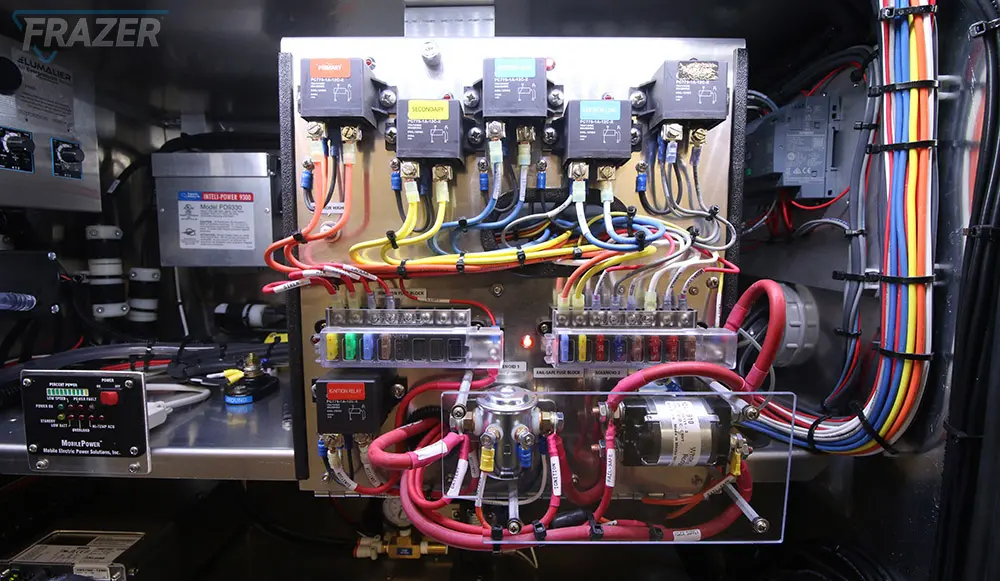
Frazer uses the Keep It Simple (KISS) principle in its point-to-point module wiring. Common terminal strips, standard automotive relays, and accessible fuses allow qualified technicians to troubleshoot circuits with standard shop tools, without relying on proprietary printed circuit boards or complex multiplex software nodes in the module wiring system.
In some cases, a technician can replace a standard relay and return the vehicle to service quickly. Cranston Fire Department has shared positive feedback about Frazer’s service, quality, and parts teams, as well as how straightforward its vehicles are to work on. The goal is simple: make it easier for your maintenance team to keep your fleet available.
Independent Power and Air Conditioning
Frazer offers dedicated onboard generator configurations, including MEPS, Cummins Onan gas or diesel, and Harrison Hydra-Gen hPower options. These configurations provide 115/120-volt AC power for patient compartment electrical needs and the independent 15,000 BTU HVAC system, with a 12-volt DC chassis fail-safe.
During long waits at the hospital or hot summer staging, independent generator power can support the patient compartment without relying on the truck engine for normal module power. This design can reduce demand on the chassis engine and alternators, which may help manage wear over time.
Five Things to Check Before Signing an EMS Vehicle Lease
1. Mileage Allowances
Make sure your agreement reflects how much your crews actually drive. Commercial and urban 911 fleets can log 50,000 to 80,000 miles or more each year. Ask about mileage limits, excess-mileage charges, and how those terms fit your expected chassis replacement or remount schedule. Some documented fleet applications have exceeded 260,000 miles per chassis, but your own replacement interval should reflect vehicle condition and operating needs.
2. Buyout and Title Ownership
Confirm in writing whether you can purchase the vehicle or retain title to the module at lease end. Ask how the buyout price is determined and whether the agreement restricts remounting.
3. Vehicle Delivery and Approved Specifications
Make sure you understand when payments begin, what happens if delivery is delayed, and how the vehicle will be accepted. Frazer’s written warranty addresses construction in accordance with customer-approved drawings and performance specifications.
Frazer ranked third for fewest defects or punch-list items in the double-blind survey. Monroe Township Fire Department also reported placing its unit into frontline service within seven days of leaving Houston without experiencing issues. That was one department’s reported experience, not a guaranteed delivery or in-service timeline.
4. Written Warranty Coverage
Review which warranties apply during the lease and after any transfer of ownership. Frazer provides a lifetime module construction warranty for the original owner, a five-year electrical wiring warranty, a five-year paint, striping, and lettering warranty, a two-year Frazer remount construction warranty, and itemized OEM component warranties. Coverage is subject to the applicable written terms.
Frazer builds vehicles to applicable Triple-K, CAAS GVS, and NFPA 1917 requirements, depending on configuration and applicable standards. Frazer’s recorded build history also reports zero module detachments across more than 4,500 builds since 1984. This describes historical experience and is not a guarantee of future performance.
5. Support After the Sale
Ask who you will contact for troubleshooting, parts, warranty questions, and repairs. Frazer supports fleets nationwide through direct factory service, quality, and parts advisors, along with authorized regional service centers.
With 90 percent of Frazer’s new 2024 customers located outside Texas, supporting fleets beyond our home state is an important part of our business. Frazer provides direct factory support through its service, quality, and parts advisors, along with authorized regional service centers.
How Does Leasing Fit Into Your Long-Term EMS Fleet Plan?
Ambulance leasing is one tool you can use to build a more manageable replacement plan. Depending on your budget and operating needs, you may choose to lease some vehicles, purchase others, and remount existing modules as their chassis reach the end of service. Our guide to ambulance total cost of ownership and fleet lifecycle management explains how leasing, grants, cooperative purchasing, and long-term ownership fit together.
Expanding Your Fleet
When you need to add capacity, a repeatable vehicle configuration may simplify fleet planning. Frazer’s 12-foot Type I Foundation Series, starting at $252,000, offers a stock or build-to-order option with an all-aluminum, remountable module. Leasing may help spread the cost of adding these vehicles over time. Pricing and delivery depend on availability, configuration, and financing terms.
Using Cooperative Purchasing or Grant Funding
Public agencies may be able to use cooperative purchasing contracts to simplify procurement where permitted by applicable purchasing requirements. Grant funding may also help eligible departments acquire emergency vehicles.
Check program requirements before combining grant funding, available capital, or financing. A remountable module may help extend the value of that investment across multiple chassis.
Planning for Future Remounts
When a chassis reaches the end of its useful life, a module inspection can help determine whether remounting is practical. Depending on condition, configuration, and project scope, a remount may cost less than a new build.
Frazer has been in business since 1956 and has built more than 4,500 EMS modules since 1984. Our team can help you evaluate vehicle configurations, future remount opportunities, and acquisition options based on what your fleet needs today and what you expect it to need in the years ahead.
Ready to Plan Your Next Fleet Addition?
Whether you are considering a municipal lease-purchase, commercial lease, or outright purchase, our team can help you compare vehicle configurations, pricing, financing, and future remount opportunities based on your fleet’s needs and budget.
Explore Frazer Leasing and Financing Options
How does EMS vehicle leasing compare to an outright capital purchase?
Buying an EMS vehicle outright can reduce financing costs when capital is available, while ambulance leasing can help preserve cash reserves and spread payments over time. The right choice depends on your budget, fleet utilization, replacement schedule, and long-term ownership goals.