The Dual-Stretcher Advantage: Reducing Rural EMS Fleet Cost of Ownership
For rural and regional departments, high mileage can put real pressure on fleet budgets. Long trips to major hospitals can tie up critical 911 resources, add wear to the chassis, and increase the need for future vehicle replacement. For agencies that cover a lot of miles, replacing single-patient vehicles on shorter service cycles can add significant long-term cost.
Managing those costs means looking at the full picture. A dual-stretcher configuration may help some departments consolidate appropriate patient transfers and reduce the number of trips they make. Over the longer term, remountable modules and service-friendly vehicle designs can also help departments make better use of their fleet investment.
The Strain on Rural Fleets: Managing 911 Resources
When the receiving hospital is an hour or more away, even a routine inter-facility transfer can become a major logistical challenge. If a county has only a few units available, sending one on a two-hour round trip can leave fewer resources in the primary response area. Operations and dispatch leaders have to balance transfer needs with the need to maintain local 911 coverage.
The mileage adds up, too. Driving 150 to 200 miles a day increases fuel use, adds wear to the truck chassis, and brings scheduled maintenance intervals closer together. Over time, that mileage may lead to more frequent chassis replacement and added pressure on capital budgets.
How can a dual-stretcher EMS vehicle help reduce rural fleet strain?
When it is clinically and operationally appropriate, carrying two stable transfer patients on one trip can increase transport capacity without requiring two separate vehicle runs. For certain routes, this may reduce fleet mileage and fuel use while keeping other vehicles available for local response.
Consolidating Transports With a Dual-Stretcher Configuration
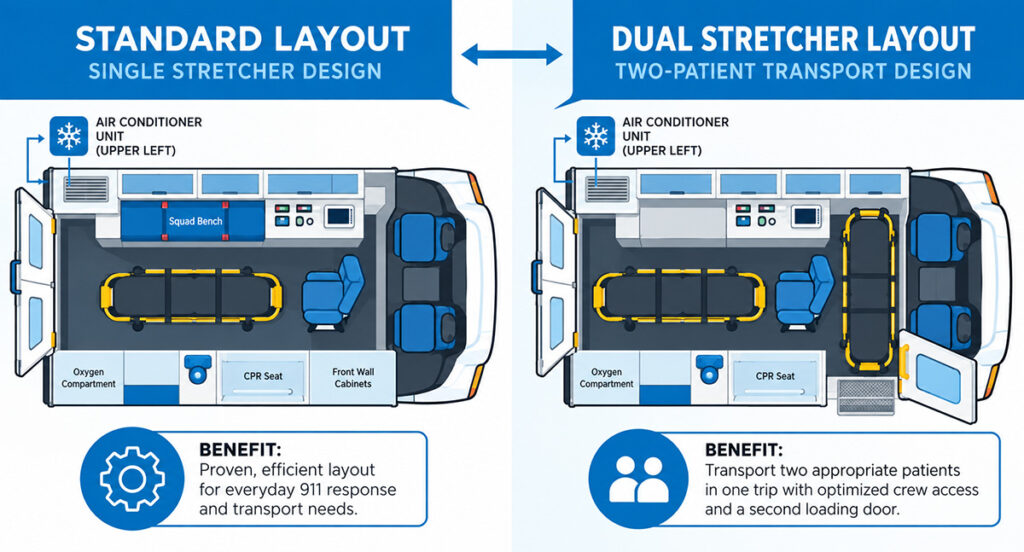
A dual-stretcher configuration is more than a different floor plan. For departments with the right transport needs, it can become part of a broader fleet strategy. A properly designed module can accommodate two appropriate patients and may allow a department to combine certain long-distance transfers that would otherwise require separate trips.
For stable transfers between regional hospitals, nursing facilities, or other care locations, fewer trips can mean fewer miles across the fleet. That may also reduce associated fuel use and chassis wear.
One question departments often have is whether a dual-stretcher layout leaves enough room for crews to work. The answer depends heavily on how the module is designed. Thoughtful placement of equipment, seating, and cabinetry can help crews reach commonly used gear from either patient’s side while maintaining useful working space.
Heavy-duty, crash-tested cot retention systems and four-point harness seating can also support crew positioning while personnel remain properly belted. The goal is a layout that gives crews practical access to patients and equipment during appropriate two-patient transports.
Lowering Overall Cost of Ownership Through Remountability
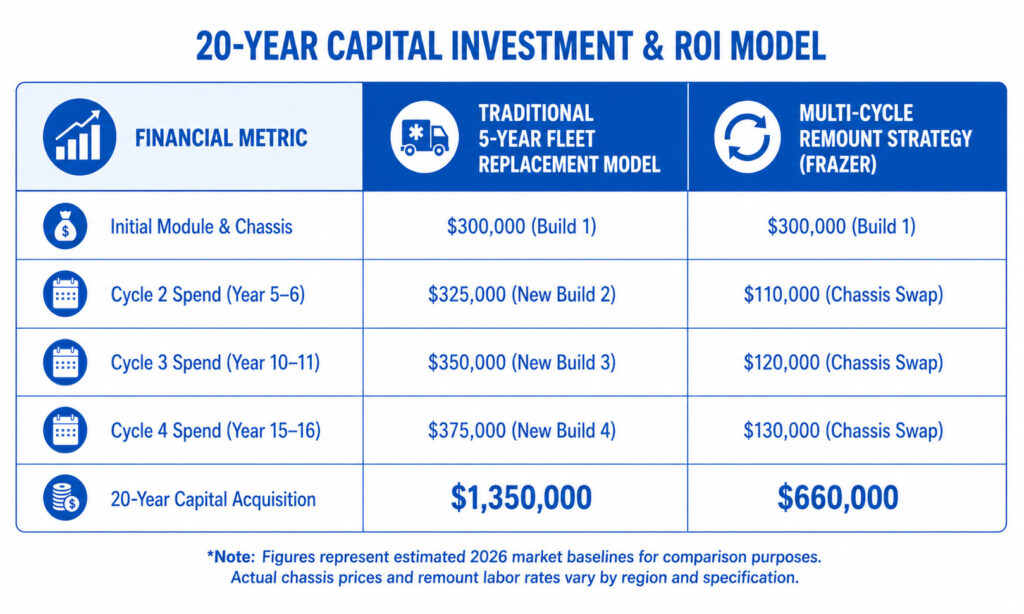
Trip consolidation may help with daily operating costs, but fleet costs extend well beyond a single trip or budget year. For high-mileage departments, it can be useful to think about a vehicle over a 15- to 20-year period. The truck chassis may eventually reach the end of its useful service life, but that does not always mean the custom EMS module has reached the end of its life, too.
A durable, all-aluminum, wood-free module can be designed with future remounting in mind. When an eligible chassis reaches the end of its service life, the module can be removed, evaluated, refurbished as needed, and installed on a compatible new chassis.
Remounting can help extend the useful life of a qualifying module and reduce the capital required compared with replacing the complete custom vehicle every time the chassis is retired. Some departments have used this strategy for many years. For example, the Houston Fire Department routinely remounts its modules up to four times, allowing individual modules to surpass 1,000,000 miles of service over their lifetime.
How can remounting help lower overall fleet costs?
Remounting places an eligible module onto a new compatible truck chassis after the original chassis reaches the end of its service life. Because the department is reusing the module rather than replacing the entire custom vehicle, remounting may reduce the capital required for that replacement cycle. Warranty coverage on a remounted unit can vary based on the manufacturer, program, module condition, and configuration, so departments should review those details as part of their procurement planning.
Reliability When You Are Hours Away
Reliability matters on every call, but long-distance transports can make downtime especially difficult. A chassis problem 60 miles from the nearest hospital can interrupt patient transport and remove an important vehicle from service.
Chassis-independent systems can add another layer of operational redundancy. With an independent power source such as a Cummins Onan generator, patient-compartment power does not rely only on the truck engine. If the chassis engine shuts down, the generator can continue supplying power to supported patient-compartment systems, including interior lighting, compatible medical equipment, and a dedicated 115VAC HVAC system, depending on the vehicle’s configuration and operating conditions.
Some custom configurations can also include a 120V inverter and a 12V automatic fail-safe, giving supported systems multiple available power paths. That flexibility can be valuable during long transports or extended periods on scene.
An independent HVAC system can also support the patient-care environment without relying on the chassis HVAC system. When equipped with an air-treatment option such as the Dometic BreatheEasy Ionizer, the system can help manage air within the patient compartment while keeping it separate from the driver’s cab.
Vehicle availability is another part of overall fleet value. In a double-blind market research study of 100 EMS and Fire professionals documented in the Survey Results Presentation 10-30-20, 39% of respondents named Frazer when asked which brand spent the least amount of time in the shop.
Frazer also uses a straightforward approach to electrical design, including simple point-to-point wiring and standard automotive parts where appropriate instead of relying exclusively on proprietary multiplex systems. This design approach can make certain electrical and service issues easier for qualified technicians to diagnose and repair, helping departments get vehicles back into service efficiently.
Rethinking Procurement for the Long Haul
Managing EMS fleet cost of ownership means looking at both daily operations and long-term planning. For departments with the right transport needs, a dual-stretcher configuration may help consolidate certain inter-facility trips and reduce associated mileage and fuel use. A module designed for remounting may also remain in service across multiple compatible chassis, helping departments extend the value of their original investment.
Independent power systems and straightforward serviceability add another part of that equation by helping departments plan around vehicle availability and long-term maintenance. No single configuration is right for every agency, so the starting point is understanding how your crews operate, how far they travel, and where your fleet costs are coming from.
If long-distance transfers are a regular part of your operation, talk with a Frazer EMS Specialist about whether a custom dual-stretcher configuration, remount strategy, or independent power setup makes sense for your department’s transport needs and long-term fleet plan.
How does a dual stretcher EMS vehicle help rural departments?
A dual-stretcher vehicle can allow rural departments to transport two appropriate, stable patients on a single trip. When clinically and operationally appropriate, consolidating inter-facility transfers may reduce fleet mileage and fuel use while keeping other vehicles available for local 911 response.