Winter Is Coming!

Maybe you’re a Game of Thrones fan unhappy with the final two seasons and an ending that felt rushed and arbitrary. Maybe you’ve never seen an episode. No matter, the calendar we live by says winter is right around the corner so we figured now was an excellent time to point out some Frazer features that can improve your cold weather experience. Bring the Heat You probably know we’re famous for ice cold air conditioning on our Generator Powered EMS modules. But you may not be aware that the same system has a beefy heater to keep you warm during cold weather months. Our electrical system allows you to plug into shore line and run the A/C or heat while the vehicle is in the station. Couple this with excellent insulation which provides thermal and acoustic protection and you’ll have a comfortable patient compartment in almost any conditions. If you’re located in a region given to winters colder than we see in Texas, we offer a supplemental hot water heater that runs off the chassis heater. Some services will close the valve on this heater during warmer months, so if you already have one, don’t forget to open that back up as the temperature starts to drop. Maintain Your Pressure Colder temperature can affect your tire pressure causing fluctuations that result in lower pressure and consequent uneven tire wear. Checking your pressure on a regular basis is a good policy no matter the weather, but becomes more important through the winter. Frazer offers the CrossFire valve extenders with an integrated pressure gauge to help you keep tabs on your rear dual wheels. Fill both tires from one stem and monitor pressure with ease. Again, this isn’t just a good idea for winter months, but is a helpful option year round. Chain Chain Chains Wintry road conditions can wreak havoc on confident driving and your crews don’t have time to spend putting on tire chains. If you’re area is prone to snow or icy conditions, consider OnSpot tire chains. Rather than putting a full chain on your tires, the OnSpot system swings an actuated arm carrying chains right in front of the tire providing extra traction without the hassle. For more information on these and many other excellent Frazer options and features, please give one of our Sales Team members a call at 888-832-9371. Or you can click here to learn more about what Frazer has to offer your service.
Thank You for your Frazer Orders! – Week of December 6

Thank you Marshall Fire Department, LifeNet – Stillwater, LifeNet – Texarkana, Wise County EMS, and Tuttle Fire Department for your Frazer orders!
Behold! The Frazer/ACETECH Demo!

An Ace in the Hole To celebrate our annual pilgrimage to the Texas State EMS Conference, we proudly announce a first-of-its-kind EMS vehicle combining the legendary durability and reliability of Frazer’s generator powered design along with the technological sophistication provided by the robust ACETECH multiplexing system. This demo unit represents multiple years of research and development trying to achieve the delicate balance between features we’ve built our reputation on and features our customers have been loudly asking for in ever greater numbers. Finding The Right Partner If you are one of our longtime customers, you know Frazer doesn’t take big steps like this without performing our due diligence. In the course of responding to this call for a more modern approach, we looked at building a system in-house, and we looked at a number of available options. With ACETECH we found a single-source integrated system where we’ll know exactly who to call when a customer needs support – or less politely, which throat to choke. ACETECH has definitely acted as a partner in this process, and we’re excited to offer something we feel meets our extremely high standards for performance on your vehicles. Their technical teams have worked hand in hand with our engineering and IT departments to ensure this hybrid system gives you what you need – Frazer Generator Power to satisfy all your electrical demands, and AceTech’s fully integrated performance monitoring and control system to make it all sing. Why ACETECH? Why Now? With over 65,000 product installations worldwide, we feel ACETECH’s proven track record and success in Europe and the Middle East would translate well as they look to move into the US EMS market. Once upon a time some of us here at Frazer used to dream about a big room full of computer screens showing us where all of our vehicles were on a map and sending real time information regarding performance or service issues. The AceTech AVI system makes that dream an achievable reality. This demo represents over a year’s worth of working together with ACETECH’s engineering and technical teams to craft a solution that works with our existing features. And while we don’t expect this system will be for everyone, we are acutely aware that many of you very much want to take advantage of the feature sets this move allows to happen. Awesomely Awesome ACETECH Features! One of our favorite aspects of the ACETECH product suite centers around the ability to use their different modules either in whole or in part. This particular demo includes all but one module, the RFID asset tracking piece, but all modules can be added to a new build (and , excepting the ECU module, likely an existing vehicle – though with different complexity levels) as individual components. AVI The Advance Vehicle Informatics module (AVI) allows for driver monitoring, feedback and coaching. As Road Safety exited the market last year, AVI represents an excellent replacement and can be configured to act as a one to one replacement, all the way down to the feedback sounds. ACETECH’s AWS powered servers capture and permanently save all driver data on all vehicles equipped with AVI. What this means for fleet managers, department directors, and training personnel is a massive data set providing real time remote monitoring coupled with a robust web-based reporting interface to evaluate historical trends with vehicle systems performance, driver actions, fuel consumption and carbon emissions (with the EcoRun module), all within granular, role-based customer portal. A service using this module could even grant access to their preferred vehicle service provider to allow tailored access to vehicle information for planning and reacting to any issues that might arise. ACETECH ECU and iNCOMMAND The solid state Electronic Control Unit acts as the brains of the module functions, and in conjunction with the iNCOMMAND touch screen control computer gives medics full control of their working environment. Emergency light flash patterns, interior light controls, door open indicators, and vehicle camera monitoring are just some of the control elements available with this system. And because the iNCOMMAND touchpad is actually a Windows PC, it can even be configured to function with your MDT. Plus, once your vehicle control schema has been configured, the underlying code can be copied to the ECU of any new vehicle to have an exact match for your fleet. Used in conjunction with the AVI system, the system allows not only for remote monitoring, but also remote diagnostics, troubleshooting, and repairs. ACETECH’s presence in both the US and Europe expands available support times with the manufacturer in addition to the availability you’ve come to expect from Frazer. EcoRun The ACETECH EcoRun module works with your chassis to monitor engine usage and power needs. The module features configurable parameters to turn the truck off and on as needed. For services looking to reduce fuel consumption or to reduce carbon emissions, this sort of system gives fleet managers and directors both the control and the resulting data to show their communities real savings and impact. And while there are other solutions in the market which address the same issues, Frazer feels the integrated nature of the ACETECH product line gives both builder and end user a level of confidence that there won’t be any finger pointing should a performance issue arise. AVA Adding the AVA module provides real time, configurable voice feedback. Depending on your requirements this module can let medics know anything from the status of emergency light activation to door open status to fuel levels and beyond. In a world with an ever increasing amount of stimuli, AVA offers the security of an extra set of “eyes” to keep your crews informed and aware of potential hazards in their working evironment. RFID Tracsense Let the magic of near-field communications take one more potential blind spot off your plate. The ACETECH Tracsense module keeps tabs on any tagged asset on your vehicle. Used in conjunction with the AVA module and the iNCOMMAND control screen, you could have your vehicle
A NEW Frazer Demo EMS Vehicle for Texas EMS!
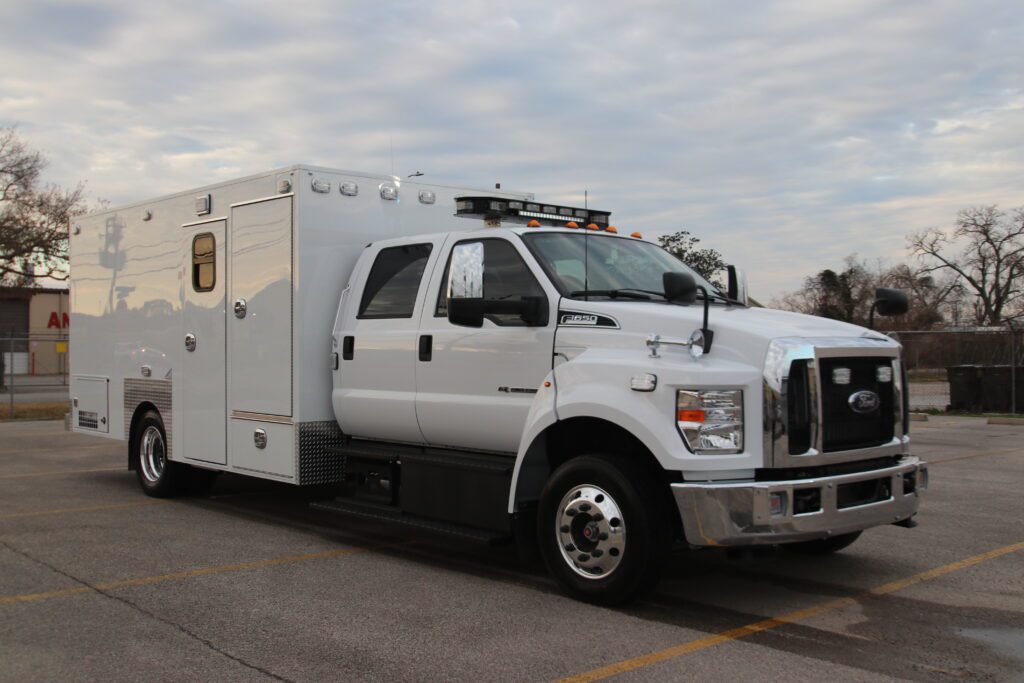
Frazer’s newest demo unit is mounted on a 2019 Chevy Silverado 4500HD diesel chassis and is equipped with ACETECH™ iNCOMMAND.
Thank You for your Frazer Orders! – Week of November 15

Thank you City of Beaumont EMS, Rosehill Fire Department, North Richland Hills Fire Rescue, and Farmers Branch Fire Department for your Frazer orders!
Ambulance Module Construction – Framing

Over the years we’ve heard a lot of different questions surrounding our construction methods. Why the square corners? Do your modules hold up? How do you mount the module to the truck? Is it safe? In this episode we’ll tackle some of these questions and maybe even answer some you didn’t know you should be asking. The Modular Body From the time we started building truck mounted modular vehicles, Frazer has needed to design for extremely harsh environments, frequently the kinds without roads. So we were ready for the transition to the rigors of the EMS industry. As with any structure, strength comes from a solid foundation and a Frazer EMS vehicle is no exception. Base Frame The strength of your Frazer module begins with an extraordinarily beefy base frame. Let’s take a look at some of the specs: So what do all those numbers mean? The heat treated 6061-T6 alloy tubing provides a Frazer module with an excellent strength (20,000 – 40,000 psi tensile) to weight ratio, excellent weldability, and advanced corrosion resistance. This particular alloy represents a typical first choice for architectural and structural applications and we appreciate the durability and strength it has provided us and our customers over the years. Construction Our 3” x 1.5” base frame tubing represents a 12.5% increase over the 2” x 2” tubing commonly used in base frame throughout the rest of the industry. And our intricate frame design features shorter spans of 3” x 1.5” channel reinforcing the longer 3” x 1.5” tubing lengths in parallel with the chassis frame for maximum strength along that axis. All of this tubing receives additional support from .250” and .375” plate welded throughout the frame. These plates provide a solid surface for cot and captain’s chair retention, as well as O2 bottle holders, and other optional features. They simultaneously create extremely strong corner gussets at key locations. And there wouldn’t be any point in designing and fabricating a ridiculously strong base frame if we didn’t attach it to the truck in the strongest way possible. For that we take eight (ten on a 14’ module) 4” x 10” x .250” steel shear plates and bolt them to both the chassis frame and the base frame with .5” Grade 8 bolts. Each plate uses 4 bolts, 2 in the chassis frame and 2 in channels on the module frame. The module bolts are insulated with rubber to avoid electrolysis. Each bolt carries a tensile strength of 150,000 psi. This attachment method is the primary reason we’ve NEVER had a base frame detach from its chassis during a violent collision. Side and Front Wall Frames So you put all that structure in your base frame, why wouldn’t you do the same for the side walls? 34 years of both building EMS vehicles and repairing them after major wrecks have given us a much greater sense of where most impacts occur than we could get from simple controlled destructive testing. And we’ve found that side wall impacts most commonly occur at or below module floor level. Once again, the beefy base frame helps out in those circumstances, but the side wall frames take very little impact. Using 1.5” x 1.5” x .125” square tubing through the side walls allows us to maintain necessary structural strength for things like mounting cabinets and compartments, seat belt plates, grab rail plates, and more, without adding unnecessary weight to your module. New cot retention systems, upgraded medical devices, bariatric requirements and more have increased the empty weight of the modern EMS module. This tubing dimension also yields extra space throughout the interior of the module resulting in more room to move and work on your patients. Where the driver and passenger side walls meet the front wall results in a corner structure that, like the strongest portions of the base frame, ends up at 3” x 1.5”. This welded, “laminated” corner piece is also bolted together to create an extremely strong leading edge of the module. Front corner impacts happen very frequently and the Frazer design provides strength where you need it. Some folks complain about the looks of the “square corners.” But we know how important they are to your safety, so we think they’re kind of awesome. Rear Walls The rear corner impact is kind of the gold standard for how an ambulance gets in a wreck. So common, in fact, that Frazer has made these two corners the focal point of some serious strength. Our rear walls feature 2” x 2.5” rectangular tubing, a 25% increase over industry standard. Again, we know where crashes occur. And we know where you need strength and durability. So if we’re going to add the weight associated with a larger extrusion, we’re going to apply it where it makes sense for your safety. Plates for grab handles, door hold opens, and other options provide structural reinforcement throughout. Roof If your vehicle rolls over, and we know they do, you’d better have a solid roof. Consequently, Frazer views the roof construction in much the same way as our base frame, it needs to be as sturdy as the foundation. Accordingly, we use the same 2” x 2.5” rectangular tubing as the rear wall around the perimeter of the roof, where that structure will be welded to the supporting side walls. The resulting corner piece ends up with an effective 3.5” side and of course there is .250” plate throughout for overhead grab bars and other optional equipment. Durability Everything we learned about building vehicles for the extreme environments found in the oil fields around the world found its way directly into our EMS vehicles. Some seismic recording modules we built well over 40 years ago are still in use. If you saw our last post maybe you noticed the Bellaire Fire Department still runs a module we built 26 years ago. And they’ve remounted it twice. So yeah, we know a thing or twenty about durability. Testing Testing And not only
Thank You for your Frazer Orders! – Week of November 8

Thank you Roanoke Fire Department, Keller Fire Rescue, City of Seguin Fire Department, and Harker Heights Fire Department for your Frazer orders!
Ambulance Modules – 12′ or 14′?

The changing requirements of EMS resulted in some fairly big updates in the design and configuration of modern ambulances. Frazer offers floor plans for emergency vehicles ranging from strictly 911 EMS operations all the way to rigs designed for technical rescue. Here we’ve broken down the different models with an eye toward helping you determine the right fit for your department. 12’ Modules – A Brief History When we entered the industry in the mid-1980’s, the vast majority of services we worked with were strictly EMS departments. Of those, quite a few were volunteer operations in remote rural communities or smaller areas outlying a larger metro region. At that time, the ambulance module was a relatively novel option for some services as they had been using Type II van conversions primarily. Our Frazer generator powered EMS vehicles were designed from the ground up by our early customers at the City of Houston, Kingwood Area EMS, Fort Bend County EMS, and Dallas/Fort Worth Airport, just to name a few. In fact, outside of figuring out how best to physically incorporate our separate generator set and our ice cold air conditioning into the module, we really had very little to do with the unique design elements our customers have loved over the years. 12’ Modules Now Our constant communication and collaboration with our customers informs much of the modern vehicle we build today. Upgrades to finishes, improvements in cot retention, advances in LED lighting both interior and exterior, better insulation, flooring, and interior wall surfaces, all provide our customers with exceptional levels of user experience and durability. As far as floor plans go though, very little has changed relative to the initial designs we worked with. You can still expect the same spacious interior feeling thanks to cabinets built to appropriate depth. The patient compartment still feels like a mobile emergency room, with bright LED lighting, stainless steel counters and wall surfaces at patient height, and the power to utilize all your medical devices without worry. Our 12’ modules are available as Type I or III with 67.5” or 71.5” (optional) headroom, and can be mounted on all the cool trucks. They represent what we believe is the best overall approach and value to a dedicated EMS vehicle in the industry. As you might imagine, the number of optional items available to customize these units is huge. 14’ Modules – A Brief History The early 1990s saw a fairly major shift in how some services operated. At that time a number of municipalities, large and small, started combining Fire and EMS operations under the purview of the Fire Department. For some this organizational change simply intended to improve efficiency among the two agencies and the operational effect on the EMS department was minimal. But others looked to holistically incorporate elements of both traditional EMS and Fire operations. More often than not, this combination required more space and storage capacity. Enter the 14’ Module. Our first effort, designed for the Bellaire Fire Department, kept the patient compartment largely the same from the rear doors to the captain’s chair, and added the extra two feet to the forward area of the module. Additional exterior storage capacity allowed for the Department to carry some of the tools and gear specific to fire. 14’ Modules Now As is so often the case with our vehicles, the idea one department comes up with leads to something new from another customer. Our 14’ modules are no different. That original 14’ design is still the go-to if your department works in the Fire/EMS model and needs gear space. The size of that particular module spurred numerous customers to design their own modifications, especially if they carried a specific tool or set of gears, SCBAs for example, that required a new solution. More recently Frazer has added two fairly significant variations on that theme. One features a door forward configuration. We’ve found this common for clinical and patient focused operations, providing additional space but without a focus on fire equipment. An unexpected benefit of this design keeps the patient out of view of onlookers or extraneous people at a scene, ensuring privacy for both patient and medic. The other modification features a full transverse compartment consuming the entirety of the additional module space. The patient compartment is virtually identical to a standard 12’ module, but the massive transverse section allows for gear used in high angle technical rescue or equipment specific to bariatric transport. Something like that version really allows for the imagination to run wild. Give Us a Call If you want to discuss the finer points of module configuration, please give one of our Sales Team a call at 888-372-9371. If they can’t help you with the decision, they can definitely get you in touch with some of our customers using the different versions. Or you can click here to browse more information for yourself.
Thank You for your Frazer Orders! – Week of November 1

Thank you Union General Hospital, Rush Springs Fire Department, San Marcos Hays County EMS, and San Antonio Fire Department for your Frazer orders!
Ambulance Stretchers – A Brief Overview

The changes in stretcher technology over the years show a radical move toward safety for both patients and medics. We field questions about these products on a daily basis so here are some points to consider when choosing the right product for your department. Power Is The Key While undercarriage and frame design have made huge leaps over the years, and construction materials have gotten stronger but lighter, the introduction of powered cot lift mechanisms has arguably been the biggest game changer. With back injuries accounting for a substantial percentage of job related injuries for Fire and EMS personnel (numbers range from 20% up to 70% depending on the data source), these new stretcher systems aim to help reduce those measurably. Power Cot Features Styker and Ferno each offer a powered cot capable of carrying 700 lbs. According to each company’s marketing literature, here are some specs worth considering: Stryker Ferno Length 81 in. 80 in. Width 23 in. 24 in. Load Height 36 in. max 36 in. max Cot Weight 125 lb 143 lb Carrying Capacity 700 lb 700 lb Unassisted Lift Capacity 500 lb 700 lb Warranty 2 years 2 years As with most products, people will have their particular preferences, and cots are not different. Frazer can accommodate systems from either manufacturer and is happy to work with the stretcher of your choice. You can learn more about the available stretcher options and features for Ferno and Stryker by clicking on the provided links. Retention and Loading Options Stryker and Ferno both have manual cot retention systems that meet the current SAE J3027 requirements present in the major standards documents, KKK-A-1822, NFPA 1917, and CAAS 2.0. All are designed to minimize cot drift inside the module and during transport and represent significant upgrades from the older antler and bar designs. Ferno Ferno offers three different models, all of which are SAE J3027 compliant. According to the Ferno literature, the Stat Trac works with their PowerFlexx+ST Cot and their 35XST ProFlexx Cot. The iNLINE retention system is built for use with the Ferno iNX cot and features charging capabilities as well as the ability to interchange with both Ferno and Stryker PowerLoad floor plates. Finally, the Ferno PRO F1 universal cot fastener is designed for cross compatibility and can be used with a variety of both Ferno and Stryker cots. Click on any of the links for more details from the manufacturer. Stryker Stryker currently offers two SAE J3027 compliant stretcher fastener systems. Their first, the Performance- LOAD, is a manual system designed for use with the Power Pro-XT, Performance Pro-XT, and Power Pro-IT cots. The Performance Load also provides an upgrade path to the Power-LOAD. Power-LOAD works with Stryker’s Power-Pro XT cot and actually lifts the cot into the patient compartment for the medic. Click on any of the links for details from the manufacturer. You can also click here to see info on the Technimount Safety Arm System for use with Stryker products. What About My Legacy Equipment? Both manufacturers still show their “Antler and Bar” systems on their respective websites (click here for Stryker; click here for Ferno) but those systems do not appear to be compliant with current ambulance standards which reference SAE J3207. Contact your rep to be sure of current availability for your existing fleet. Any new vehicles built to the governing standards will come equipped with one of the aforementioned new fastener systems. Bottom Line Ferno and Stryker have both served the EMS industry for a number of years and each has offerings that will appeal to your service based on numerous different factors. These upgraded systems and safety features do come with a considerable cost increase, so if you haven’t looked at them in a bit, be prepared for that. Contact your local rep for in depth information or you can call someone on our Sales Team at 888-372-9371 for help in making your decision.
Ambulance Safety Standards

We frequently hear the question, “Can you build to any of the safety standards?” Like any reputable builder in the ambulance industry the answer is of course we can and do. However, the standards landscape has changed substantially over time and now there are a few more things to consider. A Brief History of the Ambulance Standard Probably the most widely known ambulance safety standard is KKK-A-1822, commonly known as Triple-K, and presently on version F. Put forth in 1974 by the General Services Administration of the United States, Triple-K sought to establish a minimum safety and design standard for ambulances purchased with federal funds. In the ensuing years, as many as 30 states ended up adopting this standard as the baseline for vehicle procurement. Of course that meant there were still a number of states that didn’t mandate using Triple K in the procurement process. In these cases, agencies typically left those design and safety decisions up to the local EMS department and their expertise. This was the case for many years in our home state of Texas, for example. The Rise of the New Standards Over time other organizations added elements to the foundation set in Triple K. The Ambulance Manufacturers Division (AMD) of the National Truck Equipment Association (NTEA) created a set of performance standards that helped ensure consistency in the realm of testing procedures that referred back to the Triple K specification. Since 2002, the K spec has referenced these 25 standards promulgated by the AMD. The National Fire Protection Agency (NFPA) began work in 2008 on a set of specifications for ambulances. This represented a natural outgrowth of an increasing set of circumstances which saw municipal Fire Departments adding EMS under their umbrella. NFPA describes standard 1917 as follows: Developed with consideration of the Federal Specification KKK-A-1822 and NFPA 1901: Standard for Automotive Fire Apparatus, NFPA 1917 defines the minimum requirements for the design, performance, and testing of new automotive ambulances intended for use under emergency conditions to provide medical treatment and transportation of sick or injured people to appropriate medical facilities. nfpa.org In 2013, the Commission on Accreditation of Ambulance Services (CAAS) started reviewing the existing ambulance specifications with the goal of establishing a consensus based set of standards of their own. CAAS received certification from the American National Standards Institute (ANSI) as a Standards Developer in late 2015 and published version 1.0 of their Ground Vehicles Standard effective July 1, 2016. Version 2.0, the current revision, is available here. Additional Input All of these standards had heavy input from industry leaders as well as groups like the National Institute for Occupational Safety and Health (NIOSH), the Society for Automotive Engineers (SAE), and the National Association of State EMS Officials (NASEMSO). A great deal of design, testing, data analysis, and more has gone into the creation of all the different standards and represents a significant step forward in terms of the number of voices in the discussion and stakeholders at the table. So Now What? We hear current and potential customers consistently asking about which standard they should choose to build to, which one will be best for their department, and even which standard applies in their jurisdiction. Another big question surrounds the certification of remounts. As of this writing, both NFPA 1917 and CAAS GVS v2.0 address remounts within their respective standards. It is now up to the state regulatory bodies to consider adopting the standard in their entirety, including the remount section, or some portion of the standard. And while Frazer builds certified and tested vehicles to all the different specifications, we recognize that each department must meet different needs and will have to tailor that choice based on the challenges and mission as they see it, or will simply have to adopt whatever standard their state has decided will be in force. In Texas, for example, the state has refrained from saying which standard a department must choose, only that they must choose one. This approach makes sure that agencies at least meet a minimum set of performance and construction standards, but lets them work with the one that best meets their individual needs. Texas has also, for the meantime, refrained from requiring remounts to meet a current standard. If you already know the standard in force for your department, rest assured Frazer can build your vehicle to meet those requirements. You can click here to read more thorough descriptions of the different standards and their history. Your state Office of EMS is the final authority regarding what applies to you, but if you’re having difficulty navigating those waters, a Sales Team member can help research those requirements. We can also walk you through some of the major and minor differences among the different specs, and depending on your local requirements, help give you a sense of which one might best fit.
Thank You for your Frazer Orders! – Week of October 18

Thank you San Angelo Fire Department, Irving Fire Department, Longview Fire Department, South Lake Houston EMS, and Wilson County ESD #3 for your Frazer orders!