

Expanding Access: Mobile Healthcare Vehicles in Community Paramedicine
You have the funding, the clinical team, and a plan to bring care closer to your community. Now you need a vehicle that can support that work, whether your team is conducting wellness visits, managing chronic conditions, or following up with patients after a hospital stay.
A delivery van or converted RV may look like a practical starting point. But a mobile healthcare program has different demands than a typical transportation operation. Your team may spend an entire shift parked at a community center, running clinical equipment and keeping the treatment space comfortable without driving anywhere.
That makes the vehicle’s power system, climate control, layout, and long-term service needs worth discussing before you buy. Here’s what to consider when planning a mobile healthcare vehicle for community paramedicine.
Community Paramedicine Needs More Than Transportation
Community paramedicine can bring chronic disease management, post-discharge follow-ups, vaccinations, behavioral health services, and other care into the neighborhoods where people live. The right vehicle helps make those services possible, but the space needs to work as a clinic, not just a way to get from one appointment to the next.
Think about a team parked for eight to twelve hours. They need dependable power for equipment, effective cooling, room to work, and a comfortable environment for patients and staff. A standard vehicle may not be equipped to handle all of those needs without modifications.
Frazer has experience building specialized mobile healthcare platforms. In 2014, we built a Mobile Stroke Unit with a power-intensive CT scanner on board. That project helped support stroke assessment and treatment closer to the patient, including opportunities to begin appropriate care before reaching the hospital. It also reinforced a practical lesson: Start with the care your team needs to provide, then design the vehicle around it.
How Can You Power a Mobile Healthcare Vehicle Without Idling?
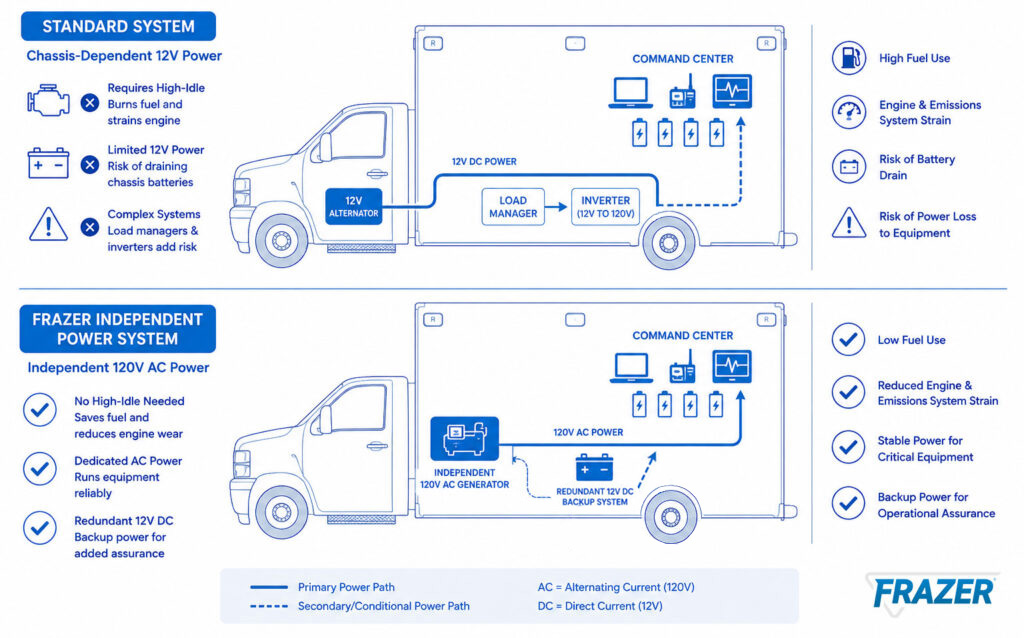
An independent 120V AC power system can keep clinical equipment and climate control running while the chassis engine is off. Depending on your vehicle’s configuration and electrical load, generator options such as MEPS or Cummins Onan can support long periods of stationary operation.
That’s important for both your care team and your fleet manager. Leaving a diesel engine idling for extended periods can create operating conditions that contribute to soot buildup in diesel particulate filters and may increase maintenance needs. The actual impact depends on the engine, duty cycle, and manufacturer guidance.
With an appropriately sized independent power system, your team can park, shut down the truck engine, and continue using interior lights, diagnostic equipment, and air conditioning. Separating those loads from the chassis can also help limit demands on the vehicle’s batteries and make maintenance planning more predictable.
Power systems are not one-size-fits-all. Some generator configurations, including certain Cummins Onan arrangements, may provide backup options that use the 12V DC chassis system. The equipment you install, its combined electrical demand, and the vehicle’s design determine what is possible. Before selecting a system, make a list of everything your team needs to run at the same time and review it with your vehicle builder.
What HVAC Features Matter in a Mobile Clinic?
A dedicated HVAC system helps maintain a comfortable patient care space without depending on the truck cab’s air conditioning. For programs involving respiratory care or patients with potentially infectious conditions, it’s also important to consider how the vehicle manages airflow and how its systems fit into your clinical infection-control plan.
A regular vehicle air conditioner is designed primarily for driving comfort. A mobile clinic may need to cool a separate treatment area for hours while the truck is parked. Filtration, air circulation, and the separation between cab and patient compartments can vary widely across vehicles.
Frazer offers a dedicated 15,000 BTU, self-contained 115VAC HVAC system with the Dometic BreatheEasy Ionizer. The system uses UV light and nano-filter components as part of a photocatalytic air-treatment process designed to help address certain airborne contaminants and odors. Its performance depends on the conditions, contaminants, and system configuration, so it should be considered one part of a broader infection-control approach rather than a replacement for clinical procedures.
Under specified operating conditions, the HVAC system is designed to provide a minimum cooling differential of 25 to 30 degrees. It also allows for separate climate-control arrangements in the patient compartment and driver’s cab, depending on the vehicle design.
Keep in mind that a comfortable treatment space is not the same as validated medication storage. Vaccines and other temperature-sensitive supplies may still need dedicated refrigeration, monitoring, and handling procedures. Work with your clinical team to define those requirements before finalizing the build.
How Long Can a Mobile Healthcare Vehicle Last?
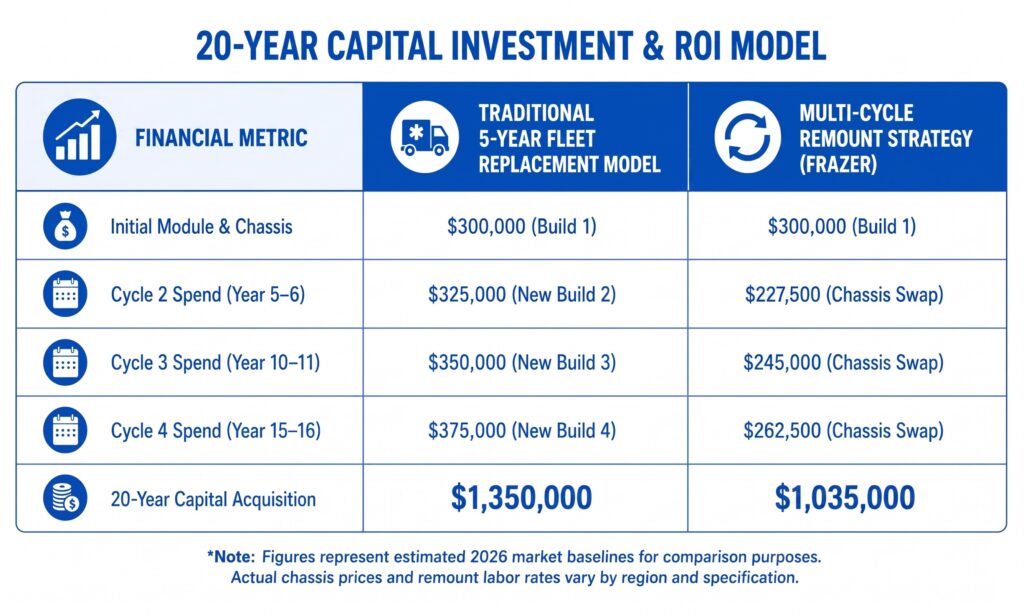
A well-maintained, all-aluminum, wood-free module may serve through more than one truck chassis. That opens the door to remounting the same clinical space on a replacement chassis instead of buying an entirely new vehicle every time the truck reaches the end of its service life.
Some fleets plan around a five- to seven-year chassis replacement cycle. A module built for long-term use can be evaluated separately from the chassis, allowing you to think beyond the first purchase when you set your budget.
Frazer modules use welded 6061-T6 aluminum structural frameworks and wood-free construction. Avoiding wood subfloors and MDF cabinetry reduces reliance on materials that can deteriorate when exposed to moisture. Depending on structural condition, maintenance history, chassis compatibility, and refurbishment requirements, a module may be remounted up to four times and potentially remain in service for more than twenty years.
This is where Lowest Overall Cost of Ownership (LOCO) matters. The question isn’t simply what the vehicle costs today. It’s what your program will spend over time on chassis replacement, module refurbishment, maintenance, and service interruptions.
For perspective, the Houston Fire Department operates 129 Frazer units, and some modules are approaching twenty years in service. With multiple remounts, certain modules may exceed 1,000,000 cumulative miles. Those examples show what’s possible with long-term planning, not a guaranteed lifespan for every vehicle. Actual results depend on how a vehicle is used and maintained.
Choosing the Right Layout for Your Care Team
A mobile healthcare vehicle should match the way your team works. A 12-foot module may provide enough space for some outreach programs, while services involving two patients, primary care procedures, or telemedicine equipment may need a larger footprint.
Start with the clinical workflow. How many team members will be inside at once? Where will patients sit or lie down? What equipment needs power, secure mounting, or quick access? Answering those questions early helps you avoid a layout that looks good on paper but slows your team down in the field.
Frazer’s Foundation series features a 96-inch-wide module with nearly 50 inches of open aisle space. For programs needing more room, an 18-foot mobile clinic can accommodate a larger workspace. Depending on the equipment, layouts may also include retention mounts designed to meet SAE J3043 specifications.
The floor plan is only part of the decision. You’ll also want to understand how easily the vehicle can be serviced and what support is available after delivery. In a double-blind industry study documented in the “Survey Results Presentation 10-30-20,” buyers ranked “Support after the sale” as their most important attribute. When respondents were asked which brand spent the least time in the shop, Frazer received 39% of mentions.
Those results reflect the respondents in that study, not a guarantee of future performance. They do highlight an important procurement question: Who will help keep your program moving when the vehicle needs attention?
Plan Your Mobile Healthcare Vehicle Around Your Mission
Community paramedicine can make care more accessible, help people manage ongoing health needs, and support local efforts to reduce avoidable emergency department visits. Success depends on your clinical model, staffing, patient population, and community partnerships. The vehicle should make that work easier, not create new obstacles.
Before you finalize your specifications, consider how your team will power its equipment, manage temperatures, move through the treatment space, and maintain the vehicle over time. Those decisions can affect the day-to-day experience for both patients and providers.
Planning a community paramedicine program? Talk with the Frazer team about your clinical equipment, independent power needs, and long-term fleet plans. We’ll help you explore a mobile healthcare vehicle configuration built around the care you want to deliver.
How do you power a mobile healthcare vehicle without idling?
Frazer mobile healthcare vehicles can use independent 120V AC power systems, including MEPS and Cummins Onan generators, to operate medical equipment, interior lighting, and climate control. Depending on the vehicle’s configuration and electrical demands, these systems allow crews to shut off the chassis engine while providing care during extended community deployments. This helps reduce unnecessary engine idling, limits chassis wear, and supports more efficient fleet operations.