
How to Evaluate Mobile Clinic Manufacturers: A 5-Point Procurement Checklist
Buying a mobile clinic is a major investment. You need a vehicle that supports your medical team, protects expensive equipment, and stays ready to serve your community. Your Request for Proposal (RFP) is where those expectations should begin.
A well-written RFP gives manufacturers clear requirements and helps your team compare their proposals. This matters even more when purchasing rules require you to select the lowest qualified bidder. If your specifications leave out important details, you may end up comparing vehicles that are built for very different demands.
Mobile clinics and Mobile Stroke Units (MSUs) have needs that go beyond those of a standard work truck or emergency vehicle. Medical equipment can place heavy demands on electrical systems, climate control, and structural design. Your specifications should reflect how the vehicle will actually be used.
Whether you’re planning a community health program or expanding a specialized medical fleet, the goal is the same: get a vehicle that meets your needs today and continues to deliver value over time. This checklist will help you evaluate manufacturers, request useful documentation, and compare options such as Frazer’s 18ft Mobile Clinic.
Why the Lowest Bid Doesn’t Tell the Whole Story
Price matters. But the lowest purchase price doesn’t always mean the lowest cost over the life of a vehicle.
When an RFP uses broad language or standard vehicle specifications, manufacturers may propose very different construction materials, electrical systems, and equipment installations. Those differences can affect how the vehicle performs in the field and how much it costs to maintain.
Consider the electrical system. A mobile clinic may need to power medical equipment, lighting, and air conditioning for extended periods. A system that works well for basic vehicle accessories may not be the best fit for that workload. The same applies to interior materials, equipment mounts, and climate-control systems.
These are questions worth answering before you award a contract. By setting clear, measurable requirements, you give every manufacturer a better understanding of what your organization needs. You also give your procurement team a stronger way to compare proposals.
The 5-Point Checklist for Evaluating Mobile Clinic Manufacturers
Use these five areas to guide your RFP and your conversations with potential manufacturers. Each one addresses a part of the vehicle that can affect performance, maintenance, or long-term value.
1. Ask for Structural Testing Documentation
Mobile clinics can carry heavy, expensive medical equipment. A portable CT scanner is one example. Keeping that equipment securely mounted takes careful engineering, and your procurement team should understand how the manufacturer has tested its solution.
SAE J3043 is a standard used to evaluate the retention of certain equipment and payloads under defined test conditions. When this standard applies to your project, ask manufacturers for documentation showing what was tested, how it was tested, and which equipment configurations the results cover.
Frazer developed an SAE J3043-compliant CT scanner mount in the United States. During testing, the retention system withstood more than 50,000 pounds of force with zero damage. The mount was developed to support advanced imaging equipment, including the Siemens SOMATOM On.site.
Results like these give procurement teams something more useful than a general claim about strength. They provide documented information that can be reviewed alongside your equipment and vehicle requirements.
What to ask: Can the manufacturer provide testing records for the equipment mounts proposed for your vehicle? Do those records apply to the equipment and configuration you’re purchasing?
2. Understand How the Clinic Gets Its Power
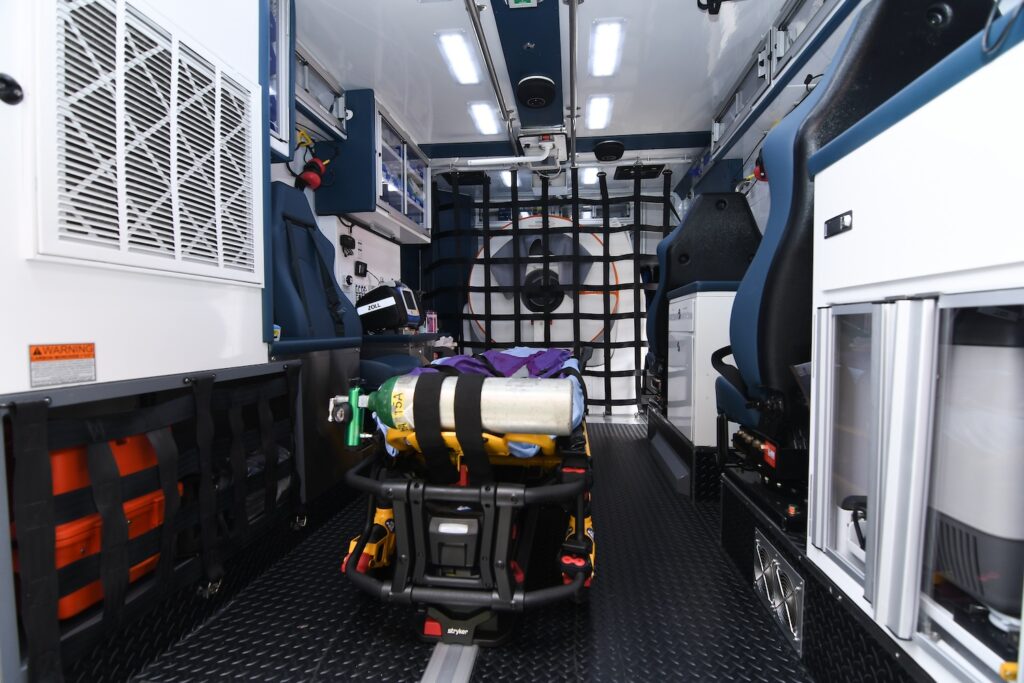
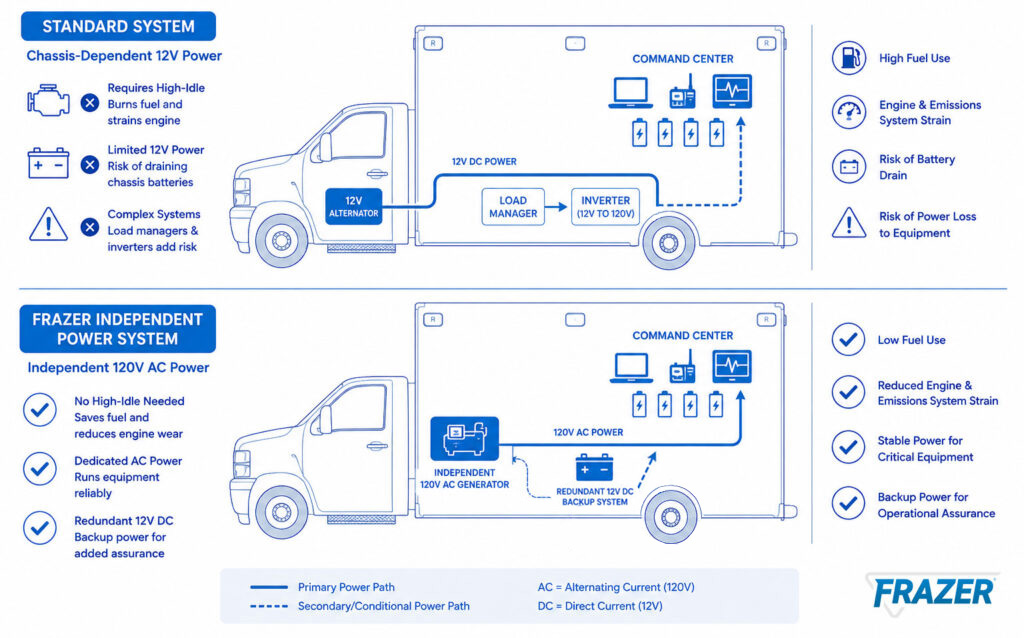
Your mobile clinic is a working medical space. That means its power system needs to support more than vehicle accessories. Depending on your equipment, you may need stable, continuous 120V AC power for medical devices, air conditioning, and other clinical systems.
Some vehicle designs use the truck’s alternator and an inverter to supply electricity. Other designs use an independent power system. Options such as MEPS, Cummins Onan, and hPower offer different ways to supply power to the clinical module.
An independent power system can separate the clinic’s electrical supply from the chassis alternator. Depending on the design, that separation may give your team more flexibility when the truck’s electrical components need service. It can also help you plan around the demands of medical equipment and climate control.
No single power system is the right answer for every application. The best choice depends on what you’re powering, how long the equipment needs to run, and where the vehicle will operate. Fuel use, maintenance requirements, available capacity, and equipment compatibility all belong in the discussion.
What to ask: What equipment can the proposed power system support at the same time? How is that capacity documented, and what happens to clinical power when chassis-related electrical components need service?
3. Look Closely at Construction Materials
A mobile clinic’s interior has to stand up to regular use, cleaning, and life on the road. That’s why the materials behind the finished surfaces deserve as much attention as the layout and appearance.
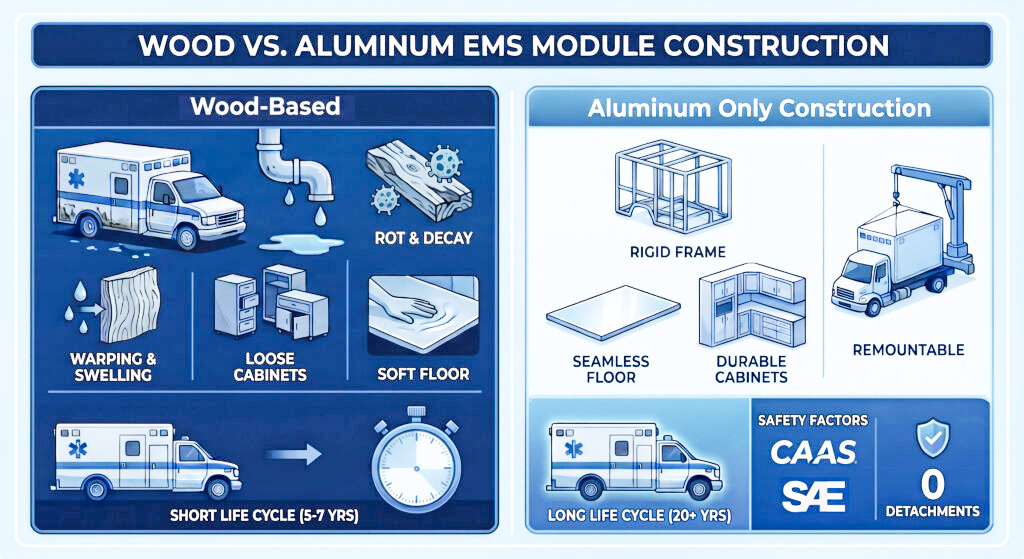
Wood-core cabinetry can be affected by moisture. Water intrusion or repeated spills may cause swelling, warping, or other damage over time. Those risks are worth considering in a space where cleaning and maintenance are part of everyday operations.
Formed aluminum cabinetry offers a wood-free alternative. It can help reduce concerns tied to moisture-related deterioration while supporting a durable, serviceable interior. The module’s structural design, joining methods, and construction quality also matter.
Frazer builds its primary module structure using welded 6061-T6 aluminum tubing and reinforced laminated corner construction. Since 1984, Frazer has built more than 4,500 EMS modules, with zero recorded module detachments in collisions.
Construction claims should be backed by details you can review. Ask manufacturers to explain the materials they use, how major components are joined, and what maintenance those materials may require over the vehicle’s life.
What to ask: Does the proposed module use wood-core materials? What are the primary structural materials, and what documentation is available to support the manufacturer’s construction claims?
4. Plan for Remounting and Long-Term Ownership Costs
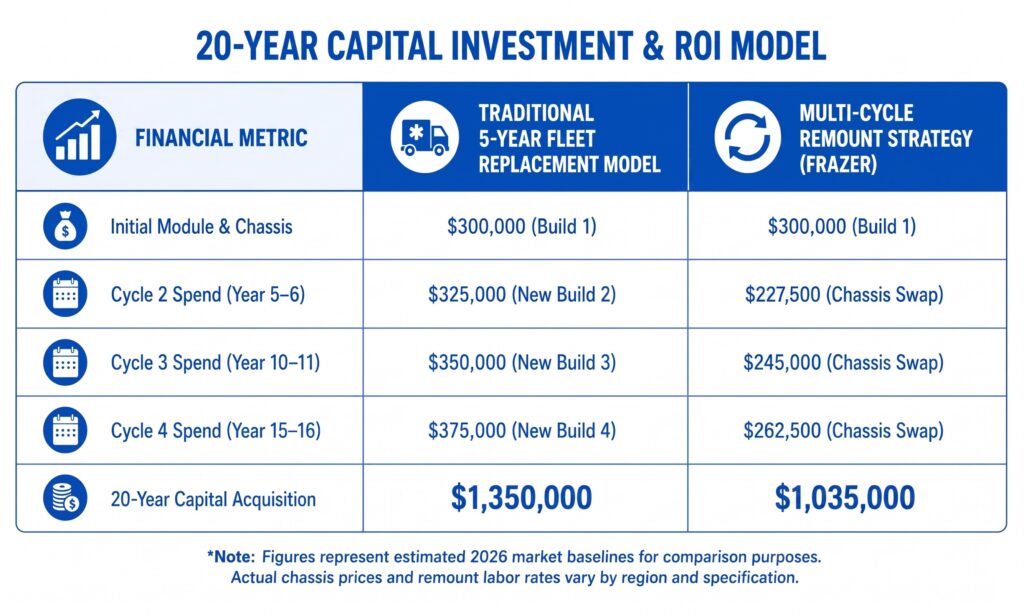
A mobile clinic is a significant capital purchase. But the first purchase isn’t the only cost your organization should consider, especially if you’re planning your fleet over the next 15 to 20 years.
The truck chassis and the medical module don’t always reach the end of their useful lives at the same time. Remounting allows an organization to move an existing module onto a replacement chassis when the original truck needs to be retired.
Whether a module can be remounted depends on its condition, the replacement chassis, and any updates needed to keep the vehicle suitable for service. When those factors line up, remounting can provide another option besides buying an entirely new mobile clinic.
That’s an important part of evaluating Lowest Overall Cost of Ownership (LOCO). Instead of looking only at the purchase price, consider maintenance, chassis replacement, remounting, equipment upgrades, and the module’s expected service life.
For example, the Houston Fire Department operates Frazer modules that routinely see more than 260,000 miles per chassis. By remounting some units up to four times, these modules have exceeded 1,000,000 miles of total service.
That experience shows why remountability deserves a place in long-term fleet planning. It doesn’t guarantee the same result for every vehicle, but it gives procurement teams a practical reason to compare more than the initial bid.
What to ask: Can the module be remounted? What inspections, repairs, or upgrades might be required, and how should those costs be included in your long-term budget?
5. Read the Warranty and Ask About Service After the Sale
A warranty is only useful when you understand what it covers. With a custom mobile clinic, that means knowing where the OEM chassis warranty ends, where the module warranty begins, and how service requests are handled.
Before choosing a manufacturer, request the complete written warranty terms. Review the coverage periods, exclusions, claim procedures, and responsibilities for different vehicle components. Your team should know who to contact when a problem comes up and what support is available.
Frazer provides a lifetime warranty on new module construction and a five-year electrical warranty for the original owner, subject to the applicable terms and conditions. When Frazer remounts a module, its construction warranty is renewed for two years under the applicable remount warranty provisions.
For municipal purchases that involve performance bonds, it’s also important to understand how the bond and warranty provisions work together. Frazer’s stated warranty provisions limit warranty claims to one year in relation to any Performance Bond. Your procurement and legal teams should review the contract documents to understand how that language applies to your purchase.
Warranty coverage is one part of the picture. Day-to-day support matters, too. Ask about technical assistance, replacement parts, service availability, and the manufacturer’s process for helping your maintenance team resolve problems.
What to ask: What is covered, for how long, and for whom? Who handles warranty claims, and what kind of support will your team receive after delivery?
Choose a Manufacturer That Will Support Your Fleet for the Long Haul
A detailed RFP helps you choose the right vehicle. But your relationship with the manufacturer doesn’t end when the keys are handed over.
Mobile clinics need regular maintenance, occasional repairs, and reliable technical support. When something goes wrong, your team needs clear answers and a practical path forward. That’s why service after the sale should be part of your buying decision from the start.
In a double-blind market research study of EMS and Fire professionals, respondents ranked “Support after the sale” as the most important attribute when choosing a builder. When asked which brand spent the least amount of time in the shop, 39% of respondents mentioned Frazer.
Those results reflect the views of the professionals surveyed, not a guarantee of future vehicle performance. Still, they reinforce a question every buyer should ask: What will it be like to work with this manufacturer after delivery?
At Frazer, serviceability is part of the design conversation. Our vehicles use straightforward, non-multiplexed point-to-point wiring. It’s an approach often called the KISS Principle: Keep It Simple, Stupid. The goal is to make electrical systems easier to understand, troubleshoot, and service.
Depending on the repair and vehicle configuration, this design may allow local maintenance teams to complete certain service tasks using commonly available automotive components. Combined with factory-direct technical support, it reflects Frazer’s focus on helping customers care for their vehicles long after delivery.
As you compare manufacturers, look at how they build their vehicles, how they document their claims, and how they respond when customers need help. A strong procurement decision considers all three.
Build an RFP Around the Way Your Team Works
Your mobile clinic should be built around your mission, not the other way around. Clear specifications help manufacturers understand what you need and give your organization a better way to evaluate what they’re offering.
Start with the equipment your team will use, the services you’ll provide, and the conditions where the vehicle will operate. Then use this five-point checklist to review structural testing, power systems, construction, remountability, and post-sale support. Together, these details can help you make a more informed decision about long-term performance and cost.
Planning a mobile clinic or Mobile Stroke Unit? Contact the Frazer team to talk through your project. We can help you explore vehicle configurations, understand relevant engineering considerations, and identify specifications that fit your clinical needs and long-term fleet goals.
What safety standards must mobile clinic manufacturers meet?
Safety requirements depend on the vehicle’s classification, intended use, and applicable regulations. Standards such as KKK-A-1822F, NFPA 1917, and CAAS GVS may apply to certain EMS vehicle configurations. For mobile clinics carrying heavy medical equipment, buyers should also ask for applicable SAE J3043 equipment retention testing documentation.