
Passive vs. Active EMS Air Filtration: Delivering the #1 Safety Feature Crews Demand
When evaluating fleet upgrades, EMS directors and fleet managers have a lot to consider. Budgets matter, but so does the environment where crews work and patients receive care. Research indicates that HVAC and air filtration rank highly among the safety features EMS professionals consider when evaluating a vehicle.
Customer Insight: According to double-blind market research conducted by Smart Advantage, 76% of EMS professionals rank HVAC and air filtration as the #1 safety feature they look for in a vehicle.
Crews may have concerns about airborne pathogens or patient modules that retain odors from previous calls. Department leaders also have to think about how illness and potential cross-contamination could affect staffing and vehicle availability. As departments write RFPs and plan their next fleet cycle, air management technology deserves a closer look.
This guide breaks down the difference between passive filtration and active EMS vehicle air treatment. It also explains how HVAC design can support air quality, infection-control practices, crew comfort, and practical fleet maintenance.
The Baseline: Understanding Passive HEPA Filters
Standard passive filters are a common starting point in mobile healthcare, but it is important to understand what they do and what they do not do. A passive filter works much like a household vacuum bag. As air passes through the filter, physical dust, dirt, and particulates are captured in synthetic or paper filter media.
The filter captures those particles rather than actively treating the circulating air. Over time, especially in a high-volume 911 environment, that filter media can accumulate material and require service or replacement. As material builds up, airflow may become restricted, and filtration alone may not address lingering odors after certain transports.
This is where active air treatment adds another layer to the air-management strategy. Rather than replacing appropriate filtration, cleaning, and infection-control practices, an active system is designed to work alongside them to support a cleaner and more comfortable environment for crews and patients.
What Is the Difference Between Active and Passive EMS Air Filtration?
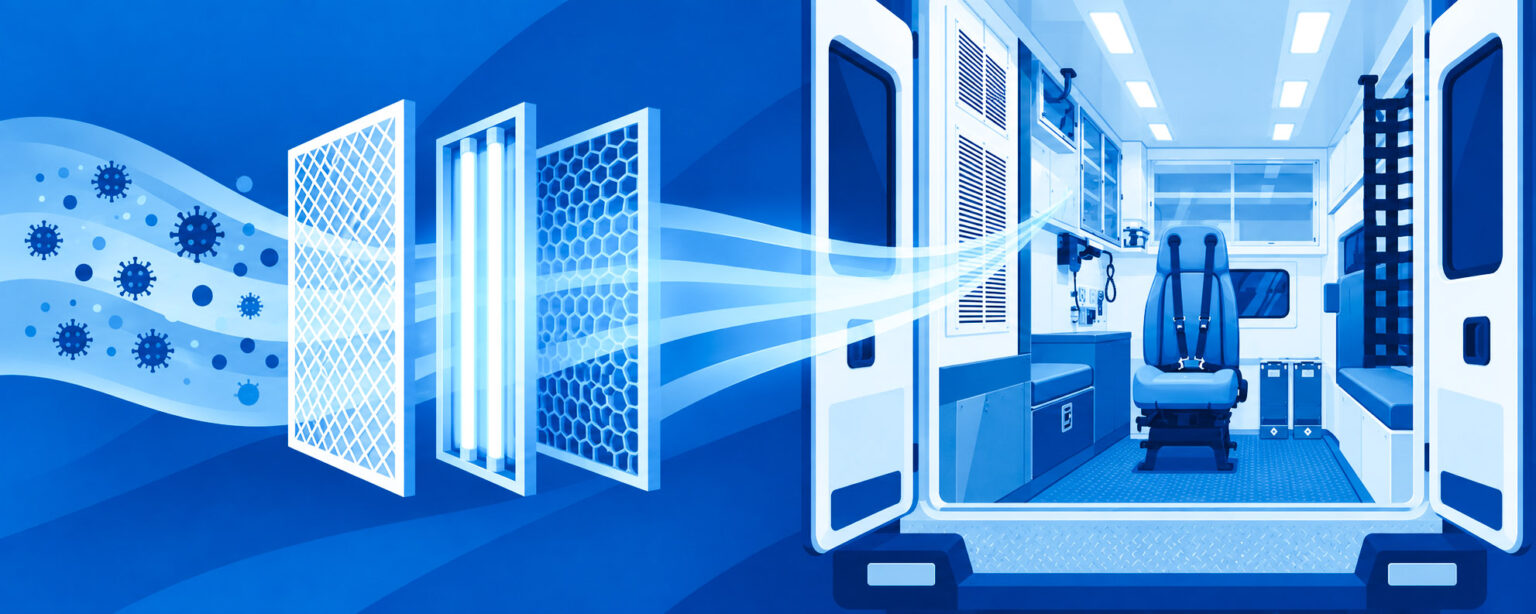
Passive filters use physical filter media, including HEPA filtration, to capture airborne dust and particulates as air passes through them. Active systems add technologies such as UV light and ionization that are designed to help reduce certain airborne contaminants and lingering odors as air circulates through the system.
The basic difference is straightforward. Passive filtration captures contaminants in filter media. Active EMS vehicle air treatment processes circulating air. Used together, these approaches can support a department’s broader filtration, sanitation, and infection-control strategy.
How Does the Dometic BreatheEasy Ionizer Work in an Emergency Vehicle?
The Dometic BreatheEasy system uses an active photocatalytic purification process. Instead of relying on passive filtration alone, it pairs UV light with nano-filters. As air cycles through the system, the technology is designed to help reduce airborne contaminants, odors, and particulates while providing ongoing air treatment when the system is operating.
Frazer integrates Dometic BreatheEasy technology into the module’s climate-control system and also uses this foundational technology in specialized infectious disease units. The goal is practical: help maintain fresher air and reduce the buildup of biological matter associated with unpleasant odors.
High-Volume HVAC: The Engineering Behind 2-Minute Recirculation
It is fair for fleet maintenance leaders to ask how much benefit UV technology can provide inside a mobile environment. Air-treatment performance depends in part on moving air through the system, which makes HVAC design and airflow an important part of the equation.
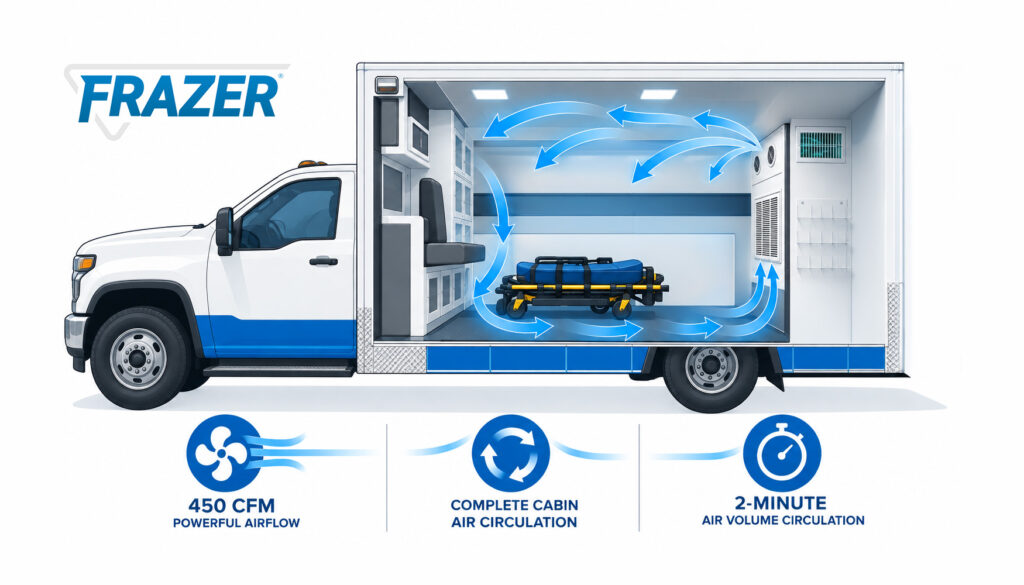
Frazer addresses this with a dedicated 15,000 BTU self-contained climate unit, an independent exhaust blower, and a custom plenum setup. This high-capacity HVAC configuration is designed to recirculate the air in the treatment compartment every two minutes, providing repeated opportunities for circulating air to move through the treatment process.
The system is also designed to handle significant environmental changes while supporting the module’s structural seal. It delivers a minimum cooling differential of 25 to 30 degrees and can maintain a 35°F+ differential between outside and inside temperatures. That climate-control capacity supports the operating environment for crews, patients, internal electronics, and climate-sensitive medical cargo while maintaining the module’s air-management cycle.
How Can EMS Vehicle Design Help Reduce Cross-Contamination Between the Module and Cab?
Physical separation can help reduce opportunities for air exchange between vehicle compartments. Frazer approaches this with a chassis-independent 115VAC HVAC system for the patient module. Because the module does not rely on shared HVAC ducting with the driver’s cab, its air handling remains separate from the front-seat climate system.
Chassis-Independent Air Management
Department leaders also have to consider the staffing and operational effects of crew illness. When someone is out sick, schedules can get tighter and available personnel can be stretched even further. Vehicle design cannot replace proper infection-control procedures, but it can support the department’s broader approach.
Some emergency vehicle configurations rely on chassis systems for portions of their climate-control needs. Frazer takes a different approach. The module’s 115VAC air-conditioning system operates from an independent power source, such as an onboard generator or MEPS system, rather than relying on the truck’s engine-driven air-conditioning system.
Keeping the HVAC systems separate helps limit direct air exchange through shared climate-control ducting between the patient module and driver’s cab. This physical separation is designed to reduce opportunities for cross-contamination through shared HVAC pathways while supporting the department’s broader infection-control practices.
Advanced Air Treatment Designed for Field Serviceability
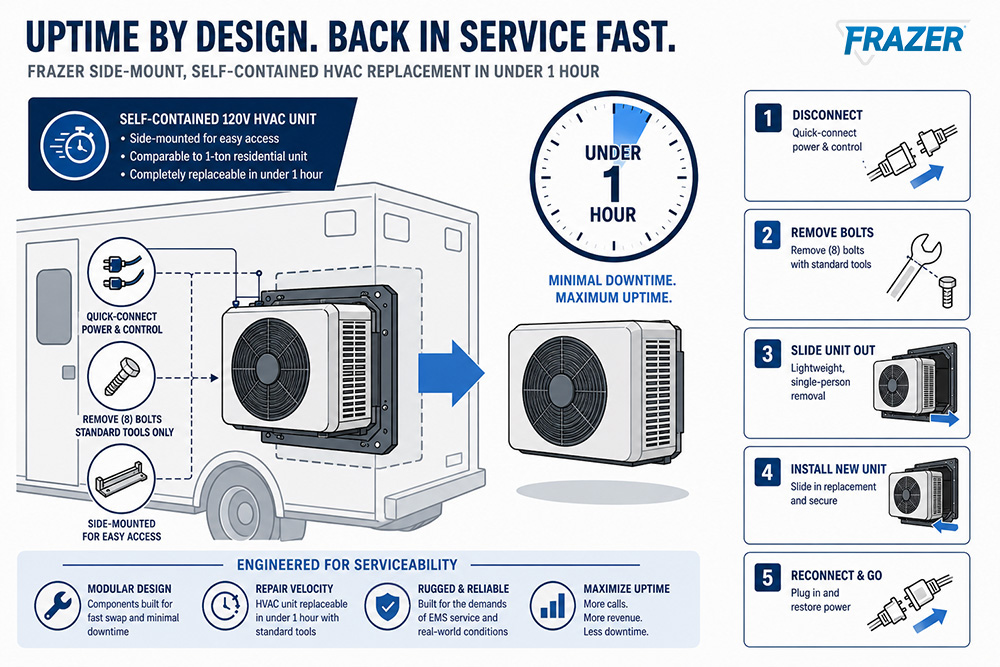
Air treatment is only useful if departments can keep it working. Fleet managers and mechanics need to consider how additional vehicle systems affect maintenance, downtime, and long-term ownership. Specialized equipment can add service requirements, so Frazer designs its electrical and air-treatment systems with field serviceability in mind.
Frazer’s electrical design follows the KISS principle: Keep It Super Simple. We use standard point-to-point wiring, common terminal strips, and standard automotive relays, reducing reliance on proprietary printed circuit boards in these applications.
The same practical thinking applies to routine HVAC and purification maintenance. Physical air filters, Part No. 35901, and active UV bulbs are field-replaceable by fleet mechanics. These service components can be replaced without proprietary diagnostic software for the replacement itself.
That serviceability supports Frazer’s Lowest Overall Cost of Ownership, or LOCO, approach. Giving fleet teams practical access to serviceable components may help reduce avoidable delays associated with specialized component replacement and get units back where they belong: serving the community.
Specify an Air Management System Designed Around Your Crew
Improving fleet air quality involves more than choosing a filter on an RFP. Air circulation, compartment separation, climate control, serviceability, and the environment where crews spend their shifts all deserve consideration. From independent power to field-serviceable components, Frazer designs its EMS vehicle systems around practical operation, crew comfort, and long-term fleet needs.
If you are planning your next vehicle and have questions about air management, talk with the Frazer team. We can walk you through how independent HVAC and active air-treatment systems work, what they are designed to do, and how they can fit the needs of your department.
What is the difference between active and passive EMS air filtration?
Passive filters use physical filter media, including HEPA filtration, to capture airborne dust and particulates as air passes through them. Active systems add technologies such as UV light and ionization that are designed to help reduce certain airborne contaminants and lingering odors as air circulates through the system.