
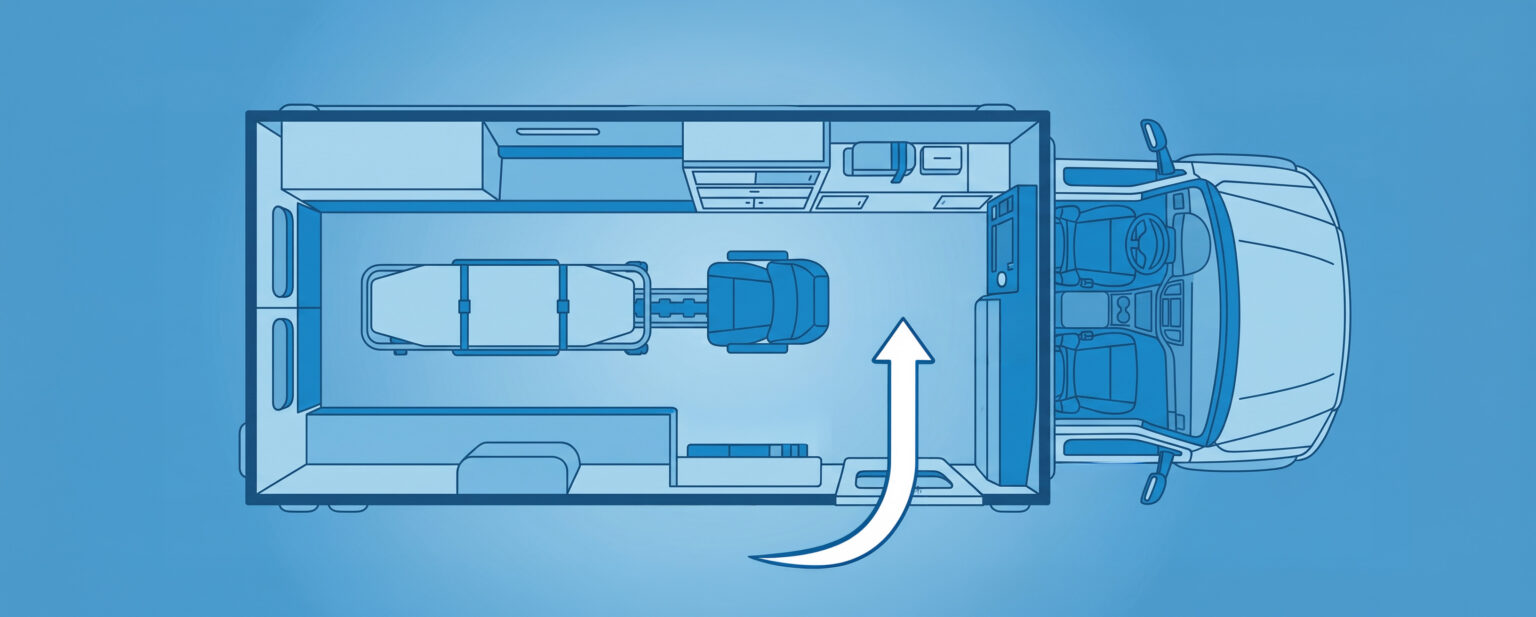
The Ergonomic and Safety Benefits of a Door-Forward Ambulance Layout
During transport, leaving a seated position to retrieve equipment can be risky. A door-forward layout can help reduce that unnecessary movement by placing airway equipment, ALS cabinets, and other frequently used supplies closer to the primary medic seat.
Equipment access is only one part of the design. Departments should also consider cooling capacity, electrical demand, restraint placement, structural composition, service access, and the final location of each piece of equipment.
This guide explains the potential ergonomic benefits of a 14 ft door-forward EMS vehicle. It also reviews how door-forward workflows can support seated service and assist crews in managing on-scene situations.
Why Are Crews Evaluating Door-Forward Layouts?
For many frontline medics, the main benefit of a door-forward layout is easier access to equipment. The design often places commonly used supplies within reach, allowing crews to complete more tasks while seated and restrained.
In some traditional layouts, primary ALS equipment and first-in bags are stored near a side entry door in the middle or rear of the module, so depending on cabinet placement, a medic seated at the head of the cot may need to leave the seat to retrieve those items.
A door-forward layout moves the side entry door toward the front of the module, directly behind the passenger seat. This allows primary cabinets and work surfaces to be placed closer to the main medic position.
Depending on the final configuration, a medic may be able to manage an airway, prepare medications, and reach common trauma supplies while remaining seated and restrained. The design can also help keep loading and unloading activity away from the primary patient-care workspace.
How Can a Door-Forward Layout Support Seated Workflows?
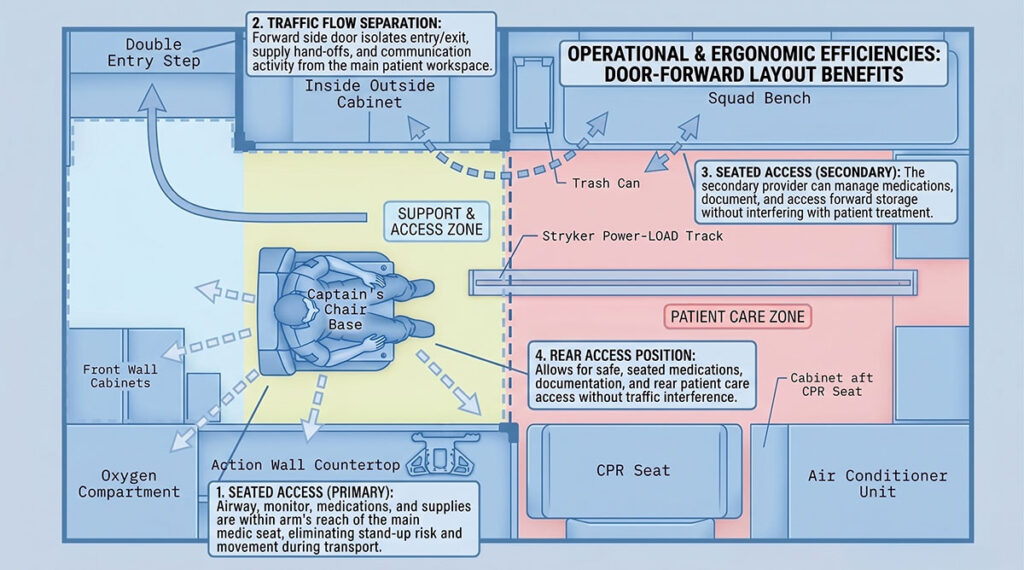
A door-forward configuration can give crews another way to organize the module around seated patient care. By placing frequently used equipment and supplies around the primary medic seat, departments can design a workspace that may reduce unnecessary movement during transport.
Airway equipment, medications, trauma supplies, monitors, and other commonly used items can be positioned within practical reach of the primary medic. This may allow providers to complete more tasks while remaining seated and restrained.
The door location is only one part of the layout. Cabinet placement, work surfaces, equipment mounts, and storage locations all affect how easily providers can reach what they need. A good place to start is by looking at what the medic uses most often during a typical call and designing outward from that seated position.
Frequently used supplies can stay closer to the primary work area, while items used less often can be stored farther away. The same thinking can be applied to the secondary medic position. If that provider is expected to prepare medications, document care, operate equipment, or assist with treatment, the surrounding cabinets and work surfaces can be arranged around those tasks.
Depending on the interior configuration, a door-forward layout can also create two more defined work areas. This gives departments another option for organizing patient care and support tasks around the way their crews actually work.
How Can a Door-Forward Layout Support Movement Around the Patient?
An EMS call can involve several people moving in and out of the module. Equipment may be passed through the side door, additional responders may enter, and crew members may need to communicate with people outside while patient care continues.
Moving the side entry toward the front of the module can help separate some of that activity from the patient-care area. A provider working near the forward workspace may be able to receive supplies, communicate through the doorway, or handle support tasks while another medic remains focused on the patient farther back in the module.
The layout will not eliminate movement or interruptions, but it gives departments another way to manage how people and equipment move through the space. It can also create more separation between the open side door and the patient, which may provide additional privacy depending on the scene, crew activity, and vehicle configuration.
What Should Crews Consider When Designing the Interior?
During the design process, crews can walk through common calls and pay attention to what each provider needs. Consider what the medic at the head of the cot must reach without standing, where airway equipment should be stored, where medications will be prepared, where the monitor will sit during transport, and which supplies need to be accessible from the forward workstation.
It is also worth looking at how two providers work together. A secondary workspace can be useful when one medic can handle documentation, medication preparation, equipment operation, or other support tasks without getting in the way of the provider treating the patient.
The area just inside the forward doorway deserves the same attention. Seating, cabinets, equipment, bags, and crew movement all compete for space. Walking through how responders enter the module while carrying equipment can help departments decide where that equipment should go once it is inside.
Is a Door-Forward Layout Right for Every Crew?
A door-forward layout may not be the preferred choice for every department. Fleet managers and crews that have worked in traditional layouts for years may prefer familiar equipment locations, storage patterns, and movement through the module.
Changing the location of the door, cabinets, countertops, and supplies can take some adjustment. That is why frontline crew involvement can be valuable before the final layout is approved.
Departments can walk through realistic scenarios such as airway management, cardiac arrest, trauma care, medication preparation, and calls involving several providers. These exercises can help identify whether frequently used equipment is within practical reach and whether multiple crew members can work in the available space without creating unnecessary interference.
Consider whether a door-forward layout supports your crew, your equipment, your staffing model, and the way your team provides patient care.
Ready to Plan Your Door-Forward Workspace?
Start with the crew and the workflow, then build the interior around them. Think about where each medic sits, what they need to reach, how equipment moves through the module, and where common patient-care tasks take place. Those observations can help guide decisions about cabinets, work surfaces, equipment storage, seating, and the overall interior configuration. The goal is to create a space that supports the way your team actually works.
See our gallery of dozens of door-forward units to explore how existing custoemrs have approached this important layout consideration.
Contact the Frazer team to talk through how a 14 ft door-forward configuration can be designed around your department’s crew, equipment, and patient-care needs. We can help you explore a layout that supports the operational needs of your next EMS vehicle.
Does a door-forward ambulance stay cool when the side door is open?
HVAC recovery time depends on the system’s capacity, outside temperature, humidity, vehicle operation, airflow, and how often the door is opened.
Frazer uses an independent 120V HVAC system designed to support module cooling while the vehicle is moving or parked. Under defined test conditions, the system is engineered to maintain up to a 35°F difference from the outside temperature. Actual performance depends on the vehicle configuration and operating environment.