
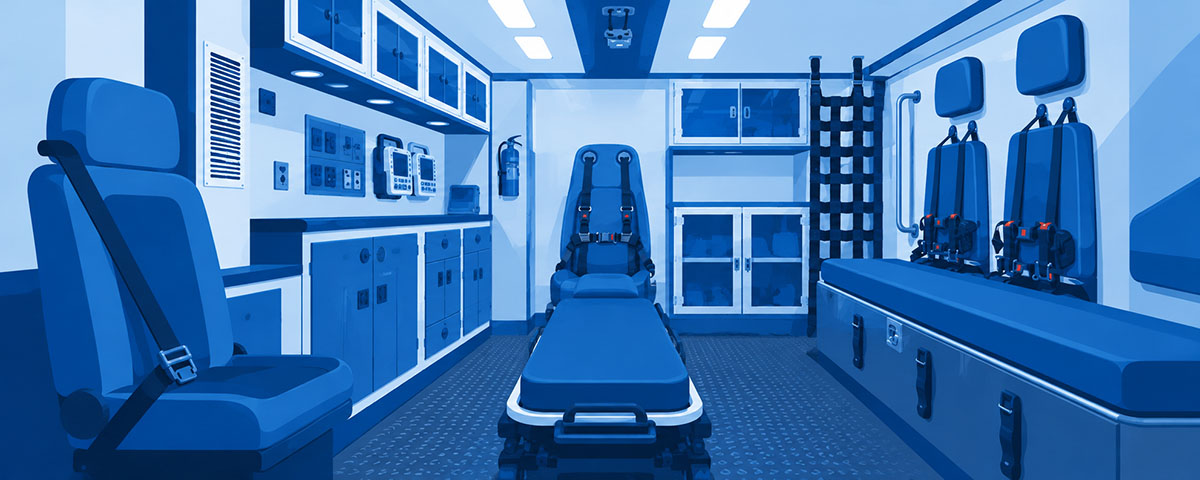
Door-Forward vs. Standard Ambulance Layouts: Optimizing Your Primary Workspace
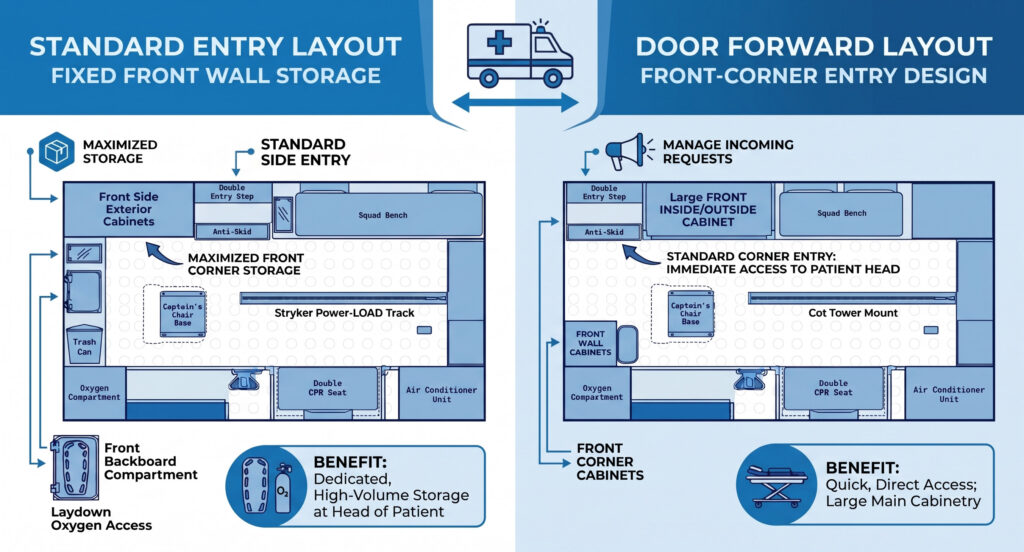
When comparing a door-forward layout with a standard ambulance layout, one of the biggest differences is the location of the side entry door. A door-forward design moves that entry closer to the cab, creating a continuous wall of cabinetry beside the primary care seat. That extra working area can help keep frequently used trauma, airway, and diagnostic equipment within easier reach.
Picture your crew moving through city traffic with a patient in the back. You are seated and buckled in when the patient’s condition changes. You need the suction unit or airway bag right away. Depending on the layout and where that equipment is stored, getting to it could mean twisting, reaching across the patient, repositioning yourself, or leaving your seat.
Those movements may seem small, but they add up over a long shift and throughout a medic’s career. That is why patient-compartment layout deserves a place in the conversation when your department starts planning its next vehicle.
This guide compares door-forward and standard layouts so your apparatus committee can better understand how each configuration affects storage, equipment access, crew movement, and day-to-day workflow.
What Is the Benefit of a Door-Forward Ambulance Layout?
Moving the side entry door forward creates a longer, uninterrupted section of cabinetry beside the primary care position. With the right cabinet and equipment configuration, frequently used gear can stay closer to the medic, reducing unnecessary reaching and movement while providing more options for organizing the primary workspace.
The Standard Layout: Familiar, but More Segmented
A standard ambulance layout typically places the side entry door near the middle of the curbside wall. It is a familiar configuration for many departments, and crews may already have workflows, training, and equipment-storage practices built around it.
The tradeoff is that the doorway separates the curbside cabinetry into different sections. Equipment may need to be stored both in front of and behind the door. Depending on how the vehicle is configured, a medic may need to turn, reach farther, stand, or reposition to access certain supplies.
That does not make a standard layout the wrong choice. It simply means departments should look closely at where their crews spend the most time, which equipment they use most often, and how much movement is required to reach it. Over a 12-hour or 24-hour shift, those details can have a real effect on comfort and workflow.
The Door-Forward Layout: Creating a More Continuous Workspace
When departments first consider a door-forward configuration, one common question is whether moving the side door will reduce usable space. Crews may wonder if the front of the module will feel tighter or if they will lose storage near the CPR seat.
The goal of a door-forward layout is not simply to move the door. It is to use the curbside wall differently. Moving the entry closer to the cab opens a longer section of continuous cabinetry near the primary care seat, giving departments more flexibility in how they organize frequently used equipment.
Frazer’s 14 ft Door-Forward configuration, for example, gives departments the ability to consolidate more equipment around the primary workspace. Depending on the cabinet design and equipment selected, airway, diagnostic, trauma, and other commonly used supplies can be placed closer to the medic’s seated position.
The result is a workspace that can be organized around how your crew actually works instead of asking your crew to work around the location of the door.
How Does Chassis Selection Affect Ambulance Cot Loading Height?
Layout is not the only factor that can affect crew ergonomics. Chassis selection can also influence deck height and the angle required to load a cot into the patient compartment.
Type III vehicles use van-style chassis with lower frame rails than many medium-duty Type I trucks. Depending on the chassis, suspension, cot system, and final vehicle configuration, that lower frame height may result in a lower deck and reduce the lift angle required during cot loading.
Reducing the “Twist and Reach”
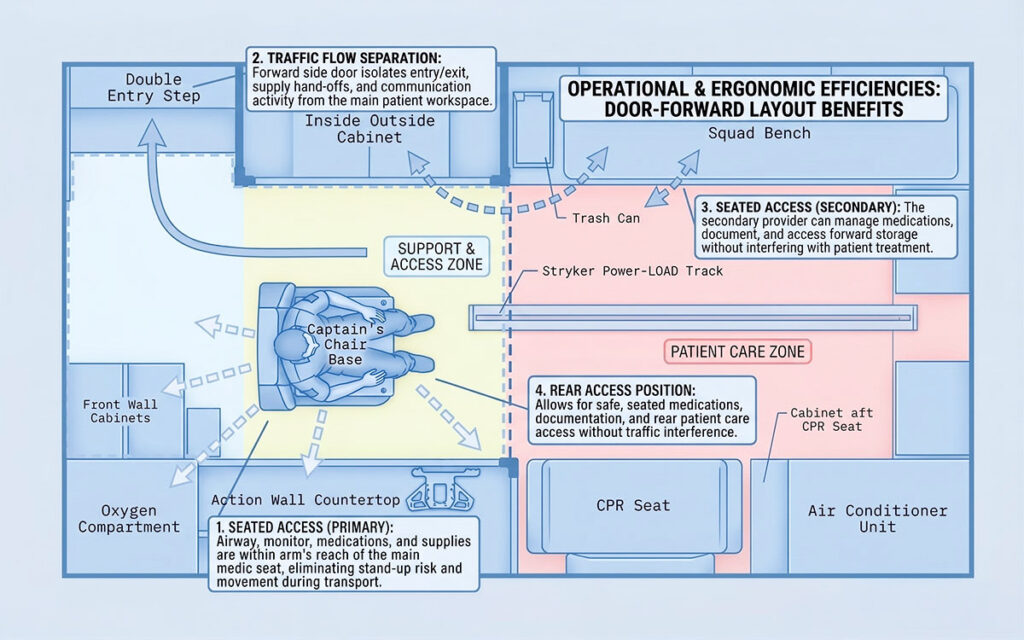
Ergonomics inside an EMS vehicle is about more than choosing a comfortable seat. Equipment location matters, too. Every time a medic has to turn, reach, stand, or move across the patient compartment, the layout is affecting how that person works.
With a standard layout, the side door divides the curbside storage area. Depending on where equipment is placed, crews may need to reach outside the immediate seated workspace to get what they need. Some medics describe this as the “twist and reach.”
A door-forward design gives departments another way to approach that problem. By creating continuous storage near the primary care seat, frequently used equipment can be arranged around the medic’s normal working position. A thoughtful configuration may help crews access more of what they need while remaining seated and buckled.
Workspace design is only one part of patient-compartment safety. The construction of the module and its interior components matters as well. Frazer modules use all-aluminum, wood-free construction along with crash-tested cabinetry and module-to-chassis mounting systems. Frazer has recorded zero module detachments across nearly 2,500 units built since 1984.
Those design and testing considerations are part of a larger goal: build an EMS vehicle that can stand up to the demands crews face every day.
Why Can Ambulance Air Conditioning Struggle While Idling?
Cabinet layout is not the only part of the workspace that affects crew comfort. Climate control matters, especially when crews spend long periods staged, parked, or idling in hot weather.
Some chassis-driven A/C systems can perform differently as engine speed and operating conditions change. Frazer takes a different approach. Its independent 120V AC system uses a dedicated generator, allowing the patient-compartment air-conditioning system to operate independently of chassis engine speed.
Heat Is Part of the Ergonomics Conversation
Working in a hot patient compartment can make an already demanding job harder. When departments evaluate vehicle ergonomics, it makes sense to look beyond seat placement and cabinet access and consider the environment crews work in throughout the shift.
Frazer’s independent 120V AC air conditioning system is designed to provide patient-compartment cooling independently of chassis engine speed. The system is comparable in capacity to a one-ton residential unit and is engineered to maintain up to a 35°F temperature difference from ambient conditions.
Because the system operates from a dedicated power source, it is designed to provide cooling whether the vehicle is moving down the highway or sitting at a staging location. For departments planning a workspace around crew comfort, patient care, and long shifts, climate control is worth considering alongside the physical layout.
Which Layout Fits Your Department’s Workflow?
There is no single layout that works for every department. The right choice depends on your equipment, your crews, your operating environment, and the way patient care happens inside your vehicle.
A standard layout gives many crews a familiar setup, but the center-positioned side door separates curbside storage into multiple areas. A door-forward configuration changes that relationship by creating a longer section of continuous cabinetry near the primary care position. When the storage is planned around the crew’s most-used equipment, that configuration may reduce unnecessary movement and make supplies easier to access.
Your apparatus committee should also look beyond the initial vehicle specification. Crew ergonomics, equipment accessibility, serviceability, climate control, maintenance, and long-term operating costs all contribute to what Frazer calls the Lowest Overall Cost of Ownership, or LOCO.
The goal is not to choose a layout because it is familiar or because it is different. The goal is to choose a layout that makes sense for the people who will work in it every day.
Contact one of our expert configuration specialists today to help your apparatus committee gather information and plan your next specification.
What Is the Benefit of a Door-Forward Ambulance Layout?
A door-forward layout moves the side entry closer to the cab, creating a continuous section of cabinetry beside the primary care position. With the right equipment configuration, this can keep frequently used supplies closer to the medic and reduce unnecessary reaching or movement during patient care.