The 2026 Guide to EMS Door-Forward Layout Structural Integrity & Safety
Your medics may be asking for a door-forward layout so they can remain seated and secured while treating patients on the move. As a Fire Chief, EMS Director, or Fleet Manager, one of your first questions may be about crew safety and institutional risk. Does placing a side entry door near the front corner affect the structural performance of the module in a collision?
That is an important question. A door-forward design has to balance everyday ergonomics with the responsibility of specifying a vehicle that supports your department’s safety requirements. As more agencies evaluate seated-and-secured care models in 2026, door-forward layouts are becoming an increasingly important operational consideration. When comparing standard vs. door-forward EMS layouts to find the right fit for your fleet, however, should never be evaluated by itself. Materials, structural design, reinforcement, testing, and engineering all matter.
This guide explains the engineering considerations behind EMS door-forward layout structural integrity, how Frazer approaches cooling in a segmented workspace, and how a custom configuration can affect your Lowest Overall Cost of Ownership (LOCO).
Balancing Medic Ergonomics with Patient Care
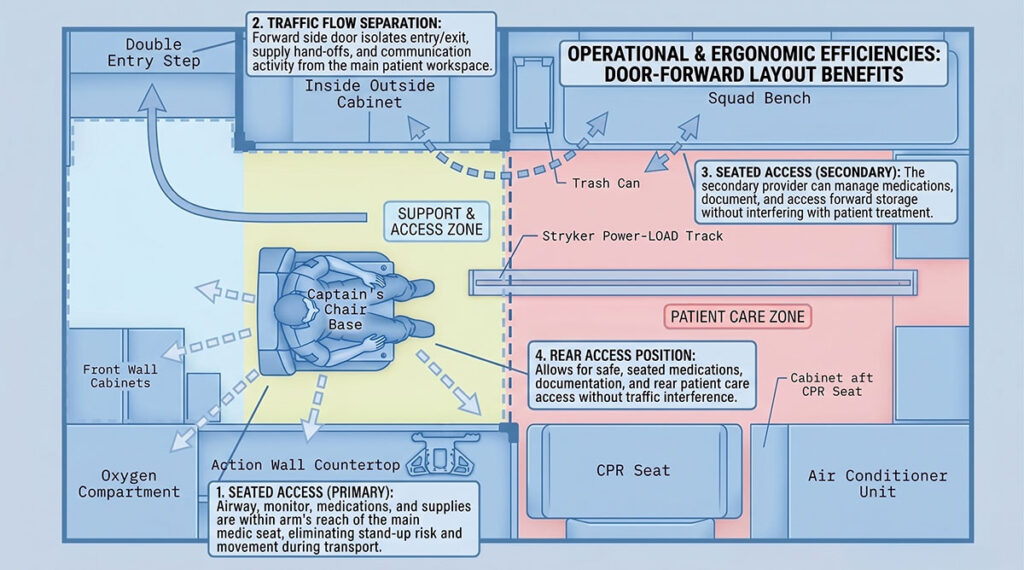
One reason agencies are considering door-forward layouts is the opportunity to support better medic ergonomics and seated-and-secured care. Moving the door forward can allow the primary medic seat to be positioned at the head or side of the patient, depending on the selected configuration. Frequently used equipment such as airway supplies, cardiac monitors, and trauma bags can then be positioned within reach.
The goal is not simply to move the door. It is to create a workspace that supports how your crew actually delivers care. A well-planned layout can reduce the need for medics to stand or move around the patient compartment while the vehicle is in motion by placing important equipment closer to a seated and secured caregiver.
Cot Loading and Workspace Efficiency
Patient compartment design also needs to account for cot loading angles, equipment placement, crew movement, and access to the patient. In some layouts, the position of a centrally located side door can affect circulation space while crews load a cot or move equipment.
A door-forward configuration can create a more defined area around the rear doors for cot loading while separating part of the side entry path from the primary patient-care zone. Depending on the layout, another crew member may be able to enter through the side door and reach equipment with less interference around the medic working near the cot.
For agencies managing high-acuity transports with several crew members in the patient compartment, this type of configuration can support a more organized workflow. The best layout depends on your department’s staffing, equipment, clinical procedures, and operational needs.
Does Moving the EMS Vehicle Door Forward Weaken the Module?
Does moving the EMS vehicle door forward weaken the module in a crash?
Moving a major opening changes the structural load paths engineers must account for in the module design. A door-forward configuration can be engineered to support crash-survivability objectives when the structure around the opening is designed with the appropriate materials, reinforcement, connections, and attachment methods.
Frazer modules use heavy-duty 6061-T6 structural aluminum tubing, and Frazer has zero recorded module detachments in collisions across nearly 2,500 builds. That field history gives agencies another data point to consider when evaluating Frazer’s structural design alongside their own safety and crash-survivability requirements.
It is reasonable to question what happens when the location of a major opening changes. A door near the forward corner affects the load path through the module walls. The door location, surrounding structure, reinforcement, connections, and module-to-chassis mounting system all contribute to how the overall structure is designed to manage collision forces.
The Importance of 6061-T6 Structural Aluminum
When comparing wood and all-aluminum module construction, agencies should look closely at the specific materials and engineering used in each design. During a severe collision, framing materials and connections can be subjected to substantial loads. Material selection, structural dimensions, reinforcement, and attachment methods all play a role in the overall design.
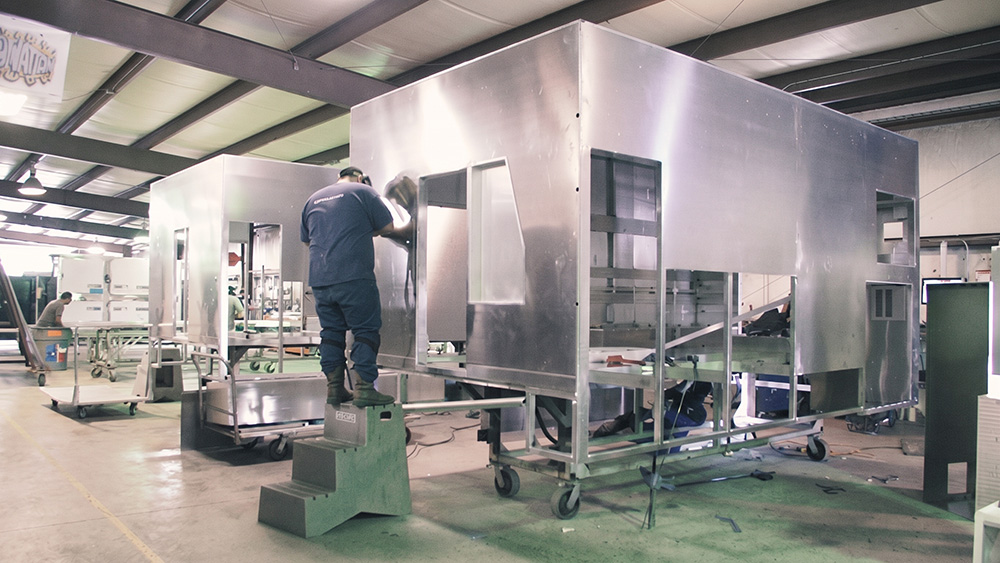
Frazer takes a wood-free approach and builds its modules with 6061-T6 heavy-duty structural aluminum tubing. The base frame uses 3″x1.5″x3/16″ tube and channel, while the roof and walls include additional structural reinforcement. These components work together as an integrated structure designed to help manage collision forces and support the module-to-chassis connection.
Across nearly 2,500 Frazer builds, there have been zero recorded module detachments in collisions. Departments can consider that documented field history when evaluating a door-forward configuration and comparing the structural approaches used by different vehicle builders.
SAE J3043 and Reducing Interior Projectile Risk
Crash-survivability involves more than keeping the module attached to the chassis. Cabinetry, equipment mounts, seating, restraints, and other components inside the patient compartment also matter.
In a door-forward layout, medics may use a 6-point harness to remain seated and secured while providing care. The restraint system is designed to help keep the medic in position during sudden vehicle movement, but equipment retention remains just as important. Frazer’s interior cabinetry and module-to-chassis mounting systems undergo crash testing intended to evaluate their performance under specified test conditions.
From crash-tested LifeDefender cabinets to heavy-duty equipment tracks, these systems are designed to help retain equipment and reduce risks associated with unsecured items during a collision. Agencies evaluating a door-forward design should look at the complete patient compartment, including seating, restraints, storage, equipment mounting, and structural construction.
Why Frazer Uses Independent 120V Power
Some patient-compartment HVAC systems depend on chassis operation or high-idle while the vehicle is stationary. Depending on the chassis and operating conditions, extended high-idle use can contribute to fuel consumption, chassis wear, alternator loading, diesel particulate filter loading, and additional maintenance considerations.
Frazer uses an independent 120V AC generator to power a residential-style air-conditioning system for the module. Because the patient-compartment HVAC has its own power source, agencies can cool the module without relying on chassis high-idle as the primary source of HVAC power.
The system uses a 450 cubic-foot-per-minute fan that recirculates the volume of air in the module approximately every two minutes. From a service standpoint, the side-mounted HVAC unit is self-contained and designed to be replaceable in under one hour. This approach is intended to simplify certain HVAC repairs and help fleets reduce downtime compared with more integrated systems.
Are Custom Door-Forward EMS Vehicles Too Expensive for Municipal Budgets?
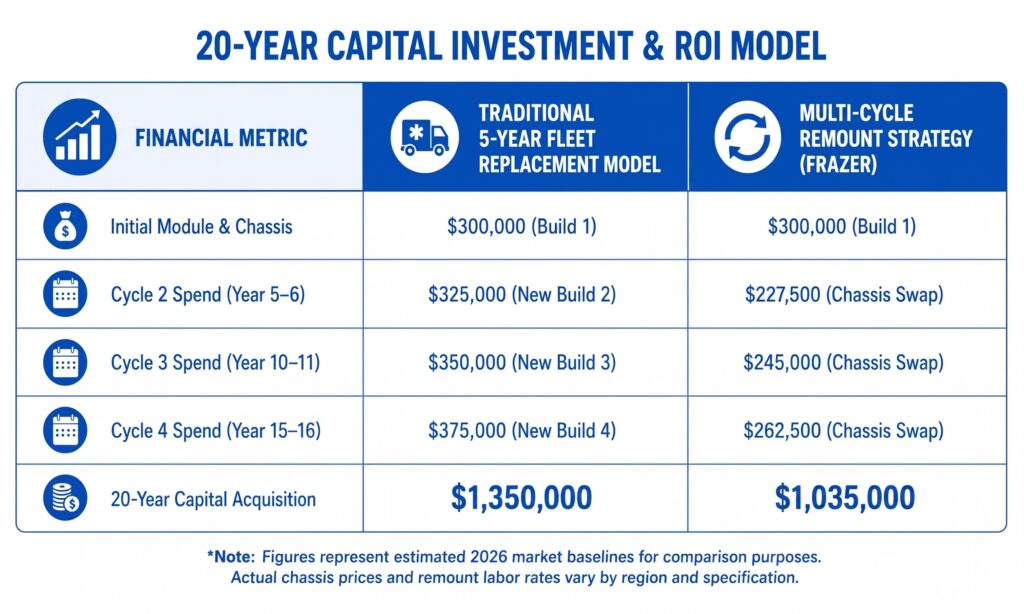
A custom configuration can require a higher initial investment depending on the selected specifications. Initial price, however, is only one part of the fleet cost equation. Frazer’s all-aluminum custom modules are designed with remounting in mind, allowing qualifying modules to be installed on replacement chassis over their service life.
Based on reported fleet data, departments have experienced maintenance cost reductions ranging from 42% to 60% when using this type of long-term module strategy compared with purchasing complete replacement emergency vehicles during each replacement cycle.
That leads to a practical question for City Councils, hospital boards, and procurement teams: Why invest in a highly customized patient compartment if the chassis may reach its replacement point in five to seven years?
The Financial Case for Remountability
Finding the right fit for your fleet means looking beyond initial capital cost and considering Lowest Overall Cost of Ownership. For agencies planning to use a custom module across more than one chassis cycle, remountability can become an important part of that calculation.
Frazer builds its modules with 6061-T6 aluminum and designs them with long-term service and remounting in mind. When a chassis reaches its replacement point, an eligible Frazer module can be evaluated for installation on a compatible replacement chassis instead of automatically replacing the entire vehicle.
Some Frazer modules have remained in frontline service for more than 20 years and exceeded 1 million miles through multiple remounts. Preserving a qualifying custom module while replacing the chassis as needed may allow departments to reduce portions of their long-term capital replacement costs while keeping the workspace their crews already know.
Structuring Your 2026 RFP for Custom Layouts
When you are ready to write your next RFP, clear requirements can make proposals easier to compare. Instead of relying on broad marketing statements, ask each vehicle builder to provide documentation supporting its claims.
If these areas matter to your department, consider addressing them directly in the specification. For wood-free construction, define the structural material you expect, such as 6061-T6 aluminum, and identify where the requirement applies, including framing, flooring, and cabinetry backing. For module power, describe the onboard 120V capability required to support HVAC and medical equipment and ask vendors to identify any chassis high-idle requirements.
Your RFP can also request documentation related to applicable testing or compliance with SAE J3043, CAAS GVS, NFPA 1917, KKK-A-1822F, or other standards required by your agency. Requirements should be tied to the proposed vehicle and components rather than broad manufacturer-level statements.
For agencies considering long-term module use, ask each vendor to explain its remounting process and provide examples of units that have operated across multiple chassis cycles. When long-term fleet data is available, request that as well.
Service should also be part of the comparison. Ask how customers access engineering assistance, parts support, warranty administration, and service after delivery. A vehicle may spend years or decades in your fleet, so understanding the support model before the purchase can be just as important as understanding the build itself.
Conclusion & Next Steps
A door-forward design can support crew ergonomics and patient-care workflows when it is engineered around the department’s operational requirements. Frazer approaches the configuration with wood-free 6061-T6 structural aluminum construction, independent module power, and a design philosophy that supports future remounting.
Structural design, documented testing, HVAC performance, serviceability, workflow, and lifecycle cost should all be evaluated together. Looking at the complete system gives procurement teams, fleet managers, and frontline crews a clearer basis for deciding whether a door-forward layout fits their operation.
Planning your next fleet cycle and looking for practical questions to help shape your structural and financial requirements? Contact our EMS and configuration experts to help develop your next RFP.
Does moving the EMS vehicle door forward weaken the module in a crash?
While traditional wood or thin-wall designs may struggle with altered load paths, custom modules engineered with heavy-duty 6061-T6 structural aluminum tubing are designed to maintain crash survivability. Frazer’s record of zero module detachments demonstrates that an ergonomic door-forward layout does not have to compromise your department’s structural safety.