How Your Type I Ambulance Truck Chassis Impacts Fleet Longevity
Choosing the right Type I ambulance truck chassis is about more than finding a truck that can carry your patient module. It’s about keeping your emergency vehicle in service, making maintenance easier, and getting the most value from your fleet investment. The chassis you choose, how the module attaches to it, and how you power your equipment can all affect long-term operating costs.
For EMS fleet managers, downtime is more than an inconvenience. When a vehicle is in the shop, crews may have fewer units available to serve their communities. Diesel emissions problems, suspension wear, and electrical repairs can all affect vehicle availability. While no vehicle is maintenance-free, thoughtful decisions during the specification process can help your team prepare for these challenges.
This guide covers the chassis, mounting, electrical, and maintenance considerations that matter when planning for long-term service. We’ll also explain how a durable, wood-free patient module and an independent power system can support future remount opportunities.
How Chassis Selection Affects Long-Term Costs
It’s easy to focus on whether a truck can handle the weight of a patient module. But meeting the minimum weight requirements is only part of the decision. The right chassis should also fit your equipment needs, crew requirements, driving conditions, and maintenance resources.
Start with the Gross Axle Weight Rating (GAWR) and available payload capacity. These ratings help determine how much weight the vehicle can safely carry. Operating near a chassis’s rated capacity can place additional demands on the brakes, tires, and suspension, especially in severe-duty EMS applications. Depending on the configuration and operating conditions, some fleets may see brake replacement intervals as short as 15,000 miles, along with uneven tire wear or more frequent suspension repairs.
Choosing a chassis with enough payload margin gives your department room to account for medical equipment, crew members, supplies, and other operational needs. It also helps reduce the likelihood of regularly operating near the vehicle’s rated capacity. Your chassis selection should reflect how your team actually uses its vehicles, not just how the specifications look on paper.
Why Chassis Flex and Module Mounting Matter
Truck frames are designed to move. When a vehicle crosses an uneven driveway, hits a pothole, or travels across rough terrain, the frame rails can twist slightly. This movement is called torsional flex, and it’s a normal part of how commercial truck frames respond to the road.
The challenge comes when those twisting forces transfer into the patient module. Over time, repeated stress may contribute to loose fasteners, cabinet movement, or changes in exterior door alignment. The way a module attaches to the chassis can make a difference in how those forces are managed.
Frazer uses engineered mounting brackets designed to accommodate chassis frame deflection during demanding operating conditions. These mounts help manage the transfer of torsional forces between the truck chassis and Frazer’s 3” x 1.5” x 3/16” 6061-T6 aluminum module structure. It’s one part of designing an emergency vehicle with long-term service in mind.
Comparing Truck Chassis Options for Type I Emergency Vehicles
There isn’t one chassis that’s right for every EMS department. Your decision depends on factors such as payload, powertrain preferences, cab space, local service availability, and the conditions your crews face every day. Several commercial truck platforms offer configurations worth considering for Type I applications.
Ford Super Duty: F-450 and F-550
Ford’s F-450 and F-550 commercial platforms give departments access to an established parts and service network. Depending on the model year and configuration, gas and Power Stroke diesel powertrains may be available. That gives fleet managers options when balancing performance requirements, maintenance preferences, and local service support.
Chevrolet Silverado: 3500 HD, 4500 HD, and 5500 HD
Chevrolet offers several commercial chassis configurations for different vehicle applications. The 4500 HD and 5500 HD platforms include Duramax diesel powertrain options and a forward-tilting commercial hood. That hood design can improve access to certain engine components during maintenance, which is worth considering when your team evaluates serviceability.
Ram: 4500 and 5500
Ram’s commercial chassis lineup includes available Cummins turbo-diesel powertrains and solid front axle configurations. Different cab layouts also give departments options for crew space and equipment needs. As with any chassis, the right fit depends on the specific configuration and how your department plans to use the vehicle.
International CV515
The International CV515 is another platform to consider for demanding applications. Depending on its configuration, it can accommodate substantial payload requirements. Departments operating in severe-duty conditions or planning specialized medical vehicles, such as Mobile Stroke Units, may find its chassis specifications worth evaluating.
Before making a decision, compare the available configurations against your department’s actual needs. A chassis that works well for one fleet may not be the right choice for another. Local service access, expected mileage, road conditions, and equipment weight should all be part of the conversation.
How Extended Idling Can Affect Diesel Engine Maintenance
Can Prolonged Idling Affect an Emergency Vehicle’s Diesel Engine?
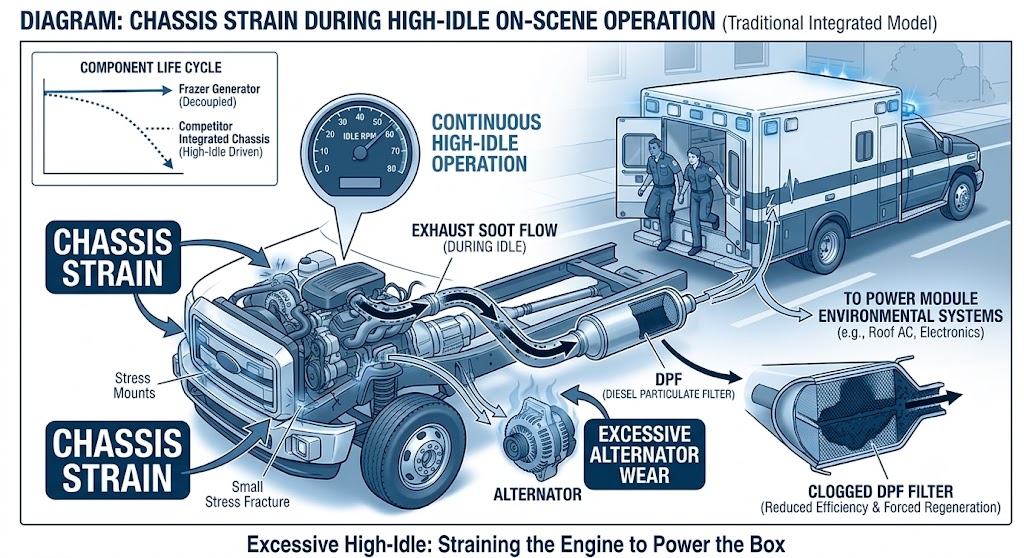
Yes. Extended low-load idling can contribute to diesel emissions system maintenance concerns under certain operating conditions. Modern diesel engines use emissions equipment that performs within specific temperature ranges. When an engine idles for long periods at lower exhaust temperatures, diesel particulate filter (DPF) regeneration may become less effective, potentially contributing to soot buildup and additional maintenance needs.
Depending on the engine design, extended idling may also contribute to conditions such as wet stacking. These issues don’t affect every vehicle in the same way, but they’re important considerations for departments that regularly keep chassis engines running to power equipment at emergency scenes.
That’s where independent power can make a difference. Rather than relying exclusively on the truck engine for auxiliary electricity, an independent power system provides another way to operate equipment while the vehicle is parked. When conditions and equipment requirements allow, crews may be able to shut down the chassis engine without shutting down the equipment they need.
How Independent Power Supports Fleet Operations
Frazer offers independent power configurations that can support auxiliary electrical loads, including 120V AC HVAC and patient care equipment. Depending on the application and selected configuration, available options may include a Cummins Onan generator, a MEPS system, or a Harrison Hydra-Gen system.
An accessible Cummins Onan generator configuration is backed by a 2-year/2,000-hour warranty. Like any mechanical equipment, an independent generator requires maintenance. The advantage is that it gives departments a way to separate certain auxiliary electrical demands from the chassis engine instead of relying entirely on extended engine idling.
For some fleets, this approach may help reduce accumulated chassis engine hours and certain idling-related maintenance concerns. Whether it lowers overall costs depends on factors such as operating hours, generator maintenance, chassis powertrain requirements, and the way crews use the vehicle. It’s important to compare the full maintenance picture rather than looking at one component in isolation.
Engine shutdown decisions should always follow the chassis manufacturer’s guidance, equipment operating instructions, and departmental procedures. Independent power creates options, but your team’s safety and equipment requirements come first.
Emergency Vehicle Wiring: Multiplex vs. Point-to-Point Systems
What’s the Difference Between Multiplex and Point-to-Point Wiring?
Multiplex electrical systems use electronic control modules and communication networks to manage vehicle functions. These systems can support integrated controls and centralized communication between components. Depending on the design and the issue being diagnosed, repairs may require specialized software or diagnostic equipment.
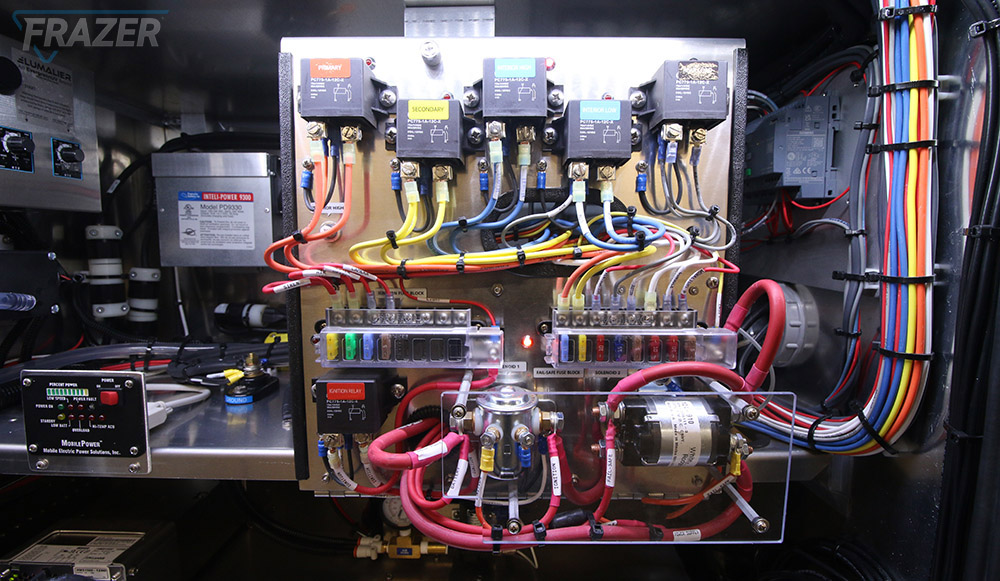
Point-to-point wiring takes a different approach. It uses dedicated circuits, standard automotive relays, and terminal strips to connect electrical components. For technicians familiar with traditional automotive electrical systems, that layout can make many circuits easier to follow and troubleshoot using commonly available tools.
Neither architecture eliminates the need for maintenance. The important question is which system best supports your department’s service capabilities, equipment requirements, and long-term operating plans.
Why Frazer Uses Non-Proprietary, Point-to-Point Wiring
At Frazer, we believe technicians should have practical access to the systems they’re responsible for maintaining. That’s why our approach emphasizes straightforward, non-proprietary, point-to-point wiring with commonly available components.
Consider a standard automotive relay that needs replacement. A technician may be able to check the affected circuit with a multimeter, identify the problem, and find a compatible replacement through an automotive parts supplier. Depending on the repair, parts availability, and technician resources, this approach may help get the vehicle back in service without specialized diagnostic software for the module’s point-to-point circuits.
For departments managing several frontline units, familiar tools and replacement components can make routine service planning more straightforward. The goal is simple: help your maintenance team understand the system, identify problems, and complete applicable repairs with less unnecessary complexity.
Planning for a Remount and a Lower Overall Cost of Ownership
Why Does a Wood-Free EMS Module Matter?
The chassis and the patient module don’t always have to reach the end of their service lives at the same time. A well-maintained module may remain serviceable after its original chassis needs replacement. That creates an opportunity to evaluate the module for a remount, where it is removed, refurbished as needed, and installed on a compatible replacement chassis.
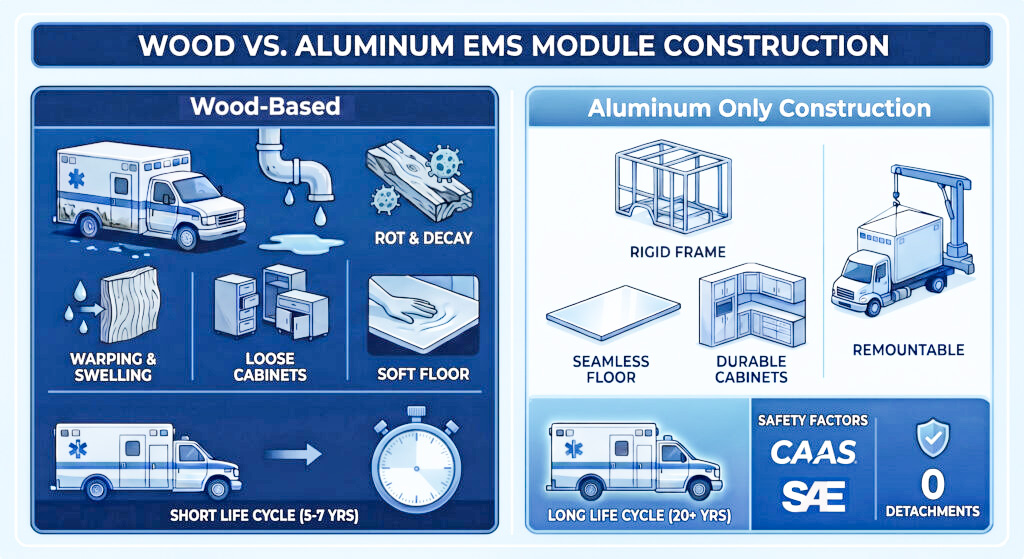
Frazer builds its patient modules using wood-free aluminum construction, including 6061-T6 aluminum structural components. Aluminum avoids the wood-related rot and warping concerns associated with wood-based construction. Of course, a module’s long-term condition still depends on its design, fabrication, maintenance, and operating history.
When a module remains in suitable condition, remounting can allow a department to retain part of its original investment instead of replacing the entire vehicle. Every remount must be evaluated for structural condition, chassis compatibility, applicable standards, and other requirements. A module’s age alone doesn’t determine whether it’s a good candidate.
What Is Lowest Overall Cost of Ownership?
At Frazer, we talk about Lowest Overall Cost of Ownership, or LOCO, because the purchase price is only one part of what an emergency vehicle costs. Maintenance, repairs, downtime, replacement schedules, and potential remounts all affect the total investment over time.
For a Fire Chief or EMS Director managing a long-term capital budget, this broader view matters. A lower initial purchase price doesn’t automatically mean lower costs over the vehicle’s service life. It’s worth considering how easily the vehicle can be maintained, how its major systems are powered, and whether the module may remain useful after the chassis is retired.
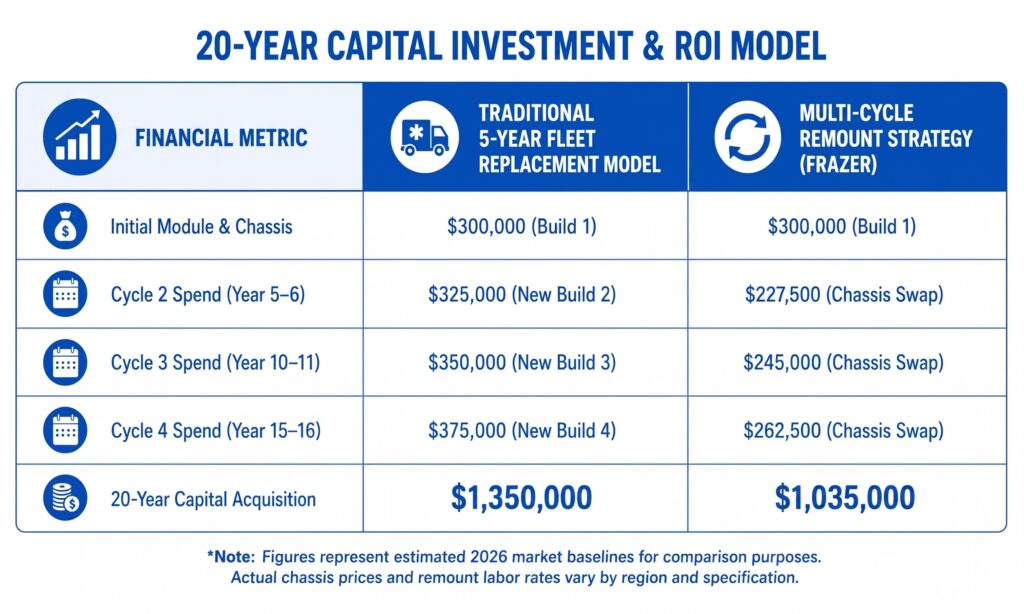
Engineered chassis mounts, wood-free aluminum construction, and independent auxiliary power are among the design choices that can support future remount evaluations. Depending on the module’s condition, service history, compatibility, and applicable requirements, it may be considered for a second, third, or even fourth service lifecycle.
When Frazer completes a remount, the module receives a renewed 2-year warranty on design, construction, and installation, subject to the applicable warranty terms. Over a 15- to 20-year period, a remount strategy may create opportunities to save hundreds of thousands of dollars. Actual savings vary based on vehicle configuration, purchasing costs, maintenance history, and how often a module can be successfully remounted.
What Does Frazer’s Long-Term Service Record Show?
Long-term fleet decisions deserve more than promises. Service history, customer feedback, and documented experience can all help departments evaluate their options.
In a double-blind survey of 100 EMS and Fire professionals conducted by Smart Advantage, 39% of respondents identified Frazer as the brand that spends the “least amount of time in the shop” compared with competitors. That result reflects the views of the surveyed professionals and should be considered in the context of the survey’s methodology, participant group, and questions.
Frazer also reports zero recorded module detachments across more than 4,500 modules built since 1984. This historical record reflects Frazer’s documented experience with its module construction and mounting systems. It does not predict how any particular vehicle will perform in a collision, where outcomes depend on many factors.
These details are useful pieces of the bigger picture. When evaluating a vehicle investment, departments should also review maintenance records, remount costs, expected chassis replacement intervals, and applicable warranty coverage. Together, those details can help leadership teams make informed decisions about their fleets.
Preventive Maintenance Tips for Longer Vehicle Service Life
Even a carefully specified emergency vehicle needs regular maintenance. Chassis selection, module construction, and electrical design can support long-term serviceability, but they don’t replace inspections and preventive care. Your maintenance program should follow the applicable manufacturer recommendations and account for the conditions your vehicles encounter.
✔ Check the Suspension
Suspension systems carry demanding loads in EMS applications. If your chassis uses an aftermarket system such as LiquidSpring, include the manufacturer’s recommended calibration checks and fluid inspections in your maintenance schedule. These checks can help your team maintain intended ride-height characteristics and identify conditions that may contribute to uneven loading or component wear.
✔ Watch for Uneven Tire Wear
Tires can tell you a lot about a vehicle’s condition. Follow the chassis manufacturer’s guidance for tire pressure, inspections, rotation, and replacement. If your team notices unusual wear patterns, investigate possible causes such as alignment, suspension condition, inflation, or uneven loading before the problem gets worse.
✔ Inspect Brakes Based on Actual Operating Conditions
Frequent stops, urban routes, and demanding service conditions can increase brake wear. Inspect brake pads, rotors, and related components according to the applicable maintenance schedule and your department’s operating conditions. Routine inspections help technicians catch developing problems before they affect vehicle availability.
✔ Keep Electrical Connections in Good Condition
Electrical inspections deserve a place in your preventive maintenance program, too. On point-to-point systems, check accessible terminal strips, relays, wiring connections, and related components for loose connections, visible damage, or corrosion. Independent power systems should also be maintained according to their respective manufacturers’ requirements.
A consistent maintenance program helps your team identify concerns early and make better-informed decisions about repairs and replacement. It also provides useful service records when the time comes to evaluate a module for remounting.
Make Your Next Chassis Decision with Long-Term Value in Mind
Your Type I emergency vehicle is a long-term investment, and the chassis is a major part of that decision. Choosing an appropriately rated platform, managing frame flex through engineered mounting, and considering how auxiliary equipment is powered can all support your fleet’s maintenance and service goals. A durable patient module and a practical electrical design add even more to the conversation.
Frazer offers Type I mobile healthcare vehicle configurations with wood-free aluminum modules, engineered chassis mounting systems, point-to-point wiring, and independent power options. Each of these design choices reflects our focus on building vehicles that are practical to operate, maintain, and support over time.
Planning a new Type I emergency vehicle or looking ahead to your next chassis replacement? Talk with the Frazer team about your department’s needs. We’ll help you explore available chassis, power, electrical, and module options so you can make an informed decision for your crews, your maintenance team, and your budget. And our commitment to service doesn’t end when your vehicle is delivered. We’re here to support you throughout the Frazer Family Experience.
Does idling an ambulance damage the diesel engine?
Prolonged idling can contribute to diesel engine and emissions system problems, particularly when exhaust temperatures remain too low for effective Diesel Particulate Filter (DPF) regeneration. Over time, this may lead to soot buildup, additional maintenance, and other engine-related concerns. Frazer’s independent power systems allow crews to operate auxiliary equipment without continuously running the chassis engine, helping reduce engine hours and certain idling-related maintenance concerns when engine shutdown is appropriate.