
What Defines a Heavy-Duty Type I Ambulance? A Guide to Construction, Reliability, and Fleet Lifecycle
A spec sheet is a starting point, not the whole story, when choosing a Type I EMS vehicle. Fleet managers also need to know how construction, electrical design, and service access will affect the vehicle throughout its working life. When a crew needs help with an electrical issue at 2:00 AM or patient compartment cooling on a hot summer day, those choices matter.
Fleet managers and Emergency Vehicle Technicians (EVTs) are managing tight maintenance budgets, complex electrical systems, and the wear that comes with daily service. As municipal budgets face pressure and emergency response demands evolve, evaluating a heavy-duty Type I ambulance involves more than selecting a commercial truck chassis. It also means considering how the patient module is built, maintained, and potentially reused throughout its service life.
This guide explains what to look for in a heavy-duty Type I EMS vehicle, from the patient module’s structure and electrical system to long-term service and remount planning.
The Structural Anatomy of a Protective Patient Module
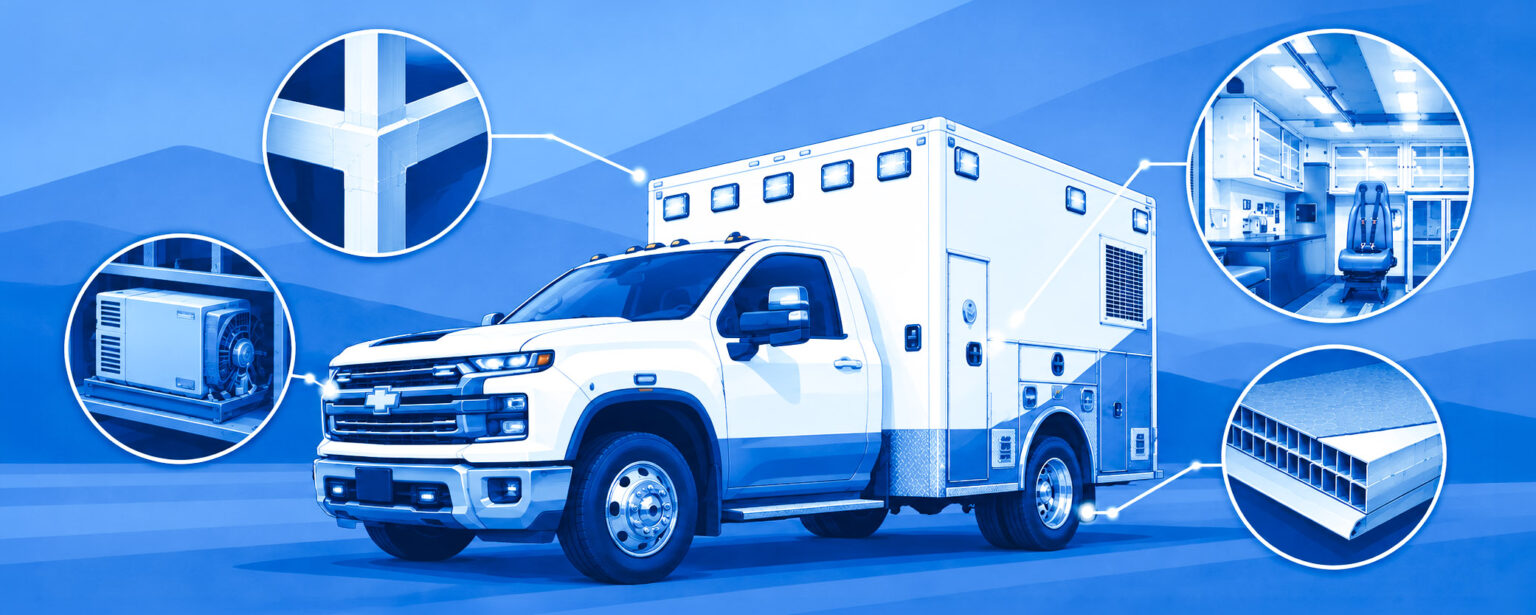
Start with the patient module’s structure. A well-designed module can help protect occupants during certain collision conditions while supporting the structural demands of regular emergency response operations. Material selection, structural connections, and overall construction methods can influence how a patient module responds to road vibration, twisting forces, and repeated service demands.
What Defines a Type I EMS Vehicle?
A Type I EMS vehicle pairs a commercial truck cab-chassis with a separate patient-care module. This configuration provides departments with options for payload capacity, chassis selection, patient compartment design, and equipment integration. Depending on the chassis, module, and application, Type I EMS vehicles can serve a range of emergency response needs, including high-volume service environments and operations involving demanding road conditions.
Welded vs. Bonded Joints: Why Structural Rigidity Matters
EMS vehicle builders use different methods to join structural components and exterior panels. Adhesive products, including 3M Very High Bond (VHB) tape, can serve important purposes in vehicle construction, particularly in applications involving exterior skin panels and other components designed for adhesive attachment.
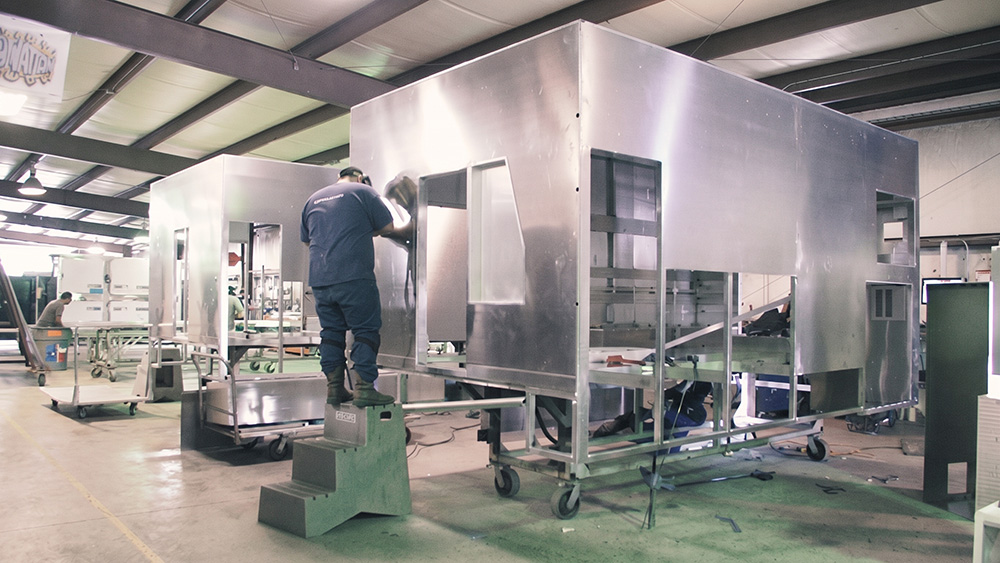
Structural welding offers another approach. When properly engineered and applied, welded connections can provide a rigid framework designed to withstand the twisting and vibration associated with emergency vehicle operation. Frazer builds its patient modules with 100% welded structural joints. The framework incorporates robust 1.5″ x 1.5″ x 1/8″ 6061-T6 aluminum structural members, creating a welded structure designed to handle the mechanical demands associated with emergency response and extended vehicle use.
What this means in the field: When an ambulance encounters potholes, uneven road surfaces, or the stresses associated with extended service, its structural connections play an important role in module durability. A welded framework can also support the structural requirements involved in removing a patient module from an existing chassis and installing it on a replacement chassis, subject to inspection and compatibility.
Frazer’s track record: Frazer engineers its module-to-chassis attachment system with long-term structural durability in mind. Across more than 4,500 custom EMS modules built since 1984, Frazer has zero recorded module detachments. This historical record reflects Frazer’s documented experience and does not constitute a guarantee of future performance or collision outcomes.
What Are the Benefits of a Welded Aluminum Module?
A 100% welded aluminum structure provides a continuous framework designed to support module rigidity and distribute operational stresses through the patient compartment structure. Welded connections can help support resistance to road vibration and repeated loading. Structural performance during a collision depends on several factors, including the nature of the impact, vehicle configuration, and the forces involved.
A durable welded framework can also support long-term remount planning. With appropriate inspections, maintenance, and chassis compatibility, some departments may remount a patient module three to four times over a 20-year lifecycle.
The Wood-Free Interior Advantage
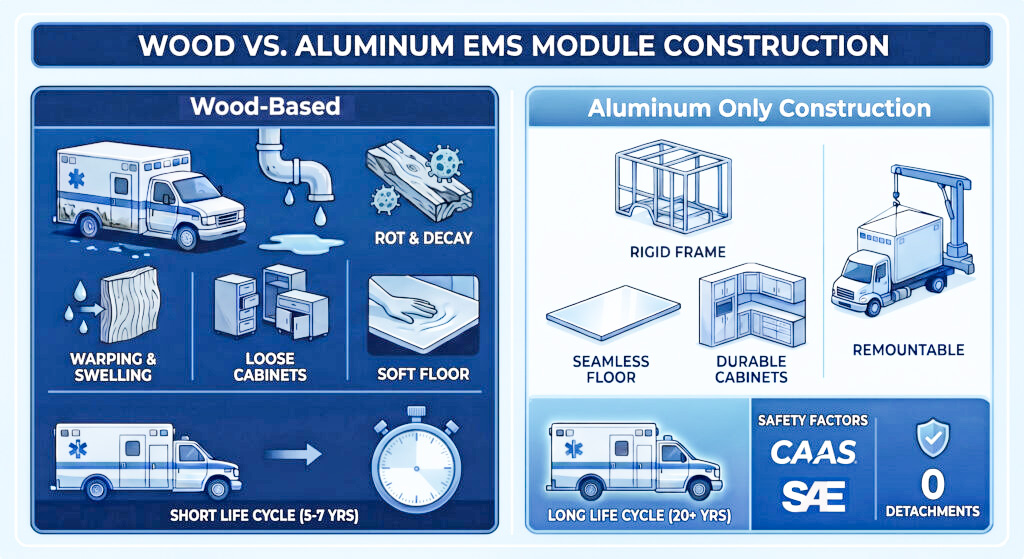
Interior materials deserve the same close look as the frame. Different manufacturers use materials such as wood, MDF, particle board, aluminum, and composite products in cabinetry, flooring, and other interior components. Emergency medical environments routinely encounter moisture from cleaning procedures, changing weather conditions, and patient-care activities. Depending on the material and its protective treatment, repeated moisture exposure can contribute to swelling, deterioration, or unwanted odors over time.
Frazer uses a wood-free interior design that incorporates formed, powder-coated aluminum cabinetry mechanically secured to the welded frame. The floor features a heavy-duty polycarbonate-core laminated subfloor.
What this means in the field: Aluminum cabinetry and polycarbonate-core flooring are designed to resist moisture absorption and reduce concerns associated with wood deterioration. These materials can also support routine cleaning and long-term interior maintenance.
For departments considering future remounts, a wood-free interior provides an additional design feature that may help preserve the condition and serviceability of the patient module over time.
Managing the Costs of Chassis-Dependent Power
Power generation and climate control are important considerations in ambulance fleet management. Many EMS vehicle configurations rely on chassis-powered systems for patient compartment electrical functions and air conditioning. These systems can serve departments effectively, but their operating characteristics and maintenance requirements may vary depending on vehicle configuration, climate, duty cycle, and equipment demands.
For agencies evaluating long-term operating costs, independent power systems offer an alternative worth considering.
How Can Independent Power Help Your Crew?
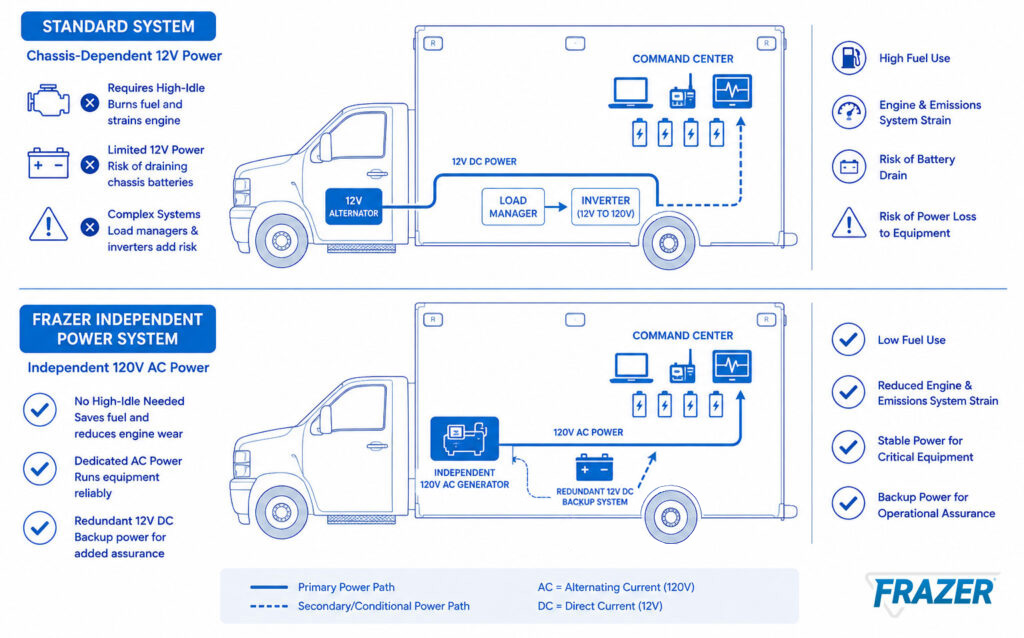
Independent 120V AC power allows certain patient module functions to operate without relying directly on the truck engine. Depending on the system configuration, this approach can reduce the amount of chassis engine idling needed to support patient compartment equipment and climate control.
Reducing unnecessary chassis idle time may help limit engine operating hours and associated maintenance demands, including those involving diesel emissions equipment such as the Diesel Particulate Filter (DPF). An independent power system can also support a self-contained 15,000 BTU HVAC system designed to cool the patient compartment while operating separately from the chassis engine.
How Chassis-Dependent Air Conditioning Can Affect Curb-Idle Performance
Air conditioning performance depends on factors such as system capacity, ambient temperature, vehicle insulation, airflow, and engine operating conditions. In some ambulance configurations, chassis-dependent air conditioning may provide different cooling performance at curb idle than it does during highway operation. Maintaining comfortable patient compartment temperatures during extended stationary operations can place additional demands on the climate control system.
Crews may choose to keep the chassis engine running to support patient compartment cooling or other equipment needs.
What this means in the field: Extended engine idling adds operating hours that may not be reflected in the vehicle’s mileage. Depending on the chassis and duty cycle, additional idle time can contribute to maintenance requirements involving the engine, alternator, emissions system, and related components.
For fleets operating diesel chassis with engines valued at $15,000+, managing unnecessary idle time can be one part of a broader maintenance and lifecycle planning strategy.
Decoupling the Module with Independent 120V AC Power
One way to manage chassis idle time is with independent 120V AC power systems, including generator options such as Cummins Onan or MEPS. These systems can supply electrical power to the patient module without requiring the chassis engine to serve as the primary power source for certain module functions.
In a properly configured installation, a dedicated generator can power a self-contained 15,000 BTU HVAC system. This type of setup is designed to deliver a 25°–30°F cooling differential, with up to 35°F+ possible under certain operating conditions. Actual cooling performance depends on ambient conditions, system configuration, insulation, operating demands, and other variables.
Independent generators also require periodic service, including oil changes, filter replacement, and other manufacturer-recommended maintenance. However, they may offer departments an opportunity to manage chassis engine operating hours while maintaining patient compartment climate control.
What this means in the field: Separating patient compartment power demands from the chassis engine can give fleet managers more flexibility in how they manage maintenance schedules and operating costs. The financial benefit depends on generator maintenance expenses, chassis operating conditions, fuel consumption, and the department’s overall duty cycle.
Electrical Architecture: The KISS Principle and Practical Serviceability
Electrical design has a direct effect on day-to-day maintenance. For fleet supervisors and EVTs, considerations include component accessibility, diagnostic procedures, replacement part availability, and the training required to maintain the system.
Understanding Proprietary Electrical Systems
Some EMS vehicles use multiplex electrical systems to manage lighting, controls, and other patient module functions. These systems can provide centralized control, integrated features, and diagnostic capabilities depending on their design. Some multiplex configurations also rely on specialized components, manufacturer-specific software, or dedicated diagnostic tools.
When a proprietary component requires replacement or specialized troubleshooting, service timing may depend on technician availability, parts inventory, and access to the necessary diagnostic resources. For departments with in-house maintenance teams, understanding these service requirements before purchasing a vehicle can help support maintenance planning and technician readiness.
What this means in the field: When an electrical function requires attention, technicians benefit from clear documentation, accessible components, and a system they are equipped to service. Evaluating diagnostic requirements and replacement part availability can help departments plan for repairs and manage downtime.
Diagnosing Problems with Standard Automotive Relays
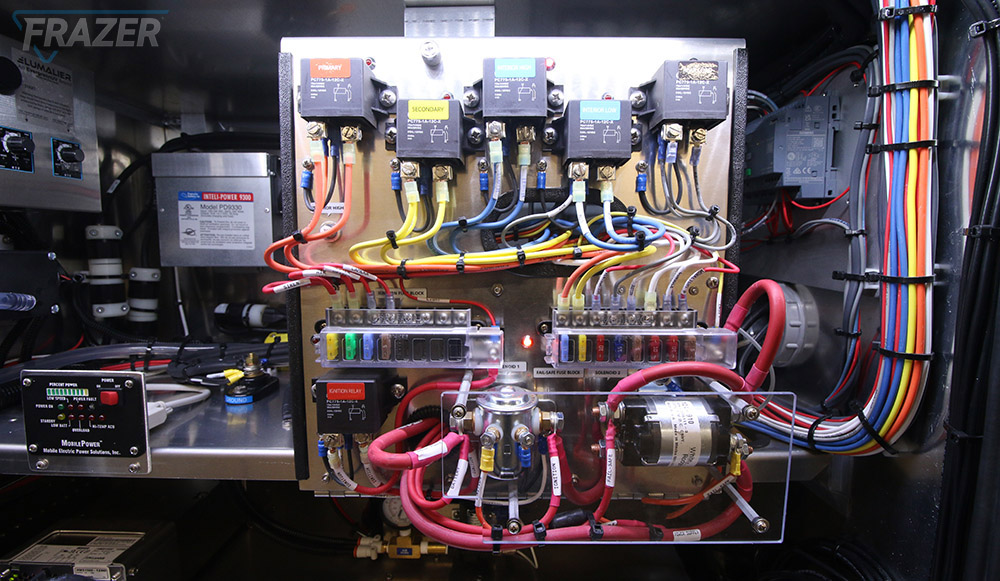
Frazer follows the KISS principle, “Keep It Super Simple,” with an emphasis on straightforward construction and practical serviceability. Frazer uses point-to-point 12V DC wiring with standard automotive relays, accessible circuit breakers, and common terminal strips.
This arrangement is designed to give technicians a direct way to trace circuits, identify components, and perform repairs using familiar electrical service methods.
What this means in the field: If a relay requires replacement at 2:00 AM on a Saturday, a technician may be able to identify the affected circuit and install a compatible replacement from available parts inventory. Depending on the issue and service conditions, certain repairs may take as little as ten minutes.
Actual repair times vary based on the cause of the problem, technician experience, equipment availability, and the work required.
“In a double-blind survey of 100 EMS and Fire professionals, ‘Support after the sale’ was ranked as the single most important attribute when selecting a builder.” — 2020 Independent Market Research
Point-to-point wiring supports Frazer’s approach to after-sale service by giving in-house EVTs access to familiar components and straightforward diagnostic procedures. For departments equipped to perform their own maintenance, this design can help simplify certain repairs and potentially reduce the time a vehicle spends out of service.
Fleet Lifecycle Planning: Exploring Up to 20 Years of Service
A custom Type I EMS vehicle is a major fleet investment. For EMS directors, fire chiefs, and fleet managers, evaluating that purchase may involve looking beyond the initial acquisition cost. One approach is to consider the Lowest Overall Cost of Ownership (LOCO) over a 15- to 20-year timeline. This includes factors such as maintenance, chassis replacement, module condition, remounting expenses, and anticipated service requirements.
How Remounting Can Affect Your Fleet Budget
EMS vehicle replacement schedules vary by department, call volume, maintenance practices, operating conditions, and vehicle configuration. Some agencies replace vehicles on cycles of approximately five to seven years, while others use different replacement strategies.
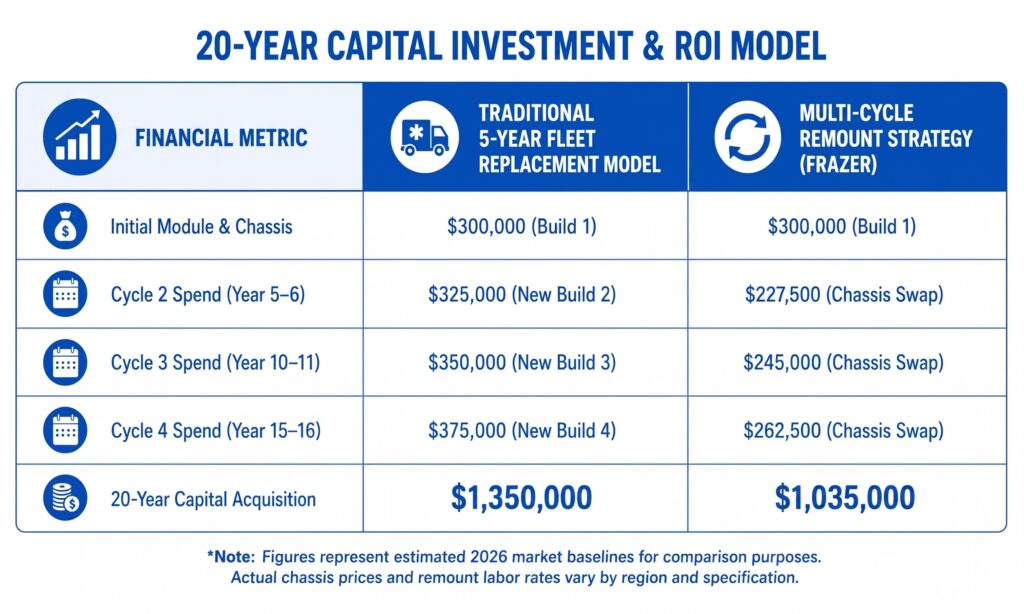
For departments that operate modular ambulances, remounting offers another option. Instead of replacing both the chassis and patient compartment, a department may be able to move its existing module to a compatible new chassis. Frazer designs its heavy-duty Type I EMS modules with this approach in mind. The combination of 100% welded structural aluminum and a wood-free interior is intended to support long-term module durability and potential reuse.
With suitable operating conditions, maintenance, inspections, and chassis compatibility, departments may be able to remount a module 3 to 4 times and achieve up to 20 years of active front-line duty. Actual module service life depends on usage, condition, maintenance history, applicable standards, and the feasibility of each remount.
What this means in the field: When an existing patient module remains suitable for service, remounting can provide an alternative to purchasing an entirely new patient-care body with each chassis replacement.
This approach may help departments manage long-term capital expenditures and make more effective use of available fleet budgets. Actual savings depend on the costs of remounting, chassis acquisition, refurbishment, ongoing maintenance, and the department’s operating requirements.
Backed by a Lifetime Structural Warranty
Long-term fleet planning also involves understanding the warranty coverage available for major vehicle components. Frazer offers factory lifetime warranty protection on new modules against design and structural defects for original owners, subject to the applicable warranty terms and conditions.
This coverage reflects Frazer’s commitment to supporting the structural construction of its patient modules over time. Warranty eligibility, covered conditions, exclusions, and claim requirements are governed by the written warranty provided with the vehicle.
Frazer’s track record: Remounting is an established part of the fleet management approach used by certain Frazer customers. For example, the Houston Fire Department, which operates a high-volume EMS system, has remounted Frazer Type I modules multiple times.
In documented applications, these modules have seen over 260,000 miles per chassis, with some eventually exceeding well over 1,000,000 cumulative fleet miles during their service life. These figures illustrate reported long-term use in specific fleet applications. Individual results depend on operating conditions, maintenance practices, module condition, and remounting decisions.
Planning a Type I Ambulance Fleet for Long-Term Service
Preparing an RFP for your next Type I EMS fleet? Consider how structural construction, electrical serviceability, independent power options, and remounting capabilities align with your department’s operational needs. Evaluating these features early in the purchasing process can help your team make informed decisions about maintenance, chassis utilization, and long-term fleet investment.
Frazer builds custom EMS modules with an emphasis on durable construction, practical maintenance access, and long-term service planning. We also offer more focused pre-configurations for our Type I products, included the Frazer Foundation unit starting at $252,000. Whether you’re evaluating ways to manage maintenance costs, reduce unnecessary chassis idling, or plan for future remounts, our team can help you explore available configurations and lifecycle options.
Talk with the Frazer team about a vehicle built for long-term service, what our documented high-mileage fleet examples can teach you, and whether remounting makes sense for your department.
What defines a Type I EMS vehicle?
A Type I EMS vehicle combines a commercial truck cab-chassis with a separate, modular patient-care body. This design offers flexibility in payload capacity, equipment layout, and chassis selection. Depending on the configuration, Type I vehicles can support high-volume emergency response, demanding road conditions, and long-term fleet planning.