
Beyond the Spec Sheet: The Practical Advantages of a Type I Ambulance
Choosing an emergency vehicle takes more than comparing specifications. Your crew needs a dependable workspace, your maintenance team needs equipment it can support, and your agency needs a vehicle that makes financial sense over time. Those needs become especially important during long shifts, frequent 911 calls, and hot weather.
For EMS leaders planning their next purchase, a heavy-duty Type I vehicle offers several features worth a closer look. Here is how patient module construction, independent climate control, caregiver-focused layouts, and remounting can affect daily operations and long-term fleet costs.
What Structural Features Matter in a Type I EMS Vehicle?
Start with the patient module. How it is built matters because crews spend much of their workday inside it. Frazer uses welded 6061-T6 aluminum tube framing and laminated corners to reinforce the structure around the patient compartment. This design is intended to help the module maintain its integrity under demanding conditions, including certain types of collisions.
Frazer reports no recorded patient module detachments in its documented collision history dating back to 1984. That record offers useful context, but it is not a guarantee of how any vehicle will perform in a future crash. Speed, impact direction, collision severity, and other conditions all affect the outcome.
What Can We Learn From Real-World Collisions?
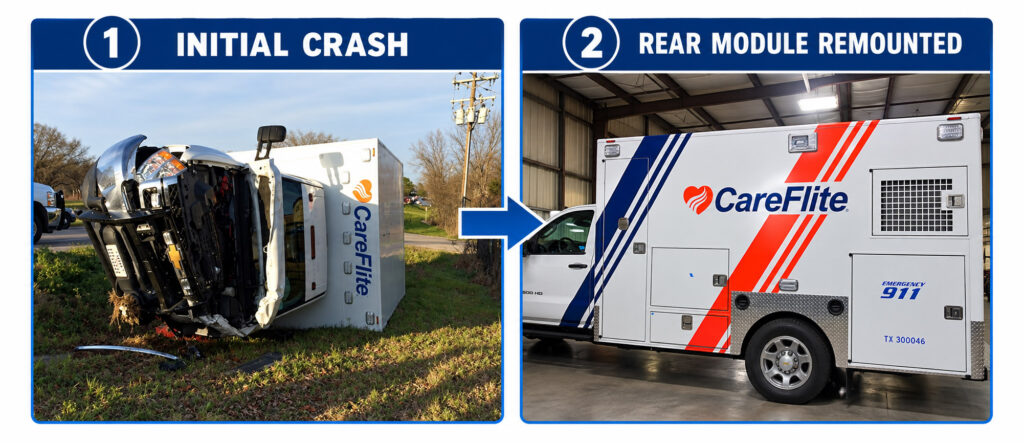
Frazer has built more than 4,500 EMS modules, and customer-reported incidents offer examples of how the construction has performed. In a CareFlite collision, a unit experienced a reported 52 mph driver-side impact and rolled 90 degrees. The chassis sustained extensive damage, but the module remained intact. The crew was reported uninjured, and the module was later repaired and remounted on a new chassis.
Jackson County Fire Rescue reported a near head-on highway collision involving a driver-side impact and rollover. The crew reportedly sustained minor injuries, and the Fire Marshal said the safety features had “performed above and beyond” in that incident. In another severe crash, a Gadsden County vehicle reportedly rolled at least two or three times, yet its patient module was considered salvageable.
These examples are worth reviewing alongside available crash records, applicable standards, and your agency’s safety requirements. They show what happened in specific incidents, not what will happen in every collision.
How Does Independent Climate Control Help During Long, Hot Shifts?
Think about a unit waiting outside a hospital for two hours in 100-degree heat. Keeping the patient compartment comfortable can be difficult, especially when a cooling system depends on the chassis engine. For agencies with long idle times, climate control deserves as much attention as engine and chassis specifications.
Frazer offers chassis-independent power configurations, including generator-based systems and the Mobile Electric Power Solution. These systems can operate a dedicated 15,000 BTU patient compartment air conditioner without relying directly on the truck’s engine-driven air conditioning. That means the cooling system can continue operating when the chassis engine is off, provided its independent power source is running.
Frazer reports a typical cooling differential of 25 to 30 degrees, with up to a 35-degree difference between outdoor and indoor temperatures under applicable conditions. Actual results depend on the weather, vehicle configuration, operating conditions, and other factors. For fleet managers, the important question is whether a vehicle’s cooling setup matches the demands of their service area.
What About Air Filtration?
Cooling is only part of the conversation. In an independent double-blind market research study of EMS leaders, 76% identified HVAC and air filtration as their most important safety feature. Frazer offers the Dometic BreatheEasy photocatalytic UV/ionization system integrated into the HVAC plenum to help address certain airborne contaminants and odors.
The system is configured to circulate the patient compartment’s air volume approximately every two minutes. Its effectiveness can vary with airflow, contaminant type, maintenance, and operating conditions. It should be considered alongside, not as a replacement for, routine cleaning, ventilation, and infection prevention practices.
For a closer look at this technology, explore our guide on active EMS air filtration.
How Can the Patient Compartment Support Safer, Easier Care?
Payload and truck performance matter, but so does the space where your clinicians work. During a 12- or 24-hour shift, medics need to reach supplies, move around the cot, and care for patients without unnecessary obstacles. A well-planned interior can help crews work more comfortably and reduce the need to leave a designated seat during transport.
Room to Work and Equipment Within Reach
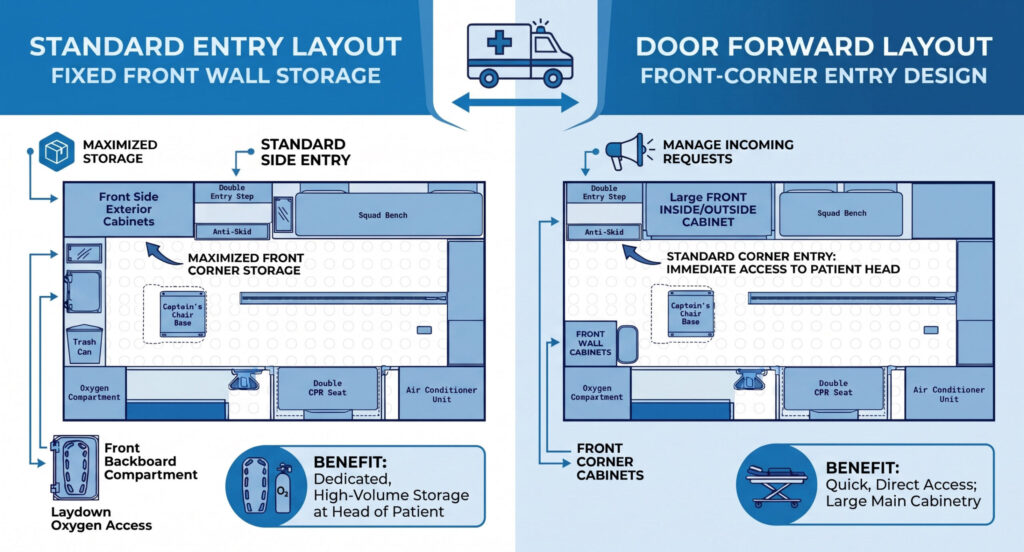
Frazer’s 96.25-inch-wide module allows flexibility in patient compartment layouts. Pre-engineered options, including the Foundation™ Series, offer nearly 50 inches of open aisle space. A center-mounted cot gives caregivers access to both sides of the patient, while carefully placed cabinets and work areas can keep frequently used equipment close to designated seating positions.
The goal is to support care while clinicians remain seated and belted whenever the procedure and circumstances allow. Every agency should evaluate its preferred layout against its equipment, clinical practices, and crew needs.
Frazer also builds its interiors without wood, using formed aluminum cabinetry and stainless steel work surfaces. These materials avoid some moisture-related concerns associated with wood-based components and provide nonporous surfaces that can support routine cleaning when proper products and methods are used.
Can Remounting Lower Long-Term Fleet Costs?
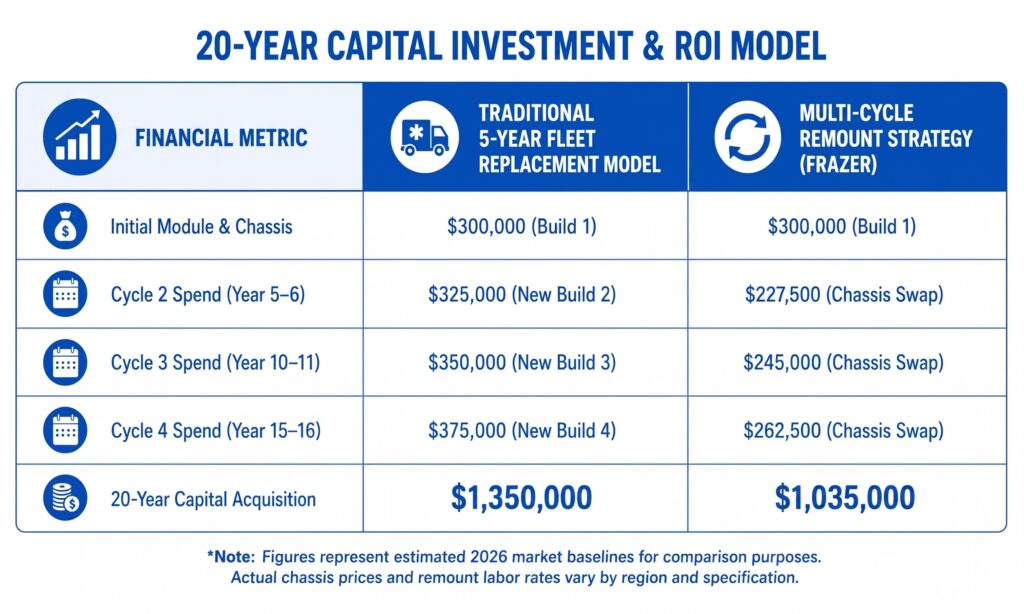
A new heavy-duty Type I vehicle may cost more upfront than some light-duty alternatives. But the purchase price is only one part of the budget. Maintenance, chassis replacement, vehicle downtime, and how long the patient module can remain in service all affect the overall cost of ownership.
Remounting gives agencies another option. If a patient module is in suitable condition and compatible with a replacement chassis, it may be possible to keep the module in service instead of buying an entirely new vehicle. Frazer’s welded, wood-free aluminum modules are designed with long-term service and potential remounting in mind.
What Does a Million-Mile Module Look Like?
The Houston Fire Department offers a practical example. Its fleet includes 129 Frazer units, and reported fleet history shows modules commonly serving through more than 260,000 miles on a truck chassis. Some modules have been remounted as many as four times, reaching more than 1,000,000 miles of total service. Certain units have also approached 20 years in active duty.
Those results reflect a specific fleet’s experience. They do not mean every module will reach the same mileage or service life. The value of remounting depends on module condition, needed updates, chassis compatibility, maintenance history, and your agency’s operating demands.
When preparing a capital request, compare the cost of a new vehicle with projected maintenance, chassis replacement, remounting work, and expected years of service. That gives decision-makers a clearer picture of Frazer’s approach to Lowest Overall Cost of Ownership (LOCO).
Choose a Vehicle That Fits the Way Your Agency Works
A heavy-duty Type I EMS vehicle offers more to evaluate than payload capacity and chassis specifications. Module construction, independent cooling, caregiver access, and remounting potential can all influence how a vehicle performs for your team and how much it costs to keep in service.
The right choice depends on your call volume, climate, equipment needs, maintenance resources, and budget. Ask how each feature works in daily service, what evidence supports performance claims, and what support will be available after delivery. Frazer’s team can help you work through those questions and plan for the long term.
Ready to explore your options? Learn more about Frazer’s Foundation™ Series, a 12-foot Type I mobile healthcare vehicle with a stated starting price of $252,000, or contact our team to discuss whether remounting could fit your fleet plan. Confirm current pricing and configuration details with Frazer before budgeting.
How does Type I EMS vehicle construction support crew safety during collisions?
Patient module construction plays an important role in vehicle safety. Frazer builds its modules with welded 6061-T6 aluminum tube framing and reinforced laminated corners to help maintain structural integrity during certain collisions. According to Frazer’s documented collision history dating back to 1984, there have been no recorded module detachments. While no design can guarantee protection in every crash, Frazer’s construction is built with crew safety and long-term durability in mind.