Custom Ambulance Builder vs. High-Volume Assembler: 6 Things to Check Before Writing Your RFP
Two emergency vehicles can look almost identical on a showroom floor. Both have fresh paint, clean interiors, and all the equipment you expect. But what happens after five years on the road? Or ten? That’s when the differences in construction, wiring, power systems, and service support can start to matter.
When your agency is preparing to invest $250,000 to $1 million in a custom EMS vehicle or mobile healthcare unit, you need to know what you’re getting. The purchase price matters, but so do maintenance costs, downtime, crew needs, and the ability to keep that vehicle in service for years to come.
Before you finalize your Request for Proposal (RFP), take a closer look at how each builder approaches the work. These six benchmarks will help you ask better questions, compare your options, and make a decision you can explain with confidence.
Custom Builder or High-Volume Assembler: What’s the Difference?
Not every EMS vehicle is built the same way. Some companies focus on standardized designs and high-volume production. Others offer more opportunities to work with their engineering teams on layouts, equipment placement, and the details that make a vehicle fit your crew’s needs.
Neither approach guarantees a better vehicle. A repeatable production process can have real advantages, and a custom design still needs careful engineering and quality control. What matters is how well the finished vehicle meets your needs and how easily your team can maintain it.
Start with these six areas when comparing builders:
| What to Evaluate | What to Look For | What to Ask |
|---|---|---|
| Engineering Support | Access to engineers, clear drawings, and a documented approval process | Who reviews design changes, and how will our team approve them? |
| Construction Materials | Cabinetry and framing materials, in-house fabrication, and repair options | What’s behind the finished surfaces, and what do you build in-house? |
| Electrical System | Accessible wiring, labeled circuits, and practical diagnostic tools | Can our technicians troubleshoot this system without proprietary software? |
| Power and Climate Control | Module power sources, HVAC capacity, and dependence on the chassis | How are the patient compartment’s power and air conditioning supplied? |
| Testing and Safety | Documented testing, equipment retention, and relevant field experience | What test results and supporting records can you share? |
| Warranty and Service | Written coverage, exclusions, service access, and replacement parts | Who helps us when something goes wrong after delivery? |
1. Can You Work Directly with the Engineering Team?
Your crew knows how it works in the field. Your builder should be able to turn that knowledge into a vehicle layout that makes sense. That takes more than selecting options from a catalog. It takes clear communication between your agency, the sales team, and the people responsible for engineering the vehicle.
Ask how your team will review drawings before production begins. Find out who can answer questions about equipment placement, electrical loads, weight distribution, and available workspace. Most importantly, make sure you understand how changes are approved and communicated.
At Frazer, one example is our true 96-inch-wide module. The layout includes a center-mounted cot, nearly 50 inches of open aisle space, and four caregiver seating positions. Those features give agencies room to consider patient access, equipment placement, and how their crews move and work during a call.
Of course, dimensions alone don’t tell the whole story. The right layout depends on your clinical equipment, staffing model, and daily operations. That’s why reviewing the drawings before fabrication matters. It’s much easier to address a concern on paper than after the vehicle is built.
Quality during delivery matters, too. In a double-blind survey of 100 EMS and fire professionals, Frazer ranked among the top three manufacturers for low-defect delivery. Monroe Township Fire Department also reported putting its Frazer unit into service within seven days of leaving Houston, with no reported issues.
Those experiences don’t guarantee the same result for every agency, but they show why it’s worth asking builders about their inspection and delivery processes. Frazer customers can also arrange a live virtual inspection of their vehicle before delivery, giving them another opportunity to see the build and ask questions.
2. What’s Your Vehicle Actually Made Of?
Cabinets may look similar from the outside, but the materials underneath can be very different. That’s worth checking if your agency expects to keep a module in service for many years or plans to remount it onto a replacement chassis.
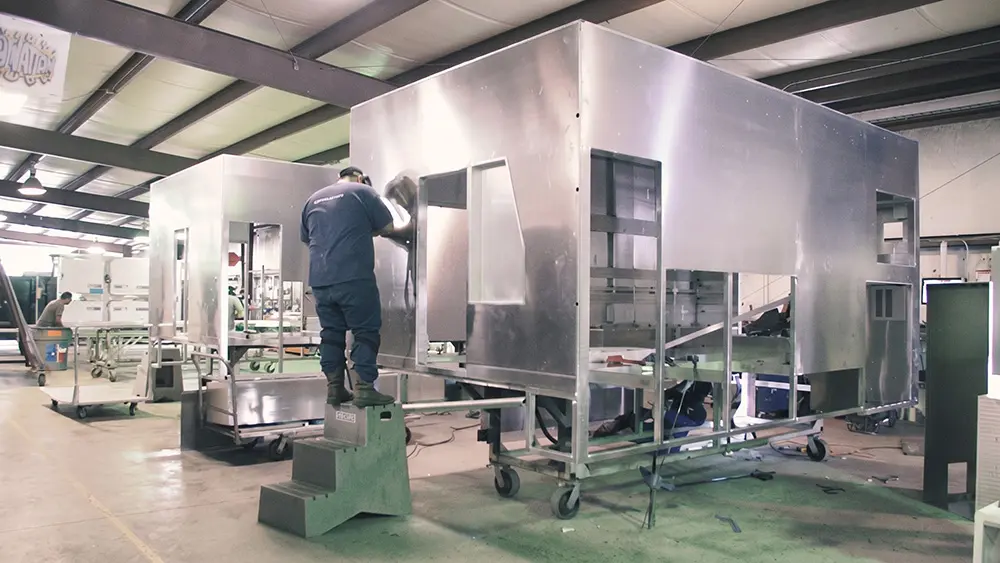
At Frazer’s facility in Sugar Land, Texas, we fabricate aluminum cabinetry and framing components in-house using equipment that includes an Amada punch press and robotic metal paneling systems. Our patient compartment uses all-aluminum cabinetry and framing, without wood, MDF, or particle board, along with stainless steel work surfaces.
Why does that matter? EMS interiors face frequent cleaning, disinfecting, spills, and daily wear. Aluminum construction avoids some of the moisture-related problems associated with wood-based materials, such as swelling. Actual durability still depends on how the vehicle is used and maintained, but material selection is an important part of the conversation.
Think Beyond the First Chassis
A new chassis doesn’t always have to mean a new patient module. Remounting an eligible module onto a replacement chassis can be part of a long-term fleet strategy, particularly for agencies planning 15 to 20 years ahead.
Houston Fire Department’s reported fleet experience offers one example. The department operates 129 Frazer units, with chassis reaching more than 260,000 miles and some modules remounted as many as four times. Those modules have reportedly reached roughly 20 years and more than 1 million miles of cumulative service. Marble Falls Area EMS has also remounted a module originally built in 1996.
These are customer fleet histories, not promises of how long any individual module will last. Remount suitability depends on the module’s condition, the replacement chassis, and the work required. Still, they demonstrate why construction materials and remount options deserve a place in your RFP.
For agencies comparing starting costs, Frazer’s 12-foot Type I Foundation Series has a stated starting price of $252,000. Your final investment will depend on the chassis, configuration, equipment, and options selected. Comparing that price alongside expected maintenance and replacement plans can help you build a more complete picture of ownership costs.
3. Can Your Technicians Troubleshoot the Electrical System?
When an electrical issue takes a vehicle out of service, your maintenance team needs answers. One of the most useful questions you can ask a custom ambulance builder is simple: What will it take to diagnose and repair this system?
Some EMS vehicles use multiplexed electrical systems with integrated control modules. Depending on the design, those systems may require specialized software, manufacturer-specific parts, or additional technical support. Other vehicles use point-to-point wiring, where individual circuits can often be traced using familiar testing methods.
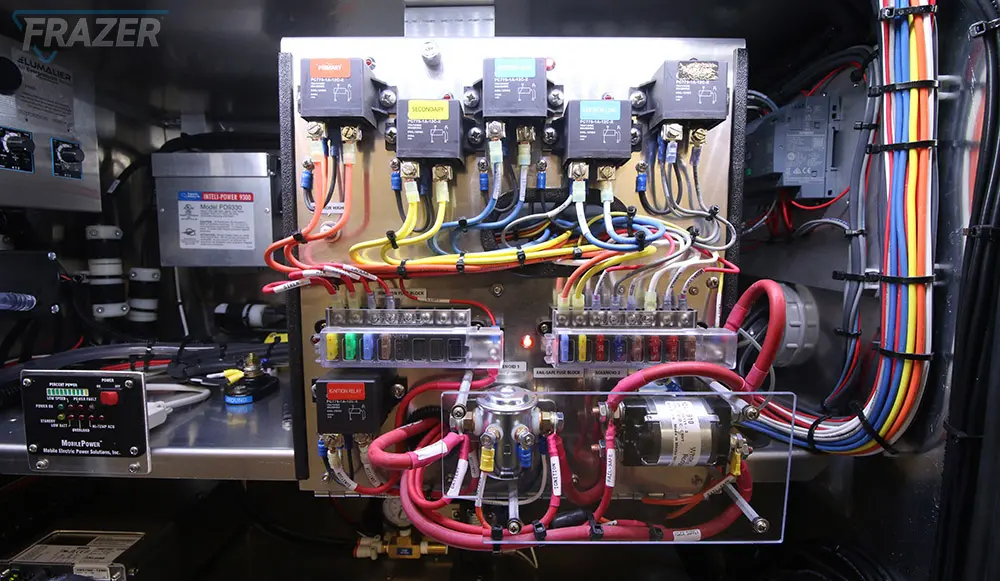
Frazer takes a straightforward approach. Our electrical architecture uses point-to-point wiring, common terminal strips, standard automotive relays, and accessible fuses. It’s an example of the KISS Principle: Keep It Super Simple. The goal is to make electrical systems easier to understand, access, and maintain.
For a fleet technician, that may mean using a multimeter to trace a circuit rather than relying on a proprietary diagnostic interface. The exact repair will still determine what tools and parts are needed, but the design gives maintenance teams a familiar starting point.
In a double-blind survey of 100 EMS and fire professionals commissioned by Frazer, 39% of respondents identified Frazer as the manufacturer whose vehicles spent the least time in the shop. The next closest manufacturers each received 7%. Cranston Fire Department put its experience more simply: “The Frazer is so simple to work on.”
That feedback is useful, but your agency should also consider its own technicians, service resources, and repair procedures. Ask each builder to show you the electrical compartment, explain common repairs, and identify any specialized diagnostic requirements.
Don’t Overlook Power and Air Conditioning
Electrical design is only part of the picture. Think about how your patient compartment gets power and stays cool, especially when your crew is working in extreme heat.
Frazer offers chassis-independent 115VAC/120V power options, including MEPS, Cummins Onan, and Harrison Hydra-Gen hPower systems. Available configurations also include an automatic 12V DC chassis fail-safe. These options are designed to provide power for the patient compartment without depending entirely on the chassis electrical system.
Frazer’s self-contained 15,000 BTU HVAC system uses separate module ducting rather than sharing the cab’s ductwork. It is engineered for a minimum cooling differential of 25°F to 30°F, with capability above 35°F under suitable conditions. The system is also designed to recirculate cabin air every two minutes through a UV/ionization purifier.
Actual performance depends on outdoor temperatures, vehicle configuration, maintenance, and operating conditions. Before choosing a system, ask what powers it, how it performs in your climate, and what happens if a chassis-related component fails.
4. What Testing Can the Builder Show You?
Safety claims should come with documentation. Every agency wants a vehicle designed to protect its crew and patients, but you need more than a sales pitch to evaluate those claims.
Ask a custom ambulance builder for relevant test reports, equipment-retention documentation, and information about applicable vehicle standards. Depending on your requirements, those may include Triple-K, CAAS GVS, and NFPA 1917. Have the builder explain which standards apply to the proposed configuration and what its testing actually demonstrates.
Frazer’s records show no documented module detachments across more than 4,500 EMS modules built since 1984. We have also documented a CareFlite collision involving a 52 MPH impact and a 90-degree rollover. In that incident, the crew reported no injuries, the module remained intact, and the module was later remounted.
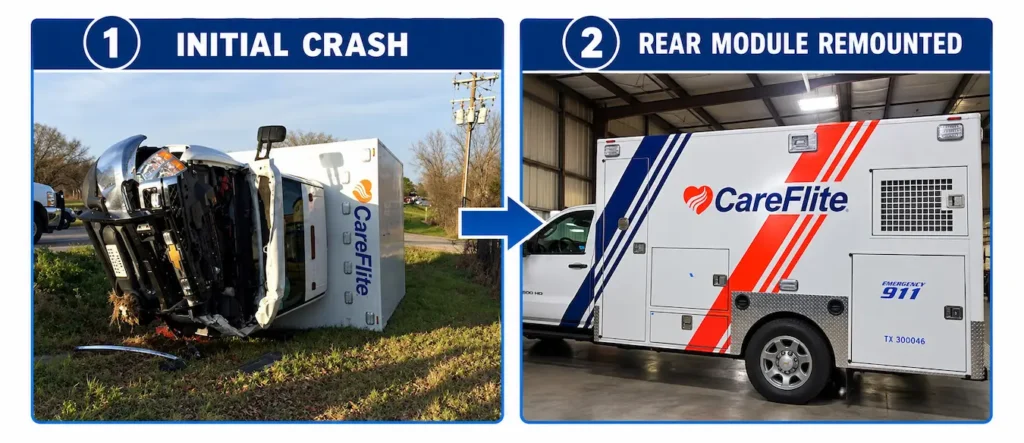
That is a meaningful example of field experience, but it isn’t a guarantee of performance in another crash. No two collisions are exactly alike, and vehicle performance depends on many factors.
Equipment retention deserves the same level of attention. For an onboard CT scanner application, Frazer engineered an SAE J3043-compliant mount that was voluntarily tested beyond 50,000 pounds of force, with no reported structural failure during the test.
If your vehicle will carry heavy or specialized medical equipment, ask for documentation specific to the mounting system and equipment you plan to use. A test result is most useful when you understand exactly what was tested and how it relates to your build.
5. What Does the Warranty Really Cover?
A warranty sounds great until you need to use it and discover that the part you expected to be covered isn’t included. That’s why the written details matter more than a broad promise.
Before you issue an RFP, request each builder’s current warranty documents. Review how long coverage lasts, who qualifies, what’s excluded, and what happens when the vehicle is remounted. Pay close attention to the difference between the builder’s warranty and coverage provided by outside component manufacturers.
Frazer’s stated warranty provisions include a lifetime module construction warranty for the original owner and a two-year warranty on Frazer-performed remounts. The company also lists five-year coverage for electrical system wiring and five-year coverage for paint, striping, and lettering.
Some installed components carry their own original equipment manufacturer (OEM) warranties. Examples in Frazer’s warranty information include four years of parts and labor coverage for AAP-Dometic HVAC and two years or 2,000 hours for Cummins Onan equipment. Frazer also identifies a one-year Performance Bond provision in its warranty information.
These details are subject to the applicable written terms, conditions, and exclusions. The lifetime warranty applies to qualifying module construction, not every component on the vehicle. Ask for the current warranty schedule and confirm which provisions apply to your specific build.
Service After the Sale Matters Just as Much
A warranty explains what may be covered. Service determines how your agency gets help when something needs attention. Before you buy, find out who answers technical questions, how replacement parts are handled, and where repairs can be performed.
In Frazer’s industry survey, support after the sale ranked as the number one purchase decision driver. We take that seriously. Frazer offers factory-direct engineering assistance, parts fulfillment, mobile service, and regional service centers, with service arrangements depending on location and repair needs.
That support matters for customers well beyond Texas. In 2024, 90% of Frazer’s new customers were located outside the state. Yorktown EMS, a single-unit customer, reported receiving the same dedicated service attention it would expect for a much larger fleet order.
Every customer deserves clear answers and dependable support, whether they’re purchasing one unit or fifty. When comparing a custom ambulance builder, ask how service requests are handled and what resources are available in your area. Those answers will matter long after the paperwork is signed.
6. What Should You Look for During a Factory Tour?
A factory tour is one of the best ways to see whether a builder’s process matches its promises. You’ll get a closer look at the materials, wiring, fabrication, and quality-control steps that aren’t always visible in the finished vehicle.
Don’t limit your visit to the showroom. Ask to see work in progress, including areas that will eventually be covered by finished panels or cabinetry. Talk with the people responsible for engineering and production, and make sure your team has time to ask specific questions.
Here’s a practical checklist to bring along:
- Look behind the cabinets. Find out whether the builder uses aluminum, wood, MDF, particle board, or other materials in the patient compartment. Ask about the components you can’t see once the interior is finished.
- Inspect the electrical compartment. Look for labeled circuits and accessible components. Ask your builder to explain how technicians diagnose problems and whether proprietary tools or software are required.
- See where fabrication happens. Ask which parts are punched, bent, welded, and assembled in-house. Find out which major components come from outside suppliers.
- Review the power and HVAC systems. Ask how the patient compartment receives electrical power and cooling. Make sure you understand what depends on the chassis and which options are independent.
- Meet the engineering team. Learn how drawings are reviewed, how changes are documented, and who your agency will work with during the build.
- Ask for the warranty in writing. Review module construction, electrical, remount, and OEM component coverage. Don’t leave without understanding the important conditions and exclusions.
Take notes and ask for supporting documents. When you visit more than one builder, use the same questions each time. That gives your purchasing committee a consistent way to compare what it has seen.
How to Turn These Findings into Better RFP Specifications
Once you’ve compared the builders, the next step is turning what you’ve learned into a clear RFP. Start with your agency’s actual needs, including how the vehicle will be used, how your crews work, and how your maintenance team supports the fleet.
For example, if your agency plans to keep modules through several chassis replacements, it makes sense to evaluate construction materials, remount eligibility, and available service history. If your technicians handle most repairs in-house, consider how easily they can access wiring diagrams, diagnose electrical problems, and source replacement parts.
Be equally specific when reviewing warranties. Rather than comparing broad claims, ask for written coverage periods, exclusions, claim procedures, and service options. This makes it easier to understand the real differences between proposals.
Your RFP should connect technical requirements to an operational reason. Clear, objective criteria help your committee explain its decisions and give prospective builders a fair opportunity to show how their products meet your needs. Be sure to follow your agency’s purchasing rules and any applicable procurement requirements.
Depending on your agency’s eligibility and purchasing process, you may also want to explore cooperative purchasing contracts, grants, leasing, or a custom build-to-order arrangement. Consider the available options as part of your overall fleet and budget planning.
Before You Finalize Your RFP, Talk with Frazer
Choosing an EMS vehicle is a big decision. You should feel confident about the engineering, the materials, the electrical design, and the support you’ll receive after delivery. And you should be able to get clear answers before you commit.
Frazer’s Inside Sales Engineering team can help you review sample CAD drawings, understand available construction and electrical options, and walk through our written warranty information. You can also discuss a live virtual walkthrough of our Sugar Land, Texas facility.
Whether you’re replacing a single unit or planning your next fleet purchase, we’re here to help you make an informed decision. Bring your questions, your specifications, and your concerns. We’ll help you understand what Frazer offers so you can decide what’s right for your agency.
How do you separate a true custom EMS vehicle builder from a high-volume assembler?
Look beyond the finished vehicle and ask how it’s built. A custom EMS vehicle builder should be able to explain its engineering process, show you customer-approved drawings, and discuss how your agency’s needs influence the design. Compare construction materials, in-house fabrication capabilities, electrical systems, and warranty coverage. At Frazer, we use wood-free, all-aluminum patient compartment construction and straightforward point-to-point wiring. The goal isn’t customization for its own sake. It’s building a vehicle that fits your crew, is practical to maintain, and supports your agency’s long-term needs.