
Inside the Ambulance Box: How Welded All-Aluminum Modules Outlast Wood and Composite
A new emergency vehicle can look solid on delivery, but the real test comes after years of calls, rough roads, and daily cleaning. In some cases, maintenance teams discover it years later in the shop, such as when removing a worn vinyl floor seam during a chassis remount reveals moisture-damaged plywood, or when cabinet doors begin to sag after years of road vibration and repeated use.
For fleet managers, emergency vehicle technicians (EVTs), and purchasing committees, hidden wear can mean more repairs, more downtime, and tougher budget decisions. With rising chassis costs and tighter capital budgets, departments and private operators may plan for an ambulance box to serve 15 to 20 years across two or more chassis swaps. Depending on the manufacturer and construction method, modules described as aluminum may also incorporate wood subfloors, MDF cabinet backing, or bonded components behind finished interior surfaces.
What is behind the walls and under the floor matters just as much as the finish you can see. Knowing how a module is built helps your team compare vehicles, plan for repairs, and write better bids.
Understanding EMS Module Wear: Vibration, Moisture Intrusion, and Interior Substrates
Every shift puts an EMS vehicle to work. Curbs, railroad crossings, potholes, and uneven pavement shake the patient compartment and everything mounted inside it. Crews also clean interior surfaces with disinfectants, while vehicle underbodies encounter rain, road salt, and spray.
When inspecting an aging module for structural red flags, maintenance teams may find that material selection, attachment methods, and exposure conditions have contributed to wear beneath the visible surfaces.
How Daily Road Vibration Affects Wood-Based Substrates
Screws hold in plywood, MDF, and particle board by gripping the fibers inside those materials. When a screw is driven into a wood-based substrate, its holding strength depends partly on how the threads engage those fibers.
Under repeated road vibration, movement around a fastener can gradually affect the surrounding material. Over tens of thousands of miles, this may contribute to loosened hardware, cabinet-door misalignment, or latches that require adjustment. The extent of wear depends on material selection, fastener design, installation, loading, and service conditions.
Understanding Marine-Grade Wood and Composite-Skin Construction
Some EMS modules use marine-grade plywood or wood-core materials beneath composite or laminate finishes. These materials can provide useful structural properties when properly specified, installed, and maintained.
In EMS applications, however, fastener penetrations, floor seams, equipment mounts, and repeated use can create potential paths for moisture intrusion. If moisture reaches a wood-based substrate, the material may absorb water and experience swelling or deterioration over time.
Moisture trapped beneath flooring or behind finished panels can also make developing conditions difficult to detect during routine inspections. Depending on the materials and exposure conditions, prolonged moisture may contribute to microbial growth or additional maintenance needs.
All-Aluminum, Wood-Lined, and Composite Modules: What’s the Difference?
If you expect a module to serve for 15 to 20 years, ask what is actually inside it. An aluminum exterior does not necessarily mean the floor, cabinets, and mounting surfaces are wood-free.
Here is how Frazer’s welded, wood-free construction compares with common wood-lined and composite approaches. Materials, attachment methods, and service characteristics may vary by manufacturer and model.
| Construction Feature | All-Aluminum Welded (Frazer Approach) | Wood-Lined Aluminum Module | Composite / Wood-Core Module |
|---|---|---|---|
| Primary Structural Frame | Welded 6061-T6 aluminum tubing (3″ × 1.5″ × 3/16″ base) with laminated corners | May use a tubular aluminum frame with wood furring or backing strips | May incorporate extruded aluminum framing or bonded composite panels |
| Subfloor Construction | Laminated aluminum sheets over a polycarbonate core (wood-free design) | May use plywood beneath vinyl flooring | May incorporate composite skins with wood-based or other core materials |
| Interior Cabinetry | Formed, powder-coated aluminum cabinetry; stainless steel counters | May use plywood, MDF, or particle board with laminate finishes | May use molded composite or laminate-over-wood cabinetry |
| Fastener Anchoring | Bolted into .250″ and .375″ welded aluminum attachment plates | May use screws anchored into plywood or MDF backing | May use mechanical inserts or fasteners anchored into composite or wood-based cores |
| Moisture & Mold Considerations | Non-porous aluminum, stainless steel, and polycarbonate help limit water absorption within these materials | Wood-based substrates may absorb moisture and experience swelling or deterioration if exposed | Moisture performance depends on core material, sealing methods, and the condition of penetrations and joints |
| 15–20 Year Remount Considerations | Designed to support multiple chassis swaps (customer-reported up to 4 remounts) | Remount suitability depends on structural condition, material integrity, and maintenance history | Remount suitability depends on structural design, core condition, attachment integrity, and maintenance history |
How Frazer Builds Its Welded Aluminum Frame
One question we hear from fleet technicians is simple: How do you build a strong patient compartment and mount the cabinets without wood backing? The answer starts with the frame and the connection points.
Primary Structural Members: 6061-T6 Tubing and Laminated Corners
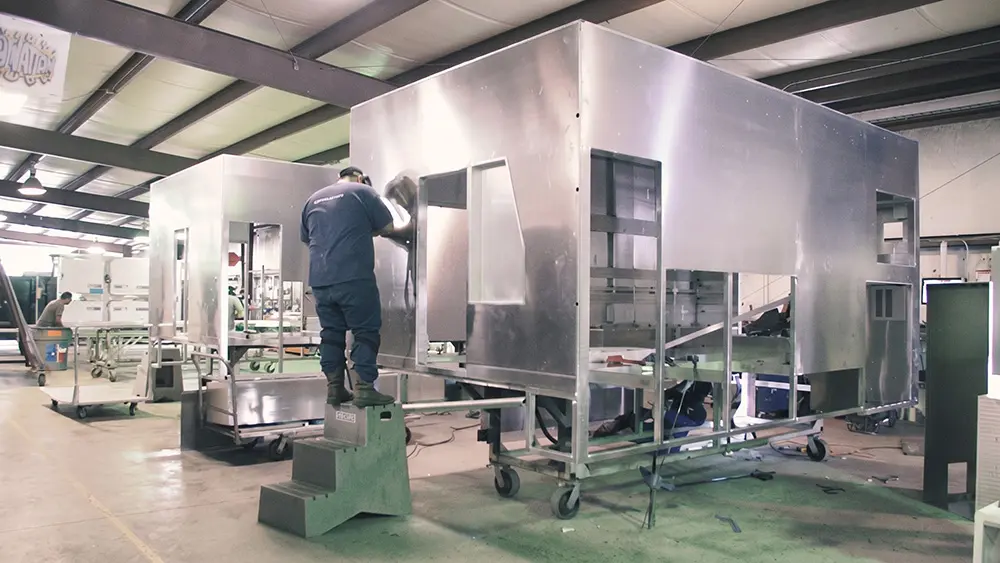
Frazer builds the main structure of its EMS modules with heat-treated 6061-T6 aluminum tubing. This alloy offers strength and corrosion-resistant properties that make it suitable for a range of transportation and structural applications.
Within Frazer’s ambulance box, the framing system is designed to support structural loads while accommodating conditions associated with vehicle operation, including chassis movement over uneven terrain.
Frazer’s structural framework includes: Base and sidewalls: The base uses 3″ × 1.5″ × 3/16″ 6061-T6 aluminum tubing, while the sidewalls use 1.5″ × 1.5″ × 1/8″ tubing. Front and rear walls: The front uses 1.5″ × 3″ × 1/8″ members, and the rear uses 2.5″ × 2″ × 1/8″ members.
Roof: 2″ × 1.5″ × 1/8″ roof members tie into a 2″ × 2.5″ × 1/8″ perimeter frame. Primary structural joints are welded, with laminated corner construction.
Welded Attachment Plates: How Interior Cabinets Anchor Without Wood Backing
We incorporate .250″ and .375″ aluminum attachment plates welded into designated high-load areas across the walls, ceiling, floor, and doors. These plates provide metal attachment points for components such as cabinetry, grab handles, seating, restraints, and cot hardware.
What this means in the field: Formed, powder-coated aluminum cabinets and other interior components attach mechanically to designated metal mounting points rather than relying on wood backing. This approach is designed to support attachment integrity during repeated use and road vibration. Welded mounting plates also provide defined attachment locations for equipment and interior features, with performance depending on the complete installation, component loads, and operating conditions.
Where Welds Stop and 3M VHB Tape Begins
If the frame is welded, why does Frazer also use 3M Very High Bond (VHB) tape? Because the frame and exterior skin have different jobs. Understanding the intended role of each joining method helps clarify the design.
Frazer uses welded joints for its primary structural members and mounting plates. Frazer also uses 3M VHB tape in designated non-structural applications, including bonding the .080″ 5052 aluminum exterior skin to the welded 6061-T6 framework.
Welding thin .080″ exterior sheet metal directly to heavier structural tubing can introduce heat distortion and localized stresses. Frazer’s approach separates the structural framing connections from the exterior skin attachment method.
This design allows the welded framework to provide structural support while the bonded exterior panels serve their intended enclosure function. Depending on the nature of a repair, the attachment method may also allow technicians to service exterior panels without disturbing primary structural welds.
Why Wood-Free Floors and Cabinets Matter
How Does an All-Aluminum Welded Ambulance Box Address Moisture-Related Deterioration?
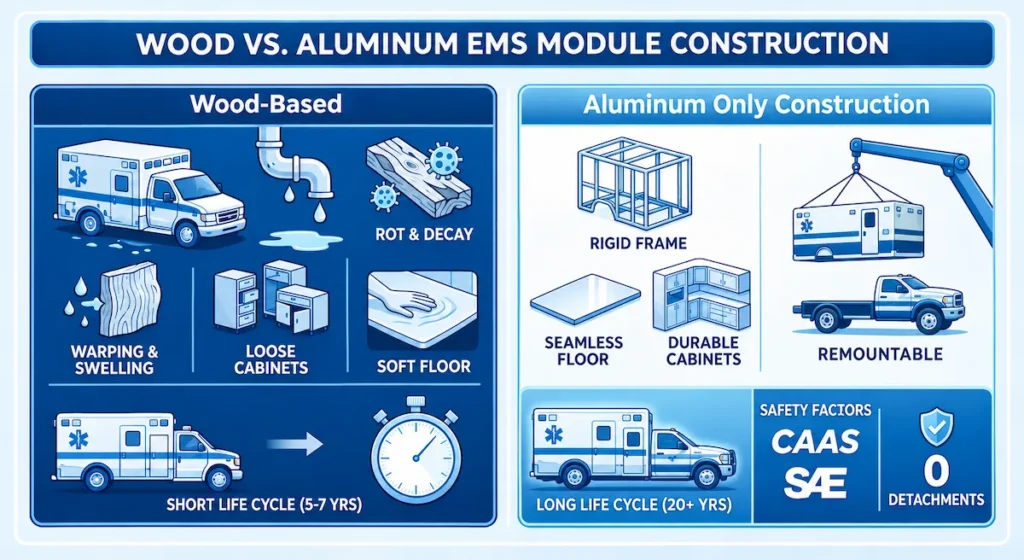
Water has a way of finding floor seams, equipment openings, and damaged seals. Using wood-free materials reduces the risk of swelling and rot associated with wet wood-based substrates.
Frazer builds its patient compartments with welded 6061-T6 aluminum framing, formed powder-coated aluminum cabinetry, stainless steel countertops, and a laminated aluminum-over-polycarbonate subfloor. These materials provide non-porous surfaces and are selected to help manage moisture exposure during regular EMS operations. The construction approach is designed to support long-term serviceability, including fleet plans that may extend across 15 to 20 years.
As with other emergency vehicle construction methods, ongoing inspection, cleaning, and maintenance remain important for identifying potential moisture entry points and addressing wear.
Inside the Laminated Aluminum-Over-Polycarbonate Subfloor
Beneath the patient-compartment flooring, Frazer uses a laminated subfloor made of aluminum sheets bonded over a polycarbonate core. By using a wood-free core instead of plywood or other wood-based materials, this construction reduces exposure to moisture-related issues commonly associated with absorbent organic subfloor materials, including swelling and rot.
The laminated subfloor is designed to support the demands of patient-compartment use, including cot loads and repeated crew foot traffic. Its long-term condition depends on factors such as loading, maintenance, damage, and environmental exposure.
Formed Aluminum Cabinetry and Non-Porous Patient-Care Surfaces
Frazer uses formed, powder-coated aluminum cabinetry paired with stainless steel work surfaces in its patient compartments. The wood-free interior construction omits plywood, MDF, and particle board from the specified ambulance box materials.
For crews cleaning the patient compartment between calls, non-porous surfaces are a practical advantage. Aluminum and stainless steel surfaces can be cleaned using compatible disinfectants according to applicable product and equipment instructions.
By reducing the use of absorbent interior materials, this approach may also help limit moisture-related swelling and deterioration associated with wood-based substrates. Routine cleaning and inspection remain important for maintaining patient-care surfaces and identifying areas requiring service.
Built for Vibration, Weather, and Years of Service
Why Can Interior Cabinets Loosen Under Daily Road Vibration?
Repeated road vibration can place stress on cabinet attachments and mounting hardware. In wood-lined construction, movement around screws may affect the holding strength of the surrounding plywood or MDF, particularly when materials experience repeated loading or moisture exposure.
Frazer’s construction approach uses formed aluminum cabinetry attached to .250″ and .375″ aluminum mounting plates welded to a 6061-T6 structural frame.
These designated metal attachment points are intended to support secure mechanical connections and provide a durable mounting foundation for interior equipment. As with other mechanical assemblies, inspection and maintenance help identify hardware movement, damage, or wear over time.
How Long Can a Wood-Free, All-Aluminum EMS Module Serve Across Chassis Remounts?
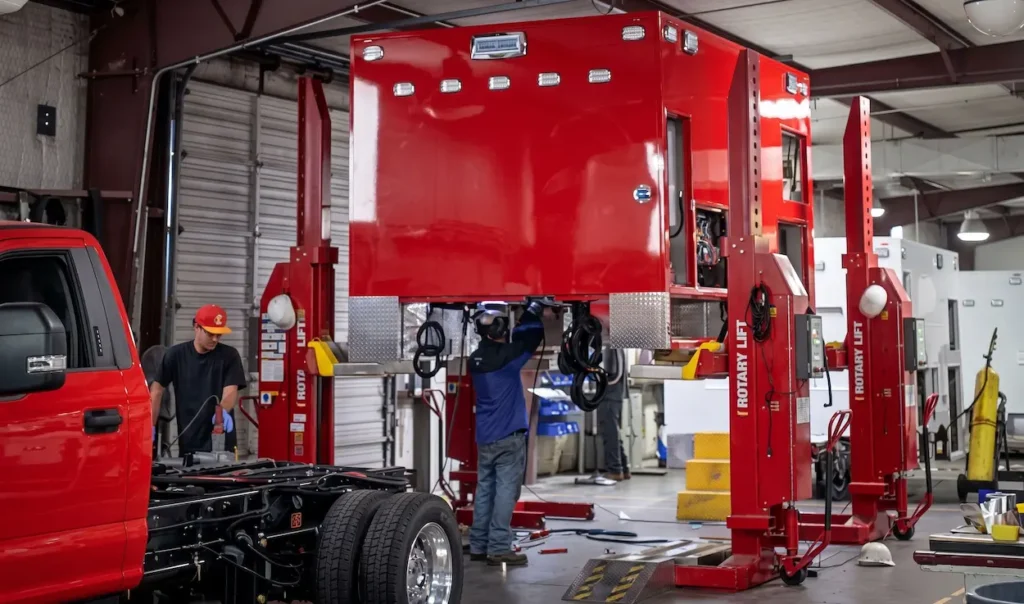
A module should not automatically be retired when its chassis reaches the end of its useful life. Frazer’s welded, wood-free construction is built with long-term service and chassis remounting in mind. Depending on vehicle condition, maintenance history, operating demands, and remount eligibility, fleets may plan for a module service life of 15 to 20 years across multiple chassis swaps.
Customer fleet reporting provides examples of extended service. The Houston Fire Department has reported remounting Frazer modules up to four times, with some modules surpassing 1,000,000 miles of service.
These examples illustrate the potential for long-term module use under documented fleet conditions. Individual vehicle service life and remount suitability depend on inspection findings, structural condition, and operational requirements.
Real-World Remount Experience
Houston Fire Department reports operating 129 Frazer units, with more than 260,000 miles per chassis in some cases. The department has reported remounting modules up to four times, representing roughly 20 years and more than 1,000,000 miles of service on certain modules. Marble Falls Area EMS has also continued remounting a Frazer module built in 1996. These are customer-reported examples, not guaranteed service-life targets. Learn more about how fleets evaluate an all-aluminum module for multiple chassis remounts.
What We Know About Module Retention
Frazer’s records covering more than 4,500 EMS modules built since 1984 report no module detachments. Documented incidents include a CareFlite collision involving a reported 52 mph impact and a 90-degree rollover, after which the crew reportedly walked away without injury and the module was later remounted. Other reported rollover incidents involved Jackson County Fire Rescue and Gadsden County Emergency Services.
These accounts describe specific incidents. Every crash is different, and no past result can predict the outcome of a future collision.
Mounting Heavy Medical Equipment
Mobile healthcare units can carry heavy equipment that needs properly engineered mounts. Frazer developed an SAE J3043-compliant CT scanner mount that, according to reported independent test results, was subjected to more than 50,000 pounds of force with no damage observed in the tested configuration. That test result applies to the stated test conditions; it is not a guarantee for every installation or event.
Look Beyond the Purchase Price: Service and Bid Specifications
A welded, all-aluminum EMS module can cost more up front than some alternatives. The purchase price matters, but it is not the whole cost of running a fleet. For finance teams and fleet decision-makers, that initial investment is one part of the overall purchasing evaluation.
Lower Overall Cost of Ownership (LOCO) considerations may include structural maintenance, repair requirements, vehicle downtime, remount opportunities, and the ability to service the module during years 10 through 20.
Actual ownership costs vary based on purchasing terms, vehicle configuration, usage, maintenance practices, and fleet replacement schedules. Evaluating those factors together can help departments make purchasing decisions that align with their operational and budget requirements.
Pairing a 20-Year Module Plan with KISS Principle Point-to-Point Wiring
Long-term service is not just about the frame. Electrical architecture and component accessibility can also influence maintenance planning.
Frazer builds modules around a KISS Principle point-to-point wiring architecture using standard automotive relays, common terminal strips, and accessible fuses rather than relying on a proprietary multiplex circuit-board architecture.
This approach is intended to make electrical components easier for qualified technicians to identify, access, troubleshoot, and service using familiar automotive maintenance practices. As Cranston Fire Department’s maintenance team noted, “The Frazer is so simple to work on.”
For departments evaluating standardized configurations, Frazer also offers its wood-free, all-aluminum construction in the 12-foot Type I Foundation Series, with pricing starting at $252,000. The Foundation Series includes a lifetime module construction warranty for the original owner, subject to applicable warranty terms and exclusions. Frazer also offers a 2-year warranty on Frazer remounts, subject to applicable coverage terms.
Frazer uses third-party testing to evaluate applicable vehicle requirements aligned with KKK-A-1822F, CAAS GVS, NFPA 1917, FMVSS, SAE, and AMD standards. Specific testing and applicability may depend on the vehicle configuration, model, and relevant requirements.
Objective Engineering Criteria to Consider in Your Next Bid Specification
A good bid specification tells manufacturers what your department needs and gives your committee a fair way to compare proposals. The following criteria reflect features of Frazer’s construction approach and may serve as reference points when determining requirements appropriate for a department’s operating conditions and purchasing objectives:
Start with materials. Define which parts of the patient compartment must be wood-free, including floors, walls, and cabinetry. If your fleet wants to avoid plywood, MDF, or particle board in those areas, say so. For the subfloor, consider laminated aluminum over polycarbonate or another non-organic, non-porous design that meets your performance requirements.
Be specific about structure and mounting. You may want to request documented 6061-T6 aluminum framing, joining methods, and corner details. Where appropriate, a 3″ × 1.5″ × 3/16″ base-frame minimum can serve as one measurable reference point. Specify how cabinetry, grab rails, seating, cot hardware, and equipment mounts must be anchored. Frazer uses welded .250″ and .375″ aluminum plates at designated mounting locations.
Ask for the warranty in writing. Compare coverage for module construction, eligibility, exclusions, transferability, and remounts. Frazer’s lifetime module construction warranty covers the original owner, subject to the written warranty terms.
Clear specifications can help purchasers compare available construction approaches while allowing manufacturers to document how their designs address the department’s operational requirements.
Specifying Your Next Module or Evaluating a Remount?
Whether you are writing a bid for a new frontline unit or deciding if an existing module is ready for another chassis, our team can help you look at the details that matter. Our team can walk you through 6061-T6 structural framing, wood-free interior materials, attachment methods, remount considerations, and applicable warranty provisions so you can make an informed decision for your fleet.
Schedule a virtual module and engineering walkthrough to see the construction details, or request specifications and pricing for your next project. We will help you understand the options so you can make the right decision for your fleet.
How does an all-aluminum welded EMS module reduce moisture-related deterioration?
Frazer’s wood-free patient compartment avoids plywood, MDF, and particle board that can absorb moisture and deteriorate. It uses welded aluminum framing, formed aluminum cabinets, stainless steel work surfaces, and an aluminum-over-polycarbonate subfloor. These materials reduce moisture-related risks, but proper sealing, cleaning, and inspections remain essential to managing water intrusion and mold.