
The 1-Million-Mile EMS Module: How to Plan for 20+ Years of Service
Rising vehicle costs and long factory lead times are putting more pressure on Fire Chiefs, EMS Directors, and municipal budgets. New emergency vehicle purchases can range from $250,000 to more than $350,000, while some departments may wait 18 to 24 months for a completed unit.
These challenges make the traditional replacement cycle harder to maintain. Replacing an entire mobile healthcare unit every 5 to 7 years may no longer be the best use of limited capital, especially when the patient compartment remains structurally sound.
As a result, more fleet leaders are looking at ways to use one EMS module across several chassis lifecycles. This guide explains how module construction, electrical design, power systems, and serviceability can support 20 or more years of use and up to 1,000,000 miles of active service.
Why the Traditional 7-Year Replacement Cycle May Not Fit Every Fleet
For many years, departments followed a simple plan. They purchased a complete emergency vehicle, operated it for about 100,000 miles or 5 to 7 years, traded it in, and purchased a replacement.
That model has become more difficult because vehicle prices have increased, production timelines have grown longer, and chassis engines often wear faster than the patient-care module. Heavy idling can add significant engine hours because the chassis may need to power medical equipment, lighting, and air conditioning while parked on scene.
When the engine reaches the end of its useful life before the module, retiring the entire unit may not be the best use of department funds. A planned multi-cycle remounting strategy allows a department to separate the service life of the chassis from the service life of the patient compartment.
This approach can help departments direct capital toward the equipment and operational needs that matter most. For a broader look at procurement and lifecycle planning, read The 2026 Guide to Ambulance Total Cost of Ownership & Fleet Lifecycle Management.
How Can an EMS Module Support 20 Years and 1 Million Miles?
Long service life starts with a module that is built for durability and future service. A 100% wood-free 6061 T-6 structural aluminum frame, combined with point-to-point electrical architecture, is designed to support repeated chassis remounts and straightforward maintenance.
Removing wood from the structural framework also helps reduce the risk of moisture-related deterioration that may weaken the module over time.
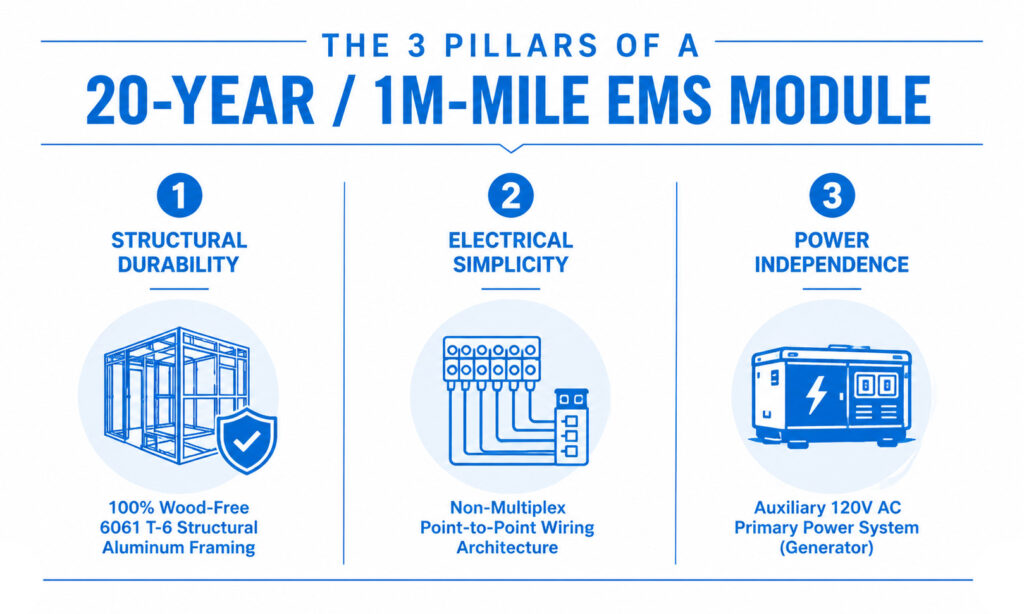
Pillar 1: 100% Wood-Free 6061 T-6 Structural Aluminum Framing
Some emergency vehicle bodies use wood backing or composite materials behind wall panels and cabinetry. Over time, humidity, washdowns, and fluid intrusion may reach these hidden materials. Because wood absorbs moisture, it may deteriorate and contribute to wall movement, loose cabinet joints, or reduced structural strength.
This damage may remain hidden until the module is inspected or removed from its chassis. If the underlying structure has weakened, the module may not be able to handle the stress of being lifted, detached, and installed on another chassis.
A wood-free module uses welded, heat-treated structural aluminum for the frame and cabinet substructure. Aluminum does not rot when exposed to moisture, which can help the walls and cabinets remain stable throughout the module’s service life.
This construction is designed to reduce the risk of hidden framing damage and support future chassis transfers. Depending on the module’s condition, maintenance history, inspection results, and configuration, it may be suitable for a second, third, or even fourth chassis.
An EMS module often experiences years of vibration and twisting forces during active response. Cabinetry that depends on surface fasteners or lightweight brackets may loosen over time.
In Frazer units, flush-mounted aluminum cabinetry can be connected directly to the structural wall tubing. This helps the cabinets become part of the module structure while maintaining an open, practical workspace for medics. Third-party static-load and crash testing can provide additional information about how these designs respond to forces from several directions.
Pillar 2: Simplified Electrical Systems
Electrical compatibility is one of the most important questions to consider before a chassis remount. Some emergency vehicles use multiplex systems with computerized circuit boards, solid-state nodes, proprietary controllers, and specialized software.
Problems may arise when an older multiplex module is removed from one chassis and connected to a newer model. New chassis CAN-bus signals may not work well with older programming. Circuit boards exposed to years of vibration and temperature changes may also develop cracks or intermittent connections.
Replacement nodes may be backordered or no longer supported by the original electronics manufacturer. Technicians may also need proprietary software or a factory programmer to diagnose problems, which can add time and complexity to a repair.
Point-to-Point Wiring: Troubleshooting with Fuses and Relays
Point-to-point wiring offers a simpler approach. It routes power through automotive relays, fuses, switches, and heavy-duty terminal strips instead of depending on multiplex boards and proprietary electronic controls.
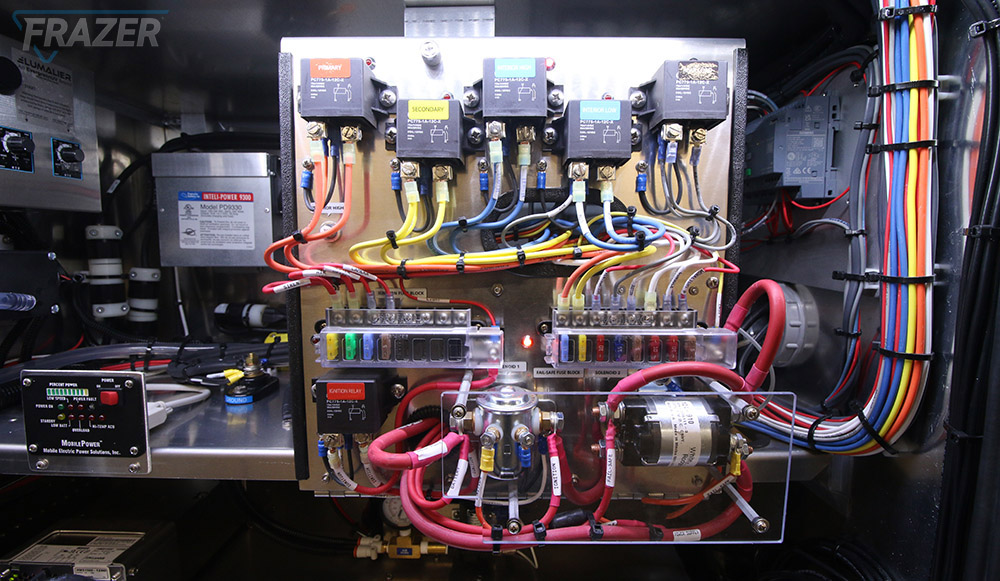
Frazer places the main electrical connections inside an accessible exterior compartment with visual LED monitoring diodes. This allows technicians to inspect circuits without taking apart large sections of the unit.
For example, if a compartment light or outlet stops working, a mechanic can open the electrical compartment, check the monitoring diodes, identify the affected circuit, and replace a standard automotive fuse when appropriate.
This design allows many routine electrical repairs to be completed with standard parts and familiar tools. In-house technicians may not need dealer programming equipment or proprietary factory software for common issues.
The same architecture can also make a chassis transfer more straightforward because the module’s electrical system is less dependent on older electronic controllers.
Frazer backs its point-to-point wiring with a 5-year electrical wiring warranty. Customers also have access to direct factory technical support and training, including free hands-on mechanic training at Frazer facilities. All warranty coverage is subject to the applicable written terms, conditions, limitations, and exclusions.
Pillar 3: Independent Module Power
An independent power system operates the module’s HVAC and medical equipment separately from the truck engine. This design can reduce the need for high-idle chassis operation and help limit engine wear caused by long periods of idling.
It can also help departments operate within applicable chassis manufacturer recommendations. Customer-reported fleet data has shown total maintenance cost reductions ranging from 42% to 60% compared with chassis-dependent electrical configurations.
Reducing Chassis Idle Wear
In many traditional emergency vehicle designs, the chassis engine performs two jobs. It moves the vehicle, and it powers the module while the unit is parked on scene.
The engine may run at high idle to support the alternator and belt-driven air-conditioning compressors. This adds engine hours even when the vehicle is not moving. Some industry estimates compare one hour of idling to approximately 25 to 33 miles of driving, although the actual effect depends on the chassis, engine, environment, and operating conditions.
Over several years, heavy idling may contribute to wear on diesel particulate filters, turbochargers, alternators, and other drivetrain components. Operating practices may also affect warranty coverage, depending on the chassis manufacturer’s written requirements.
An independent auxiliary power architecture changes this approach. A dedicated 120V AC generator or a MEPS/hPower system can operate the patient-compartment HVAC and electrical equipment without placing the full load on the chassis engine.
Depending on the unit configuration, scene requirements, and department procedures, the truck engine may be able to remain at normal idle or be turned off while the module continues to operate.
Reducing alternator demand and thermal strain can help departments remain within applicable engine and transmission recommendations. Separating module power from vehicle propulsion may also help departments operate each chassis longer before scheduling a remount.
When independent power is combined with simplified wiring and durable module construction, departments following a Lower Overall Cost of Ownership (LOCO) approach have reported total fleet maintenance cost reductions between 42% and 60%.
Self-Contained 120V AC HVAC for Serviceability and Hot-Weather Performance
Climate control affects patient care, medic working conditions, and vehicle availability. Chassis-driven HVAC systems may have difficulty cooling a patient compartment during long scene times in extreme heat.
Repairing a chassis-dependent air-conditioning system may require work inside the engine compartment, refrigerant recovery, or removal of interior panels. Depending on the problem, the unit may remain out of service for an extended period.
A self-contained 120V AC HVAC unit is mounted on the exterior side of the module. This design gives technicians direct access to the system and may allow the complete unit to be replaced without major work inside the patient compartment or chassis.
The system is engineered to maintain up to a 35°F difference from the outside temperature and recirculate 450 cubic feet of air per minute. Actual cooling performance will vary based on outside temperature, door use, vehicle configuration, maintenance, and operating conditions.
If a compressor or fan needs service, shop technicians may be able to remove the exterior unit and install a spare in less than one hour. Actual repair time depends on equipment condition, technician availability, and shop procedures.
Frazer’s independent HVAC systems include a dedicated 4-year parts and labor warranty. Coverage is subject to the applicable written warranty terms, conditions, limitations, and exclusions.
Evaluating Remount ROI Against New Vehicle Procurement
Fire Chiefs often need clear financial information when presenting a fleet plan to City Managers, Finance Directors, County Commissioners, and other decision-makers.
The following comparison shows how a traditional 5-year replacement model may differ from a multi-cycle remount strategy over 20 years. The remount strategy uses one durable, wood-free module across four chassis cycles.
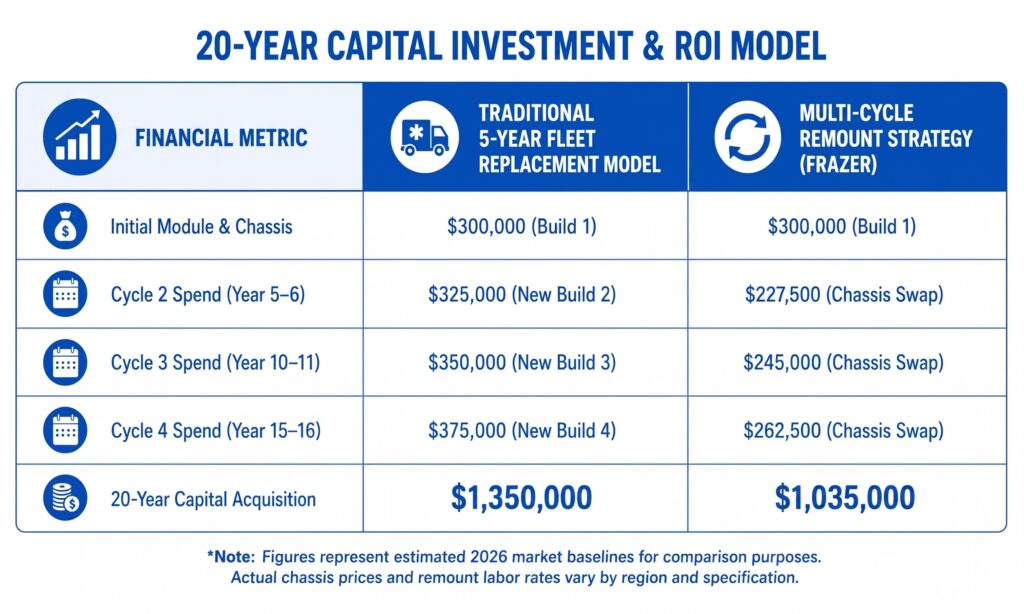
For a department operating five frontline emergency vehicles, a multi-cycle asset plan may make it possible to redirect a significant amount of capital over a 20-year period. Instead of reacting to full-unit replacement needs, the department can develop a planned process for preserving and reusing modules that remain fit for service.
Real-World Fleet Experience: More Than 1 Million Miles in Service
Large metropolitan emergency services provide real-world examples of how EMS modules can perform across several chassis lifecycles.
The San Antonio Fire Department operates a fleet that includes 129+ Frazer generator-powered modules. Its truck chassis may log more than 260,000 active response miles during one chassis cycle. SAFD has routinely remounted modules as many as four times. Multiple modules in the fleet have remained in continuous service for more than 20 years.
This service life is supported by durable construction and written warranty coverage. Frazer provides a lifetime module construction warranty to the original owner. The warranty covers qualifying issues related to design, workmanship, structural integrity, and installation, subject to the applicable written terms, conditions, limitations, and exclusions.
All-aluminum framing, point-to-point wiring, and direct factory support work together to create a repeatable approach to long-term module ownership.
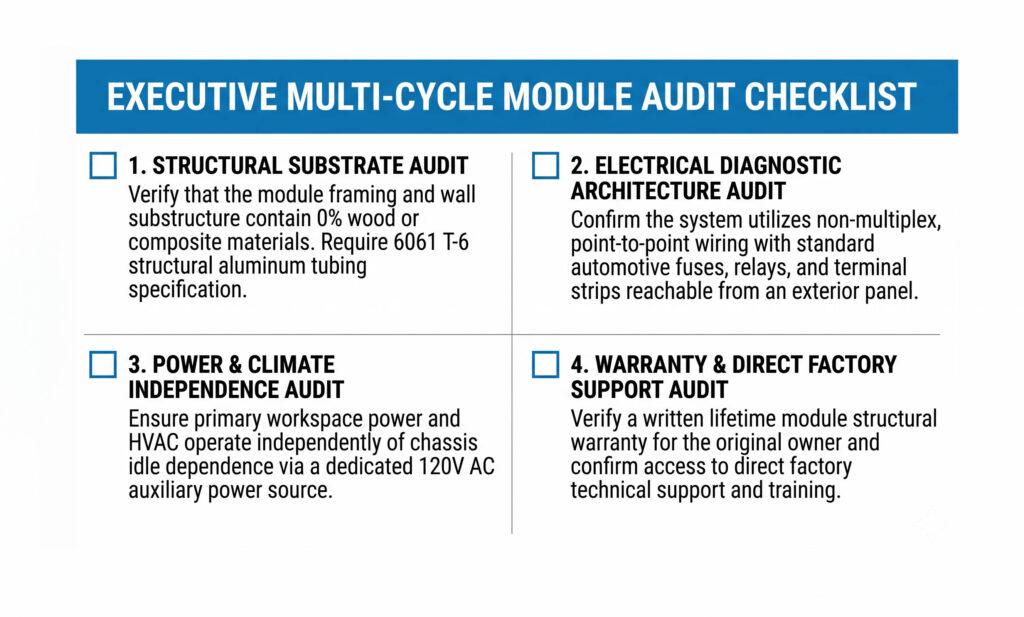
A 4-Step Review for Multi-Cycle Module Planning
Before purchasing a new unit or preparing a 5-Year Capital Improvement Plan, department leaders should evaluate whether the proposed module is designed for long-term use.
Start by reviewing the structural materials. Confirm whether the frame and cabinet supports contain wood or other materials that may absorb moisture. Next, examine the electrical system. Determine whether local technicians can troubleshoot it with standard tools and commonly available parts, or whether repairs require proprietary software and components.
Then, review how the module receives power while parked. An independent power system may reduce high-idle engine operation and separate patient-compartment demands from the chassis drivetrain. Finally, review the manufacturer’s written warranties, inspection requirements, remount process, parts availability, training, and support after delivery.
Planning for Long-Term Asset Preservation
Extending the service life of an EMS module does not mean taking shortcuts or using equipment beyond safe operating limits. It means selecting a module that is designed to be inspected, maintained, repaired, and transferred to another chassis when appropriate.
Wood-free aluminum construction can help reduce moisture-related damage. Point-to-point wiring can simplify routine troubleshooting. Independent module power can reduce chassis dependence and limit high-idle wear.
Together, these systems may help reduce maintenance complexity, improve fleet availability, and increase the value departments receive from their capital investments.
Ready to Review Your Fleet’s Long-Term Options?
Higher chassis costs and longer lead times can make fleet planning more difficult. Contact the Frazer technical team to discuss an Executive Fleet Consultation or request a customized Multi-Cycle Remount ROI Model for your upcoming capital plan.
How can an EMS module support 20 years and reach 1 million miles?
An EMS module may support a 20-year, 1-million-mile service life when it is built with durable materials and systems designed for future maintenance and remounting. A 100% wood-free 6061 T-6 structural aluminum frame helps reduce the risk of moisture-related deterioration, while point-to-point wiring can simplify repairs and chassis transfers.
A properly maintained module may be suitable for use across as many as four chassis cycles. Actual service life depends on operating conditions, maintenance, inspections, repairs, configuration, and continued fitness for service.