
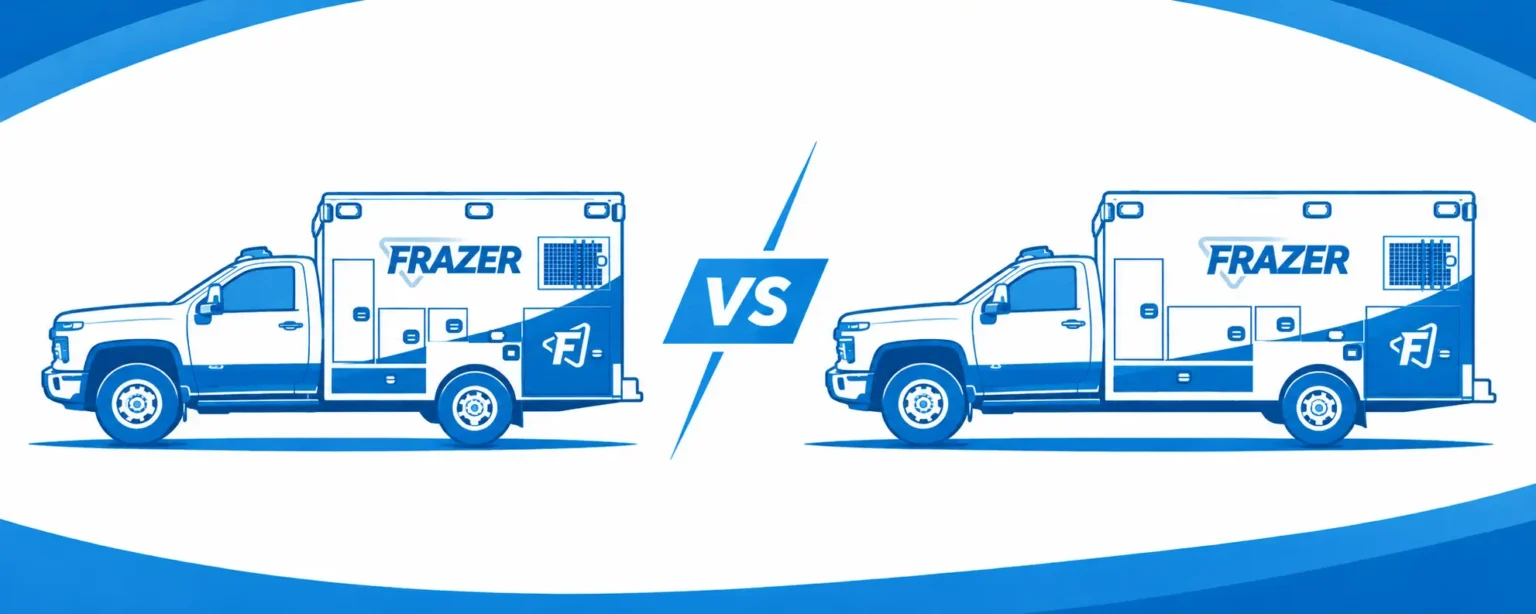
Medium vs. Large Module Ambulances: How Width, Aisle Clearance, and Bay Height Shape 12ft and 14ft Units
Choosing between a medium module and a large module ambulance is about more than picking a length. Crews need enough room to move comfortably, access equipment, and provide patient care, while fleet leaders need a vehicle that fits local streets, station doors, hospital bays, and available chassis capacity. The right choice balances patient care needs with the practical demands of daily operations.
A 12-foot medium module and a 14-foot large module each offer advantages, but bigger doesn’t always mean better. Factors like interior aisle clearance, equipment storage, turning radius, overall vehicle height, and payload capacity can make a significant difference in how a vehicle performs. Understanding these trade-offs helps departments choose a configuration that works for their crews, their communities, and their long-term fleet plans.
How Much Working Room Does a Large Module Ambulance Provide?
Length is only part of the space equation. Frazer’s standard 12-foot and 14-foot EMS module layouts both use a true 96-inch exterior width and a center-mounted cot, providing nearly 50 inches of open aisle clearance and four caregiver seating positions.
Why Width Matters for Bedside Access
Think about where your crews stand, sit, and reach during patient care. Frazer’s 96-inch-wide design and center-mounted cot help preserve access on both sides of the patient, with seating arranged so caregivers can stay belted when appropriate.
That focus on the crew is backed by customer feedback. In a Frazer double-blind survey of 100 EMS and fire professionals, 66% identified seating position and ergonomics as a top safety priority. You can see how this space is arranged in Frazer’s 12-foot Type I EMS module layouts and specifications.
What Does a 14-Foot Large Module Ambulance Add?
If both standard layouts offer similar room beside the cot, what does the extra two feet buy you? A 14-foot module adds 24 inches of length that can be used for storage, specialty equipment, or a different patient-care layout. The value depends on what your crew needs to carry and where it needs to go.
Frazer offers large module ambulance layouts in 14-foot Type I Standard, Door-Forward, Transverse, Critical Care Transport, and Bariatric configurations. Each addresses a different way of working, so it pays to compare floor plans against your equipment list rather than assuming more length is automatically better.
Medium vs. Large Module Ambulance Comparison
| Specification Factor | 12-Foot Medium Module | 14-Foot Large Module Ambulance |
|---|---|---|
| Module Length | 12 feet | 14 feet |
| Exterior Module Width | True 96 inches | True 96 inches |
| Open Aisle Clearance | Nearly 50 inches (center-mounted cot) | Nearly 50 inches (standard center-cot layout) |
| Caregiver Seating | 4 seated positions | 4+ seated positions (varies by specialty layout) |
| Interior Headroom | Varies by selected module roof height and chassis configuration; confirm exact clearance during drawing review | Varies by selected module roof height and chassis configuration; confirm exact clearance during drawing review |
| Overall Exterior Height | Depends on chassis frame height, module height, and roof HVAC/lightbar package | Depends on chassis frame height, module height, and roof HVAC/lightbar package |
| Curb-to-Curb Turning Radius | Determined by chassis platform and wheelbase length | Determined by chassis platform and wheelbase length |
| Typical Chassis Pairing | Class 3 (3500) or Type III van platforms | Class 4/5 (4500HD/5500HD/CV515) or Type III platforms |
| Common Mission Applications | Urban/suburban 911, facilities with limited bay clearance, standard ALS/BLS | Bariatric, Critical Care Transport, dual-cot, and equipment-intensive fire-rescue applications |
Will the Vehicle Fit Your Streets, Stations, and Hospital Bays?
A larger patient compartment isn’t much help if the vehicle struggles to reach the call or fit under a hospital canopy. For urban response areas, cul-de-sacs, and older facilities, the full vehicle footprint deserves as much attention as the interior.
Wheelbase, Turning Radius, and Tight Streets
Module length alone does not tell you how tightly a vehicle can turn. Chassis wheelbase, steering geometry, and rear overhang all play a part, so compare the dimensions of the complete proposed build.
Check Hospital and Station Door Clearance
Before choosing a 14-foot large module ambulance or moving to a heavier chassis, measure the places where your vehicle has the least room. Don’t rely on a nominal module height, because the finished vehicle’s rooftop equipment and chassis ride height affect clearance.
Check hospital ambulance bay canopies, especially at older emergency departments; station door headers with the doors fully open; and any change in ride height between Class 3 and Class 4/5 chassis. Compare each measurement against the finished vehicle drawings.
When Does a Large Module Ambulance Make Sense for Specialty Care?
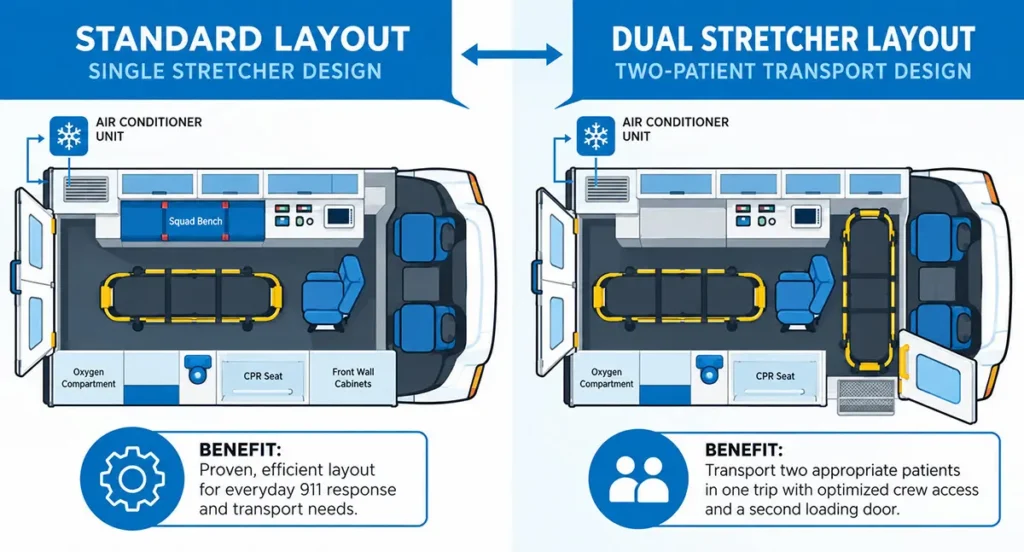
Some calls genuinely need the extra length of a 14-foot module. Bariatric transport, critical-care teams, dual-stretcher operations, and larger equipment packages can all benefit from added floor space and more flexible layouts.
Bariatric Transport and Assisted Loading
Frazer’s Type I 14-foot Bariatric configuration offers an integrated Transafe bariatric winch system to assist with loading. As with any patient-handling equipment, the benefit depends on proper setup, training, and use according to operating procedures.
Critical-Care and Dual-Stretcher Layouts
Critical-care teams may need room for ventilators, infusion pumps, neonatal isolettes, or two patient transport positions. A 14-foot module creates more choices for arranging those systems without losing sight of caregiver seating and access.
Prisma Health has deployed a Frazer 14-foot dual-cot unit designed for simultaneous PICU and NICU care. AdventHealth also uses a Frazer dual-load configuration for multi-patient transport. These examples illustrate why a specialty floor plan can matter more than module length by itself.
If your department has similar transport requirements, review Frazer’s 14-foot Critical Care Transport module configurations. Compare the available layouts against the exact dimensions, staffing, and mounting needs of your equipment.
Secure Specialty Equipment Before You Build
Frazer has developed specialty mounting solutions, including an SAE J3043-compliant mobile CT scanner mount. Frazer reports that the mount was tested beyond 50,000 pounds of force without recorded damage in the referenced test. That result applies to the tested mounting system, not every equipment installation.
How Do You Match Module Size to Chassis GVWR?
Once the floor plan looks right, make sure the chassis can handle the load. GVWR and individual axle ratings must account for the completed vehicle, its crew, fuel, supplies, and all the equipment it will carry on a normal shift.
A Class 3 chassis with a 12-foot module may be a good fit for a standard EMS mission. A heavily equipped large module ambulance may call for the additional capacity available on certain Class 4 or Class 5 platforms. Neither choice replaces a completed-vehicle weight review.
Account for the Weight of a Fully Equipped Vehicle
A published chassis payload number isn’t the same as the usable payload of a finished EMS vehicle. Cabinets, electrical systems, stocked equipment, and passengers all use some of that capacity, so build your estimate around a fully equipped unit.
Include full fuel and fluid tanks, three to four crew members with their gear, powered cots, stair chairs, bariatric winches, oxygen cylinders, monitors, ventilators, and infusion pumps in your operating-weight estimate.
Ask Frazer Engineering for current dry-weight and axle-distribution information on the chassis and floor plan you’re considering. Those figures give your committee a stronger starting point for checking the completed vehicle against its ratings.
Compare Class 3 and Class 4/5 Chassis
For a 12-foot module, Class 3 platforms such as the Chevrolet 3500 (4×2 or 4×4) or a Type III van may suit standard ALS/BLS needs, subject to payload. A heavily equipped 14-foot module may call for a Chevrolet Silverado 4500HD/5500HD, International CV515, or Ford F-450/F-550 Class 4/5 platform.
Why Frazer Uses All-Aluminum, Wood-Free Construction
Construction materials matter when you’re planning for years of daily use. Frazer builds modules with all-aluminum structural framing and cabinetry, stainless steel work surfaces, and no wood, MDF, or particle board in the patient compartment.
What About Cooling, Power, and Cost Over Time?
Frazer designs its patient-compartment power and HVAC systems to operate independently of the chassis engine. Combined with accessible wiring and aluminum modules designed for potential remounting, that approach supports practical maintenance and longer-term fleet planning.
Independent Power and Patient-Compartment Cooling
Frazer offers dedicated onboard power options, including MEPS, Cummins Onan, and Harrison Hydra-Gen hPower. These systems supply the patient compartment independently of the chassis engine, with an intelligent 12V DC chassis fail-safe designed to provide an additional support path under applicable conditions.
The system supports a self-contained 15,000 BTU, 115VAC patient-compartment HVAC unit designed for a 25°F to 30°F cooling differential, with 35°F or more possible under certain conditions. The patient compartment has its own HVAC ductwork rather than sharing it with the driver’s cab.
Frazer’s air system is designed to recirculate cabin air every two minutes through an active UV/photocatalytic purifier. In Frazer’s double-blind survey of 100 EMS and fire professionals, 76% cited air-related concerns as their top safety priority. Actual air-treatment performance depends on operation, maintenance, and conditions inside the vehicle.
Simple Wiring That Supports Serviceability
Frazer follows its KISS, or Keep It Simple, approach with point-to-point wiring, common terminal strips, standard automotive relays, and accessible fuses. The idea is straightforward: make routine troubleshooting easier for the people responsible for keeping the unit in service.
In Frazer’s double-blind survey of 100 EMS and fire professionals, 39% named Frazer as the brand they believed spent the least time in the shop, compared to just 7% for our next competitor. These are survey perceptions, not independently measured downtime figures or a promise about future maintenance.
Look Beyond the Initial Purchase Price
Frazer’s 12-foot Type I Foundation Series starts at $252,000, while custom 12-foot and 14-foot configurations are described here in a $250,000 to $450,000 range. Pricing depends on the build and should be confirmed when you request a quote. Stock vehicles and build-to-order options offer different paths based on your needs and purchasing schedule.
Frazer’s all-aluminum, wood-free modules are designed with remounting in mind when their condition and configuration allow. By remounting an all-aluminum module across multiple chassis, a department may be able to keep using its patient compartment through more than one chassis cycle. Actual savings and service life depend on the vehicle and its maintenance history.
Houston Fire Department provides one example of long-term use. Frazer reports that the department operates 129 Frazer units, with chassis reaching more than 260,000 miles and some modules remounted as many as four times, for roughly 20 years and more than one million miles of cumulative service. These figures describe that fleet’s experience, not an expected result for every department.
Frazer’s new modules include a lifetime module construction warranty for the original purchaser, subject to the warranty terms. Modules remounted by Frazer carry a two-year warranty. Frazer also provides service after the sale and offers vehicles built to applicable Triple-K, CAAS GVS, and NFPA 1917 requirements, depending on the configuration.

Four Checks to Make Before You Issue an RFP
1. Measure Physical Choke Points: Record the lowest hospital ambulance bay canopy, lowest station door header, and tightest neighborhood turn along typical response routes. Compare these measurements with the proposed vehicle dimensions.
2. Weigh Your Full Mission Gear: Calculate the anticipated weight of bariatric stretchers, winches, powered cots, fire turnout gear, clinical electronics, and other operational equipment. Use these figures to evaluate whether a Class 3 (3500) or Class 4/5 (4500/5500/CV515) chassis provides suitable capacity within applicable GVWR and axle ratings.
3. Compare Interiors Virtually: Invite frontline crews to explore Frazer’s interactive 12-foot EMS virtual tour and 14-foot EMS virtual tour. These resources can help teams compare seating positions, equipment access, and aisle layouts before reviewing final drawings.
4. Review Axle Weights and Dimensions with Engineering: Confirm proposed curb weight, overall exterior height, wheelbase, turning radius, and axle-weight distribution with the appropriate engineering team before issuing the RFP.
Ready to Review Your Payload and Clearance Requirements?
No two departments work in exactly the same environment. Share your equipment list, including powered cots, bariatric winches, and turnout gear, along with measurements from your station doors and hospital bays. That information helps turn a general module discussion into a useful specification review.
Frazer’s sales and engineering teams can help you compare 12-foot and 14-foot layouts, discuss chassis options, and review the vehicle dimensions and axle-weight information needed for your specification. The goal is a vehicle that works for your crews, your facilities, and your fleet plan.
Request a Spec & Payload Review
How do 12-foot and 14-foot EMS modules compare in interior aisle clearance and working room?
Module width and cot placement have a greater impact on bedside working room than module length alone. Frazer’s standard 12-foot and 14-foot EMS modules feature a true 96-inch exterior width and center-mounted cot, providing nearly 50 inches of open aisle clearance and four caregiver seating positions. The additional length of a 14-foot module offers more flexibility for equipment storage and specialized patient care layouts.