
EMS Vehicle Downtime: 7 Common Reliability Failures
For fleet managers, downtime is more than a maintenance problem. It can affect response readiness, department budgets, crew assignments, and long-term ownership costs. Understanding the most common causes of downtime can help departments evaluate vehicles, plan maintenance, and make better purchasing decisions.
Many fleet managers ask the same practical question:
“Why do some vehicles seem to spend more time in the shop than others?”
When an EMS vehicle goes out of service, the impact often extends beyond the repair. A department may need to deploy a reserve unit, adjust crew assignments, or pay additional overtime. Response coverage may become harder to manage while fleet personnel work to identify and correct the problem.
Knowing what contributes to downtime can help a department prepare for those challenges. It can also help fleet managers ask better questions when reviewing their current vehicles or planning a future purchase.
This article covers seven common reliability failures associated with EMS vehicle downtime. We explore how vehicle design, serviceability, maintenance, and support affects how quickly a vehicle returns to service.
Fleet Reliability Overview and Comparison
| Reliability Failure | Typical Operational Impact | Typical Downtime Severity | What Fleet Managers Should Evaluate |
|---|---|---|---|
| Electrical System Failures | Emergency lighting, communications equipment, interior systems, or powered accessories may stop working. Troubleshooting can require significant technician time. | High | Electrical architecture, diagnostic access, component accessibility, common relays and fuses, and available technical support. |
| HVAC System Failures | The patient compartment may become uncomfortable or unsuitable for service, especially during extreme temperatures. | High | HVAC accessibility, replacement time, parts availability, repair requirements, and the effect of a failure on patient-compartment operations. |
| Charging System and Battery Problems | Low-voltage conditions can affect several systems at once and create intermittent problems that are difficult to diagnose. | Medium to High | Power management, charging-system design, redundancy, maintenance requirements, and electrical load management. |
| Chassis and Drivetrain Failures | Engine, transmission, suspension, or brake problems can remove a frontline vehicle from service with little notice. | High | Expected service life, chassis support, replacement planning, remount opportunities, and preventive maintenance. |
| Parts Availability Delays | A repair may remain incomplete while the department waits for a replacement component, even after the cause has been identified. | Medium to High | Dependence on proprietary parts, vendor response, parts inventory, supply-chain support, and service network strength. |
| Preventive Maintenance Gaps | Small maintenance concerns may develop into larger failures that require longer or more expensive repairs. | Medium | Maintenance schedules, inspection procedures, technician training, and the quality of service documentation. |
| Complex Vehicle Designs | Technicians may spend more time finding the problem, increasing labor hours and total downtime. | High | Diagnostic complexity, component accessibility, training requirements, serviceability, and the simplicity of vehicle architecture. |
Note: These reliability categories and relative impacts reflect common EMS fleet-maintenance experiences and industry observations. Actual causes and downtime will vary based on fleet age, vehicle configuration, operating conditions, and maintenance practices.
Operational Consequences and Seven Common Failures
Downtime is often treated as a maintenance issue, but its effects reach across the department. An unavailable vehicle may force the use of a reserve unit, disrupt scheduled maintenance, change crew assignments, increase overtime, or accelerate replacement planning.
For EMS leaders, uptime is an important measure of fleet performance. A vehicle designed for straightforward diagnosis, repair, and support may help reduce disruption over its service life. That is why long-term factors such as maintenance requirements, serviceability, parts access, and post-sale support deserve consideration alongside features and purchase price.
A Closer Look at Seven Reliability Failures
1. Electrical System Failures
Modern EMS vehicles depend on electrical power for emergency lighting, communications equipment, medical equipment, climate systems, interior lighting, and charging systems. When an electrical problem occurs, finding the source can take longer than completing the repair itself.
Field impact: A small electrical problem can lead to hours of troubleshooting while technicians trace wiring, test components, and attempt to reproduce the failure. During that time, the vehicle may remain unavailable.
Questions to ask: How is the electrical system organized? How easy is it to reach and test key components? Does the system use commonly available relays, fuses, and replacement parts?
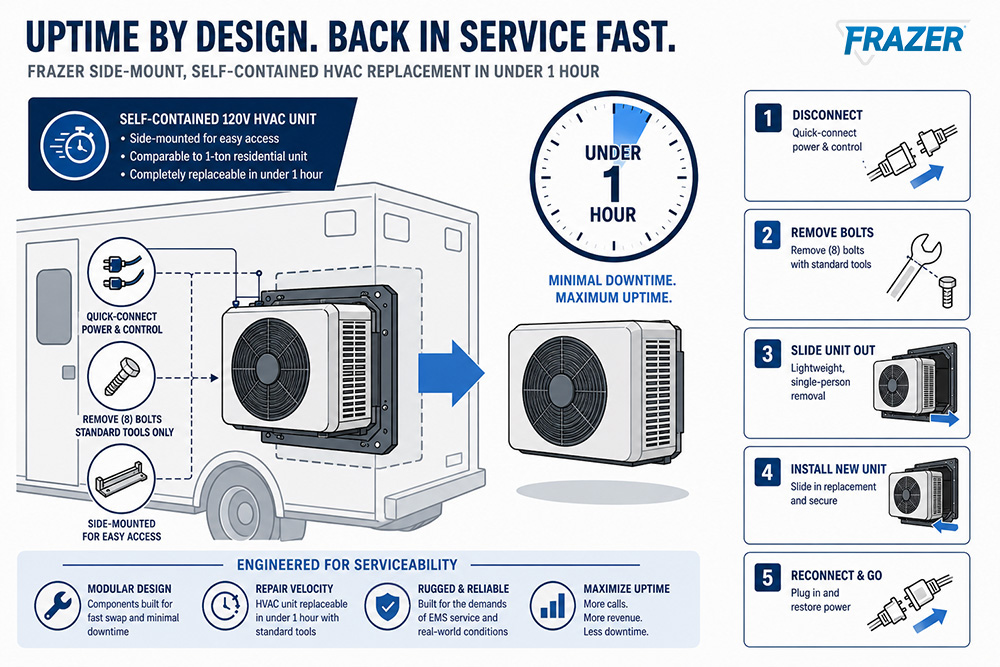
2. HVAC System Failures
Patient-compartment heating and cooling are important to daily EMS operations. When an HVAC system fails, crews may struggle to maintain a suitable environment for patients and personnel, especially in extreme temperatures.
Field impact: An HVAC failure may require the department to remove the vehicle from service until repairs are complete. The total downtime can depend on component access, technician familiarity, and replacement-part availability.
Questions to ask: How easy is the HVAC system to access? How long does it typically take to replace a major component? What technical and parts support is available when a failure occurs?
Vehicle designs place different levels of emphasis on maintenance access. When evaluating HVAC systems, fleet managers should consider how quickly common components can be inspected, serviced, or replaced.
3. Charging System and Battery Problems
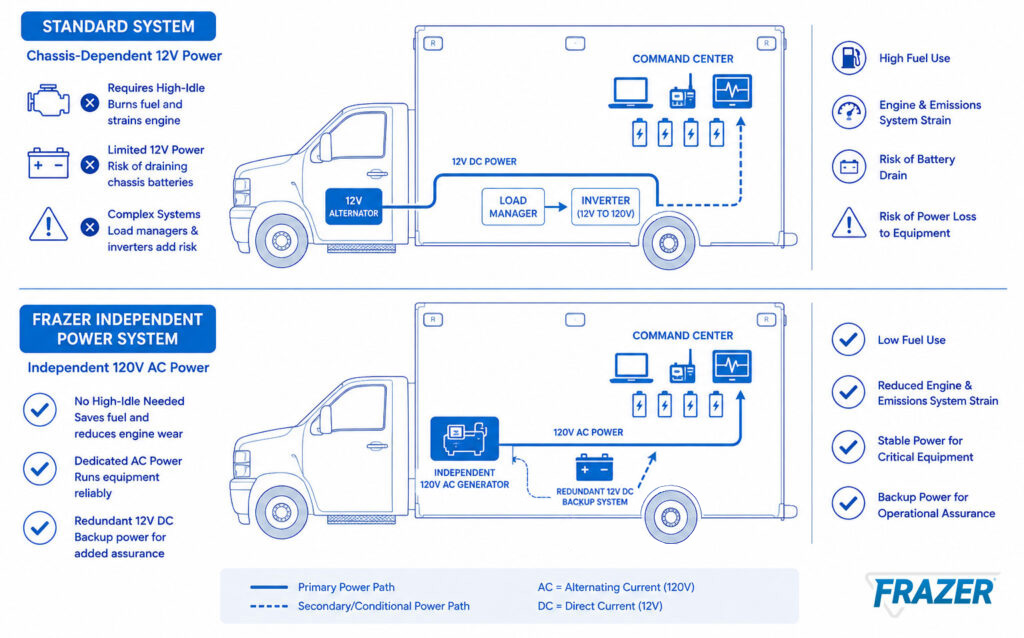
EMS vehicles place a heavy demand on their electrical systems. Radios, emergency lighting, monitors, computers, chargers, and other equipment may operate at the same time for long periods.
When the charging system or batteries cannot support that demand, low-voltage conditions may affect several systems at once. This can create intermittent symptoms that are difficult to reproduce and diagnose.
Questions to ask: How is power managed across the vehicle? What redundancy is available? How much demand does the patient compartment place on the chassis electrical system?
4. Chassis and Drivetrain Failures
Not all downtime starts in the patient compartment. Engines, transmissions, suspension components, brakes, and drivetrain systems wear over time. The risk of unexpected repairs may increase as mileage and operating hours accumulate.
Field impact: A chassis or drivetrain failure can remove a frontline vehicle from service with little warning. Repair time may depend on technician availability, chassis parts, warranty requirements, and the local support network.
Questions to ask: What service life should the department expect from the chassis? How are replacement cycles managed? Can the patient-care module continue serving after the original chassis reaches the end of its useful life?
5. Parts Availability Delays
Sometimes the repair is not the main cause of downtime. A technician may identify the problem quickly, but the vehicle can remain out of service while the department waits for a backordered or proprietary component.
Field impact: A straightforward repair may keep a vehicle in the shop for days or weeks when the required part is difficult to source. This reduces scheduling flexibility and may place additional demand on reserve vehicles.
Questions to ask: Are common replacement components locally available? How dependent is the vehicle on manufacturer-specific parts? How does the manufacturer respond when a critical part is unavailable?
6. Preventive Maintenance Gaps
Some major downtime events begin as small concerns that were not found or addressed early. Consistent preventive maintenance can help a fleet identify wear, leaks, loose connections, charging problems, and other developing issues before they cause a larger failure.
Field impact: Delayed maintenance can turn a minor repair into a more expensive problem. It can also increase the amount of time a vehicle spends out of service.
Questions to ask: Are maintenance requirements easy to understand and follow? Is the service documentation clear? Does the vehicle require specialized training or equipment for routine inspections?
7. Complex Vehicle Designs
The failed component is only one part of the downtime equation. The time required to find, reach, and replace that component can have just as much effect on how long the vehicle remains out of service.
Two vehicles may experience a similar failure but return to service at very different times. A design that provides clear diagnostics and practical component access may allow a technician to resolve the problem faster.
Questions to ask: How straightforward is troubleshooting? Can technicians reach important components without removing unrelated equipment? Is specialized training required for common repairs?
How Vehicle Design Can Affect Lifecycle Cost
Why Some EMS Vehicles Spend More Time in the Shop
Most fleet vehicles will require service during their operating life. The more useful question is how easily a problem can be identified and how quickly the repair can be completed.
Before purchasing, fleet managers should consider whether serviceable components are easy to reach, whether troubleshooting requires specialized tools, and whether common replacement parts are readily available. They should also ask how much training their technicians will need to service the vehicle.
Reliability and serviceability are closely connected. A vehicle that is easier to diagnose and repair may return to service faster, even when a failure cannot be prevented.
Electrical System Architecture
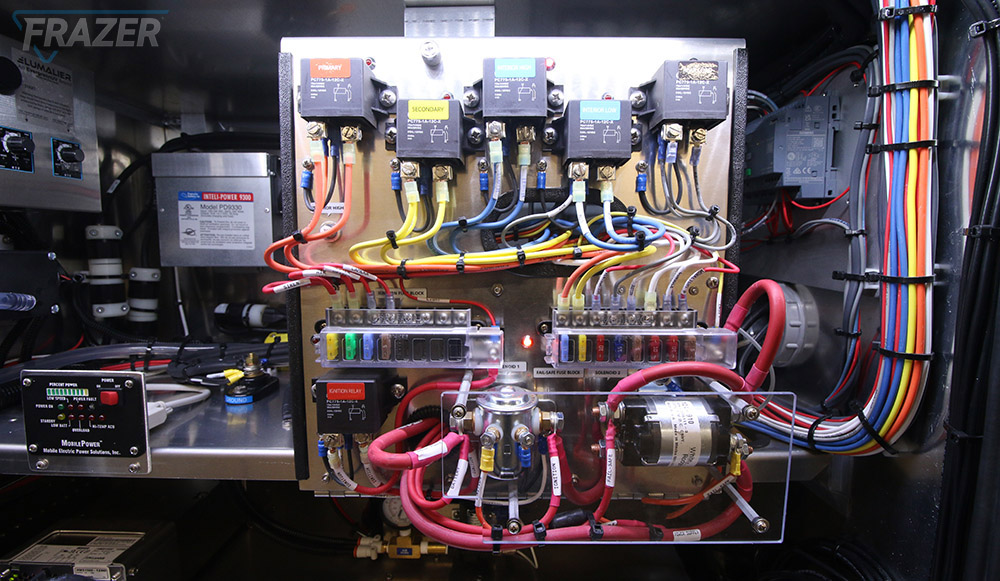
Electrical architecture can have a significant effect on serviceability. Some designs require technicians to work through extensive diagnostic processes, while other systems are organized to make circuits and components easier to identify.
Some manufacturers use multiplex systems, while others use more direct, simplified electrical architectures. Each approach should be evaluated based on the department’s operating needs, technician capabilities, and access to support.
For fleet managers, the most important question may not be which system sounds more advanced. The practical question is how quickly a technician can identify the affected circuit, reach the component, and complete the repair.
What this can mean in the field: Faster troubleshooting may help a vehicle return to service sooner. Diagnostic time is still downtime, even when the final repair is simple.
Potential Costs Associated With EMS Vehicle Downtime
Repair invoices show only part of the cost of downtime. An unexpected failure may also change staffing plans, increase overtime, and add wear to reserve vehicles. Maintenance teams may need to delay other scheduled work while they address the out-of-service unit.
Downtime can also affect response coverage and replacement planning. If a vehicle becomes unreliable earlier than expected, a department may need to accelerate a purchase or remount decision before funds were scheduled to be available.
These indirect costs are not always easy to measure, but they are part of the vehicle’s total lifecycle cost. A lower purchase price may not create long-term savings if the vehicle is difficult to diagnose, repair, or support.
Questions to Ask Before Buying Your Next EMS Vehicle
Look Beyond General Reliability Claims
Most vehicle providers describe their products as reliable. Fleet managers should ask for more detail about the design, maintenance, parts, and support systems behind those claims.
Ask how technicians access major components, how common failures are diagnosed, and whether replacement parts are locally available. Review the warranty process, technical-support options, training requirements, and expected response when a vehicle is out of service.
It is also helpful to speak with current customers. Ask how the vehicle has performed in actual service, how quickly problems were resolved, and what the ownership experience has been like after delivery.
Reliability Planning Starts Before a Vehicle Breaks Down
Electrical problems, HVAC failures, charging issues, parts delays, maintenance gaps, chassis wear, and complex designs can all contribute to EMS vehicle downtime. Most fleets will encounter at least some of these challenges over the life of a vehicle.
Vehicle design, serviceability, technical support, and lifecycle planning can influence the operational effect of those problems. Fleet managers can evaluate each of these factors before the vehicle enters service.
Asking detailed questions during procurement will not prevent every failure. It can, however, help a department choose a vehicle and support partner that are better prepared to keep the fleet moving.
Next Step: Review Your Fleet Reliability Strategy
When vehicles spend too much time out of service, it helps to look beyond individual repairs. Review maintenance practices, component access, diagnostic requirements, parts availability, and the support provided by each vehicle partner.
This same review can be useful when planning a replacement or writing specifications for a future purchase. The goal is not simply to buy a vehicle that performs well on delivery day. The goal is to select a vehicle that the department can maintain, support, and keep in service throughout its operating life.
What Is Contributing to Downtime in Your Fleet?
Talk with a Frazer representative about the maintenance, serviceability, and ownership factors that may affect your fleet. Whether you are evaluating specifications, planning a replacement cycle, or looking for ways to reduce downtime, our team can help you review the questions that matter.
For a broader look at fleet planning and performance, read The 2026 Guide to EMS Vehicle Reliability & Fleet Uptime.
What Causes EMS Vehicles to Go Out of Service Most Often?
Common causes include electrical failures, HVAC problems, charging-system issues, chassis and drivetrain failures, parts delays, and deferred maintenance. Complex vehicle designs can also increase downtime by making problems harder to diagnose or components more difficult to reach.