
The 2026 Guide to EMS Vehicle Reliability and Fleet Uptime
EMS vehicle reliability depends on more than software and service schedules. Vehicle design also affects how often problems occur, how quickly technicians can diagnose them, and how long a unit stays in service.
Independent 120V AC power, point-to-point wiring, modular HVAC systems, and all-aluminum construction can give fleets more control over maintenance and long-term ownership costs. These systems may help reduce chassis wear, support in-house repairs, and extend the life of the patient module through multiple remounts.
A Real World Example
Picture a busy July afternoon. The temperature is near 100 degrees, call volume is climbing, and three frontline units are sitting in the maintenance bay.
One has an electrical issue that may require proprietary software and a dealer technician. Two others are dealing with chassis-driven air-conditioning problems after hours of operation in extreme heat. Until those systems are repaired, the units may not be able to maintain the patient-care environment required for service.
For Fleet Operations Directors, EMS Chiefs, and private operations managers, this is more than an inconvenience. Every unavailable unit puts more pressure on the rest of the fleet, reduces reserve capacity, and increases the risk of delayed response.
Most fleet reliability advice focuses on maintenance intervals, telematics, and software. Those tools matter, but vehicle design also influences how often failures occur and how quickly a unit returns to service.
This guide explains how simpler electrical systems, independent power, accessible HVAC, factory-direct support, and remountable aluminum modules can support uptime and long-term planning.
The Hidden Causes of EMS Vehicle Downtime
When a unit stays out of service longer than expected, fleet leaders often review oil changes, inspections, and repair history. A strong preventive maintenance program is essential, but lapses in maintenance are not the cause of every major failure. Vehicle design can affect both the likelihood of a problem and the time needed to repair it.
Many traditional emergency vehicles connect the chassis and patient module through shared electrical and climate-control systems. The module may depend on the chassis alternator for power and the chassis engine for air conditioning. Some vehicles also use computerized multiplex boards to control lighting, suction, HVAC functions, and other equipment.
When several critical systems depend on the same network, one problem may affect multiple functions. Diagnosis may also require proprietary software or dealer support.
Fleet Managers should consider how much the module depends on the truck engine, specialized components, and outside service resources. Using a commercial chassis engine as a stationary module power source can affect fuel use, operating hours, and maintenance needs.
Greater separation between the chassis and module can help reduce that dependence. Simpler systems may also make it easier for an in-house technician to find a problem and complete the repair.
Engineering for Uptime
At Frazer, we believe serviceability should be considered from the beginning. A unit that is easier to understand, diagnose, and repair may spend less time in the shop.
Fleet teams often track Mean Time to Repair, or MTTR. Software can document a repair, but vehicle design affects how quickly the work can be completed.
Point-to-Point Wiring and Multiplex Systems
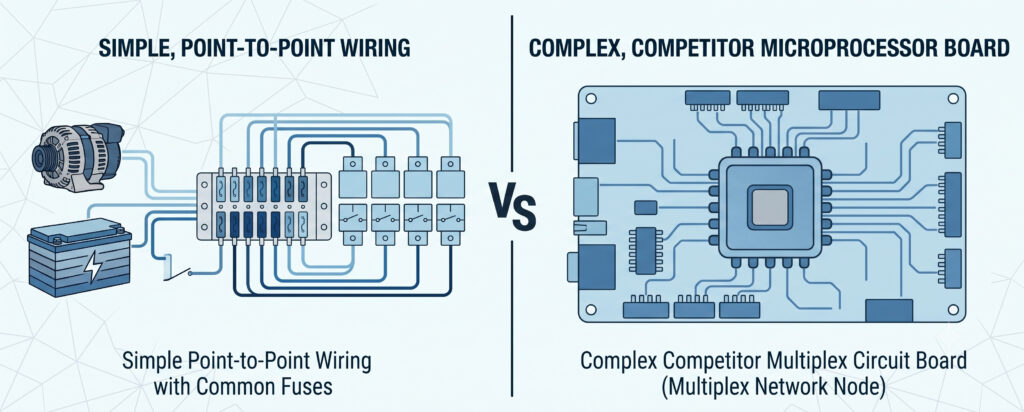
A point-to-point electrical system uses physical wiring, common relays, fuses, and terminal strips. In many cases, a trained technician can follow a schematic, test the circuit, find the failed component, and complete the repair with familiar tools.
A multiplex system works differently. Multiple digital nodes communicate through a shared Controller Area Network, commonly called a CAN bus. One node may control several unrelated functions, such as interior lights, air conditioning, and oxygen solenoids.
If a node fails or loses communication, several systems may stop working at the same time. Diagnosis, programming, or replacement may require proprietary software or a specialized laptop. That can be a challenge for departments already dealing with technician shortages.
Fleet leaders often tell us their maintenance teams lack the tools or training to repair highly specialized vehicles. One practical response is to select systems existing technicians can readily understand and service.
Frazer modules use point-to-point electrical systems instead of multiplex boards, inverters, and complex load managers. Each switch connects through a dedicated wire to a relay, fuse, and powered component.
A technician can trace a failed light using the supplied schematic and identify a standard fuse, relay, connection, or wire. This approach does not eliminate electrical issues, but it can make common repairs easier to diagnose.
Modular, Side-Mounted HVAC
Climate control is critical in mobile healthcare. It supports patient care, crew comfort, medication storage, and equipment performance. In hot climates, an air-conditioning failure can take a unit out of service until the patient module can maintain an appropriate temperature.
Many traditional vehicles use a chassis-integrated air-conditioning system. These systems may include an additional compressor mounted to the engine and refrigerant lines that run through the chassis, cab, and patient module.
Those lines and connections face heat, vibration, and road conditions. When a failure occurs, technicians may need to remove dashboard, headliner, or ceiling panels to reach the system.
Frazer uses a self-contained 120V AC HVAC system that operates independently from the chassis air conditioner. The unit is side-mounted and accessible through an exterior compartment.
If the HVAC system requires major service, technicians can reach it without removing large sections of the patient compartment. The self-contained unit can be disconnected, unbolted, removed from its tray, and replaced.
The goal is to make major HVAC service more accessible and reduce downtime.
Independent Power and Chassis Protection
When comparing power systems, buyers should consider what happens when a unit spends hours parked at scenes, staged between calls, or waiting outside an emergency department.
An independent 120V AC generator separates much of the patient module’s electrical demand from the truck chassis. It can support HVAC, lighting, outlets, and clinical equipment without requiring the chassis engine to carry the full load.
This may reduce high-idle operation, alternator demand, fuel use, and wear on the chassis engine. Results will vary by vehicle configuration, duty cycle, operating environment, and maintenance practices.
Some buyers hesitate to add a generator because it introduces another engine that requires maintenance. That is a fair concern; a generator needs oil changes, filters, inspections, and scheduled service.
However, an accessible generator can carry loads otherwise placed on the more expensive chassis engine and electrical system. Fleet leaders should consider which approach is easier and more cost-effective to maintain.
Reducing High-Idle Operation
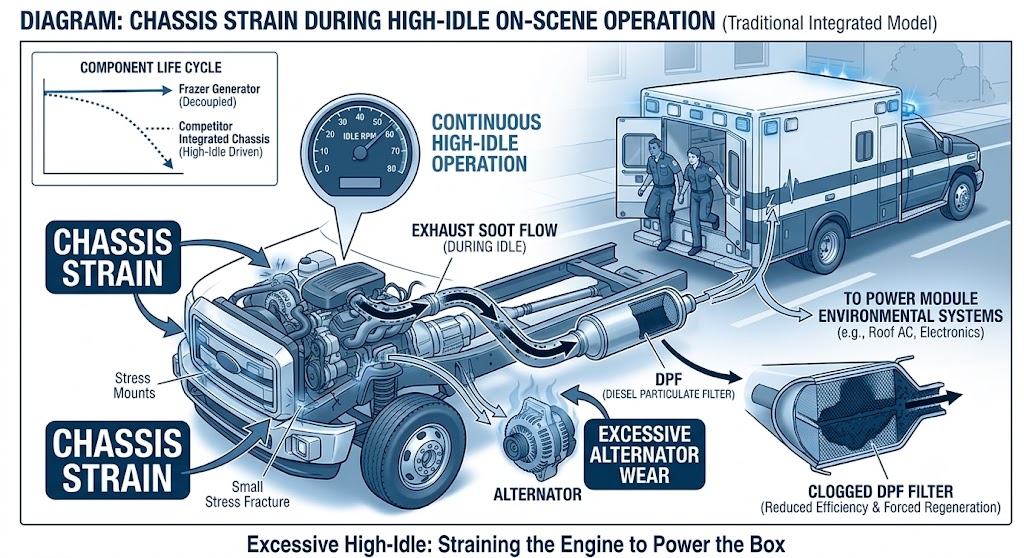
At a scene or hospital, crews often leave the chassis engine running to support air conditioning, emergency lighting, radios, interior lights, outlets, and medical equipment.
Extended idling can increase fuel use and engine hours. On modern diesel engines, it may also contribute to emissions-system buildup and added regeneration cycles, depending on the chassis and operating pattern.
Frazer’s independent 120V AC generator serves as the primary power source for the patient module. Crews can place the vehicle in park, shut off the chassis engine, remove the keys, and continue operating the module from the generator.
The generator can support HVAC, lighting, outlets, radios, and clinical equipment. By reducing the need to leave the chassis engine running, departments may be able to limit chassis wear and reduce the load placed on the alternator system.
Consistent Power for Clinical Equipment
Electrical reliability also supports the patient-care environment.
Cardiac monitors, ventilators, infusion pumps, suction equipment, communications systems, and other clinical devices require power within their specified operating ranges. Specialty equipment installed in Mobile Stroke Units may place even greater demands on the module’s electrical architecture.
Systems built around chassis alternators, battery banks, inverters, and load managers may experience changes in demand when several components operate at the same time. For example, the air-conditioning compressor may engage while emergency lighting, radios, sirens, and medical equipment are drawing power.
Depending on the vehicle, a load manager may temporarily reduce power to selected circuits. Sensitive equipment may then switch to its internal battery.
Frazer’s generator architecture is designed to provide dedicated 120V AC power for the module and its equipment. Each Frazer unit also includes a secondary 12V DC backup system.
If the generator stops operating or runs out of fuel, the backup system is designed to support selected functions such as basic interior lighting, suction, and certain equipment circuits. This redundancy gives crews another layer of support while they complete a transport or address the primary power issue.
Understanding Lower Overall Cost of Ownership
Purchase price matters, but it does not tell the full financial story. CFOs, City Managers, and Procurement Officers should also consider service life, downtime, labor, parts, chassis wear, remount potential, and replacement timing.
A lower initial price does not always result in a lower long-term cost. The final outcome depends on the design of the vehicle, how it is used, how it is maintained, and how often major components must be repaired or replaced.
Frazer uses the term Lower Overall Cost of Ownership, or LOCO, to describe this broader view. The goal is to make maintenance more straightforward, use commonly available components where practical, reduce repair time, and extend the value of the patient module.
Some fleets that transitioned to Frazer’s independent power and point-to-point electrical architecture have reported maintenance-cost reductions between 42% and 60%. These are customer-reported results, not guaranteed outcomes. Actual savings will vary based on fleet size, duty cycle, vehicle age, maintenance practices, configuration, labor rates, and operating conditions.
The Lifecycle Value of Wood-Free Construction
The materials used in a patient module can affect its service life, repair needs, and remount potential.
Wood may absorb moisture from humidity, cleaning products, and biological fluids. Over time, that exposure can contribute to soft flooring, cabinet damage, warping, and deterioration.
Frazer modules use 6061-T6 structural aluminum tubing and do not use wood in the structural frame, flooring, or cabinetry. This construction is designed to resist water-related rot and maintain structural rigidity over a longer period.
An all-aluminum module may also support multiple remounts. Some Frazer modules have remained in service for more than 20 years and have accumulated more than 1 million miles across multiple chassis.
Procurement teams should compare expected service life, refurbishment needs, remount opportunities, and full replacement costs, not just upfront price.
The Financial Impact of Remounting
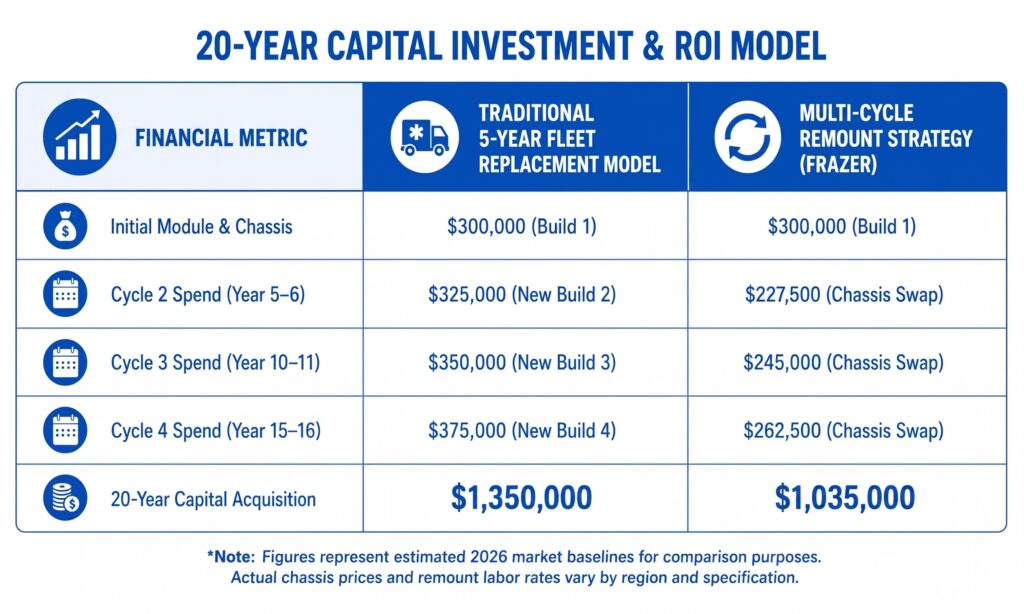
A remount allows a department to place an existing patient module on a new compatible chassis. For fleets with a structurally sound module, this can provide another option besides replacing the complete vehicle.
When a chassis reaches a point where maintenance costs begin to rise, the module may still have years of useful service remaining. Its condition must be evaluated through inspection, but an all-aluminum structure is often suitable for refurbishment and continued use.
During a Frazer remount, the module is removed from the existing chassis, inspected, refurbished, and installed on a new compatible chassis. Technology, equipment, layouts, graphics, and selected features may also be updated.
Remounting can preserve a portion of the original investment in the custom module while replacing the commercial truck underneath it. Some Frazer modules have been remounted several times and remained in frontline service for more than 20 years.
This process allows departments to spread the module investment across a longer service life instead of buying a complete replacement whenever the chassis is retired.
Planning for a More Reliable Fleet in 2026
Improving fleet reliability requires more than tracking maintenance events. Departments should also examine how the vehicle is designed, how easily technicians can reach major components, and how much the patient module depends on the chassis.
Preventive maintenance software remains useful for tracking history, scheduling service, and identifying patterns. It works best alongside a vehicle designed for straightforward diagnosis and repair.
As departments plan future purchases, they may want to evaluate independent 120V AC power, point-to-point wiring, accessible HVAC systems, and wood-free aluminum construction. Depending on the fleet’s duty cycle, these features can help reduce high-idle operation, support in-house maintenance, shorten certain repairs, and extend the usable life of the module through remounting.
Frazer works with departments to evaluate power systems, electrical architecture, HVAC access, remount planning, and long-term fleet needs. The goal is not to add complexity. It is to build a unit that is easier to operate, easier to support, and ready for the work ahead.
Ready to review the numbers for your fleet? Contact Frazer to schedule a conversation with a member of our expert team.
Can a standard fleet mechanic diagnose ambulance electrical failures without specialized software?
Yes, if the vehicle is built with simple point-to-point wiring. While complex multiplex digital systems require proprietary software and diagnostic laptops, point-to-point architectures use common relays, fuses, and terminal strips. This allows any standard fleet mechanic to quickly troubleshoot and repair electrical issues using a basic test light.