
How Long Should an EMS Vehicle Last? A Lifecycle Planning Guide
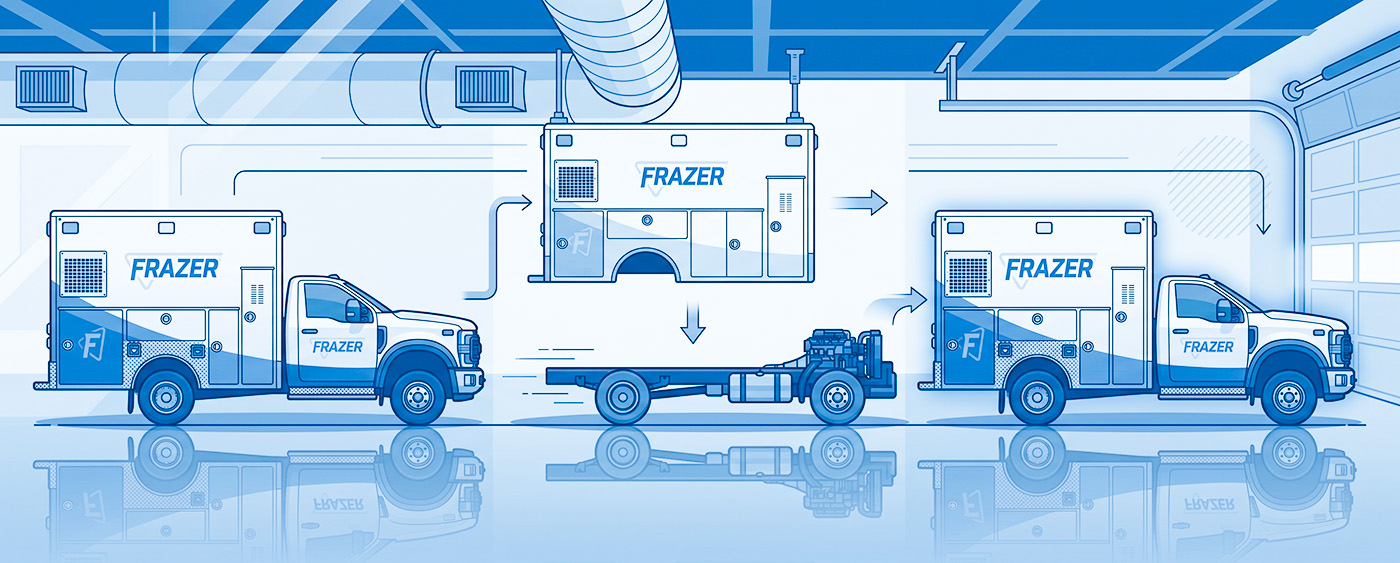
Ambulance life expectancy depends on design, use, and maintenance. A standard automotive chassis may require retirement after 5 to 7 years, while a properly maintained all-aluminum patient module can exceed 20 years and 1 million miles. Decoupling these two lifecycles through an engineered remounting program may help municipal fire departments and private healthcare operators improve asset utilization and support a lower overall cost of ownership. For a broader view of fleet preservation, consult The 2026 Guide to EMS Vehicle Reliability & Fleet Uptime.
Understanding ambulance life expectancy helps organizations plan replacement costs and downtime. For Fire Chiefs and Fleet Managers, a front-line ambulance sidelined by an electrical fault can create a significant maintenance challenge and affect vehicle availability, community response capacity, and operational planning.
This guide offers a practical framework for reviewing fleet asset life. By downloading a comprehensive Emergency Vehicle Buyer’s Guide, you can begin evaluating procurement specifications that separate short-term mechanical investments from long-term structural assets, may help limit chronic engine wear, and support a fleet plan focused on vehicle availability.
The Traditional “7-Year Reset” Approach: Why Some Ambulances Retire Early
For decades, many fleets replaced an ambulance near 150,000 miles or seven years because the vehicle was treated as one indivisible asset.
Legacy Approach: [Chassis Wears Out] + [Module Attached] = Replace the Entire Ambulance
Multi-Lifecycle Approach: [Chassis Wears Out (5-7 Yrs)] + [Engineered Aluminum Module (20+ Yrs)] = Consider a Remount
The Odometer Assumption vs. Structural Longevity
Traditional lifecycle tracking often assumes the module degrades at the same rate as the chassis. An automotive chassis is exposed to mechanical friction, road hazards, heat, fluid pressure, and other operating stresses.
The patient module does not face the same combustion, friction, and heat as the chassis, so its structure can follow a different wear pattern. Replacing a structurally sound patient box solely because the truck engine has reached the end of its useful service life may result in the retirement of a component that could remain suitable for continued use after inspection and refurbishment.
The Two-Part Asset Blueprint: Separating Chassis from Box
A multi-lifecycle strategy treats the mechanical chassis as a shorter-term asset and the structural module as a longer-term asset.
When departments decouple these lifecycles, long-term capital planning may change substantially. Instead of purchasing a complete ambulance during each replacement cycle, an organization may treat the patient module as a multi-lifecycle asset that can be inspected, refreshed, modernized, and installed on a new truck frame more than once. We’ll explore the factors involved in choosing between an ambulance remount vs replacement for your upcoming budget year.
The Drivers of Ambulance Lifespan: What Can Shorten a Fleet Asset’s Service Life?
To extend fleet life, departments should look beyond age. Design, duty cycle, maintenance, environmental exposure, and parts availability can all affect service life.
How Chassis High-Idle Hours Accumulate “Ghost Miles”
During a typical shift, an ambulance may spend hours at scenes, incident standbys, or emergency department bays. During these stationary periods, crews may need to keep the interior climate controlled to support patient comfort, maintain temperature-sensitive medications, and keep onboard medical electronics powered and charged.
In a traditional setup, the truck engine may stay in high idle to power belt-driven alternators and compressors.
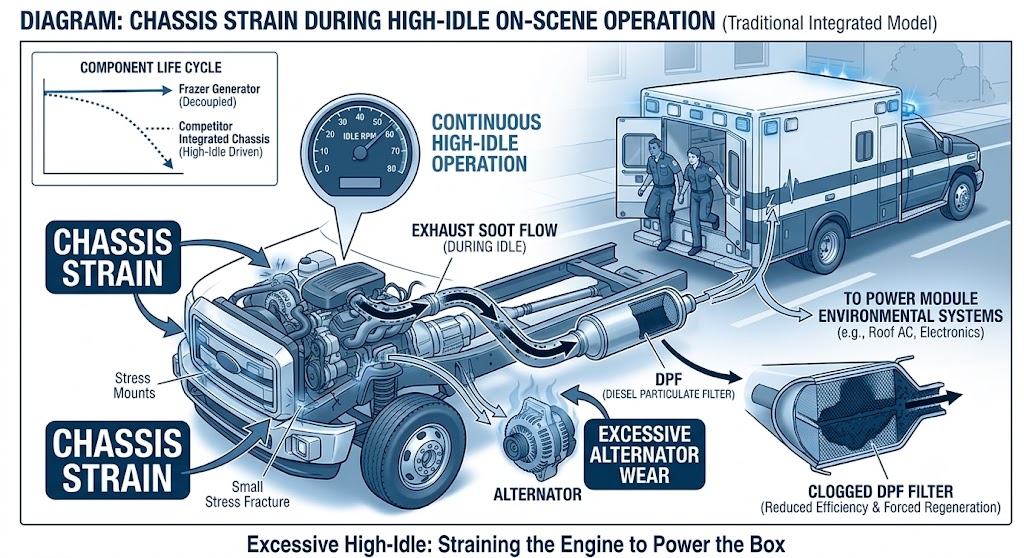
The Ghost Mile Formula: Industry maintenance guidance often equates one hour of idling to roughly 33 miles of driving wear on the engine’s internal components, pistons, and exhaust after-treatment systems, such as Diesel Particulate Filters (DPF).
Six hours of daily idling can add nearly 200 “ghost miles” per shift. These miles do not appear on the dashboard odometer, but they may accelerate powertrain wear, contribute to engine or exhaust-system issues, and affect how warranty or maintenance conditions are evaluated.
Wood-Based Materials and All-Aluminum Structural Resilience
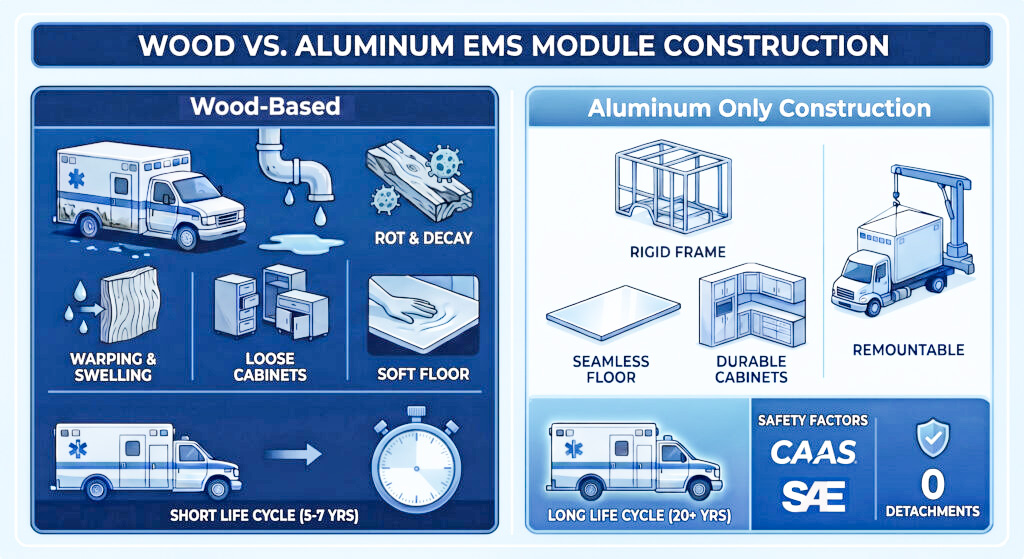
Some ambulance designs use wood-based reinforcement or composites in cabinet walls, doors, and subfloors, often because of manufacturing methods or initial cost.
In EMS service, material choice can affect longevity. Ambulances may operate in heavy rain, humid environments, snow-melting road salts, and other challenging conditions. The interior box is also routinely cleaned and sanitized with chemical disinfectants. Over time, moisture may enter through rivet holes, seam seals, door gaskets, damaged surfaces, or other openings.
If moisture reaches wood-based components, deterioration may occur. Subfloors can develop soft spots around cot hardware, internal framing may warp, fasteners can lose holding strength, and the module may experience structural degradation. A technical analysis of the Frazer Difference engineering framework explains how reducing the use of degradable structural materials may help preserve the asset’s condition and value.
Proprietary Multiplex Electrical Boards and Potential Downtime
Many modern ambulances use multiplex electrical systems that route vehicle communications through programmable solid-state components. While multiplex systems can support touchscreen controls and integrated functions, they may also introduce specialized diagnostic and repair requirements.
Emergency vehicles face constant vibration and wide temperature swings. Microprocessors and printed circuit boards can be sensitive to these conditions. When an electrical issue occurs in a multiplex vehicle (such as a dome light remaining on or a vacuum pump losing power) the diagnostic process may require specialized tools, software, or technical support.
A standard multimeter or test light may not be enough to troubleshoot a computerized logic board. In certain cases, the vehicle may need service from a dealer or technician with the software needed to diagnose, reflash, or reprogram the system. While the truck remains out of service, reserve-unit demand and maintenance expenses can increase.

Maximizing the Ambulance Module Lifecycle: Planning Around 20 Years and 1 Million Miles
For longer service life, procurement specifications should prioritize durability, occupant protection, serviceability, and remount potential.
Engineering Standards of 6061 T-6 Structural Aluminum
A multi-lifecycle module starts with material selection. Using 6061 T-6 structural aluminum tubing can help the module framework resist environmental decay. This standard alloy in Frazer modules provides a strong strength-to-weight ratio and natural corrosion resistance, which can help the module shell maintain its alignment, rigidity, and structural performance over time.
Crash-Tested Integrity and Recorded Module Detachments
Fire Chiefs and safety committees often ask:
“If we keep a module box in service for multiple lifecycles and remount it across different truck chassis over 15 or 20 years, are we affecting the structural safety of our crews?”
An ambulance module should be engineered and maintained to address multi-axis impact forces and applicable safety requirements, including NFPA 1917, CAAS GVS v2.0, Ford QVM, and SAE J3043, where applicable.
Physical crash testing helps engineers evaluate cabinetry and module-to-chassis connections under high-impact forces.
Across approximately 4,500 custom modules manufactured since 1984, there are zero recorded module detachments in collisions. Based on the manufacturer’s records, the module is supported by a lifetime warranty on module construction for the original owner, subject to the warranty’s terms, conditions, exclusions, inspection requirements, and eligibility provisions. The warranty may cover:
- Core structural design integrity
- Welding and workmanship standards
- Installation precision
- Defective raw materials
The Economics of Fleet Longevity: Ambulance Remount Cost vs. New Procurement
To evaluate a multi-lifecycle fleet model, compare capital costs, operating costs, configuration, maintenance, and replacement timing. The table below compares the two models over 20 years.
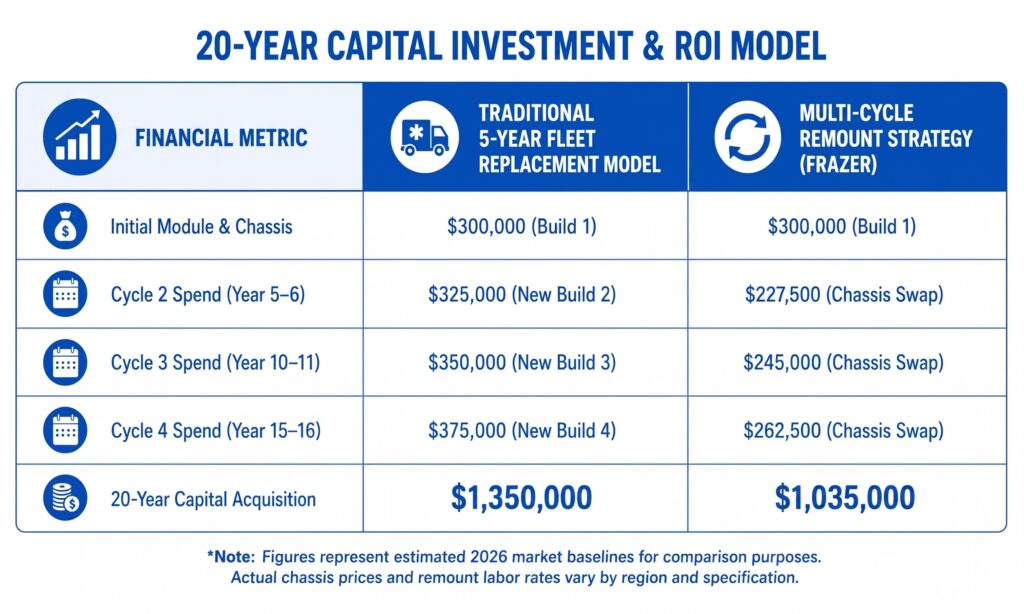
The financial effect of an engineered module can extend beyond capital savings. By selecting an emergency vehicle architecture that limits digital multiplex complexity and isolates heavy environmental loads, some organizations report lower day-to-day operating expenses. Mechanical relays and standardized point-to-point electrical systems may allow local technicians to perform more maintenance tasks directly, contributing to customer-reported reductions.
Designing for Uptime: Maintenance Architecture That Supports Long-Term Service
Fleet technicians may also have questions about post-sale support:
“If we move away from traditional vehicle builds or transition to a manufacturer operating outside a localized regional dealer franchise network, could our trucks experience out-of-service delays while waiting for specialized parts or service?”
One answer is to choose a vehicle designed for serviceability and simplicity from the start. When primary utility systems are modular and independently powered, departments may reduce their reliance on certain third-party service channels. Read more about how physical layout impacts ambulance maintenance costs.
Simple Point-to-Point Wiring vs. Digital Complexity
Point-to-point wiring uses color-coded circuits, common automotive fuses, and heavy-duty relays instead of complex computerized communication buses. This design may allow certified fleet mechanics to manage more electrical maintenance using familiar tools and processes.
This setup does not rely on the proprietary diagnostic software or centralized digital boards used in some multiplex systems. In many cases, a simple multimeter or test light may help a shop diagnose an issue and return the unit to service, depending on the nature of the repair.
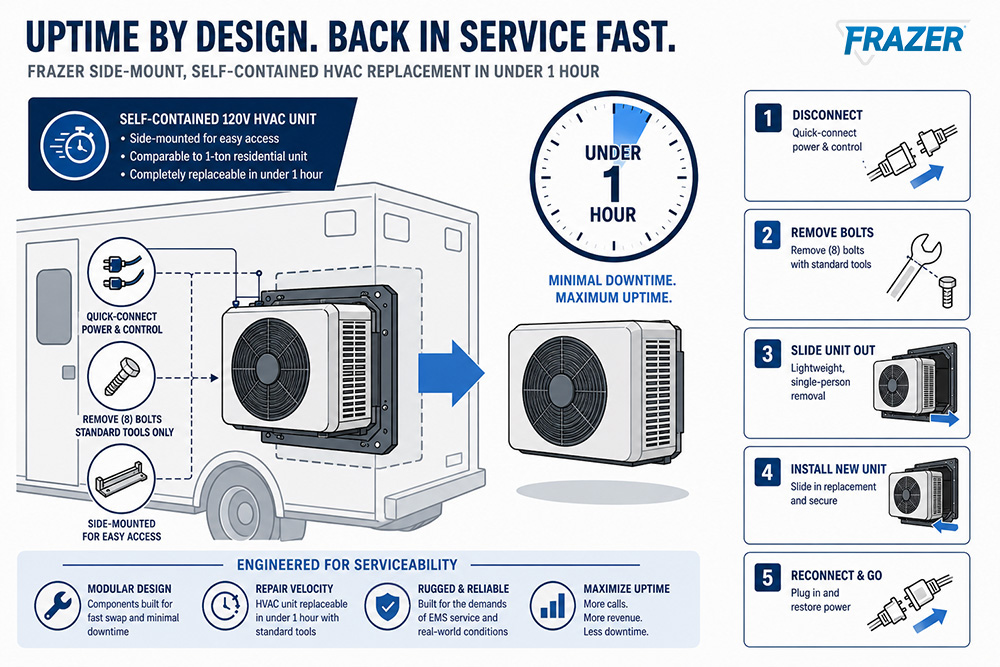
Swapping Side-Mounted HVAC Systems in Under 1 Hour
Climate-control design can drive summer downtime. Some units use split-system HVAC loops, with evaporator lines running through interior ceiling panels to engine-driven compressors located in the truck engine bay. If a line cracks or a compressor seizes, repairs may take days and can require technicians to access cabinetry or dashboard components, evacuate the system, flush the lines, and recharge the coolant circuit.
A self-contained, side-mounted 120V AC HVAC system, similar in output to a heavy-duty one-ton residential unit, takes a different maintenance approach.
Because the climate-control system is isolated within a self-contained, exterior-accessible housing, a shop mechanic may be able to unbolt and replace it quickly. If a climate-control failure occurs during a peak call-volume period, a department may install a spare unit, move the malfunctioning system to a workbench for diagnosis, and return the vehicle to service sooner, depending on staffing, parts, tools, and operating conditions.
This service model includes direct access to factory support personnel and component-parts shipping from the production facility. Customer examples from the Houston Fire Department, Fort Bend County EMS, Carrollton Fire Rescue, and Victorville Fire Department provide additional perspectives on how this model has been used in fleet environments.
Actionable Next Steps: Building a Multi-Lifecycle Fleet Plan
Extending ambulance life expectancy starts with reviewing current procurement practices. If your department or healthcare organization is mapping out a multi-year fleet allocation strategy, consider these three practical steps when evaluating alternatives to a traditional 7-year replacement cycle:
- Conduct an Idle-Hour Audit: Review electronic engine data logs across your current front-line ambulances. Compare dashboard odometers with total engine run hours to estimate the volume of “ghost miles” accumulated while vehicles are stationary.
- Separate Your Asset Categories: Consider tracking the patient transport module as a distinct asset from the underlying automotive truck chassis for capital-planning purposes.
- Evaluate Multi-Lifecycle Specifications: In your next RFP or purchasing specification, consider wood-free, all-aluminum structural tubing shells supported by documented high-impact crash testing and applicable module-construction warranty coverage.
Emergency response puts heavy demands on reliability, serviceability, and budgets. An engineered, chassis-independent module designed for multiple chassis lifecycles may help departments build a fleet strategy focused on long-term durability, serviceability, and efficient capital allocation.
Is Your Current Fleet Configured to Support Your Next Budget Cycle?
Poorly timed replacement schedules and rising chassis costs can strain capital budgets. A Fleet Lifecycle Assessment from the Frazer team can help your organization review vehicle idle hours, compare lifecycle-cost scenarios, and evaluate whether a custom remount strategy may support your capital-planning goals. Actual results depend on vehicle condition, configuration, duty cycle, maintenance history, procurement timing, and other operational factors.
What Is the Cost Difference Between Buying a New Ambulance and Remounting?
Remounting an existing aluminum module onto a new chassis may cost less than buying a complete new vehicle. By preserving a serviceable structural box and replacing the automotive chassis, departments may improve asset utilization, manage lifecycle costs, and defer a portion of future capital procurement expenses, often 30% or more. Actual savings vary by module condition, chassis selection, refurbishment scope, labor, timing, and operating requirements.