
The Complete Guide to Evaluating EMS Mobile Health Vehicles
A mobile healthcare vehicle is more than a way to get from one place to another. It is a workspace for your team, a place to care for patients, and a major investment in your program. The right vehicle needs to work reliably on day one and remain useful for years to come.
Whether you’re starting a community paramedicine program, building a mobile clinic, or adding a specialty response unit, it’s easy to focus on the purchase price. But the real cost also includes maintenance, downtime, equipment needs, and how long the vehicle can stay in service.
This guide walks through five areas worth discussing with any vehicle builder: power, climate control, long-term value, equipment safety, and support after the sale. Use these questions to compare options and build a business case your team can stand behind.
Why a Purpose-Built Mobile Healthcare Vehicle Matters
A fair question often comes up during planning: “Why not buy a commercial van and add the medical equipment we need?” A van may cost less upfront, and it may be the right fit for some programs. The key is understanding what your team will ask the vehicle to do every day.
A mobile clinic may need to power medical equipment for hours, maintain comfortable interior temperatures, and carry heavy devices safely. Those demands can be different from the work a standard commercial van was built to handle. Before choosing a platform, compare how each option will meet your clinical needs, not just what it costs to purchase.
1. Power: Can the Vehicle Run Your Equipment Without the Truck Engine?
Power is one of the first things to review, especially if your program uses equipment with high electrical demand. A CT scanner, telemedicine system, medical devices, lighting, and air conditioning can place very different demands on a vehicle’s electrical system.
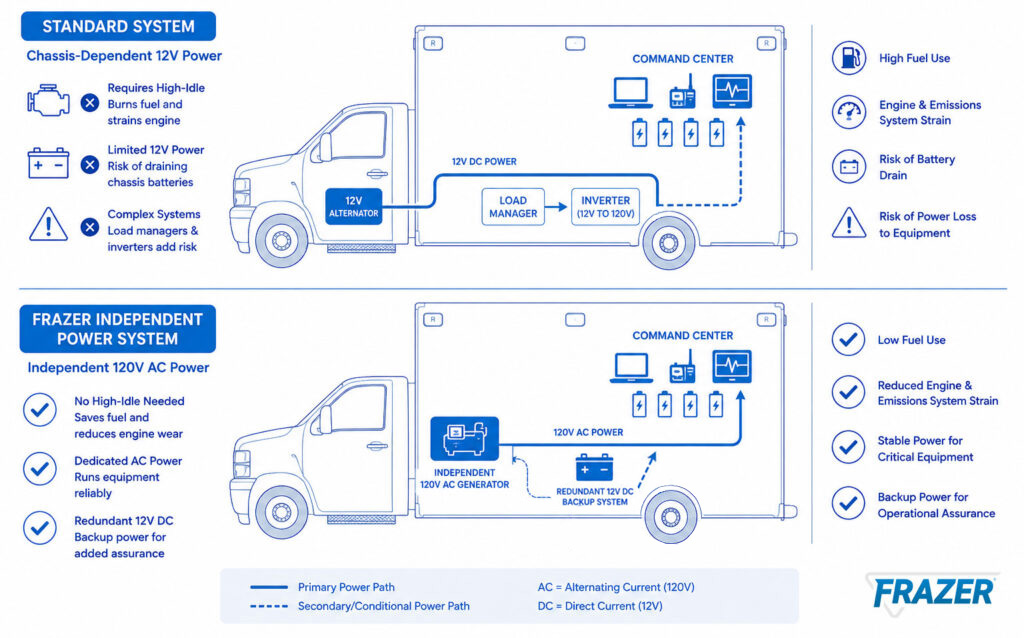
Some designs depend heavily on the truck’s battery, alternator, or engine. That may create problems if the engine must be shut off, overheats, or needs repair. Ask each builder what keeps the patient compartment powered when the chassis is not running, and which systems can continue operating.
Frazer offers chassis-independent power options, including dedicated generator systems such as MEPS, Cummins Onan, and hPower. Depending on the configuration, fuel supply, and operating conditions, these systems can power the module and its equipment without relying on the truck engine.
The benefit is flexibility. Your team can plan around the needs of the clinical space instead of assuming the truck must always be running. Be sure to ask for a load assessment that covers every piece of equipment you expect to use at the same time.
2. Climate: Will the Patient Compartment Stay Comfortable During Long Deployments?
A mobile healthcare unit may spend hours parked in a neighborhood, at an event, or outside a hospital. During that time, the team needs a dependable way to manage interior temperature, especially when caring for patients or using temperature-sensitive supplies and electronics.
Ask how the air conditioning works when the truck engine is off, how the system handles hot weather, and whether the patient compartment has its own airflow path. The answers matter more than a cooling number printed on a brochure.
Frazer uses independent 115VAC air conditioning systems with ducting separate from the truck cab. Its dedicated systems are engineered for a minimum 25-to-30-degree cooling differential under specified conditions. Actual results depend on the outside temperature, vehicle setup, occupancy, insulation, and other operating factors.
Air quality also deserves a closer look. Frazer offers active air purification options, including the Dometic BreatheEasy Ionizer, alongside conventional filtration. Ask what contaminants a system is designed to address, what testing supports those claims, and what maintenance it requires. No filtration or purification system should be treated as a substitute for appropriate clinical infection-control practices.
3. Long-Term Value: What Will the Vehicle Cost Over Its Working Life?
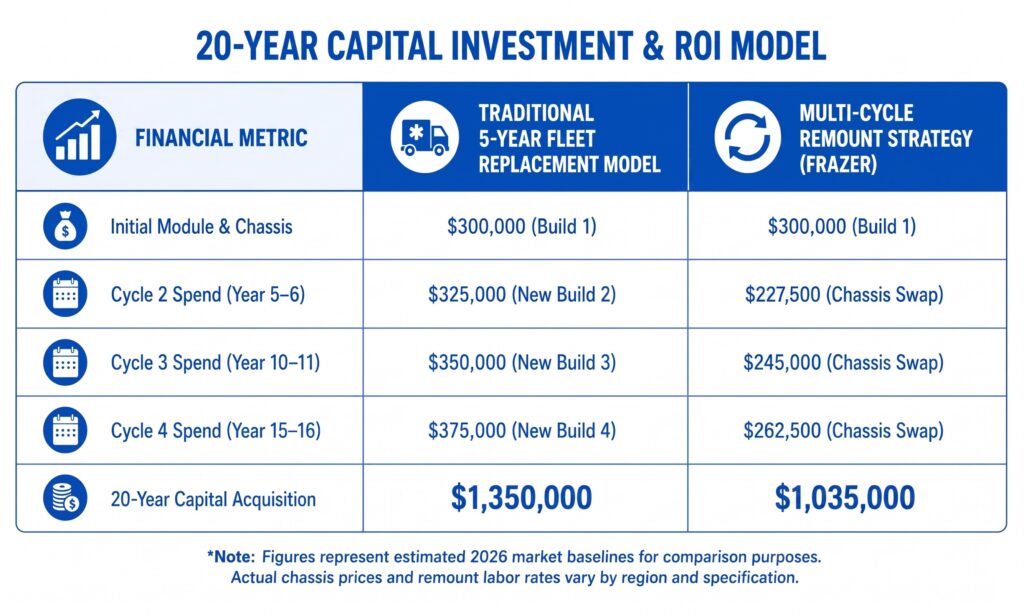
The lowest purchase price is not always the lowest cost over time. A useful comparison includes repairs, maintenance, replacement schedules, downtime, and the possibility of reusing the patient module when the truck chassis reaches the end of its service life.
Frazer builds wood-free, all-aluminum modules designed for long-term use. Depending on service conditions and upkeep, a heavy-duty custom module may serve for 15 to 20 years. It may also be possible to remount the module onto a compatible replacement chassis, with needed updates or refurbishment completed along the way.
That is the idea behind Lowest Overall Cost of Ownership, or LOCO. Instead of comparing two price tags, compare what each option is likely to cost throughout the years your program plans to operate it.
For example, the Houston Fire Department operates 129 Frazer units and has remounted some modules as many as four times. Some modules are approaching 20 years in service and have passed one million total service miles. These are examples of what can be possible, not a guarantee of how every module will perform.
When building your budget, request estimated remount costs, expected maintenance needs, and a realistic replacement plan. Use your own fleet history and operating conditions to test whether remounting makes financial sense for your organization.
4. Equipment Safety: How Is Heavy Medical Technology Secured?
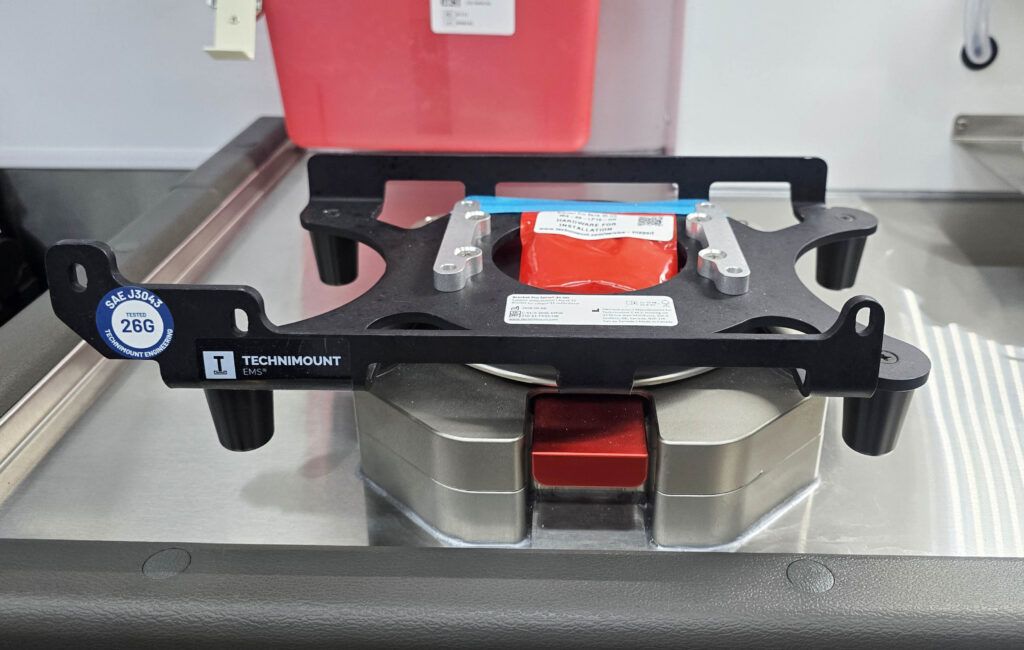
A mobile stroke unit or specialty care vehicle may carry equipment that weighs hundreds of pounds. A CT scanner weighing around 1,000 pounds is not something a builder can simply place inside the module. Its weight, location, mounting system, and effect on vehicle handling all need careful engineering.
Ask the builder for documentation showing how the equipment is secured, which standards apply, and how the mounting system was tested. Also confirm that the proposed installation meets the equipment manufacturer’s requirements.
Frazer has worked on Mobile Stroke Unit development since 2014. As part of that work, the company developed an SAE J3043-compliant CT scanner mounting system. In independent testing, the fixed-mount system was subjected to more than 50,000 pounds of force, with no damage reported under the test conditions.
The design does not require floor rails and is intended to support CT image acquisition while parked on an incline of up to five degrees, subject to the scanner’s specifications and operating limits. Review the actual test documentation and approved configuration before deciding whether a design fits your program.
5. Service: Who Helps When Something Goes Wrong?
Every vehicle needs service eventually. What matters is how quickly your team can identify a problem, get the right parts, and find someone who can help. For a mobile healthcare program, time in the shop can mean missed appointments or interrupted community services.
Ask prospective builders how their technical support works after delivery. Find out whether your local technicians can troubleshoot common problems, what diagnostic tools they need, and how they reach the manufacturer when an issue is more complex.
Frazer keeps many electrical systems straightforward, using point-to-point wiring, common terminal strips, and standard automotive relays. This approach can help technicians diagnose many issues with familiar tools, such as a multimeter. The exact repair process will still depend on the vehicle and the problem.
Service after the sale also matters to buyers. In a 2020 double-blind industry study conducted by Smart Advantage, EMS and fire professionals ranked support after the sale as the top attribute in choosing a builder. When asked which brand spent the least time in the shop, Frazer received 39% of mentions, the highest share among brands evaluated. Those figures reflect the views of the study’s respondents, not a measured guarantee of uptime.
Frazer’s goal is to remain a resource after your vehicle enters service. When you compare builders, look beyond the warranty and ask what support will actually look like for your fleet and your technicians.
How to Build a Stronger Business Case
A good vehicle proposal connects clinical needs to practical operating costs. Start by listing the equipment your team will use, how long the unit will be deployed, where it will operate, and what happens if it is unavailable for service.
Then ask each builder to explain its power system, climate performance, equipment mounting, service process, and long-term replacement options. Request written specifications and supporting documentation so your team can compare the same requirements across different proposals.
The right choice is the vehicle that supports your program’s work, fits your budget, and gives your team confidence in the years ahead. If you’re planning a mobile healthcare program, contact the Frazer team to talk through your power, climate, equipment, and layout requirements. We can help you explore configurations and identify the questions worth answering before you buy.
What are the power requirements for mobile health vehicles?
Mobile health vehicles with high-demand medical equipment, such as CT scanners, often benefit from chassis-independent power systems. Dedicated generators can provide reliable power for medical equipment and 115VAC air conditioning without depending on the truck’s engine. This helps support uninterrupted clinical operations when the truck engine is turned off or unavailable, depending on the vehicle’s configuration and operating conditions.