
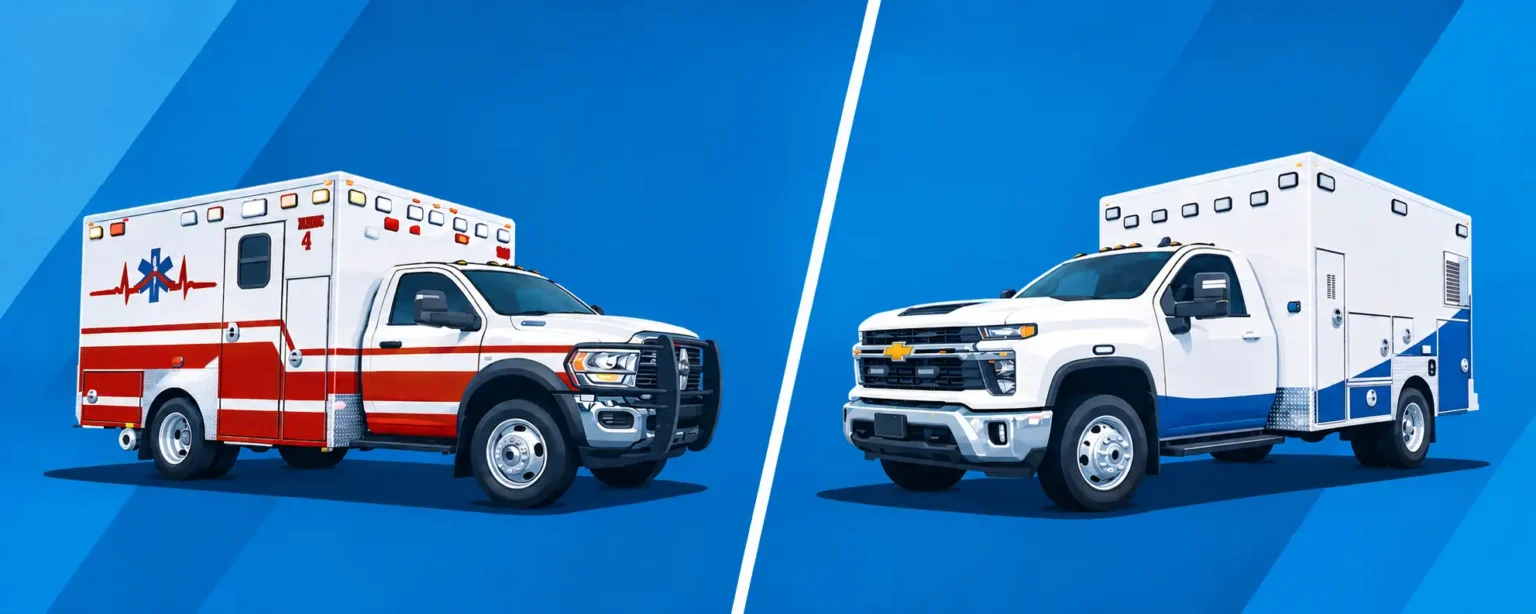
Standard vs. Custom Ambulance: The Fleet Leader’s Guide to Purpose-Built Design
Choosing an EMS vehicle is about more than its purchase price. A standard production model may meet your needs, but it can also require equipment changes after delivery. A purpose-built Frazer vehicle lets you plan equipment mounts, storage, power, and crew workflow before construction begins. Our all-aluminum, wood-free modules are designed for long-term service and potential remounting, with documented fleet applications exceeding 1,000,000 miles across multiple chassis. This guide explains what to compare before you make your next fleet investment.
Fleet demands rarely stand still. Changes in 911 and interfacility call volume, long hospital wall times, and ongoing maintenance all put pressure on replacement budgets. If your agency replaces a chassis every five to seven years, it’s worth asking whether the patient module needs to be replaced, too. We’ll compare custom and standard builds based on durability, crew space, service access, and remount potential.
Standard vs. Custom EMS Vehicles: A Side-by-Side Comparison
The important differences are often behind the walls: how the module is built, where equipment goes, how it gets power, and how technicians service it. Those details matter even more as a unit approaches 250,000 miles and beyond.
| Evaluation Criteria | Standardized Off-the-Shelf Production Model | Purpose-Built Custom EMS Vehicle (Frazer Engineering) |
|---|---|---|
| Pre-Delivery Outfitting | Catalog layouts may require additional equipment brackets, radios, dividers, or other modifications after delivery, depending on agency specifications. | Customer-approved engineering drawings incorporate specified equipment mounts, electrical circuits, and storage configurations before fabrication. |
| Interior & Frame Materials | Material selection varies by manufacturer and model. Some configurations incorporate wood, MDF, or particle board in subfloors or cabinetry. | All-aluminum module framing and cabinetry designed without wood, MDF, or particle board in the patient compartment. |
| Interior Workspace | Catalog configurations offer established aisle widths and cabinet arrangements, with customization options varying by model. | True 96-inch module width with nearly 50 inches of open aisle space and customer-specific layout options. |
| Power & Climate Architecture | Power and climate configurations vary. Some systems use chassis alternators or cab-connected HVAC components. | Dedicated 115VAC/120V onboard generator and self-contained 15,000 BTU HVAC system with a 12V backup power feature. |
| Electrical Troubleshooting | Some configurations use multiplex electrical systems that may require specialized diagnostic tools or replacement components. | KISS Principle point-to-point wiring, common terminal strips, standard automotive relays, and accessible fuses. |
| Multi-Chassis Remount Life | Remount suitability depends on module construction, condition, electrical components, and manufacturer recommendations. | Engineered to support up to 4 remounts over 15 to 20 years, with documented fleet applications exceeding 1,000,000 miles. |
Can a Custom Ambulance Reduce Work After Delivery?
Frazer’s Inside Sales Engineers work with your team before fabrication to plan aluminum equipment mounts, 115VAC circuits, and storage around your equipment list. Those details go into customer-approved engineering drawings, helping reduce the need for modifications after delivery. The actual time needed to put a vehicle in service will depend on your agency’s equipment and procedures. Monroe Township Fire Department reported placing its new Frazer unit in service within seven days of leaving Houston.
What Post-Delivery Modifications Really Cost
A standard catalog vehicle may need additional work from a local shop or third-party upfitter. That could mean adding cardiac monitor mounts, installing radios, changing interior panels, or connecting equipment to the electrical system. Every change takes planning, labor, and possibly parts that weren’t included in the original quote.
Additional installation work may extend the time between vehicle delivery and placement into active service. Shop labor, equipment brackets, and third-party fabrication can add costs beyond the initial vehicle purchase price. Under Frazer’s written warranty provisions, unauthorized third-party structural or electrical modifications may affect warranty coverage for components associated with those modifications. Agencies should review applicable warranty terms before making changes.
Plan Equipment Placement Before the Build
With a custom ambulance, equipment planning happens before the first piece of aluminum is fabricated. Your team works with Frazer’s Inside Sales Engineers to choose mounting locations, outlet positions, and compartment layouts. The details are captured in approved drawings before production begins at our Sugar Land, Texas, facility.
Frazer’s written warranty addresses construction in accordance with customer-approved drawings and performance specifications, subject to the applicable terms. That gives you a clear set of approved specifications to review before the build.
In a double-blind survey of 100 fire and EMS professionals, respondents ranked Frazer #2 for willingness to customize vehicles and #3 for delivering vehicles with relatively few reported defects or punch-list items. Those rankings reflect survey responses, not a guarantee for every vehicle.
Build for the Long Haul: Materials and Module Durability
A busy EMS vehicle faces years of road vibration, frequent cleaning, and constant use. That’s why it pays to look past the interior finish and ask how the module and cabinets are actually built. Materials and construction methods can affect maintenance needs and the potential to reuse a module on another chassis.
Why All-Aluminum, Wood-Free Construction Matters
Materials vary by manufacturer and model. Some standard production vehicles use wood, MDF, or particle board in subfloors or cabinets. Others use different materials, so it’s important to review the specifications for the exact vehicle you’re considering.
Wood-based components can absorb moisture or lose fastener holding strength over time, depending on how they’re sealed, exposed, and maintained. These factors matter when you’re planning for years of cleaning, repairs, and possible remounting.
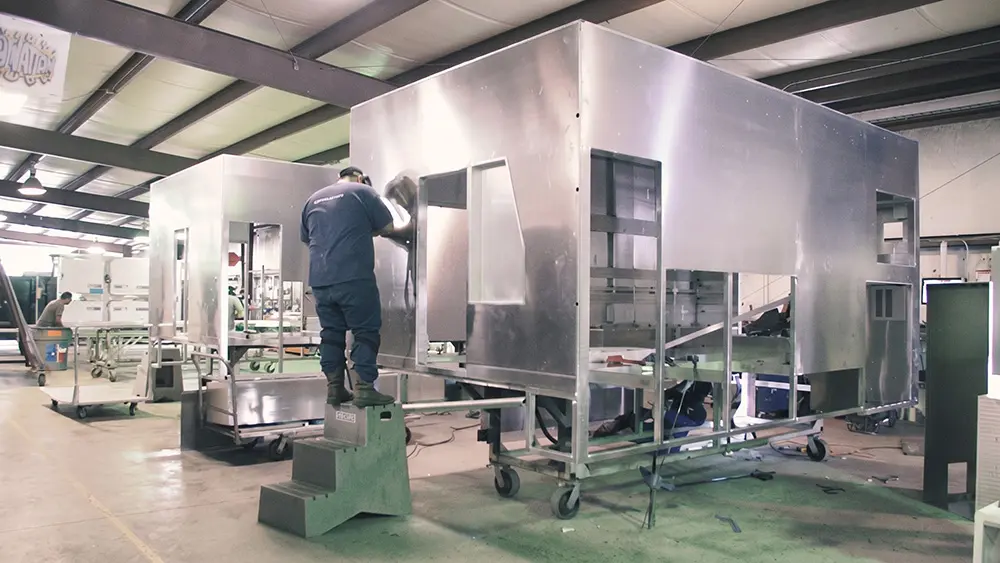
Frazer builds its module frames and interior cabinets from welded aluminum. We don’t use wood, MDF, or particle board in the patient compartment. Stainless steel work surfaces and other cleanable materials help support routine cleaning and care.
Metal mounting structures and nonporous work surfaces are designed to stand up to repeated use and cleaning. Our modules are also designed with future chassis replacements in mind. Frazer has documented fleet applications in which a module served on chassis driven more than 260,000 miles each.
What Can Collision Reports Tell You?
Crew safety matters at every mile. When Frazer surveyed 100 fire and EMS professionals, 70% identified structural or collision-related protection as a safety consideration. Module construction and properly mounted equipment should be part of any vehicle review.
Frazer engineers its EMS vehicles with reference to applicable Triple-K, CAAS GVS, and NFPA 1917 requirements. Ask for the compliance and testing documents that apply to the specific model and model year you’re evaluating.
Frazer’s reported records cover more than 4,500 EMS modules built since 1984. In the collisions documented in those records, Frazer reports no module detachments, including incidents involving rollovers and side impacts. That’s a record of reported events, not a prediction of how a vehicle will perform in a future crash.
Jackson County Fire Rescue: Following a near head-on, driver-side collision involving at least one full rollover, the module reportedly remained intact, and the crew sustained minor injuries. Gadsden County Emergency Services: In a major collision involving two to three vehicle rotations, the all-aluminum module reportedly remained together and was considered salvageable following the incident. CareFlite: Following a reported 52 MPH driver’s-side impact and 90-degree rollover, the crew was reported uninjured. The module was subsequently remounted onto a new chassis and returned to service.
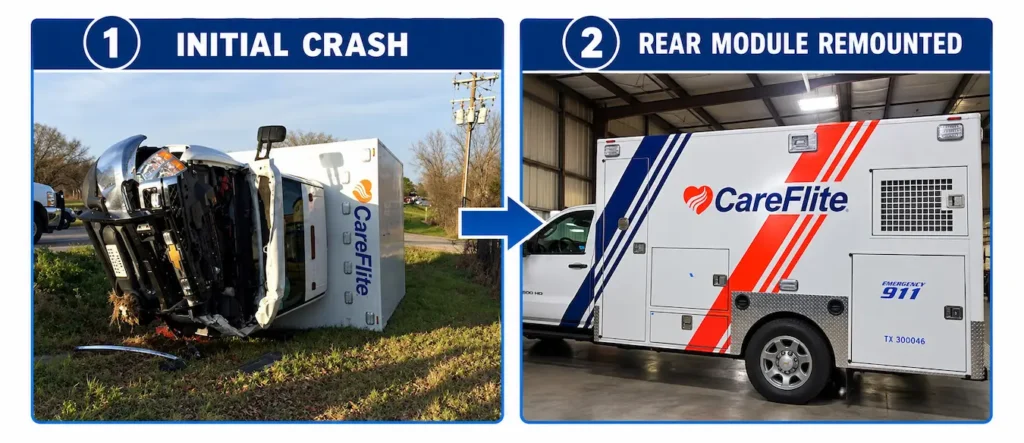
These are real-world reports, but no two crashes are alike. Speed, impact angle, vehicle configuration, restraint use, and equipment installation all affect the outcome. Use these examples as context, not as a substitute for the testing and documentation relevant to your build.
Frazer also reports developing an SAE J3043-compliant CT scanner mount for specialty mobile healthcare vehicles. According to Frazer’s testing documentation, the mount underwent voluntary testing beyond 50,000 pounds of force, with no damage reported under those test conditions. The results apply to the tested configuration and conditions.
Design a Patient Compartment Around Your Crew
Your crew works inside the patient compartment every day, so the layout needs to fit how they deliver care. A custom floorplan lets you plan equipment locations, seating, and storage around your protocols. That can make essential supplies easier to reach while seated and restrained.
Room to Work: 96-Inch Width and Seated Access
Start with the people who use the vehicle. In Frazer’s double-blind survey, 66% of respondents identified seating position and ergonomics as a primary safety consideration. Have caregivers test access to frequently used supplies from the seats they’ll actually use.
Frazer offers a true 96-inch-wide module with nearly 50 inches of open aisle space around a center-mounted cot and four seated caregiver positions. The available space gives departments room to consider equipment placement and workflow.
Your team can choose how to organize commonly used supplies and equipment. Options include Door-Forward layouts, fire-rescue exterior compartments, dual-stretcher critical care interiors, and Mobile Stroke Units. The goal is to build a space that supports your care model instead of forcing your crew to work around a fixed layout.
Actual reach depends on the selected floorplan, the equipment installed, and where each caregiver sits. Review those details before you approve a layout, especially when seated, belted access is a priority.
Independent Climate Control and Air Purification
Climate control and air quality are important to crews and patients. In Frazer’s double-blind survey, 76% of respondents identified those features as important, making them the top-ranked safety-related feature in that survey.
Hot weather, cold weather, and long hospital wall times all affect the demands on a patient-compartment HVAC system. When you compare vehicles, ask whether the patient area depends on the cab climate system and what operating conditions the published specifications cover.
Frazer modules use a self-contained 15,000 BTU HVAC system that operates separately from the cab’s air system. We pair it with a Dometic BreatheEasy UV/ionization air purifier.
The purifier is designed to recirculate cabin air about every two minutes. Frazer’s stated HVAC specifications include a minimum cooling differential of 25°F to 30°F, with capability above 35°F under certain conditions. Real-world performance depends on outdoor temperature, airflow, maintenance, configuration, and how the vehicle is used.
Altoona Fire Department has shared positive feedback about its Frazer heating and cooling systems in winter weather and summer temperatures of 95°F to 100°F. That’s the department’s experience, not a promise of identical results in every climate.
Can You Keep the Module When You Replace the Chassis?
When a chassis reaches the end of its useful service life, the module may still have years left. Whether it can be remounted depends on its structural condition, materials, electrical systems, and current requirements. That’s why construction matters from the beginning.
Frazer’s welded, all-aluminum, wood-free modules are designed with long-term use in mind. Reported fleet examples include modules remounted up to four times over 15 to 20 years, with total service exceeding 1,000,000 miles. Those results come from specific fleet applications, including Houston Fire Department.
What a Million Miles Can Mean for Fleet Planning
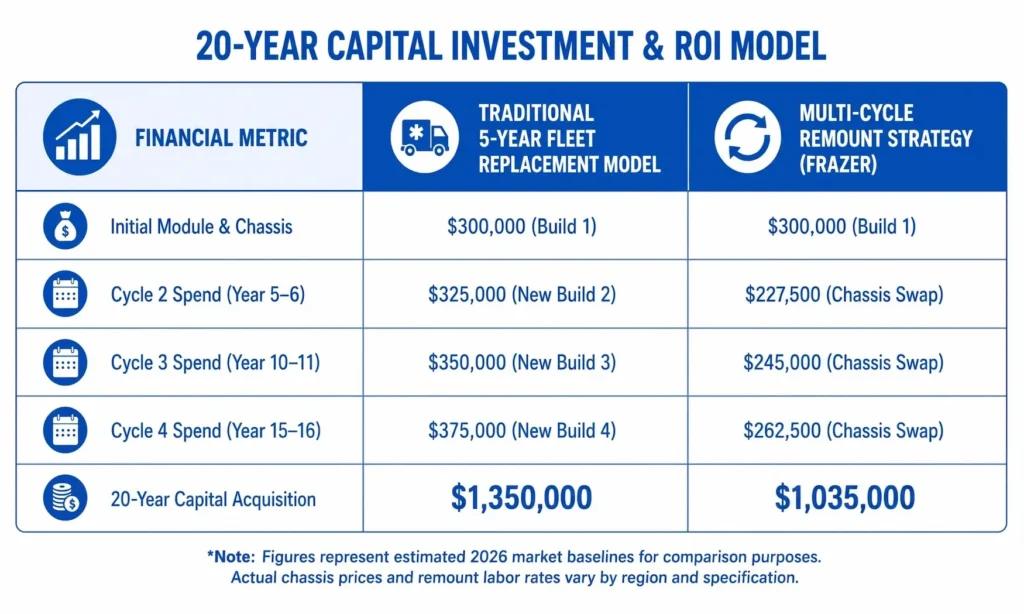
In a high-use fleet, a chassis may reach 250,000 miles in roughly five to seven years. Your replacement schedule will depend on calls, duty cycles, maintenance, and department policy. But replacing a chassis doesn’t always mean replacing the patient module.
If a module passes the required inspections and remains suitable for service, remounting it on a replacement chassis may be worth considering. The evaluation should cover structure, electrical compatibility, current vehicle standards, and the cost of updates.
Houston Fire Department: Frazer’s reported fleet information describes 129 Frazer units, with modules routinely accumulating 260,000+ miles per chassis. The department’s reported experience includes modules remounted up to four times, with some exceeding 1,000,000+ miles and approaching 20 years of service. Marble Falls Area EMS: The department has reported continued remounting of a Frazer module originally purchased in 1996, providing an example of extended module service in a specific fleet application.
These examples show what’s possible in individual fleets, not what every module will achieve. Structural inspections, component condition, current standards, and planned upgrades determine whether a future remount makes sense.
Frazer offers a written lifetime module construction warranty to the original owner of qualifying new modules, subject to its terms and exclusions. Frazer-performed remounts also carry a two-year remount construction warranty under the applicable written provisions.
Compare Custom Builds With the Foundation Series
You don’t have to choose between a fully customized vehicle and an inflexible catalog layout. Frazer offers different purchasing and configuration options, including the Foundation Series and fully custom Type I and Type III builds. Both approaches use Frazer’s all-aluminum, wood-free module construction.
Frazer Foundation Series (Starting at $252,000): A focused 12-foot Type I configuration available from stock or through build-to-order purchasing. The Foundation Series includes all-aluminum, wood-free construction, true 96-inch module width, nearly 50 inches of open aisle space, independent power and HVAC systems, and a module design intended to support future remounting, subject to inspection and eligibility. Custom Type I & Type III Builds ($200,000 to $450,000+): Custom configurations allow agencies to select floorplans, storage arrangements, equipment integration, and other features based on their operational requirements. Specialty configurations include Mobile Stroke Units at $900,000 to $1,000,000 and Mobile Clinics at $1,000,000 to $1,200,000.
These are the stated starting prices and ranges, not guaranteed quotes. Your final price will depend on chassis, configuration, equipment, purchasing terms, and availability.
Price is important, but it wasn’t the only priority in Frazer’s double-blind survey of 100 fire and EMS professionals. Fewer than 25% initially named price as their primary decision factor. When the survey also considered durability, uptime, and support after the sale, that number fell to 9%.
Is a Custom Ambulance Harder to Maintain?
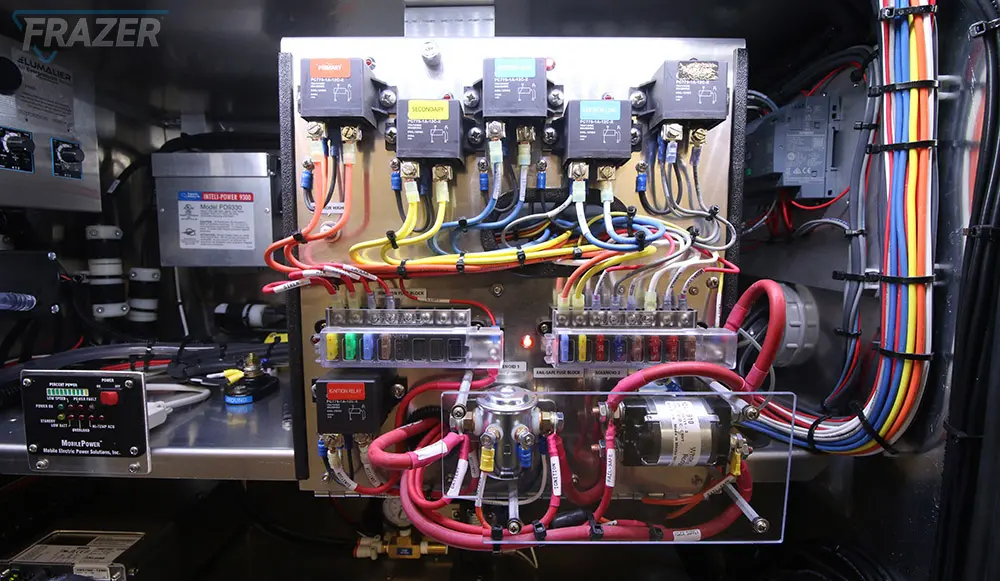
A custom ambulance doesn’t have to mean a harder-to-service vehicle. What matters is how its systems are designed, how easy components are to reach, and whether your technicians can troubleshoot them. Frazer’s KISS Principle emphasizes straightforward point-to-point wiring, common terminal strips, standard automotive relays, and accessible fuses.
In a double-blind survey of 100 fire and EMS professionals, 39% associated Frazer with the least time in the maintenance shop. The major competitor brands in that comparison each received 7%. These are respondents’ perceptions, not measured shop-time data.
The KISS Principle: Keep Electrical Service Simple
Electrical designs differ across manufacturers. Some use multiplex systems with electronic control modules. Others use traditional wiring. Neither label tells the whole service story, so compare the actual diagrams, diagnostic procedures, and parts requirements.
Frazer follows the KISS, or ‘Keep It Simple,’ Principle. Our approach uses point-to-point wiring, common terminal strips, standard automotive relays, and accessible fuses. For the module functions described in our electrical architecture, we use no proprietary printed circuit boards.
The idea is simple: make individual circuits easier to access and troubleshoot with familiar components. Repair time will still depend on the problem, technician experience, and parts availability.
Cranston Fire Department has spoken positively about its experience with Frazer’s service, quality, and parts teams, as well as access to vehicle systems. Its feedback is one department’s reported experience.
Independent Power and Support After the Sale
Long calls and hospital wall times can place significant demands on medical equipment and electrical systems. That’s why it’s worth asking where the patient compartment gets its power and what happens if a primary power source becomes unavailable.
Frazer offers dedicated 115VAC/120V onboard generator power for the patient compartment, separate from the chassis electrical system. Available configurations include MEPS, Cummins Onan Gas/Diesel, and Harrison Hydra-Gen hPower systems.
An intelligent 12V DC chassis backup feature is designed to support specified electrical functions under applicable operating conditions. Ask which functions are covered in the configuration you’re considering.
Support after the sale ranked first among the decision drivers in Frazer’s industry survey. And serving customers outside our home state is already part of our work: according to Frazer’s customer information, 90% of new customers in 2024 were outside Texas.
Our customers can work with Frazer’s factory engineering, parts, and quality teams, plus mobile service and authorized regional service centers. Availability and response times vary by location, service need, and support arrangement.
Frazer’s written warranties include five years of electrical wiring coverage and lifetime module construction coverage for the original owner of qualifying new modules. All coverage is subject to the applicable terms, conditions, and exclusions.
Five Questions to Ask Before You Buy
Before your apparatus committee chooses a build, work through these five questions together. They connect everyday operating needs with long-term fleet costs.
- Audit Post-Delivery Retrofit Costs: Review shop labor, third-party installation expenses, and equipment modifications associated with previous vehicle purchases. Consider how those modifications may have affected warranty coverage and deployment schedules.
- Verify What Sits Behind the Walls: Review module framing and cabinetry materials. Confirm whether the selected configuration uses 100% all-aluminum, wood-free construction or incorporates wood, MDF, or particle board in specific areas.
- Evaluate Seated-and-Belted Reach: Have caregivers sit in the primary seating positions with restraints fastened. Evaluate access to airway, cardiac, suction, and other frequently used equipment according to department procedures and the vehicle’s intended operating conditions.
- Review Electrical Serviceability with Your EVTs: Ask fleet technicians to examine wiring diagrams, diagnostic procedures, component accessibility, and parts requirements. Consider how the selected electrical architecture fits the department’s maintenance capabilities.
- Model 15- to 20-Year Remount Costs: Compare the projected costs of full vehicle replacement with potential module remounting across multiple chassis. Include inspections, equipment updates, maintenance, warranty provisions, and financing considerations. Agencies can also evaluate Frazer’s $252,000 Foundation Series alongside available cooperative purchasing, grant, or leasing options.
Ready to Compare Your Fleet Options?
Bring your current specifications, equipment list, and call-volume needs to a 20-minute conversation with a Frazer Inside Sales Engineer. We’ll help you look at what your next emergency vehicle needs to do, not just what it needs to cost.
We can compare a custom layout with the Foundation Series, starting at $252,000, and review equipment integration, service access, and long-term ownership considerations. You’ll leave with clearer questions to ask and a better understanding of your options.
Schedule a Fleet Spec & Lifecycle Consultation
Explore Available Stock & Foundation Series Inventory
How can a purpose-built custom EMS vehicle reduce post-delivery retrofit costs?
Frazer works with your team before production to incorporate equipment mounts, electrical outlets, and storage into customer-approved engineering drawings. This helps reduce the need for additional installation work after delivery, saving potential time and expense. Monroe Township Fire Department, for example, reported placing its Frazer vehicle into service within seven days of leaving Houston. Actual deployment timelines depend on each department’s equipment and operational needs.