
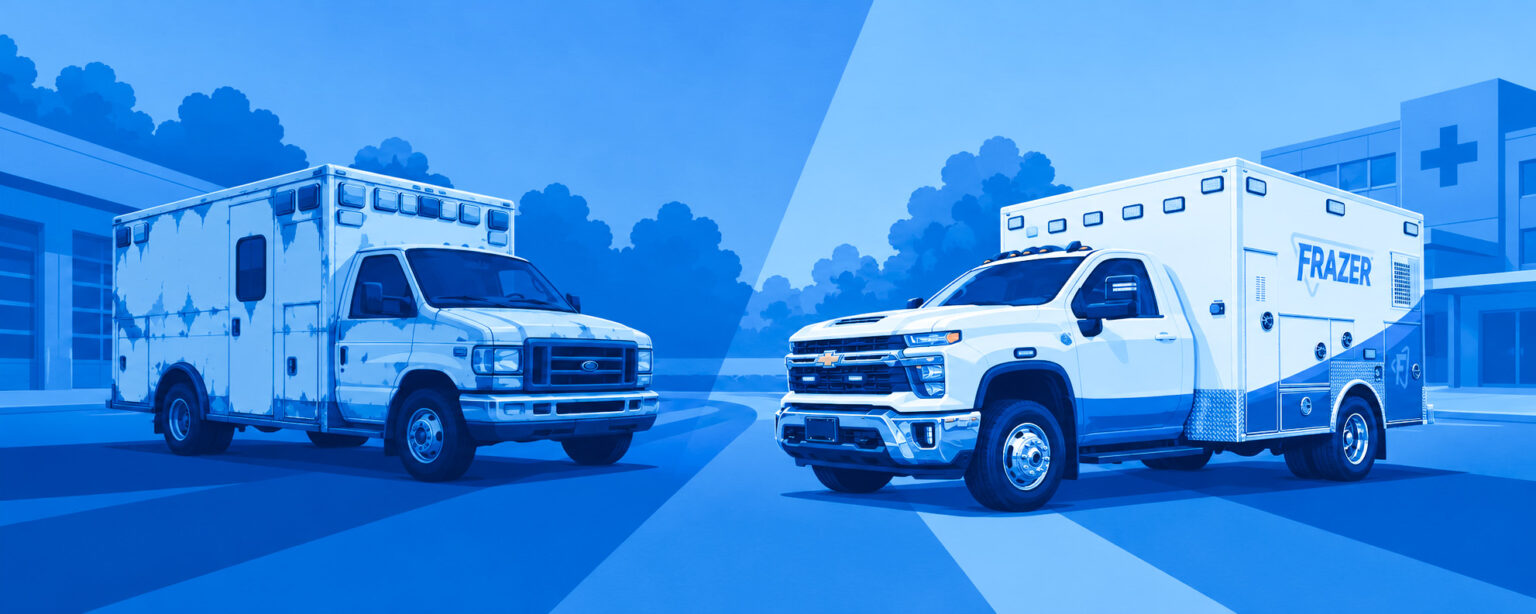
Ambulance Lifecycle Cost: Remounting vs. Buying New
The maintenance bills for your 12-year-old remount just landed on your desk. The air conditioning needs work again, your reserve fleet is stretched thin, and crews need dependable vehicles for the next shift.
Now budget season is here, and leadership wants to know whether refurbishing three older units will save money. It might lower the upfront cost, but you also have to plan for repairs, downtime, and the demands of everyday service.
Chassis prices and procurement timelines make that decision even harder. To understand the real cost, compare the money you spend to acquire a vehicle with what you expect to spend operating and maintaining it over the next 5 to 10 years.
Is It Cheaper to Refurbish an Ambulance or Buy a New EMS Vehicle?
Remounting an existing ambulance module often costs less upfront than purchasing a new EMS vehicle. Buying new, however, may offer more predictable maintenance, easier service access, and updated systems. A useful comparison starts with a realistic remount quote, the condition of your current module, and the $252,000 starting price of a Frazer Foundation Series vehicle.
Understanding CapEx Savings vs. Long-Term OpEx Costs
Imagine reviewing a budget that shows a $100,000 quote for a third-party refurbishment next to the price of a new vehicle. That difference matters, especially when several fleet needs are competing for the same capital dollars.
The lower price deserves serious consideration. It just should not be the only number in the discussion, because an older module may not have the same maintenance needs or warranty coverage as a new one.
Before committing to a remount, look closely at the parts of the module you intend to keep. Aging wiring, worn insulation, structural fatigue, and past repairs may affect future maintenance costs. A thorough inspection can help you decide which expenses are likely and which are still unknown.
Warranty terms are another important difference. For the original owner, Frazer warrants a new module against failure or malfunction caused by design or construction for the life of the module, subject to the applicable warranty terms. Remounted modules, including Frazer-authorized remounts, carry a two-year warranty under their applicable terms.
That difference can matter when you are building a maintenance budget. Ask what each proposal covers, how long the coverage lasts, and what your department will be responsible for after it expires.
Estimated New EMS Vehicle Price Ranges
A new Type I emergency vehicle typically ranges from $250,000 to over $400,000, depending on configuration and customization. Standardized heavy-duty frontline platforms are available with starting prices around $252,000, while highly customized builds frequently exceed $350,000. Remounting an existing module onto a new chassis may offer capital cost reductions of approximately 30% to 50% compared with purchasing a new vehicle, depending on the scope of work.
When evaluating available vehicles, the following estimated pricing bands can provide a starting point for capital planning. Actual prices may vary based on chassis availability, vehicle specifications, equipment selections, manufacturer pricing, and contract terms.
- Base Commercial / Transport Models: $200,000 to $250,000
- First Responder / Standard Type I Rescue Platforms: $225,000 to $275,000
- Most Common Frontline Municipal Builds: $250,000 to $300,000
- Highly Customized / Bespoke Multi-Agency Apparatus: $350,000 to $450,000+
- Specialized Platforms (Mobile Stroke Units / Large Mobile Clinics): $900,000 to $1.2M+
How Does Hospital Wall Time Affect Ambulance Lifecycle Costs?
Hospital wall time can add operating hours even when an ambulance is not moving. If the truck engine must run to power patient-compartment air conditioning or electrical equipment, long waits may add to idle-related maintenance. A generator-powered, chassis-independent system can operate supported equipment with the truck engine off, helping departments reduce unnecessary idle time.
How Hospital Wall Time Can Affect Chassis Maintenance
When crews are waiting to transfer a patient at the hospital, they are often ‘holding the wall.‘ The vehicle may be parked, but the need for patient-compartment cooling and power does not stop.
Some refurbished ambulance configurations continue to rely on the truck chassis engine to operate patient-compartment air conditioning and electrical equipment. During a 100-degree summer day, crews may need to keep the chassis engine running to maintain the desired patient-compartment temperature.
Extended idling adds engine hours and can contribute to additional wear on diesel engines and emissions-related components. The extent of that impact depends on factors such as engine design, maintenance practices, operating conditions, and total idle time.
A remount can give an existing module more years of useful service. Before making that investment, though, check whether its heating, cooling, and electrical systems still fit how your crews work today.
Frazer offers independent power options, including MEPS and Cummins Onan generator systems. Depending on the configuration, these systems can power supported patient-compartment equipment without running the truck chassis engine.
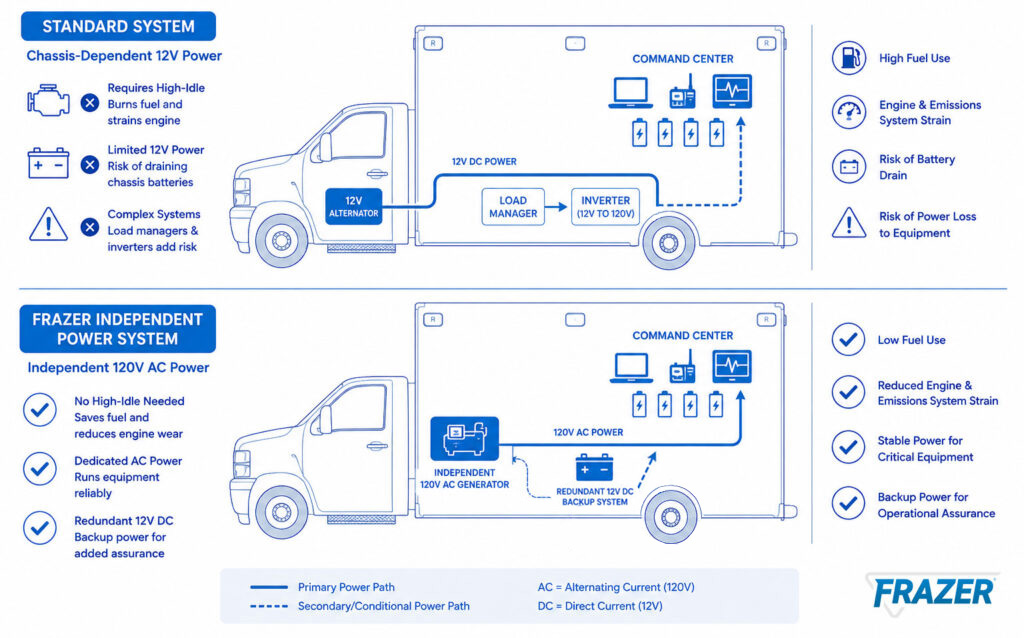
What this means in the field: When the independent power system is running, crews can switch off the truck engine while they wait at the hospital. The generator-powered 115VAC HVAC system can continue cooling the patient compartment. Under applicable operating conditions, the system can provide a 25- to 30-degree cooling differential, with results above 35°F in certain conditions.
That gives crews a way to maintain patient-compartment comfort without relying on extended chassis engine idling. Actual fuel, maintenance, and engine-hour savings will depend on how the department operates its vehicles.
How Serviceable Electrical Systems Support Fleet Uptime
Electrical problems are frustrating enough without a long search for the right replacement part. When comparing a remount with a new vehicle, ask how technicians will access circuits, diagnose faults, and obtain the parts they need.
Some EMS vehicles use multiplex systems with specialized circuit boards, control modules, or diagnostic interfaces. Those systems can offer useful capabilities, but certain repairs may require specific parts, tools, or expertise.
When a repair takes longer than expected, that vehicle is unavailable for calls. Your shop may also need to move another unit into service, putting more pressure on the reserve fleet.
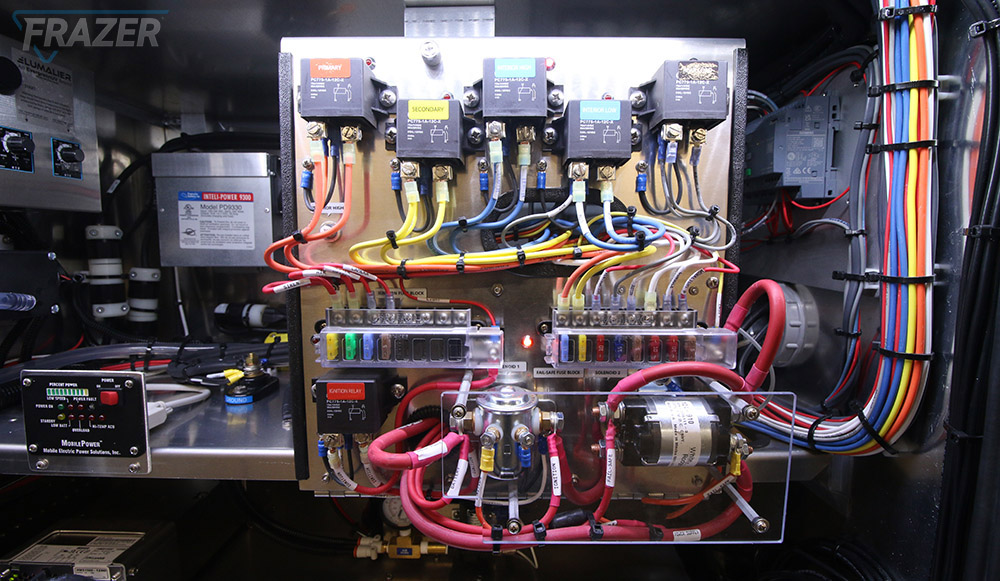
Frazer takes a straightforward approach to core module wiring. Our point-to-point electrical design focuses on accessible components and practical troubleshooting, following the familiar ‘keep it simple’ principle.
What this means for your shop: Frazer’s point-to-point architecture uses terminal strips, standard automotive relays, and accessible fuses. Technicians can troubleshoot core module circuits without depending on proprietary printed circuit boards or multiplex nodes for that wiring.
If a lighting circuit stops working, for example, a technician can inspect the wiring, test the circuit, and replace a serviceable component when needed. Familiar parts and tools can make some repairs easier to handle in-house, although repair times will vary.
That service-first approach is reflected in one market research finding. In a double-blind study by Smart Advantage, 39% of respondents identified Frazer as the brand that spends the ‘least amount of time in the shop.’
That result describes respondents’ perceptions, not a guaranteed outcome for every fleet. Actual time in the shop depends on vehicle age, configuration, maintenance practices, and operating conditions.
Wood-Free Construction and Crash Testing: Evaluating the Structure of Aging Ambulance Modules
A remount decision starts with a simple question: Is the existing module in good enough condition for more years of service? Its structure, materials, maintenance records, and expected use all deserve a close look.
A 15-year-old module may still be a good candidate for continued service. An inspection can identify areas that need repairs before the module is installed on another chassis.
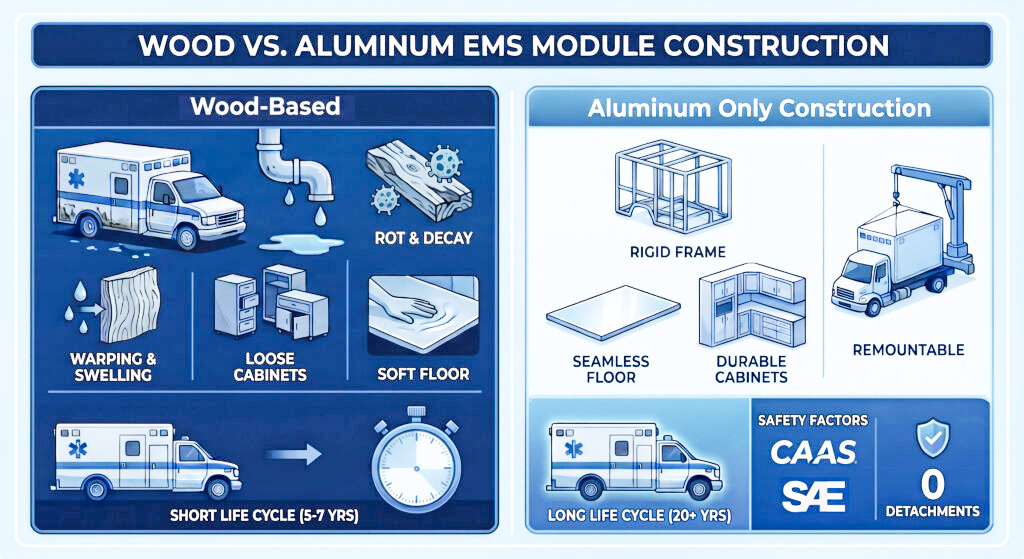
Moisture and daily cleaning can take a toll on interior materials. In modules built with wood-based floors or cabinetry, prolonged exposure may cause deterioration that needs attention during refurbishment. Construction methods and testing practices have also changed over time. Compare the documentation and structural features of your existing module with those of any new vehicle you are considering.
Frazer builds its modules with a 6061-T6 aluminum framework and wood-free patient compartment. There is no wood, MDF, or particle board in the module construction, which helps avoid certain moisture-related concerns associated with those materials.
We also test specific structural components and equipment retention systems. Reviewing what was tested, which standard applied, and what the results mean is more useful than relying on broad claims about crash safety.
For example, a CT scanner mount used in Frazer Mobile Stroke Units and designed to comply with SAE J3043 was tested beyond 50,000 pounds of force, with no damage recorded in the referenced test. That result applies to the tested mount and conditions; it is not a guarantee of performance in every collision.
Frazer also reports zero recorded module detachments in collisions across more than 4,500 EMS modules built since 1984. This is a company-reported historical figure, and individual collision outcomes depend on the circumstances.
These examples are useful when reviewing the evidence behind a manufacturer’s design. They do not replace a careful inspection of an aging module or a review of the standards and testing that apply to a proposed vehicle.
Whether you remount or buy new, request the relevant construction and testing information. It can help your team make a more informed decision about long-term service and safety requirements.
What Is the Starting Price of a New Type I EMS Vehicle?
The Frazer Foundation Series Type I EMS vehicle starts at $252,000. Its defined configuration includes independent power, 115VAC chassis-independent HVAC, and wood-free aluminum module construction, giving departments a clear baseline for comparing a new purchase with a remount.
Planning Around the $252,000 Foundation Series Starting Price
It’s hard to present a vehicle budget when every option comes with a different list of equipment and add-ons. Starting with a defined configuration helps your team understand what is included and which changes may affect the final price.
The Foundation Series is built for EMS providers looking for a practical, value-focused vehicle. It combines features intended to support day-to-day operations with a more straightforward starting point for purchasing decisions.
The 12-foot Type I Foundation Series starts at $252,000 and includes independent power, 115VAC chassis-independent HVAC, nearly 50 inches of open aisle space, and all-aluminum construction. Final pricing depends on the equipment selected, vehicle configuration, and applicable purchasing requirements.
What this means for your budget: You have a published starting point for the new-vehicle side of your comparison. Pair it with a detailed remount estimate that includes inspections, repairs, equipment updates, and expected downtime.
From there, consider service access, chassis engine hours, expected repairs, electrical design, and time out of service. These costs will vary by department, but leaving them out can make the least expensive quote look like the least expensive long-term option.
Frazer designs modules with the possibility of future remounting in mind. Whether a particular module can be remounted later depends on its condition, chassis compatibility, inspections, and engineering requirements.
Houston Fire Department operates more than 120 Frazer units, including modules approaching 20 years in service. Frazer reports that some modules may reach more than 1 million miles of total service across multiple chassis, depending on maintenance, operating conditions, and remount decisions.
That experience shows why module life and chassis life should be evaluated separately. A well-maintained module that remains suitable for remounting may support a longer-term capital plan.
We call that bigger-picture approach the Lowest Overall Cost of Ownership, or LOCO. Instead of looking only at the purchase price, include acquisition, maintenance, downtime, and potential future chassis replacement costs when comparing options.
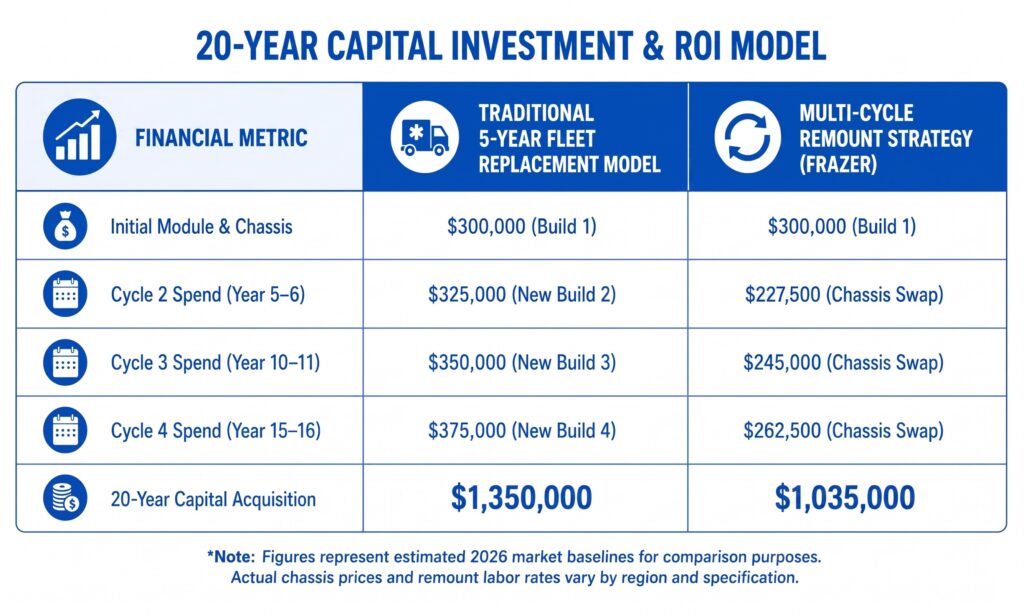
Take a Closer Look at Your Ambulance Lifecycle Costs
Remounting can be a smart way to stretch a capital budget when your existing module is in good condition. The right decision depends on the inspection results, the cost of the work, and how well the finished vehicle will meet your department’s needs.
A new EMS vehicle may make sense when older components are becoming costly to maintain or when your crews need a different power, HVAC, or electrical configuration. There is no single answer for every fleet, which is why a side-by-side lifecycle comparison matters.
At a starting price of $252,000, the Frazer Foundation Series gives departments a clear reference point for the new-vehicle option. Compare that figure with a complete remount proposal and realistic estimates for repairs, downtime, and future chassis needs.
When you consider both capital expenses (CapEx) and operating expenses (OpEx), you can explain the tradeoffs to your leadership team with greater confidence. The goal is not simply to spend less today, but to choose a vehicle plan your department can sustain.
Ready to compare your options? Talk with Frazer about the Foundation Series and the questions that matter most to your fleet. We can help you understand the configuration and plan a practical next step.
Is it cheaper to refurbish an ambulance or buy a new EMS vehicle?
Refurbishing an ambulance typically costs less upfront, but ongoing maintenance, repairs, and vehicle downtime can affect long-term costs. A new Frazer Foundation Series EMS vehicle starts at $252,000 and offers independent power, serviceable electrical systems, and wood-free construction. Comparing both initial purchase costs and expected operating expenses can help departments determine which option provides the best long-term value.