
What Does a Cost-Effective Ambulance Manufacturer Really Look Like? Inside Frazer’s $252,000 Foundation Series
When you’re buying EMS vehicles for your department, the lowest price on a proposal doesn’t always tell the whole story. What comes standard? What costs extra? And how will that purchase affect your fleet budget five, ten, or even twenty years from now?
Those are important questions for EMS leaders, fleet managers, and municipal purchasing teams. At Frazer, we believe you should have clear answers before you make a major investment. That’s why our Foundation Series starts at $252,000 with a defined package that includes independent power, dedicated HVAC, and a 96-inch-wide patient module.
Let’s look at what’s included, what can affect the final price, and how to evaluate the long-term cost of your next EMS vehicle.
What Do You Get for $252,000?
Picture this: Your department selects a vehicle based on an attractive initial bid. Then, as you work through the final specifications, you discover that several features your crews need weren’t included in the quoted price. Those additions push the total beyond what you planned to spend.
It’s one reason we encourage departments to look closely at standard equipment before comparing prices. Two proposals can have very different starting prices because they include different features. Understanding those differences early makes it easier to build a realistic budget and explain the purchase to city leadership.
Frazer’s Foundation Series starts at $252,000 and includes independent power, a dedicated chassis-independent HVAC system, a 96-inch-wide module, and nearly 50 inches of open aisle space. These aren’t features you have to add just to get the Foundation configuration. They’re part of the starting package.
Inside the patient compartment, you’ll find four caregiver seated positions and a center-mounted cot. The open aisle space gives caregivers room to reach the patient from either side. It’s a layout built around the work EMS crews do every day.
For purchasing teams, that defined starting point makes it easier to review the equipment list, identify any additional needs, and develop a more accurate estimate. The final purchase price will still depend on your department’s specifications and selected options, but you’ll have a clearer picture of what you’re starting with.
How Can You Keep Customization Costs Under Control?
The best way to manage customization costs is to know what’s included before you sign off on a purchase. Ask each manufacturer for a detailed equipment list, then compare the proposals based on what your crews actually need.
A lower starting price may be appealing, but it could reflect a different set of standard features. Electrical systems, climate control, and patient compartment equipment can all affect the final cost. If those items aren’t included in the initial proposal, you’ll want to know what it takes to add them.
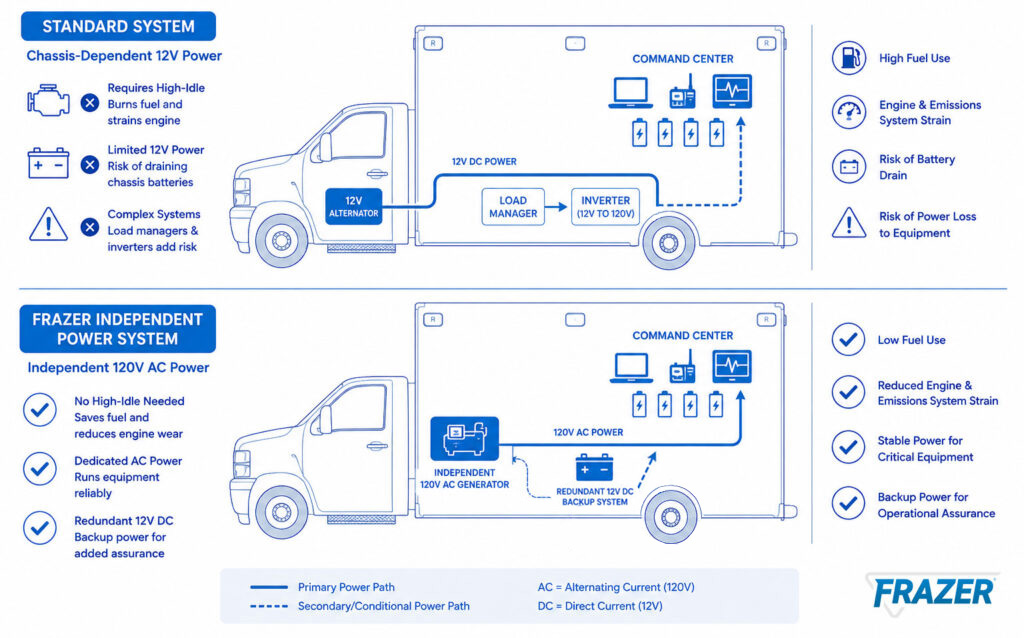
For example, Frazer’s Foundation Series includes chassis-independent power and HVAC systems. These systems are designed to support patient compartment electrical equipment and climate control without relying on the truck’s engine under applicable operating conditions.
That separation can matter in the field. If the chassis engine becomes unavailable, the independent systems may allow crews to continue using supported electrical equipment and climate control, depending on system status, available power, and operating conditions.
Including these systems in the Foundation package gives departments a clearer understanding of the vehicle they’re evaluating. It also helps purchasing teams spot potential additions before those costs become surprises.
Why the Purchase Price Is Only Part of the Cost
Your department isn’t just buying a vehicle for today. You’re making an investment that will affect maintenance, replacement schedules, and fleet availability for years to come.
A lower initial purchase price can help with this year’s budget. But it makes sense to look beyond that number. How often will the chassis need to be replaced? What will maintenance involve? Can you keep using the patient module when the truck underneath it reaches the end of its service life?
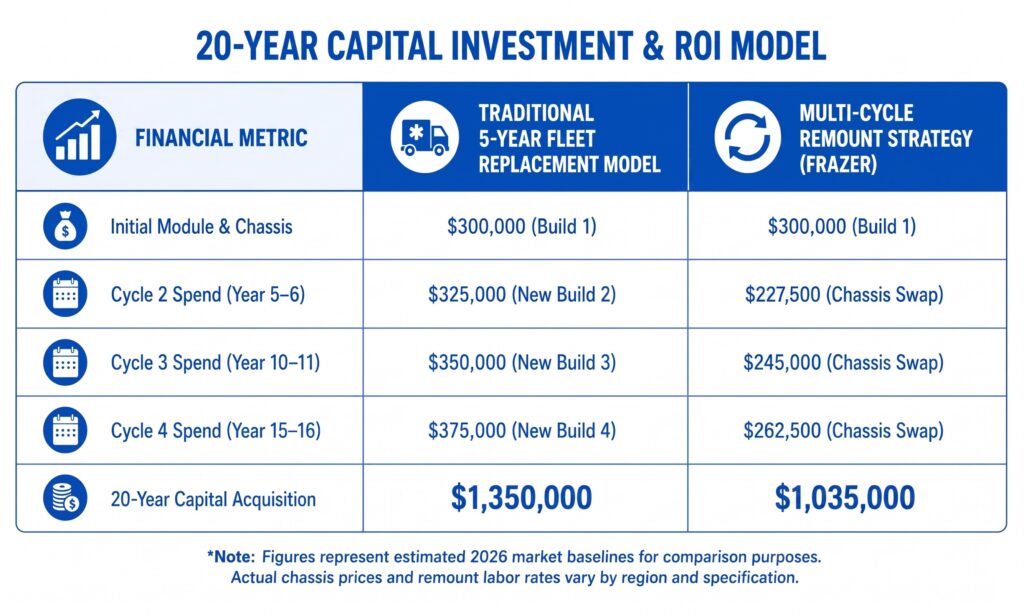
These questions are part of evaluating the lowest overall cost of ownership, or LOCO. Instead of comparing purchase prices alone, departments can estimate what each vehicle will cost to own and maintain over a longer period, such as 10 to 20 years.
For fleets that typically replace a chassis every five to seven years, the ability to reuse a patient module may be especially worth exploring. That’s where remounting comes into the conversation.
Can Remounting Save Your Department Money?
Remounting means moving an existing patient module from an aging chassis onto a replacement truck. If the module is still in suitable condition and compatible with the new chassis, your department may be able to keep using it instead of purchasing an entirely new vehicle.
Frazer builds its modules with long-term service and remounting in mind. Our all-aluminum, wood-free construction includes a welded 6061-T6 structural aluminum framework. We also use aluminum instead of wood in the subfloor and cabinetry, reducing exposure to certain moisture-related concerns associated with wood components.
That construction gives departments options as their fleets age. Of course, whether a module can be remounted depends on its condition, maintenance history, compatibility, and the requirements of the remounting project.
We’ve seen what extended module use can look like in a large municipal fleet. According to Frazer’s reported fleet experience, certain Houston Fire Department units have approached 20 years of continuous service. Some modules have been remounted as many as four times and accumulated more than 1,000,000 miles of total service.
Those examples aren’t a promise that every module will last 20 years or reach the same mileage. They do show why it’s worth considering remounting when planning future capital purchases. If a module remains suitable for service, replacing the cab and chassis instead of the entire vehicle may help a department manage its long-term spending.
The actual savings will depend on the cost of the replacement chassis, the remounting work, the module’s condition, and your department’s operating needs.
What About Maintenance and Downtime?
Every fleet manager knows that the cost of a vehicle goes beyond the purchase order. When a unit is in the shop, your department has to deal with the repair itself and the operational impact of having that vehicle unavailable.
Electrical problems can be particularly frustrating when a system requires specialized tools, hard-to-find parts, or extensive troubleshooting. That’s why Frazer takes a practical approach to electrical design.
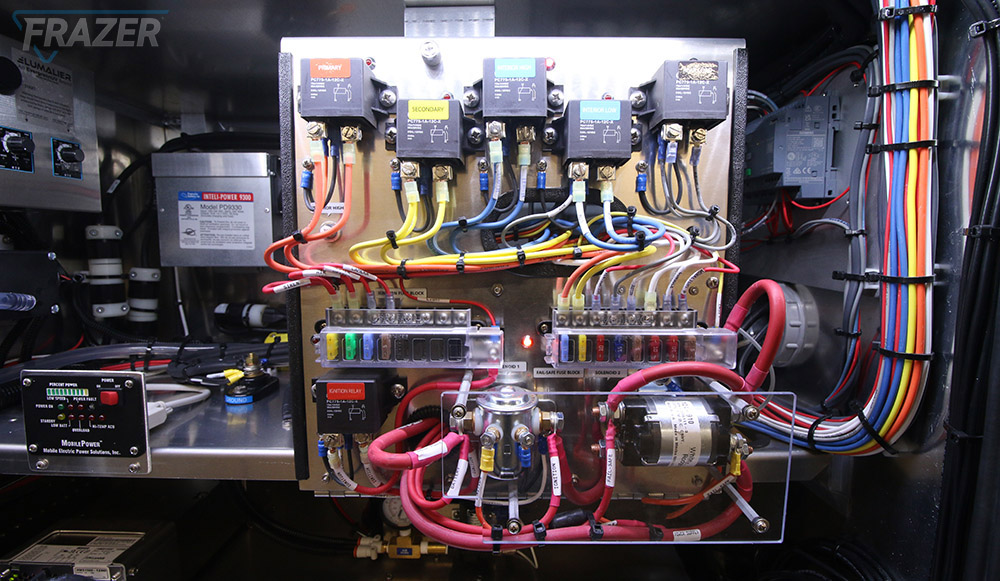
We follow the KISS Principle: Keep It Super Simple. Our electrical architecture uses point-to-point wiring, common terminal strips, standard automotive relays, and accessible fuses.
For qualified service technicians, that means working with components that are designed to be easier to locate, inspect, and repair. Depending on the issue, technicians may also be able to find compatible replacement parts through familiar automotive service channels.
Our goal is straightforward: Make service and maintenance more practical for the people responsible for keeping EMS vehicles on the road. Actual repair times and downtime will still depend on the problem, parts availability, vehicle use, and maintenance practices.
What Do Customers Say About Time in the Shop?
Customer feedback gives us another way to understand how manufacturers are perceived. In a 2020 double-blind market research study conducted by Smart Advantage, respondents were asked which brand spends the least amount of time in the shop.
Frazer received 39% of unprompted mentions. The nearest competing brands each received 7% of mentions, according to the study’s Survey Results Presentation 10-30-20.
It’s important to understand what those numbers represent. They reflect customer perceptions reported in that study, not measured downtime across every fleet. Actual maintenance experiences vary, but the findings offer useful insight into how respondents viewed Frazer’s serviceability.
How Much Does Support After the Sale Matter?
When your department invests in an EMS vehicle, you’re also starting a long-term relationship with the manufacturer. Questions about warranty coverage, service support, replacement parts, and future maintenance deserve just as much attention as the equipment specifications.
Customers recognize that importance, too. In the same 2020 Smart Advantage survey, support after the sale was rated the number-one most important attribute driving customer decisions when choosing an ambulance builder.
That finding lines up with how we approach the Frazer Family Experience. We want customers to know what they’re buying, understand the support available to them, and feel confident reaching out when they need help after delivery.
What Does Frazer’s Warranty Cover?
Frazer provides written warranty terms so customers can review the coverage and its conditions before purchasing. Under those provisions, Frazer, Ltd. warrants a new module against failure or malfunction caused by design, construction, or installation errors, defective workmanship, and missing or incorrect parts for the life of the module, provided it remains with the original owner and has not been repaired or modified by or on behalf of that owner.
Frazer also offers a five-year warranty on electrical system wiring. All warranty coverage is subject to the applicable written terms, conditions, and limitations.
If your purchase involves a Performance Bond, there’s another detail to review. Frazer’s warranty provisions include a one-year limitation on warranty claims in relation to the Performance Bond. Your purchasing team should review the applicable warranty documents, bond provisions, and contract terms to understand how they apply to your order.
We encourage departments to ask questions about warranty coverage before making a purchase. Knowing what’s covered, what’s excluded, and how service requests are handled can help you plan for the years ahead.
How Do You Decide Which EMS Vehicle Offers the Best Value?
There’s no single purchase price that tells you everything about an EMS vehicle’s value. The right decision depends on your department’s budget, operating needs, maintenance resources, and long-term fleet plans.
Start by comparing what’s included in each proposal. Then look at the costs that may come later, including maintenance, chassis replacement, remounting, and any additional equipment your crews need. It’s also worth asking how the manufacturer supports customers once the vehicle is in service.
Frazer’s Foundation Series gives departments a defined starting point at $252,000, with independent power, dedicated HVAC, a 96-inch-wide module, and a patient compartment designed for daily EMS work. Our wood-free aluminum construction, approach to serviceability, and support after the sale are additional factors to consider when evaluating long-term ownership.
The goal isn’t simply to find the lowest number on a bid sheet. It’s to understand what you’re getting for your money and choose a vehicle that makes sense for your department today and in the years ahead.
Let’s Talk About Your Next Fleet Purchase
If you’re comparing EMS vehicle options or preparing your next budget request, we’re here to help you work through the details. We can review the Foundation Series configuration, discuss your department’s needs, and help you understand which options may affect the final price.
Ready to explore the Frazer Foundation Series? Start a conversation with our team to confirm current pricing and availability, review standard equipment, and get answers to your questions before you make a decision.
What is included in the base price of a custom EMS vehicle?
What’s included in the base price depends on the manufacturer and vehicle configuration. Frazer’s Foundation Series starts at $252,000 and includes independent power, dedicated chassis-independent HVAC, nearly 50 inches of open aisle space, and a 96-inch-wide patient module as standard features. This gives departments a clear starting point for comparing equipment, reviewing options, and planning their purchase. Final pricing depends on the selected configuration and any additional equipment.