Fleet Planning Guide: Choosing a Type 1 Ambulance Manufacturer
If you manage an EMS fleet, you know vehicle replacement is rarely as simple as ordering a new unit when an old one wears out. Your department has to plan around available funding, purchasing rules, delivery schedules, and the vehicles needed to keep crews on the road. When frontline units approach or exceed 180,000 miles of urban service, maintenance needs may increase. At the same time, taking a vehicle out of service can put more pressure on your reserve fleet.
Now add the time it takes to prepare specifications, complete a bid process, and wait for a new vehicle. A custom purchasing cycle that takes nine months or longer can make an already difficult replacement schedule harder to manage. For municipal departments, those delays may also affect the Capital Improvement Plan (CIP) and the timing of future purchases.
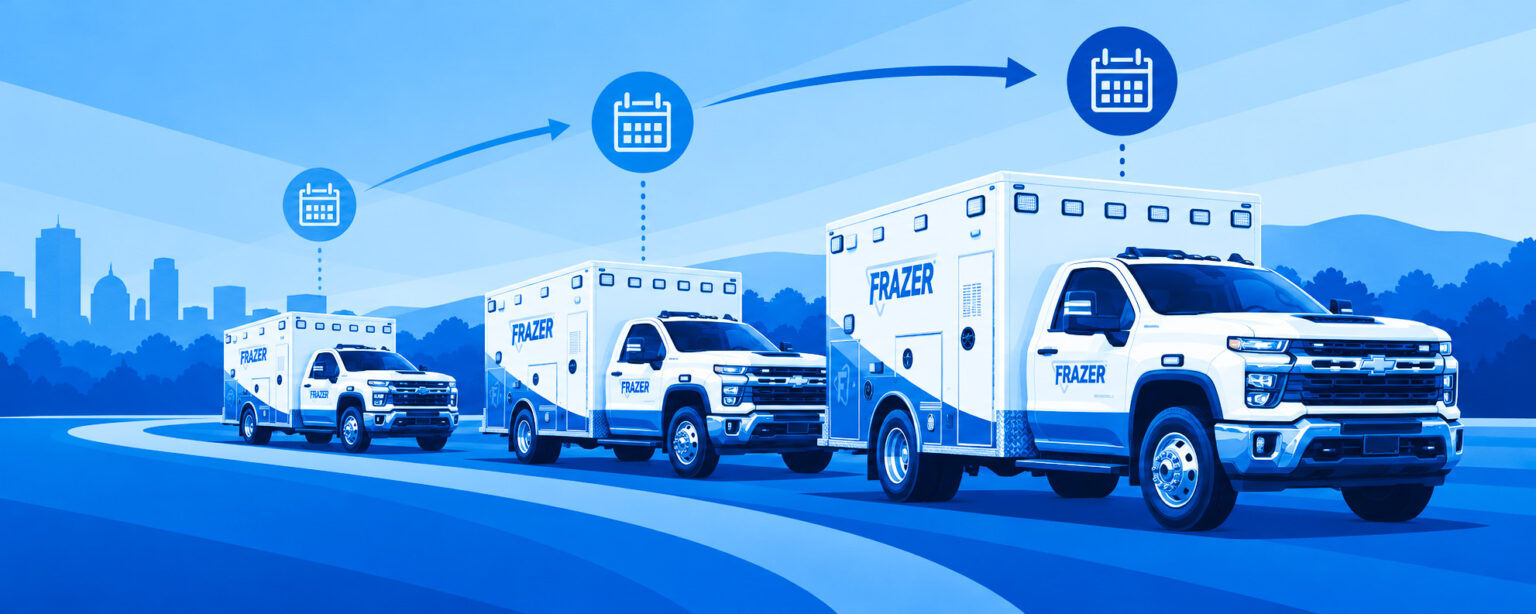
A multi-year fleet plan gives your department a chance to get ahead of those challenges. Instead of starting from scratch with every purchase, you can identify a vehicle configuration that meets your needs and use it as a starting point for future orders. That approach does not eliminate changes in chassis availability, pricing, or delivery schedules, but it can help your team make more informed decisions.
How Standardized Vehicle Specifications Can Help Control Procurement Costs
Every EMS department has its own needs, and custom vehicle specifications can help address them. The challenge comes when each replacement vehicle requires a new set of drawings, equipment decisions, and engineering reviews. Over time, those differences can make purchasing and maintenance more complicated than they need to be.
Standardizing your fleet does not mean giving up the features your crews need. It means identifying the equipment, layout, and systems that work well for your department, then using those decisions consistently whenever practical. That gives your purchasing team a more predictable starting point and helps your crews know what to expect from one vehicle to the next.
The Cost of Changing Specifications During Production
Custom orders may include different compartment sizes, wiring layouts, and console designs. Those changes can require additional engineering and production coordination. If your department adds equipment or changes a layout during a pre-construction review, the final price may also change, depending on the contract and the work involved.
For a municipal department, even a reasonable change can create extra work. An unexpected cost may require another budget review or approval from city leaders. Different vehicle configurations can also leave your maintenance team stocking more parts and learning more repair procedures. None of these issues makes customization a bad choice, but they are worth considering when you plan several purchases over multiple years.
What a $252,000 Starting MSRP Means for Your Budget
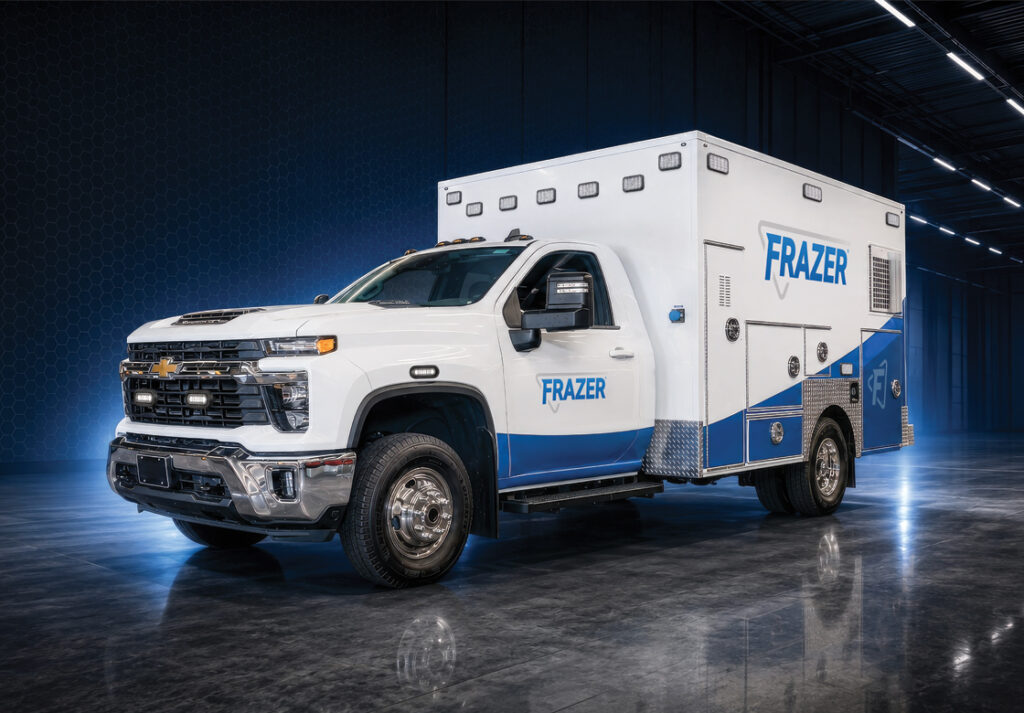
A defined starting configuration can make budget conversations more productive. Frazer’s Foundation Series 12-foot Type I platform starts at a base MSRP of $252,000. That gives your team a published starting point when estimating the cost of future fleet replacements.
The standard configuration includes independent 115VAC power and HVAC, Whelen CenCom Core controls, all-aluminum cabinetry, and wood-free subfloors. Because these features are part of the baseline platform, your team can spend more time identifying what else your department needs rather than rebuilding the entire specification for each order.
For example, a department planning to purchase several vehicles over the next two to four budget years can use the standard configuration to develop initial estimates and compare options. The final purchase price and delivery schedule will still depend on factors such as chassis availability, selected equipment, pricing changes, and purchasing terms. A starting MSRP is a planning tool, not a guarantee of future pricing.
What Are the Benefits of Using One Type I Platform Across Your Fleet?
When your vehicles share a common layout and service design, everyday work can become more consistent. Crews can move between units with fewer surprises, and technicians can become familiar with the parts and systems they maintain. Those benefits may be especially useful for departments that operate multiple stations or regularly move vehicles between frontline and reserve assignments.
Standardization can also support long-term planning. If your department knows which systems and components it intends to use, it may be easier to prepare maintenance procedures, plan parts inventory, and evaluate future vehicle purchases. The actual savings will depend on fleet size, equipment choices, and how your department maintains its vehicles.
A Familiar Layout for Crews at Every Station
Think about a medic who normally works at one station but is assigned to a reserve vehicle across town. If the controls, supplies, and equipment are in different locations, that medic has to spend time getting familiar with the layout. A consistent patient compartment can help reduce that adjustment.
Departments can establish common locations for switch panels, suction equipment, diagnostic tools, and airway supplies across similarly configured vehicles. This familiarity supports established workflows and helps crews focus on patient care rather than searching for equipment in an unfamiliar unit.
More Consistent Maintenance for Your Fleet Shop
Your maintenance team benefits from consistency, too. When vehicles use similar electrical layouts, body hardware, and service components, technicians can work from familiar schematics and procedures. Your parts inventory may also become easier to manage because more vehicles use the same replacement components.
For Emergency Vehicle Technicians (EVTs), that could mean stocking common latch assemblies, relays, and HVAC service parts instead of maintaining a different inventory for every vehicle. It may also make routine inspections and certain repairs more efficient. The benefit depends on how closely the vehicles are configured and what each repair requires.
Is a 12-Foot Type I Patient Compartment Large Enough?
One of the first questions departments may ask about a standardized 12-foot module is whether it offers enough room for patient care. That is a fair question, especially if your crews are used to working in a 14-foot body. The answer depends on more than the length of the vehicle. Interior width, cot placement, cabinet design, and seating all affect how much usable space providers have.
Frazer’s Foundation Series uses a 96-inch-wide module, with an exterior width of 96.25 inches, and a center-mounted cot. This layout provides nearly 50 inches of open center aisle space and is designed to allow access around the patient. As with any patient compartment, the usable space will depend on the equipment installed and how the vehicle is being used.
Why Cot Placement Matters as Much as Module Length
A longer module does not automatically mean a better working layout. When you compare vehicle designs, look at where providers stand, how they reach supplies, and whether they can move around the cot. Those details can matter more in daily use than the exterior body length alone.
The Foundation Series pairs its wide interior with a center-mounted cot to provide nearly 50 inches of open walking clearance. The layout is designed to give providers access near the patient’s head and along both sides of the cot for procedures such as airway management, chest compressions, and IV access. Your team should still review the actual configuration to make sure it supports your equipment and clinical procedures.
Four Caregiver Seats for Different Crew Needs
Some calls involve two providers, while others may include additional personnel, students, or specialty transport staff. The Foundation Series 12-foot layout includes four dedicated caregiver seating positions with adjustable seatbelts, giving departments flexibility for different crew arrangements.
Selected supplies and diagnostic tools are positioned within reach of belted seating locations to support access during transport. The 12-foot body may also offer maneuverability advantages compared with certain longer modules, particularly on tight streets or in residential areas. Actual maneuverability depends on the complete vehicle, including its chassis, wheelbase, weight, and equipment.
What Keeps Emergency Vehicles in the Repair Shop Longer?
When an emergency vehicle is out of service, the problem is not always the repair itself. Sometimes the delay comes from diagnosing the issue, locating a part, or getting the right technical support. Electrical complexity, chassis maintenance, parts availability, and access to service information can all affect how long a unit stays in the shop.
That is why serviceability matters when choosing a vehicle platform. Accessible electrical components and familiar diagnostic methods may help your technicians handle certain problems in-house. Independent power and cooling systems may also help departments manage some of the demands placed on the chassis engine during long periods of stationary operation.
Point-to-Point Wiring and the Value of Simple Diagnostics
Modern emergency vehicles use different approaches to electrical control. Some rely on multiplex systems with electronic modules and software-based controls. These systems can offer useful capabilities, but certain repairs may require specialized tools, software, or manufacturer support. What matters to your department is whether your technicians have the information and resources needed to maintain the system.
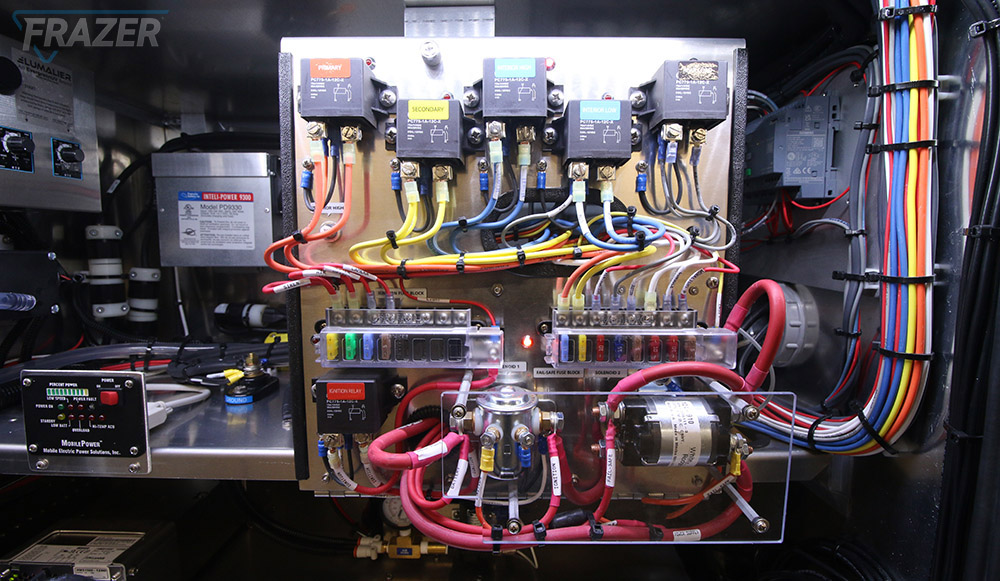
Frazer follows what it calls the KISS Principle: Keep It Super Simple. Its non-multiplexed, point-to-point wiring design uses individual color-coded circuits, conventional automotive relays, fuses, and accessible terminal strips. The goal is to make electrical systems easier to understand and troubleshoot using familiar shop tools.
For an in-house technician, that may mean using a test light or multimeter to trace a circuit rather than relying on specialized software for every diagnosis. In some cases, an EVT may be able to identify a failed component and replace it with a compatible, commonly available part. A standard automotive relay, for example, might cost around $15. That does not mean every electrical problem is a quick or inexpensive repair, but access to familiar components can give your maintenance team more options.
What EMS Departments Said About Time Spent in the Shop
Maintenance experience is also something fleet managers consider when evaluating different brands. In a double-blind study conducted by Smart Advantage, 100 EMS and fire departments were asked which brand they believed spent the least amount of time in the shop. The research reported a 90% confidence level.
Frazer received 39% of all mentions. Three other national brands included in the reported results each received 7%. These findings describe respondents’ perceptions, not independently measured repair times or guaranteed vehicle performance.
| Brand | Share of Mentions |
|---|---|
| Frazer | 39% |
| National Competitor A | 7% |
| National Competitor B | 7% |
| National Competitor C | 7% |
Source: Smart Advantage double-blind research involving 100 EMS and fire departments, with a reported 90% confidence level. The original research summary identified AEV, Horton, and Wheeled Coach as the three competitors, each receiving 7% of mentions. These figures reflect survey perceptions and do not establish actual repair times, fleet availability, or comparative product performance.
How Independent Power and HVAC Can Help Manage Engine Idling
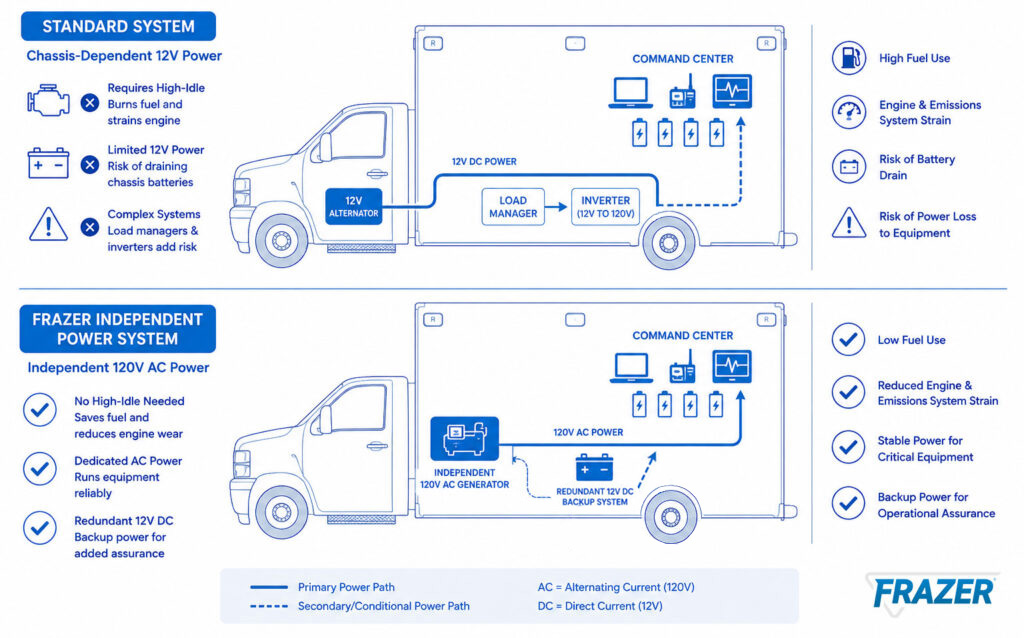
Emergency vehicles often spend long periods parked at scenes or waiting at hospitals. During that time, crews still need lighting, electrical power, and a comfortable patient compartment. Depending on the vehicle’s design, meeting those needs may require the chassis engine to keep running.
Extended idling can add engine hours and place demands on components such as alternators, belts, and diesel emissions equipment, including diesel particulate filters. The effect varies by chassis, operating conditions, and maintenance practices. For departments trying to manage those demands, an independent power system is worth considering.
Frazer offers auxiliary power options that include MEPS, Cummins Onan, and Harrison hPower systems. These systems are designed to supply patient compartment electrical power separately from the chassis engine. Frazer’s dedicated 15,000 BTU self-contained air conditioning system is also designed to operate independently of the chassis engine, with a stated 25°F to 30°F temperature differential under specified operating conditions.
Separating patient compartment power and cooling from the chassis engine may help reduce certain idling demands and associated wear. Actual results depend on the selected system, outside temperatures, how the vehicle is used, and how it is maintained. When evaluating this approach, ask how the system will perform during your department’s typical calls and weather conditions.
Can Remounting Help Lower the Overall Cost of Fleet Ownership?
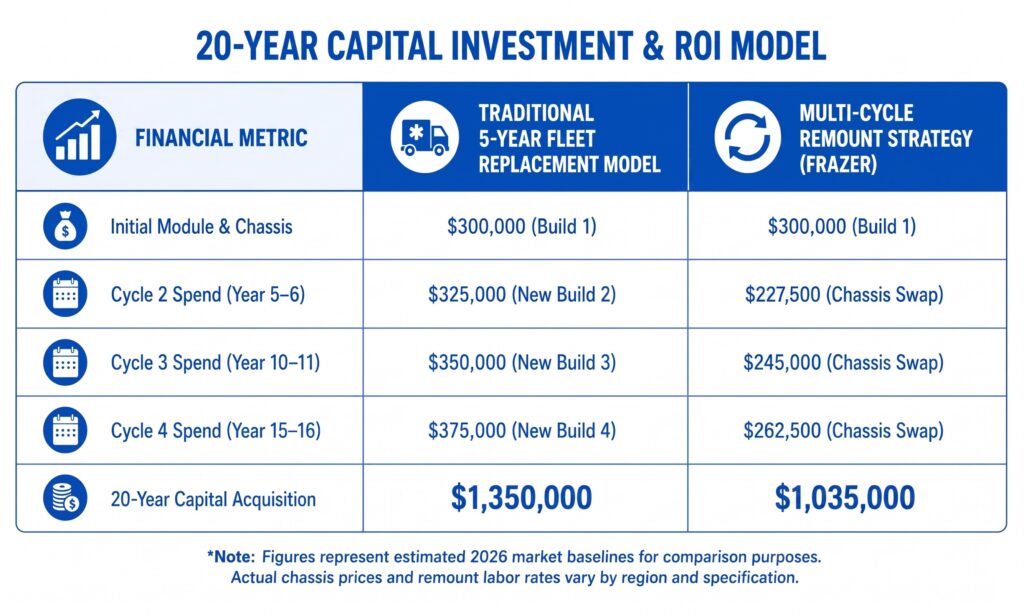
When you replace an emergency vehicle, you are making a decision about two major assets: the commercial truck chassis and the patient compartment. Those two parts do not always have the same useful service life. A chassis may reach your department’s mileage or maintenance threshold while the patient module remains in suitable condition for continued service.
Some municipal fleets consider replacement cycles of about five years, and vehicles approaching 180,000 to 200,000 miles may be reviewed for retirement. Those are not universal replacement rules. Actual decisions depend on mileage, maintenance costs, operating conditions, and department requirements.
Remounting gives departments another option to evaluate. Instead of replacing the complete vehicle, a suitable patient module may be transferred to a compatible new chassis. This can support a longer-term fleet plan when the module is in good condition and the cost of remounting makes sense. It is an option to evaluate, not an automatic recommendation for every vehicle.
Why Module Construction Matters for Long-Term Fleet Planning
Frazer’s approach to Lower Overall Cost of Ownership (LOCO) encourages departments to look beyond the initial purchase price. A vehicle’s long-term cost can include maintenance, downtime, chassis replacement, and the possibility of reusing a patient module. If you are planning fleet purchases over 15 to 20 years, it is worth considering how those costs may change over time.
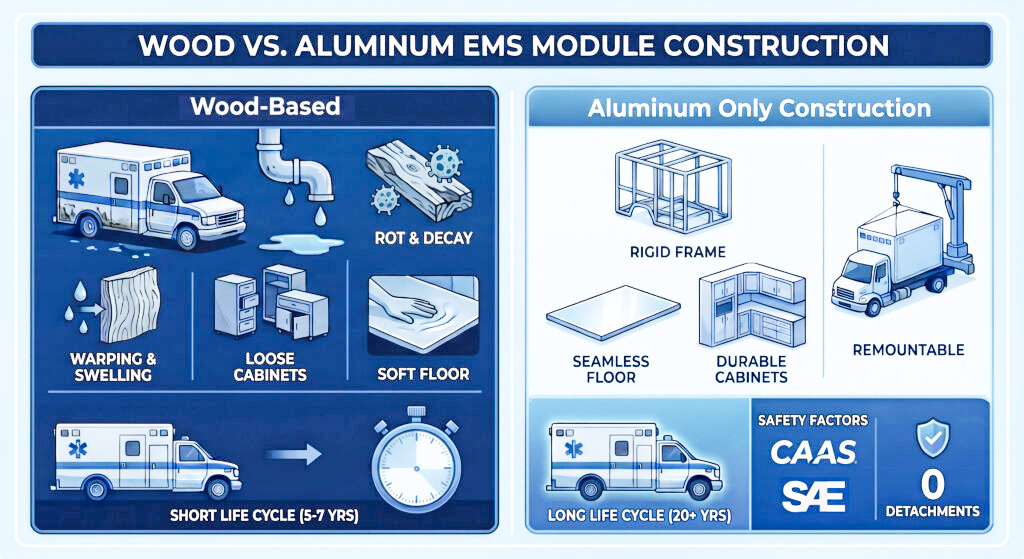
Frazer builds its patient modules using welded 6061-T6 structural aluminum and wood-free subfloor construction. These materials are selected to support the demands of emergency vehicle service and provide a durable structure that may be considered for future remounting. Whether a particular module can be reused depends on its maintenance history, structural condition, inspection results, and compatibility with the replacement chassis.
Planning for More Than One Chassis Lifecycle
When evaluating a vehicle for long-term service, it helps to think about the patient module and chassis separately. A commercial chassis may need to be replaced because of mileage, age, or increasing maintenance costs, while the patient compartment may still have useful life remaining. If the module is a suitable candidate for remounting, your department may be able to keep using an existing asset rather than purchasing an entirely new vehicle.
That possibility is especially important when building a 15-to-20-year fleet plan. Instead of assuming every replacement cycle requires a complete new vehicle, your team can compare the costs of a new build with the costs of inspecting, updating, and remounting an existing module. The right choice will depend on the module’s condition, the chassis available at the time, your department’s equipment needs, and the total cost of the work.
What to Evaluate Before Choosing a Remount
Not every patient module is a good candidate for remounting, and that is why an inspection matters. Before including remounting in your capital plan, review the module’s structural condition, maintenance history, electrical systems, cabinetry, and current clinical requirements. You will also need to confirm compatibility with a replacement chassis and identify any updates required to meet your department’s needs.
It’s also important to look at the complete project cost. Chassis pricing, module modifications, equipment updates, labor, and the time a vehicle is unavailable can all affect the decision. A remount should make sense for your operations and budget, not simply because the existing module can be reused. Frazer’s Lower Overall Cost of Ownership approach provides a useful starting point for thinking through these longer-term decisions.
Building a Fleet Replacement Plan You Can Actually Use
A good fleet plan should answer more than how many vehicles your department needs next year. It should help you understand when vehicles are likely to need replacement, what those purchases may cost, and how your department will maintain coverage while new units are being built or existing ones are being serviced.
Start by reviewing your current fleet’s age, mileage, maintenance history, and expected replacement dates. Then identify the equipment and layout requirements your department wants to keep consistent. With that information, you can begin comparing a standardized vehicle platform against your current purchasing process and decide whether future remounting should be part of the plan.
As you develop the budget, make room for variables you cannot fully control. Commercial chassis availability, equipment costs, purchasing requirements, and production schedules can change. Working with your vehicle upfitter early gives you an opportunity to discuss those factors before they become urgent problems.
Questions Worth Asking Before Your Next Fleet Purchase
Whether you are replacing one unit or planning several years of purchases, ask your vehicle upfitter how pricing is established, which features are included in the base configuration, and what may affect the final cost. Discuss current chassis availability and the steps involved in moving from an approved specification to production. These conversations can help your purchasing team build a more realistic schedule and budget.
It is just as important to ask about life after delivery. Find out how electrical systems are diagnosed, what service information your technicians will receive, and what support is available when your department needs help. If remounting is part of your long-term strategy, ask how the module is constructed and what determines whether it can be transferred to another chassis in the future.
The Bottom Line: Plan for the Full Life of Your Fleet
Multi-year fleet planning is about making better decisions before a vehicle reaches the end of its service life. A consistent Type I platform can help your department simplify specifications, improve familiarity across the fleet, and give maintenance teams a more predictable set of systems to support. Independent power, accessible electrical components, and the potential for module remounting are additional factors worth evaluating as part of the total ownership picture.
There is no single replacement schedule or vehicle configuration that works for every EMS department. Your call volume, operating environment, budget, and crew requirements should guide the decision. The goal is to build a practical plan that keeps your department prepared, supports the people maintaining your vehicles, and helps your crews stay focused on serving patients.
Ready to Talk About Your Next Fleet Replacement?
Whether you are preparing next year’s capital budget or looking several replacement cycles ahead, Frazer can help you explore your options. Our team can walk you through the Foundation Series, discuss standard configurations and available options, and help you understand the factors that may affect pricing and delivery. We can also talk through how independent power systems, serviceability, and potential future remounting fit into your department’s plans.
Our commitment doesn’t stop when your vehicle is delivered. Service after the sale is an important part of the Frazer Family Experience, and we want your team to have the support it needs throughout ownership. If you have questions about your next Type I emergency vehicle, we’re ready to have that conversation.
Let’s start with your fleet’s needs. Explore the Foundation Series and connect with the Frazer team to discuss your next vehicle purchase, upcoming replacement schedule, or long-term fleet strategy.
How does standardizing on a single Type I vehicle platform improve municipal fleet rotations?
Standardizing on a Type I vehicle platform can make fleet planning, maintenance, and daily operations more consistent. When vehicles share similar layouts, crews can find equipment and controls more easily as they move between stations or reserve units. Maintenance teams also benefit from familiar electrical systems, service procedures, and replacement parts. Using a repeatable configuration can help departments plan future purchases, manage inventory, and reduce the need to develop new specifications for every vehicle. Actual cost and maintenance benefits depend on fleet size, vehicle configuration, and operating conditions.