
Battling Coastal Corrosion: The Financial Case for All-Aluminum EMS Modules
Coastal Fire Chiefs and Fleet Managers know what salt air and moisture can do to emergency vehicles. Corrosion, electrical problems, added maintenance, and unexpected downtime can put pressure on a fleet and its budget.
When vehicles need to stay in service longer, the way an EMS module is built matters. Construction materials, electrical design, serviceability, and the ability to remount a module can all affect long-term cost. Looking beyond the purchase price can help departments make a more informed fleet decision.
Here is what coastal fleets should consider when comparing long-term capital and operating costs.
Do aluminum EMS modules last longer in coastal environments?
All-aluminum, wood-free EMS modules can offer practical advantages in areas where salt, moisture, and humidity are part of daily operations. When a module remains in good condition after the chassis reaches the end of its service life, remounting can give a fleet the option to keep using that module on a replacement chassis.
The purchase price of an EMS vehicle is only one part of its cost. Fleet leaders also have to consider maintenance, repairs, downtime, replacement schedules, and how often the entire vehicle may need to be replaced.
Frazer builds its modules with an all-aluminum, wood-free structure. That construction is designed for long-term use and gives customers another option when planning future chassis replacements. Instead of assuming the module and chassis must always be replaced together, a fleet can evaluate whether the existing Frazer module is a good candidate for remounting.
That matters when you are planning several budget cycles ahead. A module that can remain in service through more than one chassis can help a department get more use from its original capital investment.
How does coastal humidity affect an EMS module?
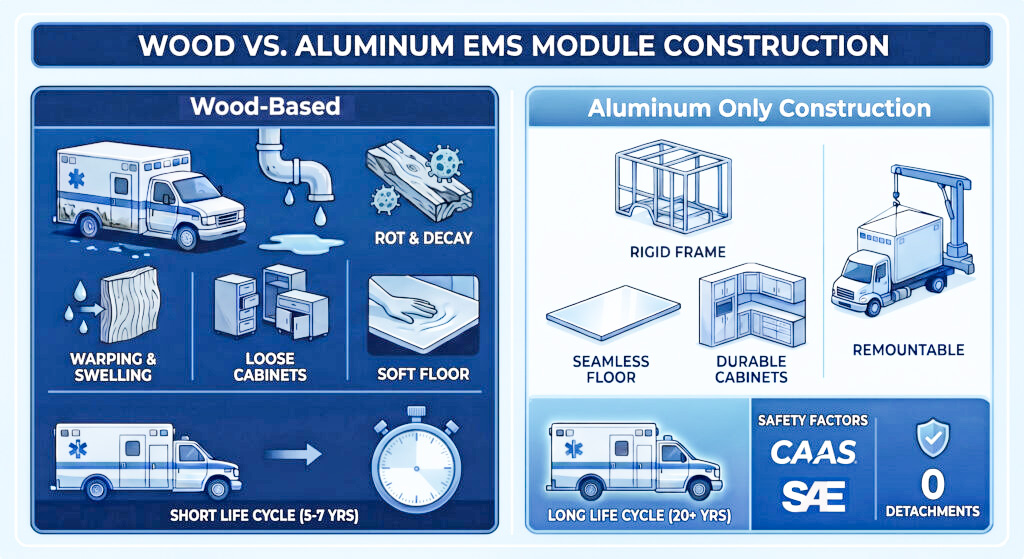
Corrosion on the outside of a vehicle is easy to see. Moisture inside a vehicle body can be harder to spot. Over time, repeated exposure to high humidity can affect moisture-sensitive materials, including wood.
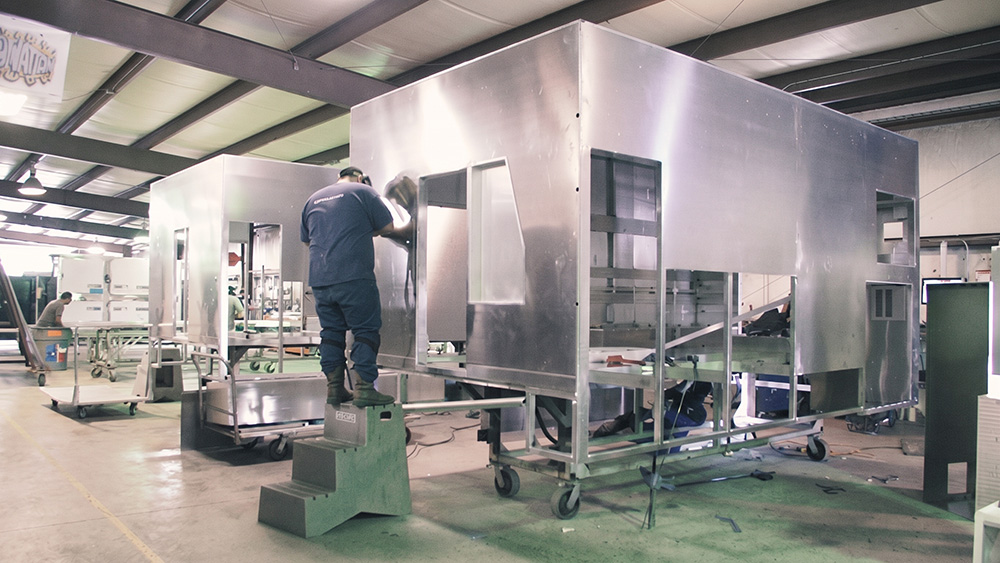
Frazer removes that concern from the module structure by using wood-free construction with 6061 T-6 structural aluminum tubing. Instead of relying on wood as part of the module structure, the patient compartment is built around an aluminum framework designed for demanding operating environments.
For a coastal fleet, the benefit is simple: wood rot is not a structural concern when there is no wood in the structure. That does not make any vehicle immune to the effects of salt, water, or poor maintenance, but it removes one moisture-sensitive material from the equation.
Long-term durability also depends on how the unit is operated, inspected, cleaned, and maintained (especially when prioritizing hurricane readiness and severe weather preparation). Construction is one part of that picture, but it is an important one when a department plans to keep equipment in service for many years.
How does salt air affect EMS vehicle electrical systems?
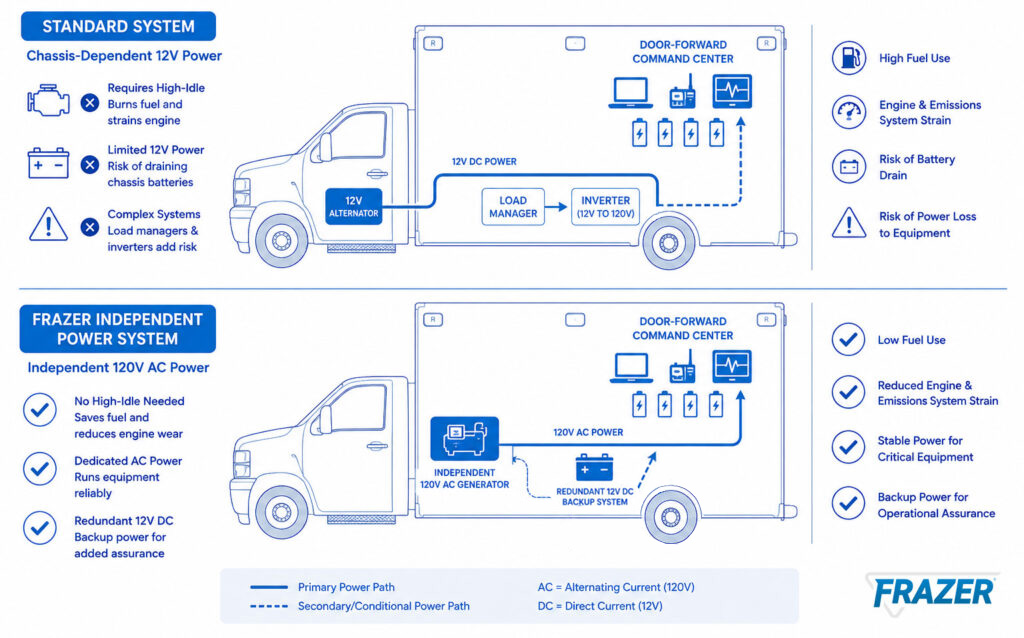
Salt and moisture can contribute to corrosion at grounds, connectors, and other electrical components. Frazer’s independent power approach separates important patient-compartment functions from much of the chassis electrical system, giving fleets another layer of flexibility when electrical problems occur.
For Mechanics and Fleet Managers, electrical problems can take time to diagnose. Coastal conditions can make that job harder because salt and moisture may contribute to corrosion in connections and other electrical components.
Frazer offers independent power systems for the patient compartment instead of depending entirely on the chassis electrical system. With the generator-powered configuration, a 120V AC generator supplies primary module power and a 12V DC system provides backup support.
This separation gives the patient compartment its own power source for key functions such as lighting and climate control. The exact capabilities available during a chassis electrical issue depend on the problem and the vehicle’s configuration, but the goal is to reduce unnecessary dependence on the chassis for module power.
Frazer also uses a service-friendly electrical approach built around point-to-point wiring and commonly available relays, fuses, and terminal strips. For fleet technicians, that can make many components easier to identify, test, and replace without relying on specialized proprietary equipment.
That simplicity matters when a vehicle is out of service. The easier a problem is to understand and repair, the sooner a fleet may be able to get that unit back to work.
Can you remount an EMS module if the chassis rusts out?
In many cases, yes. If a Frazer module remains structurally sound and is a suitable candidate for remounting, it can be removed from an aging chassis and installed on a compatible replacement chassis.
That can be especially valuable for coastal departments. Chassis components may face years of exposure to salt, standing water, road spray, and humid conditions. The chassis may eventually reach the end of its useful service life while the module still has years of service left.
Frazer’s aluminum, wood-free construction is designed with long-term module use in mind. When the time comes to replace the truck underneath it, the department can have the module evaluated for continued service rather than automatically replacing the complete vehicle.
Remounting gives fleet leaders another capital-planning option. Keeping a serviceable module and pairing it with a replacement chassis may help spread the original module investment across more than one chassis lifecycle.
Not every module or chassis combination will be a candidate for remounting. Condition, compatibility, configuration, regulatory requirements, and the scope of work all need to be evaluated before a project moves forward. Frazer’s team can help customers understand those factors and determine the right path for their fleet.
How should coastal fleets calculate long-term cost of ownership?
Purchase price matters, but it does not tell you what a vehicle will cost to own. A better long-term comparison looks at the full picture: routine maintenance, repairs, downtime, chassis replacement, module replacement, power-system service, parts availability, and remount opportunities.
This is especially important in coastal environments, where salt and moisture can add another layer of wear. As outlined in our guide to EMS fleet procurement for extreme weather reliability, a lower purchase price today does not automatically mean a lower fleet cost over the next 10 or 20 years.
Frazer’s approach is built around long-term serviceability. All-aluminum, wood-free construction supports module longevity. Independent power reduces dependence on the chassis for patient-compartment power. Straightforward electrical systems can make maintenance easier to understand. Remounting can give fleets another option when a chassis is ready for replacement.
There is also the support behind the vehicle. Frazer’s relationship with customers continues after delivery through parts, service, warranty assistance, technical support, and remount planning. For a department thinking in terms of total cost of ownership, that ongoing support deserves a place in the calculation too.
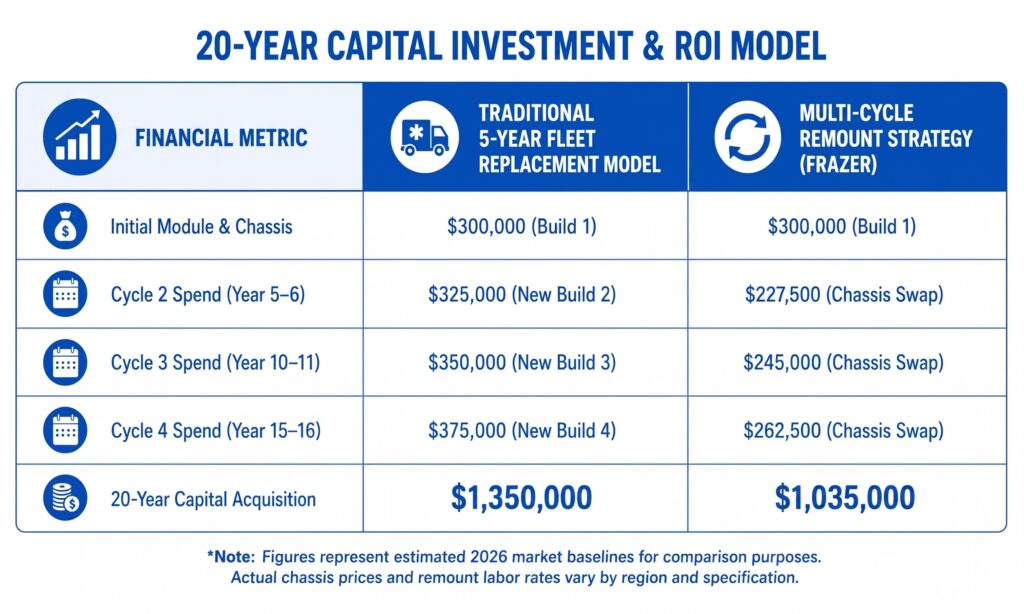
The right question is not simply, “What does this vehicle cost today?” It is, “What will it take to keep this fleet ready for the years ahead?” Asking that question gives Chiefs, Fleet Managers, and budget teams a much better foundation for comparing their options.
Ready to take a closer look at your department’s long-term fleet plan? Download our Buyer’s Guide to learn more about how Frazer’s engineering supports long-term fleet use, or contact our team to discuss EMS vehicle remounting for your current fleet.
Do aluminum ambulances last longer in coastal environments?
Yes, all-aluminum, wood-free EMS modules are highly resistant to ambulance corrosion and coastal humidity. Engineered to outlast the underlying truck, these modules can often survive multiple chassis life cycles, typically enabling cost-saving remounts over a 10-to-20-year lifespan and significantly lowering the lowest overall cost of ownership.