
Meeting California’s Complex EMS Demands: A Guide to Fleet Longevity, Infection Control, and Proactive Design
For California fire chiefs, EMS directors, and fleet managers, keeping frontline emergency vehicles ready for service can be a challenge. Long hospital offload delays, extreme summer heat, high engine idle time, and regional clean-air requirements can all put added strain on equipment. Consistent California EMS care depends on vehicles designed with those real-world conditions in mind.
Frontline diesel chassis may spend hours idling outside emergency departments to support climate control, lighting, and electrical equipment. Over time, that can add engine hours, increase wear, place added demand on batteries and alternators, and contribute to exhaust aftertreatment issues. Crews may also face high call volumes, biological contamination, extreme temperatures, and limited airflow inside the patient compartment.
California agencies also manage Ambulance Patient Offload Time (APOT) requirements, local anti-idling rules, and expanding community healthcare programs supported by initiatives such as CalAIM. These demands give purchasing teams another reason to think beyond initial purchase price. Structure, sanitation, climate control, power, serviceability, and remount potential all play a role in long-term fleet performance.
1. The Operational Pressures Facing California EMS Fleets
California emergency fleets operate in a wide range of environments. One department may respond through crowded city streets, steep mountain roads, and coastal areas exposed to salt air. Each setting creates different demands on the chassis, module, electrical system, and climate-control equipment.
Summer conditions can be especially tough. In the Central Valley, Inland Empire, and high desert, pavement temperatures can climb well above 100°F. When a unit sits outside an emergency department during a long offload delay, radiant heat from the road can raise the load on the climate-control system. Systems that depend on the chassis engine for patient-compartment cooling may require the engine to remain running during that wait.
That stationary operation can add wear. High idle adds engine hours even when the vehicle is not moving, while modern clean-diesel systems still depend on the right operating conditions to manage exhaust particulates. Long periods of low-load idling may make passive regeneration more difficult and can contribute to soot buildup or exhaust-filter loading.
A more integrated vehicle design can help agencies manage these concerns together. Independent auxiliary power, stable climate control, durable construction, and easy-to-clean interior materials can support uptime while giving fleet teams simpler systems to maintain.
2. Infection Control Starts Below the Surface
In busy EMS systems, crews regularly work in difficult sanitary conditions. Disinfectants and cleaning procedures matter, but infection-control planning should also consider what is underneath the finished surfaces of the patient compartment.
Modules built with plywood, particleboard, or other organic substrates may face added maintenance concerns if moisture or contaminants reach seams, penetrations, or damaged surfaces. Over time, absorbed moisture can contribute to swelling, softening, delamination, odor, and cleaning challenges.
What does that mean in the field?
Frazer modules use no wood, composite pressboard, or plywood in the module structure. The frame is built from welded structural aluminum tubing, exterior panels use aluminum, and interior areas use non-porous materials such as stainless steel. This construction is designed to reduce the opportunity for spilled fluids, moisture, and cleaning chemicals to soak into structural wood substrates.
For crews and fleet teams, that can make routine cleaning and long-term sanitation simpler. Wood-free construction also avoids concerns tied directly to moisture-damaged plywood subfloors or wood-based cabinetry attachment points.
These inorganic surfaces provide a durable foundation for routine cleaning and may be paired with additional decontamination tools, including the Sentinel Vehicle Disinfection System and ultraviolet light packages.
For a closer look at inorganic materials and sanitation durability, read Wood-Free EMS Modules: Why Materials Matter for Cleaning, Durability, and Long-Term Fleet Costs.
3. Air Quality and Thermal Management During Urban Staging
Air quality affects crew comfort and the patient-care environment. In heavy traffic, vehicles may be surrounded by exhaust, dust, heat, and strong odors. Inside an enclosed patient module, airflow and ventilation capacity become an important part of keeping that environment comfortable and manageable.
In independent double-blind market research conducted by Smart Advantage, Inc. with 100 verified municipal and private EMS leaders, 76% identified HVAC and air filtration as a safety feature that influenced vehicle selection. That ranked ahead of crash-test results at 70% and seat positioning at 66%.
Frazer addresses this need with a self-contained HVAC system built for the patient module. The module climate system operates separately from the OEM cab climate system, helping keep patient-compartment airflow separate from the driver’s cabin.
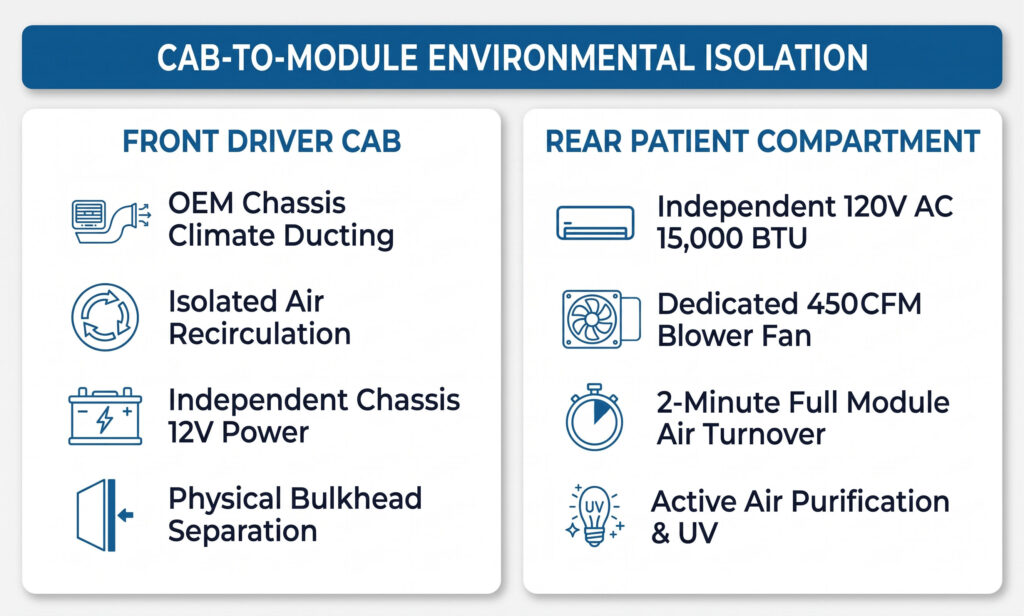
Because the module HVAC system does not share ductwork with the cab, airflow remains separated between the two spaces. That design may help reduce cross-circulation of airborne particles, odors, and chemical vapors between the patient compartment and driver area.
The patient compartment uses a 450 Cubic Foot per Minute (CFM) blower designed to circulate the module air approximately every two minutes. Powered by an independent 120V source, the system is designed to maintain up to a 35°F difference from outside temperature. At 105°F outside, that capacity is intended to support a patient-compartment temperature near 70°F without using the truck drivetrain as the primary source of module HVAC power.
For more detail on ventilation and filtration, visit Clearing the Air: How High-Capacity HVAC Protects Crews on Challenging Calls.
4. Taking Healthcare Into the Community
California fire and EMS systems often serve vulnerable populations, people experiencing homelessness, and patients dealing with behavioral health or chronic medical needs. When every concern depends on a traditional 911 response and emergency-department transport, the system can face additional pressure and longer hospital wall times.
Healthcare systems and public health agencies are increasingly using mobile healthcare units to bring care directly into communities. Programs supported by California’s CalAIM initiative may use mobile platforms for preventive care, wound management, harm-reduction services, chronic disease screening, and other field-based healthcare services.
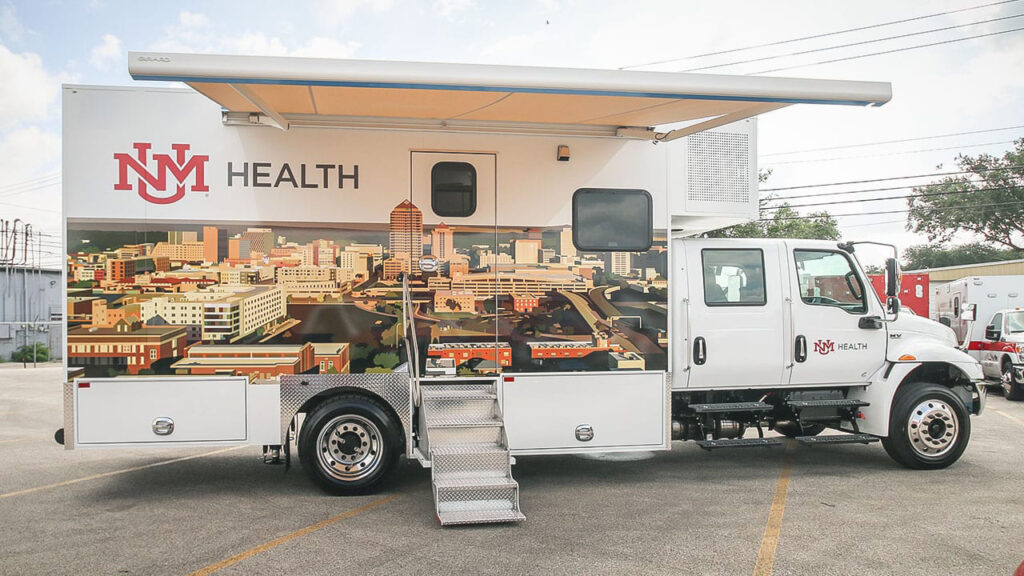
Commercial van conversions can work well in some settings, but extended mobile-clinic use may call for more interior workspace, privacy, or electrical capacity. Depending on configuration, a van platform may limit aisle width, exam space, or the ability to support continuous stationary electrical loads.
Frazer’s purpose-built 18-foot Mobile Clinic platforms are designed for extended field use. Built on heavy-duty truck chassis, they can be configured with wide center aisles, private consultation areas, and dedicated exam spaces to support patient comfort and privacy.
Independent onboard 120V auxiliary power can support stationary operation of equipment such as vaccine refrigeration, point-of-care analyzers, diagnostic monitors, telemedicine equipment, and other clinical tools. That allows the module to operate without depending on continuous chassis-engine operation for primary module power.
Learn more about specialized mobile healthcare platforms at Beyond the ER: Mobile Clinics and the Frontline of California’s Healthcare Crises.
5. Structural Durability Across California’s Varied Geography
California emergency vehicles can face repeated stress from potholes, elevation changes, coastal conditions, rough road surfaces, and tight city maneuvers. Over time, those forces can place vibration and twisting loads on the module structure.
Frazer addresses these conditions with a welded, all-aluminum module structure designed for long service life. The base frame uses 3″ x 1.5″ x 3/16″ 6061-T6 structural aluminum tube and channel. Sidewalls use 1.5″ x 1.5″ x 1/8″ 6061-T6 tubing with .250″ and .375″ gusset plates at key stress points, while the roof perimeter uses a 2″ x 2.5″ x 1/8″ structural framework welded to the walls.
Corner posts are built by welding two heavy tubes together to create a minimum 3″ x 1.5″ laminated post. Exterior .080″ 5052-H32 aluminum skins are bonded to the structure with full-contact 3M Very High Bond (VHB) tape. This approach is designed to help manage road vibration, thermal expansion, weather exposure, and material distortion.
What makes a module suitable for multiple remounts?
Long-term remount potential starts with a structure that can be inspected and reused when its condition supports doing so. Frazer’s welded 6061-T6 aluminum construction avoids the wood rot and moisture-related warping associated with organic structural substrates. Customer fleets have operated remounted Frazer modules across multiple chassis lifecycles, with documented examples exceeding 20 years and 1 million miles.
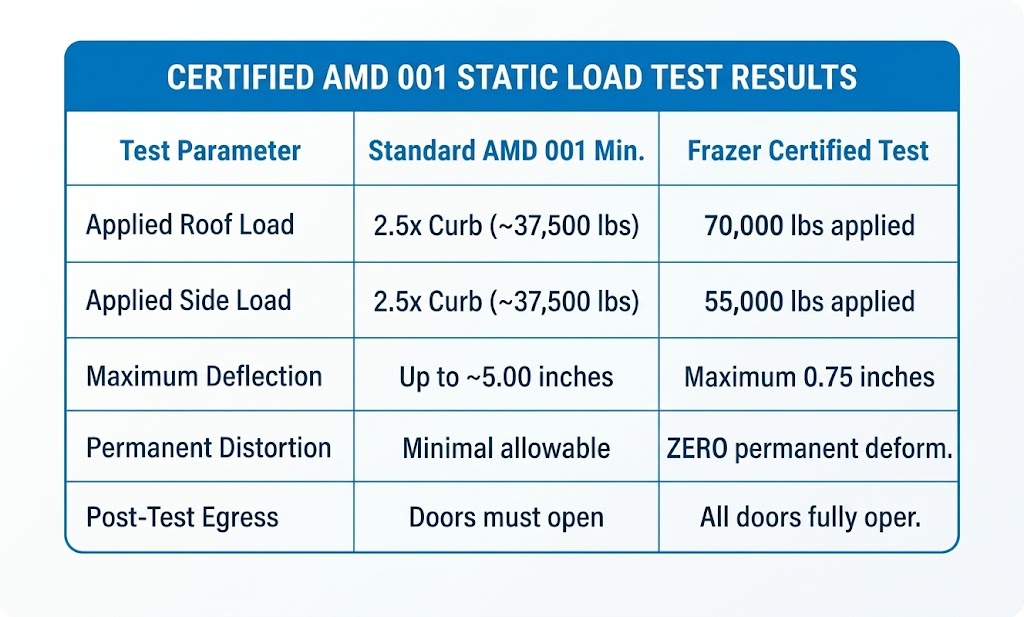
Third-party testing adds more context to the module’s structural performance. During certified Ambulance Manufacturers Division (AMD 001) static load testing under KKK-A-1822F requirements, the Frazer module was subjected to 70,000 pounds on the roof and 55,000 pounds on the sidewalls. The roof deflected three-quarters of an inch under load, returned to its original shape after the load was removed, and showed no permanent deformation. All module doors remained operational after testing.
Frazer company records covering approximately 4,500 EMS modules built since 1984 show zero recorded module detachments from the chassis during a collision. Those records include head-on crashes, side impacts, and rollovers. For coastal fleets, the aluminum framing and exterior skins also provide corrosion-resistant material properties that can help in salt-air environments.
6. Reducing Dependence on Chassis Idling
For fleet managers and mechanics, long periods of stationary engine idling can add operating and maintenance costs. A unit sitting outside an emergency department for hours may continue adding engine time even though it is not adding road miles.
Low-load idling can also make it harder for some modern diesel exhaust systems to reach the operating conditions needed for normal aftertreatment. Depending on the chassis and duty cycle, that may contribute to soot buildup, DEF-related issues, warning conditions, additional service, or forced regeneration.
Frazer’s approach separates primary patient-module electrical demand from the truck chassis. A dedicated auxiliary power system can operate the module HVAC and other electrical equipment, reducing the need to use the chassis engine as the primary power source during stationary operation.
How can independent auxiliary power help control maintenance costs?
Independent auxiliary power separates patient-module climate and electrical loads from the truck drivetrain. During extended stationary operation, this can reduce chassis engine hours associated with powering the module and may help reduce some of the operating conditions that contribute to diesel particulate filter soot buildup. Customers have reported fleet maintenance reductions ranging from 42% to 60%.
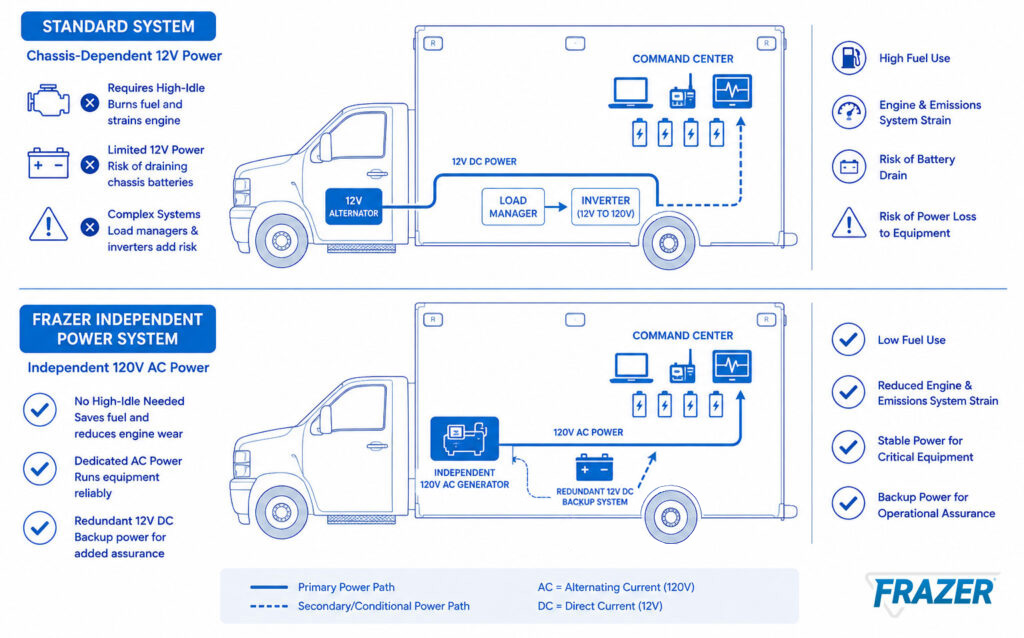
With the auxiliary system powering the 15,000 BTU patient-module climate system, medical outlets, and scene lighting, crews may be able to turn off the truck’s diesel engine during extended hospital staging when conditions and department procedures allow. Victorville Fire Department, operating in California’s high-desert climate, uses this architecture to support patient-compartment cooling and diagnostic equipment while reducing reliance on chassis idling for module power. A 12V chassis electrical path remains available for designated backup functions if the main auxiliary source stops operating.
Supporting OEM chassis systems and simpler diagnostics
Separating major module loads from the truck alternator can help reduce accessory demand on the OEM chassis electrical system. Chassis and component warranty coverage remains subject to the applicable manufacturer’s terms, vehicle configuration, use, maintenance, and service conditions.
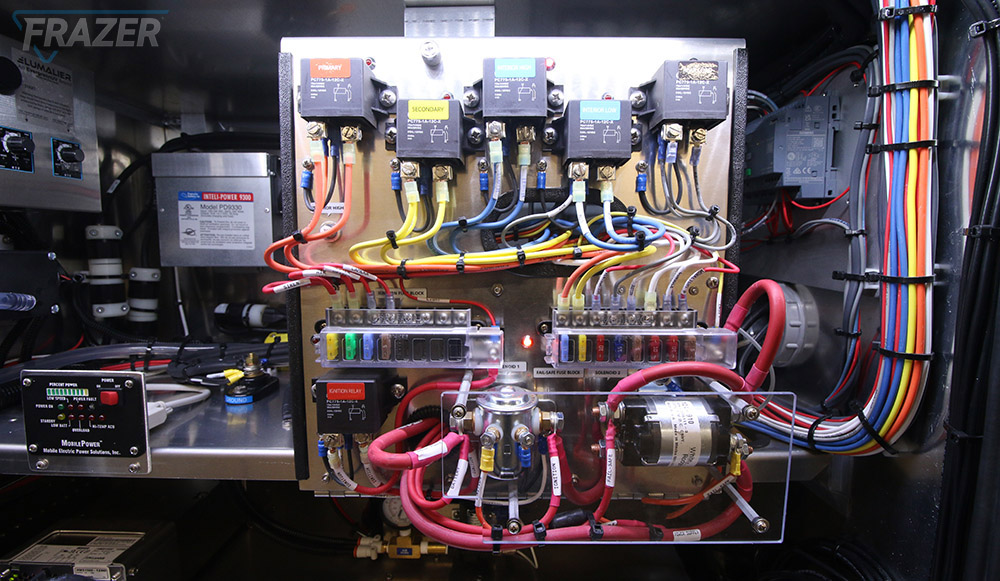
Frazer also uses point-to-point wiring in the module rather than proprietary multiplex circuit boards. This setup gives fleet technicians familiar circuits and service components to work with when diagnosing many routine electrical issues.
Why use point-to-point wiring?
Point-to-point wiring uses standard color-coded wires, commercial relays, fuses, and terminal strips rather than relying on printed multiplex circuit boards for normal circuit control. This design is intended to help in-house fleet technicians diagnose many routine electrical issues with a standard digital multimeter and commonly available service parts.
Frazer’s electrical components are housed in an accessible exterior compartment. Wires are color-coded and labeled, while status-monitoring diodes provide visual information that can help technicians narrow down a fault. For applicable repairs, technicians can test circuits and replace serviceable commercial components without proprietary module diagnostic software.
Shore power and future platform options
Frazer units include standard 30-amp shore-power receptacles for station readiness. When connected to a compatible shore-power source, the 120V HVAC system and onboard battery chargers can operate from station power. This can keep the module conditioned and support onboard equipment without using the chassis engine for module power.
Frazer is also developing additional low-emission platform options. In March 2026, Frazer announced a development partnership with Harbinger to integrate purpose-built mobile healthcare modules with medium-duty electric and plug-in hybrid commercial chassis. The effort is intended to give fleets another option as they evaluate emissions goals, range, duty cycles, and clinical power requirements.
7. Lifecycle Planning, LOCO, and Remount Economics
For a municipal fleet, purchase price is only one part of the cost of keeping a frontline unit in service. Fuel, repair work, downtime, maintenance, remount opportunities, and replacement schedules can all affect the total cost over the life of the vehicle.
Frazer considers these factors through its Lowest Overall Cost of Ownership (LOCO) approach. The goal is to look beyond the initial transaction and consider how equipment design, serviceability, auxiliary power, and remount potential may affect fleet costs over time.
The financial role of multi-chassis remounting
Any module can experience wear over time, and its condition will depend on construction, environment, duty cycle, maintenance, and inspection findings. Organic subfloors or composite materials may also face moisture-related deterioration if water reaches the substrate.
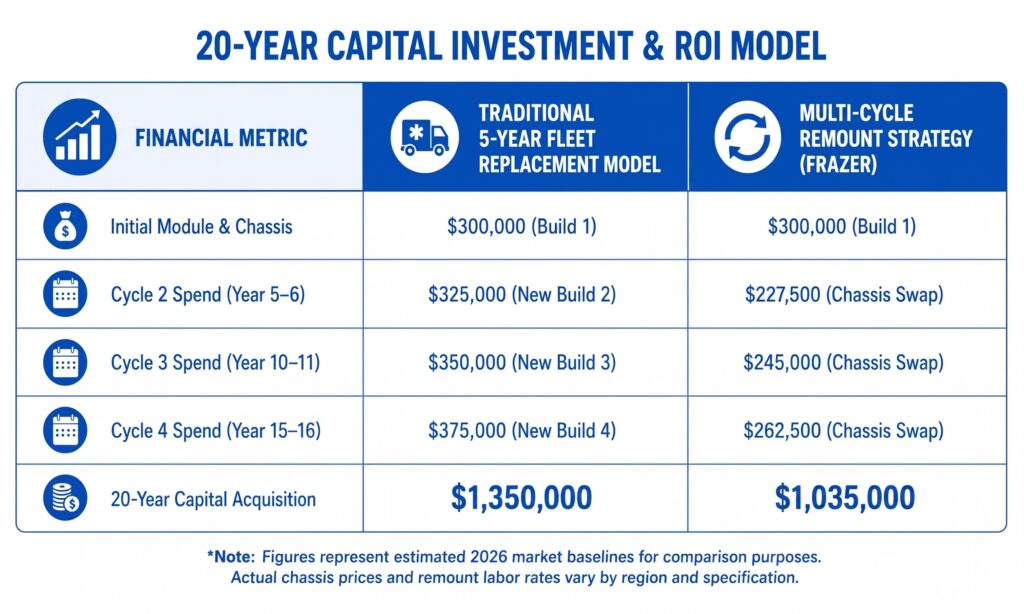
Frazer modules are built from structural 6061-T6 aluminum tubing and heavy-gauge aluminum with remounting in mind. When the chassis reaches its planned replacement point, an eligible Frazer module can be inspected, updated, and remounted to a compatible chassis instead of automatically replacing the entire vehicle.
Customer fleets have documented Frazer modules serving through two, three, and even four chassis lifecycles, including examples operating beyond 20 years and 1 million total road miles. Depending on chassis choice and equipment, agencies using eligible remounts have reported capital savings in the range of 30% to 50% compared with purchasing an entirely new unit.
Reducing time in the shop
Unplanned downtime affects more than the maintenance budget. When a frontline unit is unavailable, agencies may need to rely on reserve vehicles, change deployment plans, or adjust staffing and coverage.
In the independent double-blind Smart Advantage survey, verified fleet operators were asked which emergency vehicle brand spends the least amount of time in the shop. Frazer was identified by 39% of respondents, while the nearest competitor received 7% of mentions.
Frazer designs key systems with service access in mind. The side-mounted self-contained HVAC assembly can be removed and replaced in under one hour, while certain critical modular assemblies are designed for service or replacement in under two hours. Many maintenance components can also be reached through exterior access points, helping technicians work without entering or disassembling large portions of the patient compartment.
Customers have reported overall fleet maintenance cost reductions ranging from 42% to 60% after transitioning to Frazer fleets. Actual results will vary by fleet size, duty cycle, maintenance practices, chassis, configuration, and operating environment.
Cooperative purchasing for California agencies
California municipal fire departments, EMS agencies, and health districts may be able to purchase Frazer units through cooperative contracts, including Sourcewell and HGACBuy. Each agency should confirm that the available contract and purchasing process meet its own legal, policy, and procurement requirements.
For eligible agencies, cooperative purchasing may simplify procurement compared with creating a separate local solicitation. Pricing, contract terms, and timelines depend on the specific cooperative agreement and the agency’s requirements.
8. Building a Long-Term Fleet Partnership
Choosing a mobile healthcare vehicle upfitter starts a relationship that can continue long after delivery. For California fleets operating far from Houston, access to technical help, training, parts, and warranty support can be just as important as the original configuration.
Frazer’s post-sale support model is built around direct access to the people who know the product. Fleet mechanics can reach factory technical support around the clock, and many system or electrical concerns may be diagnosed remotely depending on the issue. Frazer also offers hands-on generator, electrical, and HVAC training for municipal mechanics and emergency vehicle technicians so local teams can become more familiar with routine service procedures.
Many maintenance items use non-proprietary, commercial-grade parts that may be available through local distributors or directly from Frazer. Availability and shipping time vary by component and destination, but the goal is simple: help customers get the right part and get their unit back in service.
Plan Your Agency’s Next Apparatus Cycle
Whether your department is navigating extended hospital offload delays, updating capital improvement plans, or expanding street medicine outreach, Frazer’s team can help you build an apparatus fleet tailored to your service area.
Connect with a Frazer Account Executive to review California customer case studies, request detailed point-to-point electrical schematics, evaluate remount feasibility for your current apparatus, or calculate estimated idle-reduction and maintenance savings for your agency.
What makes an EMS vehicle module suitable for multi-chassis remounting?
A module designed with remounting in mind can support reuse when a fleet replaces its chassis. Frazer modules use an all-aluminum, wood-free structure built with welded 6061-T6 structural alloy tubing. Aluminum construction helps reduce concerns associated with moisture-related deterioration in wood-based materials and can support a module’s use through future remounts, depending on its condition, configuration, maintenance history, and chassis compatibility.