Fully Stocked Ambulance Cost: What Drives Price Beyond the Initial Quote?
Buying a fully equipped EMS vehicle is a significant investment. Apparatus committees, fleet managers, and maintenance supervisors must balance the needs of their crews with available funding while considering how their vehicles will perform over years of service.
Understanding the fully stocked ambulance cost means looking beyond the initial purchase price. Maintenance, downtime, serviceability, and the ability to reuse a module across multiple chassis can all affect what your department spends over the next 15 to 20 years.
At Frazer, we call this the Lower Overall Cost of Ownership (LOCO). Let’s look at how module construction, straightforward electrical systems, remount opportunities, and smart financing can help your department make an informed investment.
Why the Initial Purchase Price Is Only Part of the Story
Your initial EMS vehicle quote covers the chassis, module, equipment, and labor required to build your unit. What it doesn’t necessarily tell you is how much that vehicle will cost to maintain, how often it may be out of service, or whether the module can continue serving your department after the original chassis needs replacing.
A lower purchase price doesn’t always mean lower ownership costs. When Frazer surveyed 100 EMS and fire professionals, fewer than 25% initially identified price as their top purchasing consideration. After respondents rated individual purchasing attributes, that number dropped to 9%, while “support after the sale” ranked as the number one decision driver.
What Determines the Cost of a Fully Equipped EMS Vehicle?
Several factors influence the final cost, starting with the chassis and vehicle type. A Type I unit built on a truck chassis has different requirements than a Type III unit built on a van chassis. Specialty vehicles, such as Mobile Stroke Units and 18-foot mobile clinics, require additional engineering and equipment considerations.
Module size, interior layout, storage configurations, and equipment mounting requirements affect material and labor costs. Independent power systems, patient compartment climate control, stretcher mounts, and specialized medical equipment also contribute to the final price.
To help your department establish a budget, Frazer vehicle pricing generally falls within these ranges:
| Vehicle Configuration | Approximate Price Range |
|---|---|
| Base Models | $200,000 to $250,000 |
| First Responder Vehicles | $225,000 to $275,000 |
| Commonly Selected Models | $250,000 to $300,000 |
| Highly Customized Models | $350,000 to $450,000 |
| Mobile Stroke Units | $900,000 to $1,000,000 |
| Mobile Clinics | $1,000,000 to $1,200,000 |
For departments looking for a defined configuration, Frazer’s 12-foot Type I Foundation Series starts at $252,000. Final pricing depends on your selected configuration, equipment, and options.
Where Additional Costs Show Up After Delivery
Every hour an EMS vehicle spends in the shop is an hour it isn’t available to serve your community. Recurring repairs, difficult-to-access components, and premature module replacement can increase maintenance expenses and put additional pressure on your fleet.
In our survey of 100 EMS and fire professionals, Frazer received 39% of mentions when respondents were asked which manufacturer’s vehicles spend the least amount of time in the shop. Having few defects or punch-list items also ranked among the top purchasing considerations. These findings highlight why serviceability deserves attention alongside the initial purchase price.
How All-Aluminum, Wood-Free Construction Supports Multiple Remounts
When planning a fleet investment that could span 15 to 20 years, consider what your EMS module is made of. Construction materials can influence how well the module holds up over time and whether it remains suitable for future remounts.
Why Wood-Free Aluminum Construction Matters
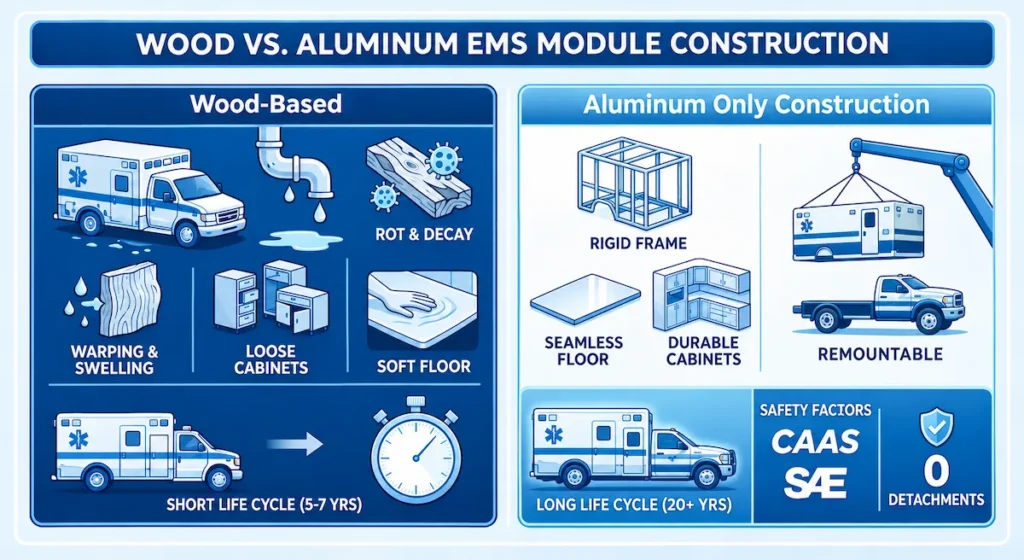
Frazer builds modules with all-aluminum framing and cabinetry, using wood-free construction in the patient compartment rather than wood, MDF, or particle board. Aluminum framing and cabinetry avoid the moisture absorption associated with wood-based materials, helping reduce concerns about rot, warping, and soft spots.
This construction approach supports long-term durability while providing your crews with a practical working environment. It also helps preserve the opportunity to reuse a serviceable module when it’s time to replace the chassis.
What Makes a Module a Candidate for Up to Four Remounts?
A chassis reaching the end of its useful service life doesn’t necessarily mean the module needs replacing. Frazer engineers its modules to support up to four chassis remounts over 15 to 20 years and more than 1,000,000 miles, depending on operating conditions, maintenance history, and inspection results.
When evaluating a remount candidate, your maintenance team should consider structural condition, cabinet integrity, electrical systems, and chassis replacement timing. Understanding how EMS module remounting works across chassis lifecycles can help your department plan future replacements and make better use of available capital.
New Build, Foundation Series, or Remount?
The right choice depends on your operational needs, existing fleet, and budget. A full new build may make sense when expanding your fleet or developing a custom or specialty vehicle. For departments seeking a defined Type I configuration, the 12-foot Foundation Series starts at $252,000.
If you already have a serviceable aluminum module that meets applicable inspection and remount requirements, a chassis remount may offer another option. Compare each approach against your department’s long-term fleet plan rather than focusing exclusively on the immediate purchase.
Why Point-to-Point Wiring Matters to Your Maintenance Team
Your maintenance team shouldn’t have to spend unnecessary time tracking down electrical problems. Component accessibility, replacement parts availability, and system complexity can all influence troubleshooting time, repair costs, and vehicle availability.
Keeping Electrical Systems Simple and Serviceable
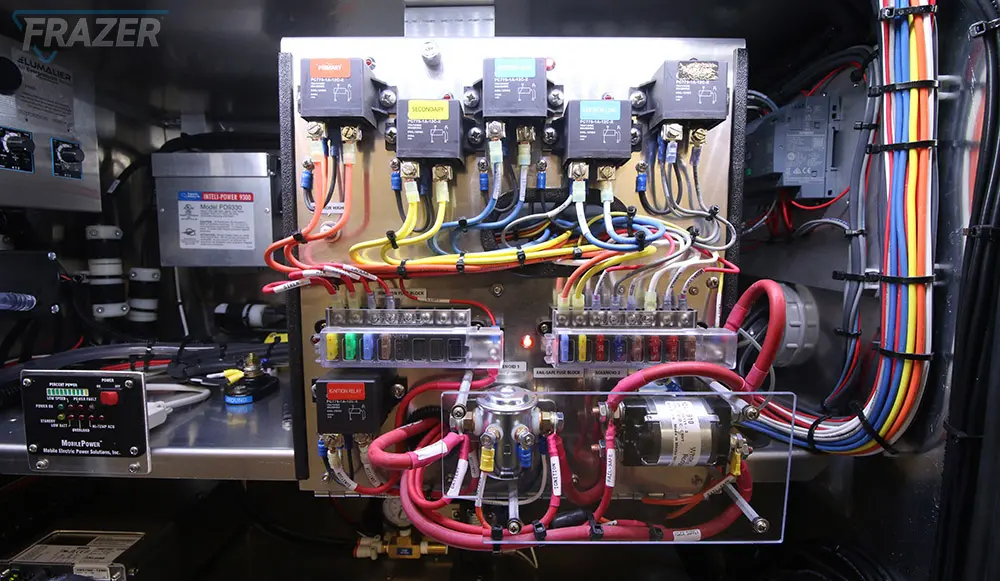
At Frazer, we follow the Keep It Simple (KISS) approach to electrical design. Our modules feature point-to-point wiring, common terminal strips, standard automotive relays, and accessible fuses rather than proprietary printed circuit boards or complex multiplex nodes.
Qualified technicians can trace circuits, inspect connections, and replace standard components without relying as heavily on specialized electronics. Combined with wood-free aluminum construction, this approach supports routine maintenance and Frazer’s multi-remount engineering philosophy.
The Cranston Fire Department has shared positive feedback about Frazer’s Service, Quality, and Parts departments, noting how simple its unit was to work on. We also offer free generator and electrical classes to help your maintenance team become more familiar with its Frazer units.
Maintaining Independent Power and Climate Control
When evaluating a fully stocked ambulance cost, consider how the vehicle supports medical equipment and patient compartment comfort. Frazer offers independent power options, including MEPS, Cummins Onan gas and diesel generators, and Harrison Hydra-Gen hPower, designed to operate separately from the chassis electrical system, with a 12V DC chassis backup.
Frazer’s chassis-independent 115V AC HVAC system features a dedicated, self-contained 15,000 BTU unit. Its stated design performance includes a minimum cooling differential of 25 to 30 degrees Fahrenheit under applicable operating and test conditions, with differentials of 35 degrees or more possible under favorable conditions.
The system is designed to recirculate air at two-minute intervals and can be paired with active air purification through the Dometic BreatheEasy Ionizer, field-replaceable filters (Part No. 35901), and UV bulbs. Independent power, separate cab-to-module air handling, and accessible service components help support patient compartment conditions and routine maintenance.
LifeNet, Inc. has highlighted the value of separate chassis and module power, while the Altoona Fire Department has reported comfortable operating conditions during winter weather and summer days with temperatures between 95 and 100 degrees Fahrenheit.
Municipal Fleet Longevity: Experience Beyond the Spec Sheet
Specifications explain how an EMS vehicle is designed, but hearing from departments that have operated those vehicles for years provides another valuable perspective. Several Frazer customers have shared their experiences with long-term module ownership and remounting.
Real-World Experiences With Multiple Remounts
Houston Fire Department reports a fleet that includes 129 Frazer units, with some modules approaching 20 years of service and surpassing 1,000,000 miles across up to four remounts. The department has reported frequently reaching more than 260,000 miles per truck chassis.
Marble Falls Area EMS purchased its first Frazer unit in 1996 and reports continuing to remount that module. Robertson County EMS reports a 15-year relationship with Frazer, operating frontline Type I, 12-foot units on Chevrolet 3500 4×4 Duramax Diesel chassis.
These customer-reported experiences illustrate how remounting and ongoing support can contribute to extended module service. Actual results depend on individual fleet operating conditions, maintenance practices, and module condition.
Reported Collision History and Module Durability
Since 1984, Frazer has built more than 4,500 EMS modules. In our available collision records, which include rollovers and impacts involving all four sides of the module, there have been no recorded module detachments. We design our modules with applicable Triple-K, CAAS GVS, and NFPA 1917 standards in mind.
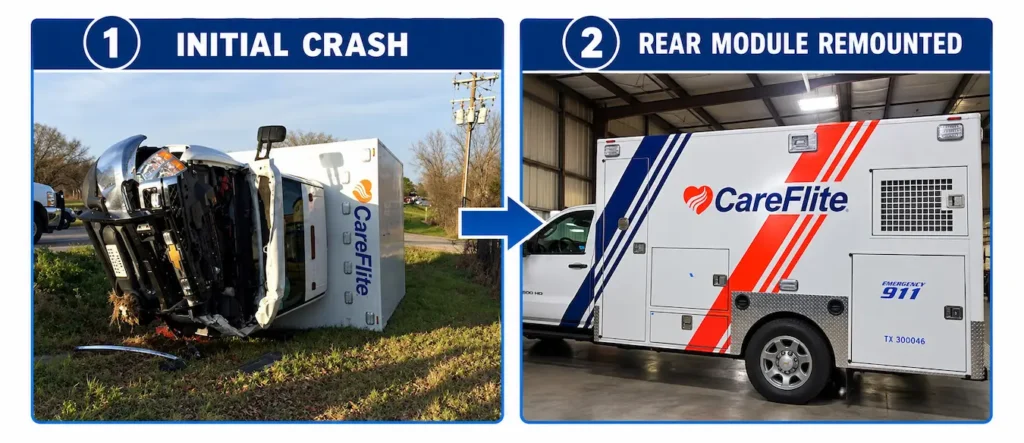
In one incident reported by CareFlite, a Frazer unit was involved in a 52 mph impact and a 90-degree rollover. According to CareFlite’s account, the crew was uninjured, and the module was later remounted onto a new chassis and returned to service.
These experiences provide additional context when evaluating module construction and durability. Individual collision outcomes should not be interpreted as guarantees or predictions of what will happen in other incidents.
Connecting Module Durability With Smart Financing
What would your fleet replacement plan look like if you could continue using a serviceable module through multiple chassis replacements? For departments working within limited budgets, that possibility can change how they approach capital planning.
Rather than treating a fully stocked ambulance cost as a single purchase expense, consider how construction, electrical serviceability, maintenance, vehicle availability, and remount opportunities could affect spending over 15 to 20 years. These considerations are at the center of Frazer’s Lower Overall Cost of Ownership and smart financing strategies.
Making the Case for a Long-Term Fleet Investment
When presenting a vehicle purchase to your Fire Chief, EMS Director, city council, or finance team, compare the potential costs of complete vehicle replacement with remounting a serviceable module. Consider how each approach fits into your department’s multi-year capital replacement plan.
Explore financing, leasing, cooperative purchasing agreements, grants, and available stock or expedited acquisition opportunities. Eligibility, availability, and financing terms will vary, but understanding your options can help address budget and delivery requirements.
Finally, match your configuration to your operational needs and available funding. A defined Foundation Series configuration, custom build, or remount may serve different purposes within the same department’s fleet plan.
Four Questions to Ask Before Finalizing Your Specifications
Bring your apparatus committee, maintenance team, procurement staff, and leadership together to discuss these questions before finalizing your next EMS vehicle purchase:
- Have we considered long-term ownership costs? Evaluate initial outfitting, maintenance, chassis replacement, and potential remount needs over 15 to 20 years.
- Is the module designed for durability and serviceability? Review construction materials, point-to-point wiring, and electrical component accessibility.
- Will the power and climate systems meet our needs? Consider equipment loads, local weather, independent power capabilities, and routine servicing requirements.
- What support will we receive after delivery? Review warranty coverage, parts availability, technical support, and technician training.
Why Support After the Sale Matters
Buying an EMS vehicle is the beginning of a working relationship. Your department needs access to knowledgeable service professionals, replacement parts, technical training, and ongoing support. That’s why support after the sale deserves attention when comparing vehicle providers.
Frazer’s written warranty and service provisions include the following coverage, subject to applicable conditions, limitations, and exclusions.
| Warranty Category | Coverage |
|---|---|
| New Module | Lifetime coverage for specified failures or malfunctions related to design, construction, installation, workmanship, and missing or incorrect parts, subject to original-owner possession and repair or modification restrictions. |
| Remount Module | Two-year warranty, subject to applicable original-owner and non-modification conditions. |
| Electrical System Wiring | Five-year warranty, subject to component exclusions and non-modification terms. |
| Module Paint, Striping, and Lettering | Five-year warranty. |
| Performance Bond | Warranty-related performance bond coverage limited to one year from acceptance. |
We encourage your department to review Frazer’s factory-direct support and module warranty coverage to understand the complete written terms and applicable conditions before making a purchasing decision.
Make Your Next EMS Vehicle Investment Count
Understanding the cost of a fully stocked ambulance starts with the initial quote, but it shouldn’t end there. Module construction, electrical serviceability, independent power, climate control, remount opportunities, and support after delivery all deserve consideration when evaluating long-term ownership costs.
At Frazer, our commitment extends beyond delivering your next EMS vehicle. We’re here to support your department throughout its working life. That’s what the Frazer Family Experience is all about.
Whether you’re replacing an aging chassis, expanding your fleet, or preparing specifications for your next EMS vehicle, explore our Lower Overall Cost of Ownership resources or request a pricing and configuration walkthrough. Our team is here to help you find an option that makes sense for your crews, your community, and your budget.
Why does the initial sticker price tell only part of the EMS vehicle cost story?
The initial purchase price covers your chassis, module, equipment, and outfitting, but it doesn’t account for long-term maintenance, vehicle downtime, or future remount opportunities. Evaluating these expenses over 15 to 20 years can help your department better understand the Lower Overall Cost of Ownership (LOCO) and make smarter fleet investments.