A Practical Guide to Ambulance Financing, Pricing, and Long-Term Ownership Costs
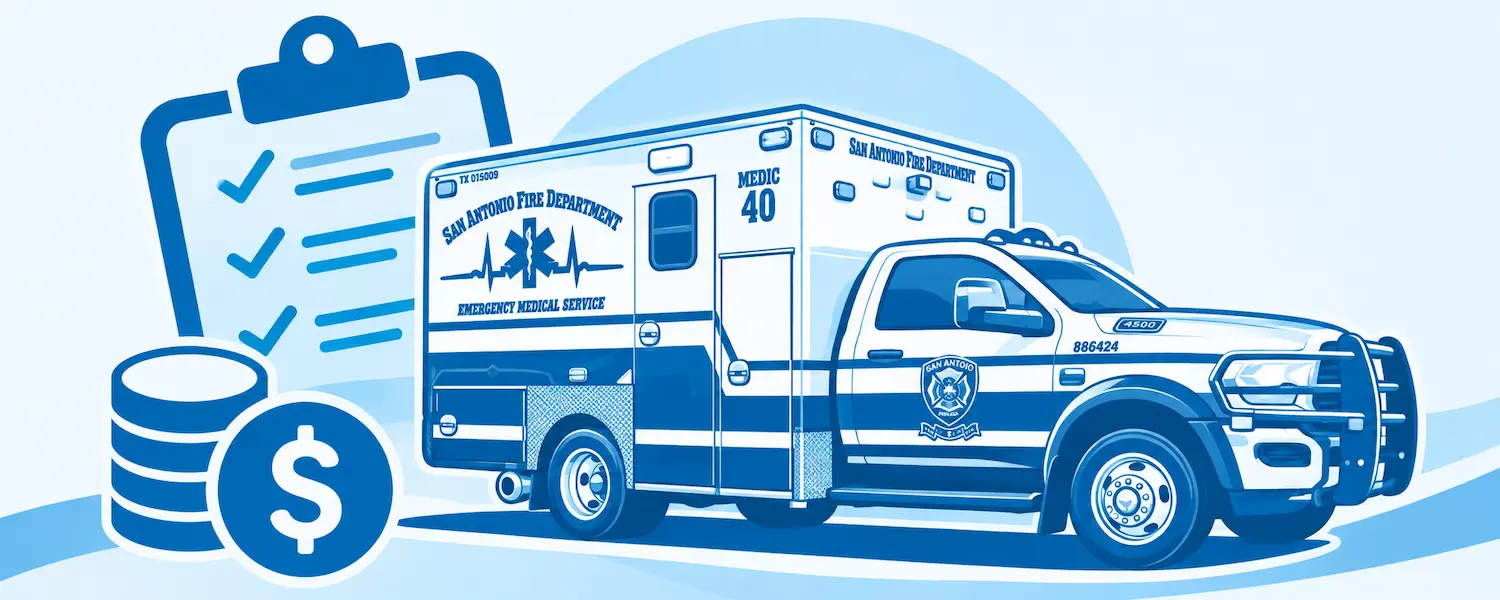
How you pay for your next EMS vehicle matters, but so does what it costs to keep that vehicle in service. From municipal leasing and rural EMS grants to capital purchases and commercial financing, the right funding option should support both your current budget and the long-term needs of the fleet.
When you have aging vehicles, rising maintenance costs, and a council or board asking you to justify your next purchase, the initial price is only part of the conversation. You also need to consider how long the vehicle will serve your community, how much time it may spend in the shop, and whether the patient module can be used across multiple chassis.
This guide will help you compare ambulance financing options, understand 2026 EMS vehicle pricing, and plan for a Lower Overall Cost of Ownership (LOCO) over 15 to 20 years. We’ll also look at how vehicle construction, remounting, ease of maintenance, and support after the sale can affect your investment.
Why the Purchase Price Is Only Part of the Cost
When budgets are tight, choosing the vehicle with the lowest initial price can seem like the right decision. A lower quote may also make it easier to gain approval from a city council, Emergency Services District (ESD) board, hospital finance committee, or business owner.
But what happens after that vehicle arrives? Maintenance, repairs, downtime, and future chassis replacements all contribute to what your organization spends over the life of the vehicle. A lower purchase price does not necessarily mean a lower cost of ownership.
What Does Vehicle Downtime Cost Your Organization?
Every day an EMS vehicle spends in the shop is a day it is not available to serve your community. Your crews may need to rely on older reserve vehicles with higher mileage or unfamiliar layouts. Your technicians have more work to manage, and your fleet leaders have fewer vehicles available to meet demand.
Electrical system design, access to replacement parts, and the materials used to build the patient module can all affect repair costs and maintenance time. Understanding these factors before you buy can help you make a more informed financing and purchasing decision.
What Do EMS Leaders Value Beyond Price?
In a double-blind survey of 100 EMS and fire professionals, fewer than 25 percent initially identified price as their top purchasing factor. After respondents rated individual purchasing factors, that number dropped to 9 percent. Support after the sale ranked highest.
Frazer also received 39 percent of mentions when respondents were asked which vehicle manufacturer or upfitter they believed spent the least amount of time in the repair shop, compared to 7 percent for other manufacturers. These results reflect customer perceptions, not independently measured repair times.
When presenting a vehicle purchase to your council, board, or finance team, consider the full picture. The initial price matters, but so do the vehicle’s expected service life, maintenance needs, and the support available to your team after delivery.
How Can You Finance Your Next EMS Vehicle?
There is no single ambulance financing option that works for every EMS organization. Your budget, purchasing requirements, funding deadlines, and long-term fleet plans will help determine which option makes the most sense for your operation.
A municipal fire department may need to spread payments across several budget years, while a rural EMS agency may be working within a grant deadline. A private EMS provider or hospital transport program may need to preserve cash for staffing and daily operations. Each situation calls for a different approach.
| Funding Option | Upfront Cost | Budget Benefits | What to Review | Who May Benefit |
|---|---|---|---|---|
| Municipal Lease-Purchase | Low or potentially no upfront payment, depending on terms | Spreads payments across annual budgets and may preserve cash reserves | Non-appropriation clauses and end-of-term ownership | Municipal fire and EMS departments and ESDs |
| Rural Grants and Cooperative Purchasing | Grant funding may cover a portion of the purchase | May reduce the need to use general-fund reserves | Grant deadlines, bidding requirements, and approved drawings | Rural and public EMS agencies using programs such as Texas HB 3000 |
| Capital Purchase (Cash or Bond) | Typically requires a larger upfront investment | Can align with existing capital funds or bond allocations | Budget approval, vehicle specifications, and expected service life | Agencies and healthcare organizations with dedicated capital funding |
| Commercial EMS Leasing | May require less cash upfront | Can preserve working capital and align payments with operating revenue | Mileage terms and end-of-term purchase options | Private EMS providers and healthcare organizations expanding their fleets |
Actual financing costs, payment schedules, eligibility, and ownership terms depend on your organization, lender, and financing agreement.
Municipal Leasing and Lease-Purchase Options
Municipal fire departments, county EMS agencies, and ESDs often work within multi-year capital budgets or bond schedules. When call volumes increase or an aging vehicle needs to be replaced sooner than planned, waiting for the next capital budget may not be practical.
Where available, a tax-exempt municipal lease-purchase agreement can spread the cost of an EMS vehicle across annual budgets instead of requiring a large upfront payment. Your finance and legal teams should review applicable laws, tax treatment, non-appropriation clauses, and ownership terms before entering an agreement.
One important question to ask is what happens when the lease ends. If your patient module is built for long-term service, retaining ownership or having the option to purchase it may support future remounting plans. Understanding these terms early can help you get more value from your investment.
To better understand how these agreements work, compare municipal and commercial EMS vehicle leasing options.
Rural EMS Grants and Cooperative Purchasing
For rural EMS agencies, state and federal grants can help make vehicle replacement possible without placing as much pressure on local budgets. Programs such as those associated with Texas HB 3000 may provide funding opportunities for eligible organizations.
Receiving a grant is only part of the process. You also need to meet purchasing requirements, develop vehicle specifications, and commit funds before applicable deadlines. A traditional Request for Proposals (RFP) can take months, making early planning especially important.
Cooperative purchasing contracts can help simplify the process when they meet your organization’s bidding rules and grant requirements. Establishing clear pricing and approving engineering drawings before issuing a purchase order can also help reduce unexpected expenses.
Planning equipment installation before your vehicle is built may reduce the need for additional work after delivery. This is especially important when grant funds are no longer available to cover unexpected installation costs.
Learn more about how to align rural EMS grants and cooperative purchasing timelines.
Capital Purchases and Commercial Financing
If your organization has capital funds available, purchasing a vehicle outright may reduce financing expenses and provide immediate ownership, depending on the purchase agreement. Ownership can also support long-term fleet planning, including future chassis remounts.
For private EMS providers, hospital transport programs, and mobile healthcare teams, commercial leasing or financing may offer more flexibility. Spreading payments over time can help preserve cash and available credit for staffing, equipment, and daily operations.
Regardless of how you fund your next vehicle, consider how the payment schedule fits its expected service life. An ambulance financing plan should support your organization’s ability to provide care today while preparing for future fleet needs.
How Much Does an EMS Vehicle Cost in 2026?
Building a realistic budget starts with understanding what affects the price of an EMS vehicle. Chassis selection, module size, interior layout, power systems, air conditioning, and equipment mounting all play a role in the final cost.
A Type I EMS vehicle built on a truck chassis will have different configuration options than a Type III built on a van chassis. Specialty vehicles, including Mobile Stroke Units and Mobile Clinics, have additional clinical and equipment requirements that affect pricing.
| Vehicle Configuration | Approximate Price Range | Typical Use |
|---|---|---|
| Base Models | $200,000 to $250,000 | Entry-level custom builds for essential operational needs |
| First Responder Vehicles | $225,000 to $275,000 | Rapid response and specialized first responder operations |
| Foundation™ Series (12-ft Type I) | Starting at $252,000 | A defined starting configuration with optional equipment available at additional cost |
| Commonly Selected Models | $250,000 to $300,000 | EMS vehicles with additional equipment and layout options |
| Highly Customized Models | $350,000 to $450,000 | Complex transport, bariatric, and critical care operations |
| Mobile Stroke Units (MSUs) | $900,000 to $1,000,000 | Specialized stroke care with onboard CT equipment |
| Mobile Clinics | $1,000,000 to $1,200,000 | Larger mobile healthcare units, including 18-foot clinic configurations |
These prices are approximate 2026 budgeting estimates, not formal quotes. Actual pricing and availability depend on chassis selection, equipment, vehicle configuration, and purchasing terms.
When Does a Defined Starting Configuration Make Sense?
Knowing where pricing starts can make it easier to prepare a budget, apply for a grant, or present a purchase to your board. Frazer’s 12-foot Type I Foundation™ Series starts at $252,000 for a defined configuration, with optional equipment available at additional cost. Stock and build-to-order availability may vary.
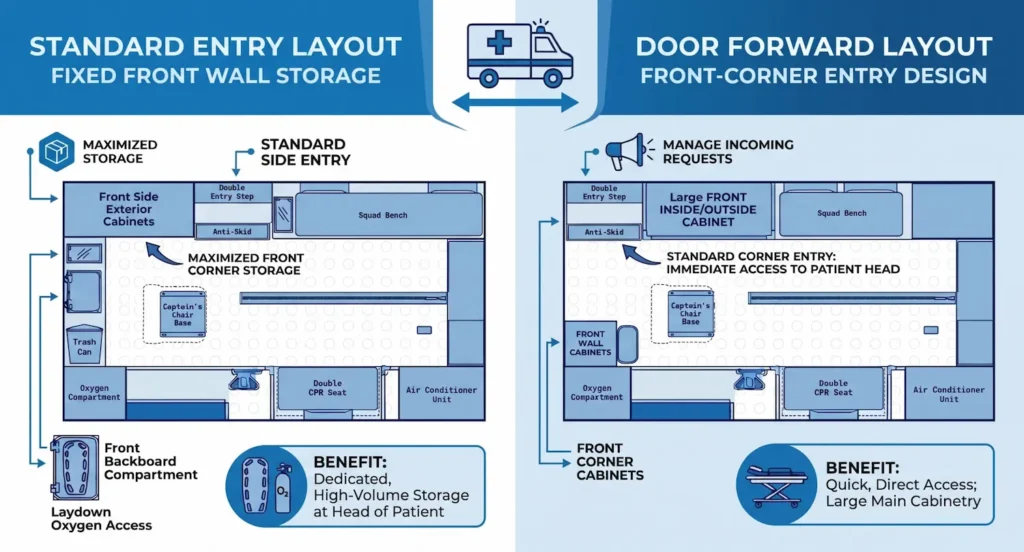
The Foundation Series features a 96.25-inch-wide module, nearly 50 inches of open aisle space, four seated caregiver positions, independent power and HVAC, and welded 6061-T6 aluminum, wood-free construction.
The open aisle gives your crews room to work, while the four caregiver positions support seated, restrained patient care during transport. For your finance team, a defined starting price provides a practical budgeting reference.
Custom and specialty builds may be a better fit when your operation has specific clinical, equipment, or layout requirements. The goal is to choose a vehicle that supports how your crews work without paying for features your organization does not need.
To explore your options, review Frazer EMS financing and configuration options.
How Can You Reduce Unexpected Costs After Delivery?
Radios, chargers, equipment mounts, and medical brackets are easy to overlook during the budgeting process. If these items require additional installation after delivery, they can add costs and delay the date your vehicle enters service.
Reviewing equipment locations, electrical loads, and mounting requirements on customer-approved engineering drawings before the build begins can help reduce unexpected work. It also gives your team a clearer understanding of what will be installed before delivery and who is responsible for any remaining work.
There are warranty considerations as well. Under Section 1.0 of Frazer’s written Warranty and Service Provisions, unauthorized third-party repairs or modifications to a module can void warranties. The five-year electrical wiring warranty also excludes unauthorized radio and charger hook-ups.
Working with Frazer to plan equipment installations early can help protect your investment, reduce warranty concerns, and limit additional work after delivery.
How Can Remounting Lower EMS Vehicle Ownership Costs Over 15 to 20 Years?
When a chassis reaches the end of its frontline service life, does the entire EMS vehicle need to be replaced? Not necessarily. If the patient module remains in suitable condition, remounting it onto a new chassis may be an option.
This is an important part of planning for a Lower Overall Cost of Ownership (LOCO). Rather than budgeting for a complete vehicle replacement every time a chassis wears out, your organization may be able to continue using the patient module across several chassis.
Frazer designs its aluminum, wood-free modules to support a potential service life of 15 to 20 years and up to four chassis remounts. Actual remount eligibility depends on module condition, maintenance history, chassis compatibility, operating conditions, and inspection results.
Why Does Wood-Free Aluminum Construction Matter?
The materials used to build a patient module can affect how well it holds up over years of service. Wood, MDF, and particle board used in cabinetry or subfloors can be affected by moisture, leading to swelling, deterioration, or weakened joints under certain conditions.
Frazer builds its modules using welded 6061-T6 structural aluminum framing and aluminum, wood-free construction in the patient compartment. This helps address concerns such as rot, warping, and soft spots associated with wood-based materials.
For your crews, durable construction supports a dependable work environment. For your fleet team, it can help preserve the condition of the module and support future remounting opportunities when the chassis is ready for replacement.
What Does Long-Term Module Ownership Look Like in the Field?
High-volume EMS fleets put significant mileage on their vehicles. Frazer’s documented fleet reporting includes chassis that frequently reach more than 260,000 miles while well-maintained aluminum modules remain candidates for continued service.
Frazer designs its modules to support the potential for up to four remounts, 15 to 20 years of service, and more than one million miles across multiple chassis. Customers have also reported fleet maintenance cost reductions ranging from 42 to 60 percent. These results reflect individual fleet experiences and will vary based on vehicle use, maintenance practices, fleet composition, and how costs are measured.
Houston Fire Department provides an example of what long-term module ownership can look like. According to documented fleet reporting, its Frazer units commonly exceed 260,000 miles per chassis. Examples within the fleet include units that have undergone up to four remounts, surpassed one million miles, and approached 20 years of service.
Marble Falls Area EMS has also reported remounting a Frazer unit originally purchased in 1996. These experiences demonstrate the potential for extended module service life when operating conditions, maintenance, and module condition support continued use.
Should You Remount or Buy New?
Remounting may make sense when your existing module is in suitable condition and continues to meet your crews’ needs. A new build may be a better choice when you are expanding your fleet, changing clinical capabilities, or replacing a module that no longer meets your operational requirements.
Comparing both options can help you plan fleet expenses across several chassis cycles instead of focusing on a single vehicle purchase. To understand the costs and factors that determine whether a module is a good candidate for continued service, learn more about remounting and long-term module ownership.
How Do Serviceability and Support After the Sale Affect Ownership Costs?
Even a well-planned fleet budget can be affected by unexpected repairs and vehicle downtime. How easily your technicians can identify a problem, access components, and complete repairs matters throughout the life of your vehicle.
When comparing EMS vehicles, ask how the electrical system works, how the patient compartment is powered, how major components are replaced, and who will help your team when something goes wrong. The answers can help you understand what ownership may look like long after delivery.
Point-to-Point Wiring and Accessible Components
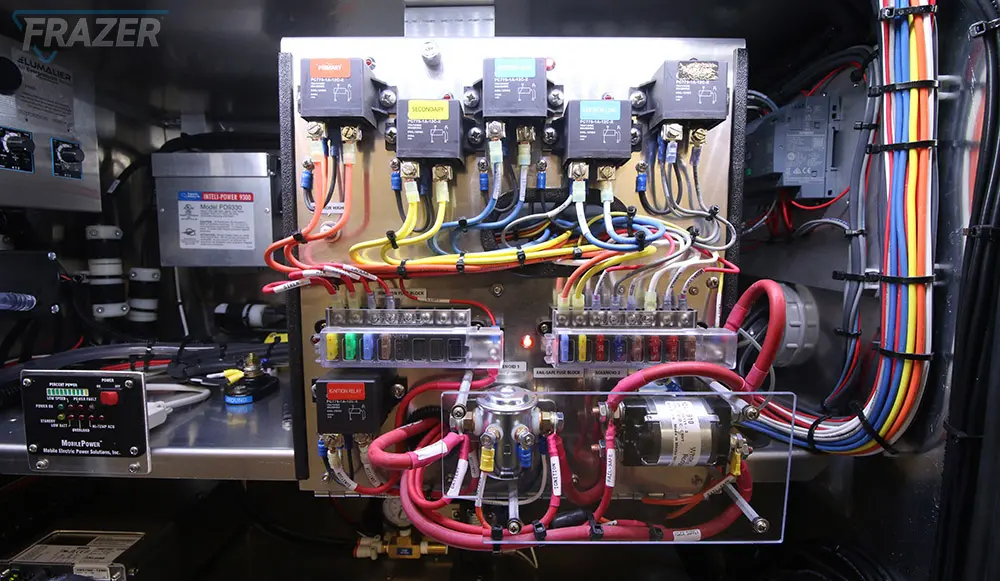
Frazer uses point-to-point wiring with common terminal strips, standard automotive relays, and accessible fuses rather than a multiplex system for its module wiring. This approach allows technicians to trace circuits and access standard electrical components when troubleshooting a problem.
Frazer also designs its side-mounted HVAC systems and modular components with maintenance access in mind. Design targets include HVAC replacement in under one hour and modular component replacement in under two hours. Actual repair times depend on vehicle configuration, technician experience, parts availability, and repair conditions.
Shop feedback from agencies such as Cranston Fire Department describes straightforward maintenance and service experiences. Frazer also offers free generator and electrical training classes to help technicians become more familiar with these systems, subject to scheduling and availability.
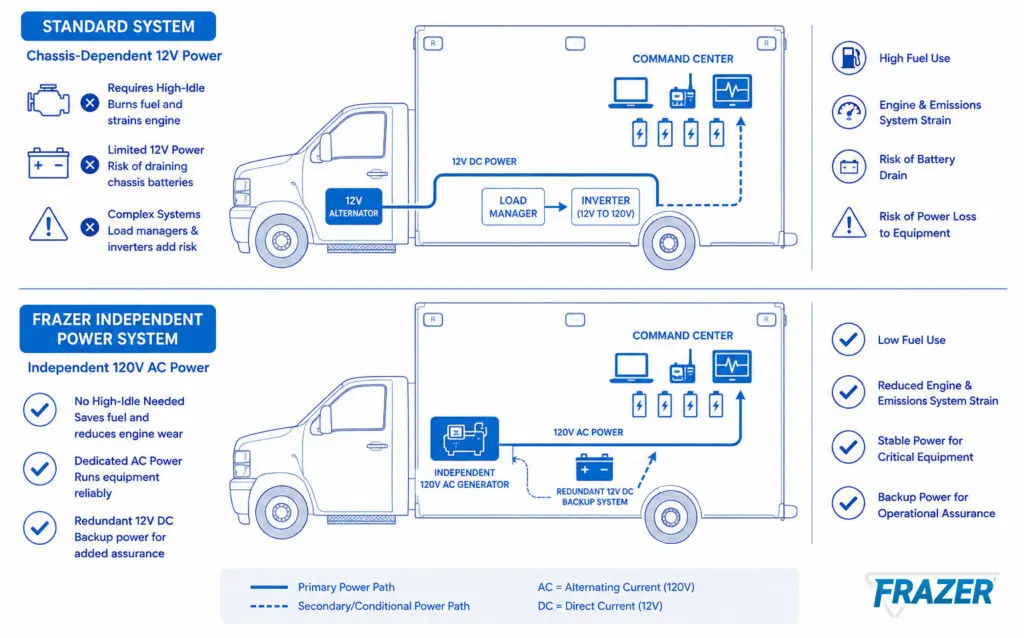
Independent Power and Patient Compartment Climate Control
Your crews need reliable power and climate control while caring for patients. Frazer offers independent power options designed to operate separately from the chassis electrical system, with a 12V DC chassis backup where applicable.
Available power options include MEPS, Cummins Onan gas and diesel generators, and Harrison Hydra-Gen hPower. These options give your organization flexibility when choosing a power system that fits your operational needs.
Frazer’s chassis-independent 115V AC HVAC system includes a dedicated 15,000 BTU unit with a stated cooling differential of 25 to 30°F or more under applicable test and operating conditions, and up to 35°F or more under favorable conditions. Optional Dometic BreatheEasy Ionizer active air purification is also available for applicable configurations.
Actual HVAC performance and equipment availability depend on vehicle configuration, outside temperatures, and operating conditions. Understanding these systems before purchasing can help your team choose the right configuration for your service area.
What Support Can You Expect After Delivery?
Support after the sale ranked as the most important purchasing factor among the evaluated attributes in Frazer’s survey of 100 EMS and fire professionals. When your vehicle needs attention, knowing who to call and how to get help matters.
Frazer builds direct relationships with customers and provides 24/7 access to service and troubleshooting support. Customers also have access to a nationwide network of authorized service centers, subject to regional coverage and service availability.
Before purchasing any EMS vehicle, review the written warranty. Understanding what is covered, how long coverage lasts, and which exclusions apply can help you plan for future maintenance and repair expenses.
| Frazer Warranty or Provision | Coverage |
|---|---|
| Structural Module Warranty | Lifetime structural warranty for the original owner, subject to written warranty terms and restrictions on unauthorized repairs or modifications |
| Remount Module Warranty | Two-year remount module warranty, subject to written terms |
| Electrical Wiring Warranty | Five-year coverage, excluding unauthorized radio and charger hook-ups |
| Paint, Striping, and Lettering | Five-year coverage, subject to applicable terms and exclusions |
| OEM Components | Coverage according to the original equipment manufacturer’s warranty terms |
| Performance Bond | One-year limit from acceptance, subject to applicable provisions |
All warranty coverage is subject to Frazer’s written Warranty and Service Provisions and applicable manufacturer terms.
Construction and Safety Considerations
Vehicle construction and equipment mounting are also important considerations when evaluating a long-term fleet investment. Frazer incorporates welded 6061-T6 aluminum construction and crash-tested cabinetry and mounting systems into its vehicle designs.
According to Frazer’s documented manufacturing and collision records, no module detachments have been recorded in collisions across more than 4,500 EMS modules built since 1984.
For Mobile Stroke Unit applications, Frazer reports SAE J3043-compliant CT scanner mounting tested beyond 50,000 pounds of force for applicable mounting configurations. These historical records and test results reflect documented experiences and specific test conditions. They do not predict performance in future collisions.
Putting Your Ambulance Financing Plan Into Action
Your next EMS vehicle purchase should support more than this year’s budget. It should also support your crews, your fleet team, and the people who depend on your organization for care over the years ahead.
Start by identifying which funding options fit your organization. Then compare vehicle configurations, expected module service life, maintenance requirements, and the potential for future remounting. These factors can help you build a more complete picture of what your investment may cost over 15 to 20 years.
Explore These Four Fleet Planning Topics
Leasing vs. Capital Purchases: Understand how municipal lease-purchase agreements, commercial leasing, and outright purchases affect cash flow, ownership, and future fleet replacement plans.
Rural Grants and Cooperative Purchasing: Learn how funding deadlines, purchasing requirements, and early specification planning can help your organization manage a grant-funded vehicle purchase.
Remounting and Long-Term Ownership: Evaluate whether your existing or future aluminum modules may be suitable for continued service across multiple chassis and how that could affect long-term fleet costs.
Budget-Conscious Vehicle Configurations: Compare the 12-foot Type I Foundation™ Series, starting at $252,000, with custom and specialty builds to determine which configuration fits your budget and operational needs.
Let’s Find the Right Fit for Your Fleet
Whether you are preparing your 2026 fleet budget, applying for a grant, exploring financing, or deciding whether to remount an existing unit, you deserve clear answers before making a major investment.
At Frazer, we believe our relationship with you extends well beyond the day your vehicle is delivered. From helping you choose the right configuration to supporting your technicians throughout the life of your vehicle, our team is here to help you get more from your investment.
Connect with the Frazer team to discuss your budget, funding options, vehicle requirements, and long-term fleet plans. Together, we can explore what makes sense for your organization, your crews, and the community you serve.
How do you compare municipal leasing, rural grants, cooperative purchasing, and capital budgets for an EMS vehicle?
Start by considering your available funds, cash flow, purchasing requirements, and funding deadlines. Municipal leasing can spread payments over time, grants can help offset purchase costs, and cooperative purchasing can simplify procurement. Capital purchases may reduce financing expenses. Consider how each option supports your fleet’s needs and overall cost of ownership over the next 15 to 20 years.