Navigating California’s Diverse Geography: EMS Durability Across Demanding Terrain

Navigating California’s Diverse Geography: EMS Durability Across Demanding Terrain If your shop has ever pulled back commercial flooring during an inspection and found damaged plywood underneath, you know how frustrating hidden damage can be. In California, routine washdowns, marine air, heat, rough roads, and long periods of operation can all affect an emergency vehicle over time. That is why California EMS durability is about more than choosing a tough-looking vehicle. Fleet managers and specification committees need to consider how materials, structural design, power systems, and service access fit the conditions their crews face every day. Capital costs are also rising, budgets remain tight, and chassis lead times can make downtime harder to absorb. Depending on vehicle design, use, and maintenance history, fleets may deal with problems such as stressed joints, exterior corrosion, alternator wear, HVAC repairs, or other maintenance concerns. This guide looks at several California operating environments and explains what agencies may want to consider when specifying a vehicle for a long service life. The California Operating Reality: One Fleet, Four Demanding Terrains California agencies can operate across very different environments. A regional fire district or county EMS system may see coastal moisture, steep mountain roads, dry agricultural regions, and temperatures above 100°F, sometimes within the same fleet. Coastal Salt Fog and Decontamination Washdowns From San Diego to the Redwood Coast, salt-laden air and marine moisture can create a demanding environment for emergency vehicles. Add routine disinfectant washdowns inside the patient compartment, and moisture may find its way toward flooring, seams, and other construction materials. Some emergency vehicle designs use plywood beneath finished flooring or wood blocking behind interior components. If moisture reaches those materials and stays trapped, deterioration can develop over time. Depending on the location and severity, that damage may affect floor rigidity or attachment points. Mountain Switchbacks and Repeated Road Flex Agencies working in the Sierra Nevada, Coast Ranges, and canyon corridors regularly travel steep grades, switchbacks, and uneven roads. As the chassis moves over those surfaces, its frame can twist. Some of that movement can transfer into the module, placing repeated loads on corners, doors, exterior skin connections, and interior components. Over time, technicians may see door alignment change, cabinet latches require adjustment, or stress appear around structural joints. Road conditions, mileage, construction method, maintenance, and vehicle use all play a role in how these issues develop. Central Valley Heat and Extended Idling Summer temperatures in the Central Valley and Inland Empire can climb well above 100°F. During long incidents or extended waits outside emergency departments, crews still need climate control, lighting, and electrical power inside the patient compartment. When those systems depend heavily on the chassis, extended idling can increase demands on electrical, cooling, emissions, and powertrain components. Depending on the chassis and operating conditions, this may add maintenance requirements for alternators, diesel particulate filters, and related systems. The Hidden Weakness: Plywood Subfloors in Moisture-Prone Environments An emergency vehicle described as having an “all-aluminum body” may still contain other materials inside the finished structure. Depending on the manufacturer and specification, that can include plywood or composite wood panels beneath the floor. What Makes an Emergency Vehicle Subfloor Wood-Free? A wood-free emergency vehicle subfloor can use welded structural aluminum tubing, aluminum sheet decking, and welded bulkheads without plywood, OSB, or organic composite backers in the specified assembly. This removes the moisture absorption concern associated with wood-based subfloor materials and is designed to help maintain floor rigidity and cot-anchor support over time. When cleaning liquids or other moisture move through flooring seams or penetrations, plywood can absorb that moisture. Repeated exposure can cause wood fibers to swell or deteriorate, and because the damage is below the finished floor, crews may not know it is there until an inspection or repair exposes it. When significant floor damage is found, repairs may require removing interior components and replacing sections of decking. Depending on the amount of work required, repairs can cost more than $15,000 and may keep a vehicle out of frontline service for weeks. Reducing Exterior Fastener Penetrations Moisture is not only a flooring concern. Exterior panel construction also matters. Mechanical fasteners placed through exterior panels create penetrations, and certain combinations of dissimilar metals and moisture can contribute to galvanic corrosion. Frazer bonds .080-inch 5052-H32 aluminum exterior skin to structural tubing using full-length 3M VHB tape. This reduces the need for rows of mechanical fasteners through the exterior skin. The continuous bond also creates another barrier at the connection and is designed to accommodate vibration between joined surfaces. For agencies operating in humid or coastal areas, reducing exterior penetrations can help limit some of the conditions associated with moisture intrusion and galvanic corrosion while maintaining panel attachment. Managing Mountain Roads with Structural Unibody Design Steep passes, canyon roads, and uneven surfaces place twisting loads on an emergency vehicle body. How the structural frame is designed affects the way those forces move through the module. How Does Structural Unibody Framing Help Manage Corner Stress? Structural unibody framing is designed to spread loads through an integrated structure rather than concentrating them at a few points. Frazer’s construction includes a heavy 6061-T6 aluminum tube-and-channel base frame, laminated tube-in-tube corner columns, and welded roof framing. Laminated Tube-in-Tube Corners Emergency vehicle modules can use several types of framing and construction. Under repeated twisting, localized areas may experience fatigue depending on the material, geometry, weld design, road conditions, and how the vehicle is used. Frazer uses 6061-T6 structural aluminum square tubing, a heat-treated alloy used in structural and marine applications. The base of the module uses a 3″ x 1½″ x 3/16″ structural tube-and-channel frame. At each corner, Frazer laminates two structural tubes together to create a double-walled column measuring at least 3″ x 1½″ x ⅛″ to ¼″ thick. The roof uses 2″ x 1½″ x ⅛″ structural tubing with perimeter framing measuring 2″ x 2½″ x ⅛″. The perimeter is joined with 6-inch welds on 8-inch centers. Together, these components are designed to work as an integrated structure and spread
Beyond the Bracket: What Fleet Managers Need to Know About SAE J3043 and Interior Projectile Prevention
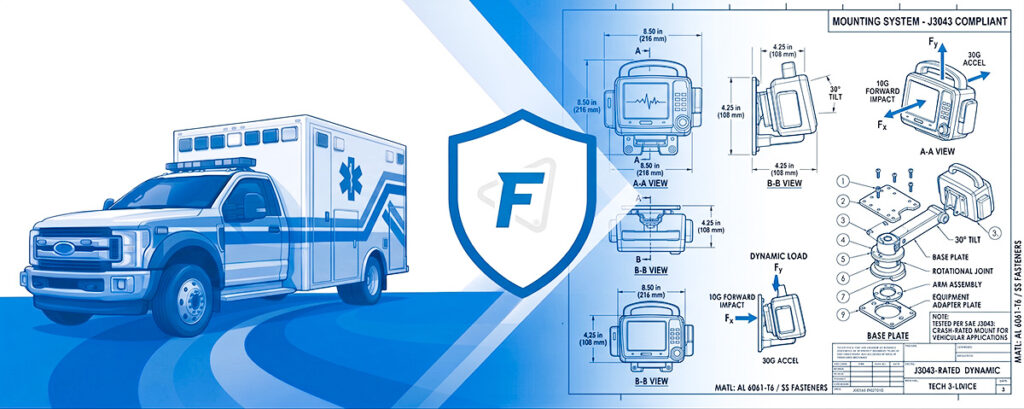
Beyond the Bracket: What Fleet Managers Need to Know About SAE J3043 and Interior Projectile Prevention Introduction A loose equipment mount can remove an EMS vehicle from service and require inspection or repair. In some cases, technicians may also discover wear or damage where the mount connects to the vehicle structure. Many discussions about equipment retention focus on the mounting device itself. The structure supporting that mount deserves equal attention. Years of vibration, moisture exposure, equipment changes, installation practices, and everyday vehicle use can all influence attachment points over time. When evaluating an EMS vehicle, it is helpful to consider the mounting system and the supporting structure as one complete system rather than as separate components. The Mount and the Structure Work Together Crash-tested equipment mounts help secure medical equipment under the conditions defined by the applicable test. Their performance after installation also depends on several other factors, including the attachment method, supporting material, installation quality, vehicle configuration, and ongoing inspection. Structural materials respond differently to years of service. Moisture, vibration, repeated equipment changes, and environmental conditions can affect attachment points over time. The extent of that wear depends on the construction method, operating environment, maintenance history, and the materials used. For that reason, departments should evaluate the mount, attachment hardware, wall structure, cabinetry, and module framework together when optimizing your primary workspace and planning equipment retention. Does an SAE J3043-Compliant Mount Make an Entire Vehicle Safe? An SAE J3043-compliant mount demonstrates equipment retention under the conditions defined by the applicable standard. It does not establish the safety of an entire vehicle or installation. Actual performance depends on factors such as the supporting structure, attachment hardware, equipment weight, mounting location, installation method, maintenance practices, and overall vehicle condition. Before selecting any mounting system, departments should review the available test documentation and verify that the tested configuration matches their intended application. A Structural Approach to Equipment Retention Equipment retention extends beyond the mounting device itself. A complete evaluation may include the mounting hardware, attachment points, wall structure, cabinetry, storage systems, and the module-to-chassis connection. Frazer designs its modules to meet the standards and requirements that apply to the specific vehicle and configuration. Certification and test documentation should always be confirmed for the exact model, options, and installation before publication or purchase. Have a question for the team? Ask a Question Wood-Free Aluminum Module Construction Frazer modules use a wood-free structural cage built from 6061-T6 aluminum tubing. This design provides a defined structural framework for equipment installation while eliminating wood from the structural cage. Aluminum does not rot, although its long-term condition still depends on engineering, fabrication, installation quality, inspection, maintenance, environmental exposure, and vehicle use. Equipment should be installed only at approved mounting locations and according to both Frazer engineering requirements and the mounting manufacturer’s installation instructions. Heavy Equipment Installations Frazer has engineered mounting solutions for specialty mobile healthcare equipment, including CT scanner installations. For one Mobile Stroke Unit application, Frazer engineers evaluated a mounting system supporting equipment weighing approximately 1,000 pounds. Structural Design and Lifecycle Planning Structural materials influence more than initial installation. They can also affect long-term maintenance, repair planning, service life, and the possibility of remounting a module onto a future compatible chassis. Frazer designs its modules with future remounting in mind. Whether a specific module remains suitable for remounting depends on its structural condition, inspection results, maintenance history, chassis compatibility, regulatory requirements, and the work required to complete the remount. In some fleet situations, remounting may preserve a portion of the module’s remaining value and reduce certain replacement costs. Actual financial results vary depending on vehicle condition, chassis pricing, equipment upgrades, labor costs, downtime, financing, and the department’s replacement strategy. Bid Specification Considerations Departments developing bid specifications may benefit from requesting documentation covering both equipment retention and structural design: Evaluating Retention Beyond the Mount Equipment retention involves more than selecting a mounting device. The supporting structure, installation method, equipment configuration, maintenance practices, inspection requirements, and available testing documentation all contribute to long-term performance. Reach out to our expert configurators for more information about Frazer aluminum module construction, equipment-mounting provisions, testing documentation, and remounting process. Final vehicle specifications should always reflect the department’s intended application, operating environment, and procurement requirements. F.A.Q.
Wood vs. Aluminum EMS Module Construction: A Lifecycle Safety Analysis

Wood vs. Aluminum EMS Module Construction: A Lifecycle Safety Analysis Many departments replace emergency vehicles on a regular cycle, often around the same time the chassis reaches the end of its planned service life. Sometimes the chassis or drivetrain is the main reason for replacement. In other cases, wear, movement, moisture exposure, or deterioration inside the patient module can also factor into that decision. Wood subfloors and cabinetry have been used in EMS vehicle construction for decades. Over time, repeated exposure to moisture, fluids, vibration, and daily use can change the condition of wood and composite components. That can create added maintenance work and may affect how long a module remains practical to keep in service. When you write specifications for your next vehicle, it is worth looking beyond the initial purchase price. The difference between wood-composite and wood-free aluminum construction can affect maintenance, remount options, service life, and long-term fleet planning. What Should You Consider with Wood-Based Construction? Picture your lead mechanic inspecting a five-year-old frontline unit. The engine is running well, but one area of the module floor feels soft and some interior cabinetry has started to shift. Moisture intrusion, fluid exposure, vibration, installation methods, maintenance practices, and operating conditions can all contribute to changes in wood or composite materials over time. Emergency-service driving also puts the module through years of vibration and movement. If deterioration develops, a department may face additional repairs and downtime. Fleet managers then have to decide whether continued repairs make sense or whether it is time to replace the module. Those issues can affect more than maintenance. Movement or deterioration inside the patient compartment can make the primary workspace harder for crews to use and maintain. Repairs to floors, cabinetry, or other components can also take the vehicle out of service. Some departments operate on a five- to seven-year replacement cycle. If the module reaches the end of its useful service life at roughly the same time as the chassis, the department may need to fund a complete replacement instead of reusing the module on another chassis. How Can Wood-Free Aluminum Construction Support Safety? A wood-free module built with 6061 T-6 structural aluminum tubing uses a rigid aluminum framework around the patient compartment. Unlike wood, aluminum does not rot when exposed to moisture. That removes one potential source of material deterioration from the module structure. Material choice is only part of the safety picture. Crash performance depends on the complete module design, mounting system, configuration, impact conditions, maintenance, and other factors. Frazer uses 6061 T-6 structural aluminum tubing as part of a module design intended to support structural integrity under demanding operating conditions and evaluated through applicable testing. What Is the Difference Between Sheet Aluminum and 6061 T-6 Structural Tubing? Saying a module is made with aluminum does not tell you how its structure is built. Manufacturers may use different alloys, tubing profiles, sheet products, joining methods, mounting systems, and structural designs. Those details matter when comparing vehicles. Frazer builds its module framework with heat-treated 6061 T-6 structural aluminum tubing. The material has defined properties that engineers can account for when designing the structure. For fire chiefs, EMS leaders, fleet managers, and safety officers writing specifications, it makes sense to look at the complete construction method, mounting system, and documented testing instead of evaluating the material name alone. No Recorded Module Detachments in Frazer’s Records Module attachment matters because a severe collision can place significant loads on the connection between the module and chassis. That is why the mounting system should be considered along with the module structure itself. Frazer modules are engineered and tested to applicable requirements, including CAAS GVS v2.0 and SAE J3043. Frazer’s records covering nearly 2,500 units built since 1984 report zero module detachments in collisions. That history is one data point departments can consider along with laboratory testing, vehicle configuration, maintenance history, and the circumstances of individual crashes. Frazer also uses crash-tested cabinetry and an aluminum module mounting system as part of its overall approach to patient-compartment construction. How Can Wood-Free Construction Affect Cost of Ownership? Removing wood from the module structure eliminates exposure to wood rot and related moisture deterioration in those structural components. The goal is straightforward: help the module remain serviceable beyond the life of a single chassis when its condition, maintenance history, inspection results, and configuration support continued use. If a module is still suitable for service when the chassis is ready for replacement, a department may be able to remount that module onto a compatible replacement chassis. That can reduce how much body structure and equipment must be purchased again during the next fleet cycle. Have a question for the team? Ask a Question Looking Beyond a Seven-Year Replacement Cycle “An aluminum unit costs more on day one. We cannot justify the capital expense.” Initial price matters, especially when departments are working within a fixed municipal budget. But the purchase price is only one part of lifecycle cost. Maintenance, downtime, module life, remount potential, and future replacement costs can all affect what a vehicle actually costs over years of service. A complete new emergency vehicle can cost $300,000 or more depending on its chassis, configuration, equipment, and options. If a department can reuse a serviceable module when a high-mileage chassis is replaced, it may avoid purchasing another complete module during that replacement cycle. Frazer’s wood-free construction is designed to avoid wood-related rot and moisture deterioration in the module structure. Depending on operating conditions and maintenance history, that may also reduce repairs tied specifically to deteriorated wood floors or cabinetry. Customers have reported fleet maintenance cost reductions ranging from 42% to 60% after moving to this design philosophy. Results will vary by fleet, duty cycle, vehicle configuration, labor rates, maintenance practices, operating environment, and other factors, so departments should evaluate their own costs when comparing options. Can You Remount an Aluminum EMS Module? Yes. A purpose-built aluminum module can be designed for remounting. Frazer’s wood-free 6061 T-6 aluminum construction is intended to support
The Ergonomic and Safety Benefits of a Door-Forward Ambulance Layout
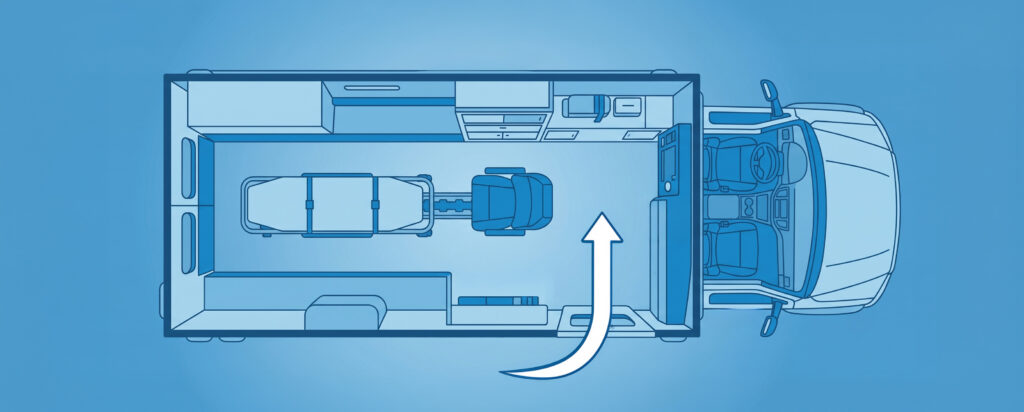
The Ergonomic and Safety Benefits of a Door-Forward Ambulance Layout During transport, leaving a seated position to retrieve equipment can be risky. A door-forward layout can help reduce that unnecessary movement by placing airway equipment, ALS cabinets, and other frequently used supplies closer to the primary medic seat. Equipment access is only one part of the design. Departments should also consider cooling capacity, electrical demand, restraint placement, structural composition, service access, and the final location of each piece of equipment. This guide explains the potential ergonomic benefits of a 14 ft door-forward EMS vehicle. It also reviews how door-forward workflows can support seated service and assist crews in managing on-scene situations. Why Are Crews Evaluating Door-Forward Layouts? For many frontline medics, the main benefit of a door-forward layout is easier access to equipment. The design often places commonly used supplies within reach, allowing crews to complete more tasks while seated and restrained. In some traditional layouts, primary ALS equipment and first-in bags are stored near a side entry door in the middle or rear of the module, so depending on cabinet placement, a medic seated at the head of the cot may need to leave the seat to retrieve those items. A door-forward layout moves the side entry door toward the front of the module, directly behind the passenger seat. This allows primary cabinets and work surfaces to be placed closer to the main medic position. Depending on the final configuration, a medic may be able to manage an airway, prepare medications, and reach common trauma supplies while remaining seated and restrained. The design can also help keep loading and unloading activity away from the primary patient-care workspace. How Can a Door-Forward Layout Support Seated Workflows? A door-forward configuration can give crews another way to organize the module around seated patient care. By placing frequently used equipment and supplies around the primary medic seat, departments can design a workspace that may reduce unnecessary movement during transport. Airway equipment, medications, trauma supplies, monitors, and other commonly used items can be positioned within practical reach of the primary medic. This may allow providers to complete more tasks while remaining seated and restrained. The door location is only one part of the layout. Cabinet placement, work surfaces, equipment mounts, and storage locations all affect how easily providers can reach what they need. A good place to start is by looking at what the medic uses most often during a typical call and designing outward from that seated position. Frequently used supplies can stay closer to the primary work area, while items used less often can be stored farther away. The same thinking can be applied to the secondary medic position. If that provider is expected to prepare medications, document care, operate equipment, or assist with treatment, the surrounding cabinets and work surfaces can be arranged around those tasks. Depending on the interior configuration, a door-forward layout can also create two more defined work areas. This gives departments another option for organizing patient care and support tasks around the way their crews actually work. How Can a Door-Forward Layout Support Movement Around the Patient? An EMS call can involve several people moving in and out of the module. Equipment may be passed through the side door, additional responders may enter, and crew members may need to communicate with people outside while patient care continues. Moving the side entry toward the front of the module can help separate some of that activity from the patient-care area. A provider working near the forward workspace may be able to receive supplies, communicate through the doorway, or handle support tasks while another medic remains focused on the patient farther back in the module. The layout will not eliminate movement or interruptions, but it gives departments another way to manage how people and equipment move through the space. It can also create more separation between the open side door and the patient, which may provide additional privacy depending on the scene, crew activity, and vehicle configuration. What Should Crews Consider When Designing the Interior? During the design process, crews can walk through common calls and pay attention to what each provider needs. Consider what the medic at the head of the cot must reach without standing, where airway equipment should be stored, where medications will be prepared, where the monitor will sit during transport, and which supplies need to be accessible from the forward workstation. It is also worth looking at how two providers work together. A secondary workspace can be useful when one medic can handle documentation, medication preparation, equipment operation, or other support tasks without getting in the way of the provider treating the patient. The area just inside the forward doorway deserves the same attention. Seating, cabinets, equipment, bags, and crew movement all compete for space. Walking through how responders enter the module while carrying equipment can help departments decide where that equipment should go once it is inside. Have a question for the team? Ask a Question Is a Door-Forward Layout Right for Every Crew? A door-forward layout may not be the preferred choice for every department. Fleet managers and crews that have worked in traditional layouts for years may prefer familiar equipment locations, storage patterns, and movement through the module. Changing the location of the door, cabinets, countertops, and supplies can take some adjustment. That is why frontline crew involvement can be valuable before the final layout is approved. Departments can walk through realistic scenarios such as airway management, cardiac arrest, trauma care, medication preparation, and calls involving several providers. These exercises can help identify whether frequently used equipment is within practical reach and whether multiple crew members can work in the available space without creating unnecessary interference. Consider whether a door-forward layout supports your crew, your equipment, your staffing model, and the way your team provides patient care. Ready to Plan Your Door-Forward Workspace? Start with the crew and the workflow, then build the interior around them. Think about where each medic
Standard vs. Door-Forward EMS Layouts: What Fleet Managers Should Know
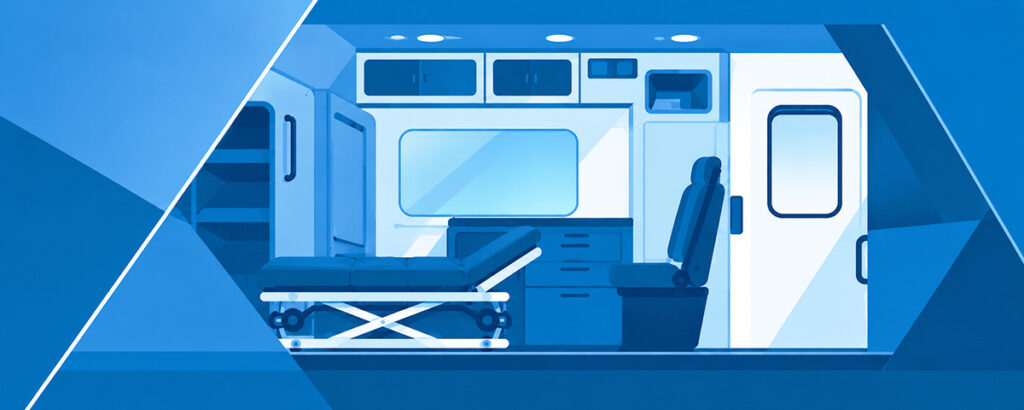
Standard vs. Door-Forward EMS Layouts: What Fleet Managers Should Know Your frontline medics may be asking for a door-forward layout on your next EMS vehicle. At the same time, your maintenance team may be wondering what that change means for electrical service, component access, and long-term upkeep. Those are both fair concerns. Choosing a layout is not just about where the door goes or how the patient compartment looks. You also have to consider crew workflow, fleet uptime, maintenance needs, and the systems behind the walls. If you are looking to explore the clinical benefits and ergonomics of a door-forward module, it helps to understand what that layout may mean for the people who maintain the vehicle. Here is how Frazer approaches door-forward designs while keeping the electrical system, module power, and major service components straightforward. The Fleet Manager’s Dilemma: Crew Preferences and Maintenance Needs The conversation about a standard side-entry layout versus a door-forward layout often starts with the crew. Moving the primary side entry closer to the cab can change how providers move through the module and how the primary workspace is used. Depending on the configuration, it can also give crews more room for charting, medication preparation, and staging equipment near the patient’s head. Once that request reaches the fleet manager or maintenance shop, the questions usually change. How will moving the door and cabinets affect the wiring? Will added laptops, radios, and monitors increase the demand on the vehicle’s electrical system? Will technicians still be able to reach HVAC and other serviceable components? And will the new layout create a completely different maintenance process from the rest of the fleet? Those questions matter because customization should not make routine service harder than it needs to be. Frazer uses a consistent point-to-point electrical approach across its module configurations, including door-forward layouts. Does a Door-Forward Layout Require More Complicated Wiring? Not necessarily. Electrical architecture varies by builder, but Frazer uses point-to-point wiring across its module layouts, including door-forward configurations. The goal is to give technicians a familiar electrical structure even when the interior layout changes. Some electrical systems rely on multiplex controls that may require special software, diagnostic tools, or manufacturer-specific components. That can affect how a technician approaches troubleshooting, especially when a problem happens outside normal business hours. Frazer takes a more straightforward approach. Our point-to-point system uses common relays, fuses, and terminal strips so technicians can trace individual circuits and work with familiar components. That same service philosophy applies whether you choose a standard module or a customized 14 ft. door-forward layout. The cabinets may move, but the basic approach to electrical troubleshooting stays familiar. Have a question for the team? Ask a Question What About HVAC and Other Serviceable Components? Changing the location of doors and cabinets can affect how technicians reach equipment, so component access should be part of the layout conversation. A good interior design still needs to make sense when something eventually needs service. Frazer standardizes the location and service approach for key components where practical. One example is our self-contained 120V AC air-conditioning system. It is mounted on the side of the module rather than on the roof and is designed so the system can be replaced without taking apart large sections of the patient compartment. This approach stays consistent across standard and door-forward configurations. Keeping the HVAC system accessible from the exterior can simplify service and gives fleet teams a more familiar maintenance process across vehicles with different interior layouts. Can You Remount a Door-Forward Frazer Module? Yes. Frazer’s all-aluminum, wood-free modules are designed with remounting in mind, including door-forward configurations. When the condition of the module and the replacement chassis make it appropriate, a department may be able to move the existing module onto a new chassis instead of replacing the entire unit. That matters because a custom EMS vehicle is a major capital investment. If your team spends time developing a layout that works well for crews and maintenance staff, you may want to keep that configuration after the original chassis reaches the end of its service life. Frazer modules are built with 6061-T6 structural aluminum tubing and wood-free construction. Some Frazer modules have exceeded 1 million miles of service and remained in operation for more than 20 years. Actual module life depends on use, maintenance, operating conditions, and the condition of the module over time. When the chassis is ready for replacement, departments may be able to remount a Frazer module onto a new chassis. This can help preserve a proven layout while giving the department another option for managing long-term capital costs. Remounting is also one part of Frazer’s Lower Overall Cost of Ownership, or LOCO, approach. Customer-reported fleet maintenance cost reductions have ranged from 42% to 60% when adopting a Frazer fleet strategy. Results vary based on fleet size, vehicle use, maintenance practices, configuration, and other operating conditions. Finding the Right Balance Between Crew Needs and Fleet Uptime Choosing between a standard and door-forward layout does not have to mean choosing between crew preferences and maintenance needs. The right configuration should support patient care while still giving your technicians a vehicle they can understand, access, and service. Frazer approaches that balance with point-to-point wiring, independent module power, accessible service components, and all-aluminum module construction designed with structural integrity and future remounting in mind. Those systems stay familiar even when the interior layout changes. The best layout for your department comes down to how your crews work, how your maintenance team supports the fleet, and what you want the vehicle to deliver over its service life. Looking beyond cabinets and floorplans can help you make a decision that works for everyone. Planning your next vehicle specification? Lower Overall Cost of Ownership involves more than the purchase price or interior layout. It also means looking at service access, power systems, maintenance needs, remount potential, and long-term support. Contact our module configuration experts to get your questions answered and on the road as quickly ass possible. F.A.Q.
Door-Forward vs. Standard Ambulance Layouts: Optimizing Your Primary Workspace
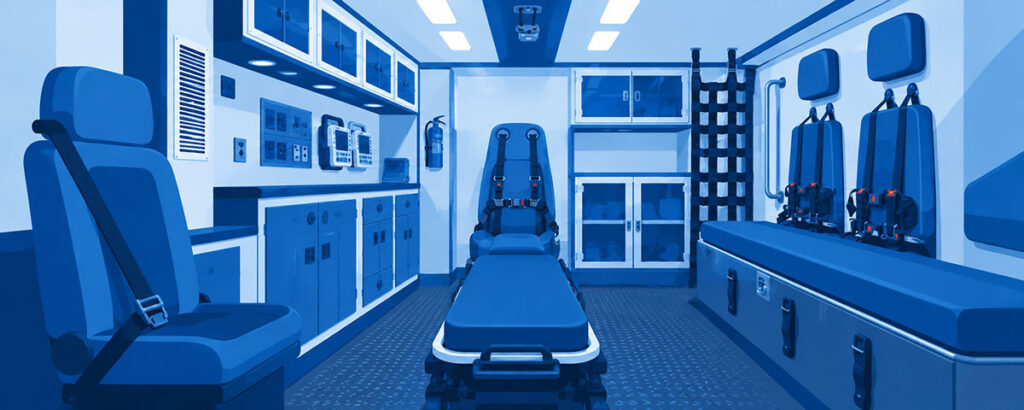
Door-Forward vs. Standard Ambulance Layouts: Optimizing Your Primary Workspace When comparing a door-forward layout with a standard ambulance layout, one of the biggest differences is the location of the side entry door. A door-forward design moves that entry closer to the cab, creating a continuous wall of cabinetry beside the primary care seat. That extra working area can help keep frequently used trauma, airway, and diagnostic equipment within easier reach. Picture your crew moving through city traffic with a patient in the back. You are seated and buckled in when the patient’s condition changes. You need the suction unit or airway bag right away. Depending on the layout and where that equipment is stored, getting to it could mean twisting, reaching across the patient, repositioning yourself, or leaving your seat. Those movements may seem small, but they add up over a long shift and throughout a medic’s career. That is why patient-compartment layout deserves a place in the conversation when your department starts planning its next vehicle. This guide compares door-forward and standard layouts so your apparatus committee can better understand how each configuration affects storage, equipment access, crew movement, and day-to-day workflow. What Is the Benefit of a Door-Forward Ambulance Layout? Moving the side entry door forward creates a longer, uninterrupted section of cabinetry beside the primary care position. With the right cabinet and equipment configuration, frequently used gear can stay closer to the medic, reducing unnecessary reaching and movement while providing more options for organizing the primary workspace. The Standard Layout: Familiar, but More Segmented A standard ambulance layout typically places the side entry door near the middle of the curbside wall. It is a familiar configuration for many departments, and crews may already have workflows, training, and equipment-storage practices built around it. The tradeoff is that the doorway separates the curbside cabinetry into different sections. Equipment may need to be stored both in front of and behind the door. Depending on how the vehicle is configured, a medic may need to turn, reach farther, stand, or reposition to access certain supplies. That does not make a standard layout the wrong choice. It simply means departments should look closely at where their crews spend the most time, which equipment they use most often, and how much movement is required to reach it. Over a 12-hour or 24-hour shift, those details can have a real effect on comfort and workflow. The Door-Forward Layout: Creating a More Continuous Workspace When departments first consider a door-forward configuration, one common question is whether moving the side door will reduce usable space. Crews may wonder if the front of the module will feel tighter or if they will lose storage near the CPR seat. The goal of a door-forward layout is not simply to move the door. It is to use the curbside wall differently. Moving the entry closer to the cab opens a longer section of continuous cabinetry near the primary care seat, giving departments more flexibility in how they organize frequently used equipment. Frazer’s 14 ft Door-Forward configuration, for example, gives departments the ability to consolidate more equipment around the primary workspace. Depending on the cabinet design and equipment selected, airway, diagnostic, trauma, and other commonly used supplies can be placed closer to the medic’s seated position. The result is a workspace that can be organized around how your crew actually works instead of asking your crew to work around the location of the door. How Does Chassis Selection Affect Ambulance Cot Loading Height? Layout is not the only factor that can affect crew ergonomics. Chassis selection can also influence deck height and the angle required to load a cot into the patient compartment. Type III vehicles use van-style chassis with lower frame rails than many medium-duty Type I trucks. Depending on the chassis, suspension, cot system, and final vehicle configuration, that lower frame height may result in a lower deck and reduce the lift angle required during cot loading. Reducing the “Twist and Reach” Ergonomics inside an EMS vehicle is about more than choosing a comfortable seat. Equipment location matters, too. Every time a medic has to turn, reach, stand, or move across the patient compartment, the layout is affecting how that person works. With a standard layout, the side door divides the curbside storage area. Depending on where equipment is placed, crews may need to reach outside the immediate seated workspace to get what they need. Some medics describe this as the “twist and reach.” A door-forward design gives departments another way to approach that problem. By creating continuous storage near the primary care seat, frequently used equipment can be arranged around the medic’s normal working position. A thoughtful configuration may help crews access more of what they need while remaining seated and buckled. Workspace design is only one part of patient-compartment safety. The construction of the module and its interior components matters as well. Frazer modules use all-aluminum, wood-free construction along with crash-tested cabinetry and module-to-chassis mounting systems. Frazer has recorded zero module detachments across nearly 2,500 units built since 1984. Those design and testing considerations are part of a larger goal: build an EMS vehicle that can stand up to the demands crews face every day. Why Can Ambulance Air Conditioning Struggle While Idling? Cabinet layout is not the only part of the workspace that affects crew comfort. Climate control matters, especially when crews spend long periods staged, parked, or idling in hot weather. Some chassis-driven A/C systems can perform differently as engine speed and operating conditions change. Frazer takes a different approach. Its independent 120V AC system uses a dedicated generator, allowing the patient-compartment air-conditioning system to operate independently of chassis engine speed. Heat Is Part of the Ergonomics Conversation Working in a hot patient compartment can make an already demanding job harder. When departments evaluate vehicle ergonomics, it makes sense to look beyond seat placement and cabinet access and consider the environment crews work in throughout the shift. Frazer’s independent 120V AC air conditioning
The 2026 Guide to EMS Door-Forward Layout Structural Integrity & Safety
The 2026 Guide to EMS Door-Forward Layout Structural Integrity & Safety Your medics may be asking for a door-forward layout so they can remain seated and secured while treating patients on the move. As a Fire Chief, EMS Director, or Fleet Manager, one of your first questions may be about crew safety and institutional risk. Does placing a side entry door near the front corner affect the structural performance of the module in a collision? That is an important question. A door-forward design has to balance everyday ergonomics with the responsibility of specifying a vehicle that supports your department’s safety requirements. As more agencies evaluate seated-and-secured care models in 2026, door-forward layouts are becoming an increasingly important operational consideration. When comparing standard vs. door-forward EMS layouts to find the right fit for your fleet, however, should never be evaluated by itself. Materials, structural design, reinforcement, testing, and engineering all matter. This guide explains the engineering considerations behind EMS door-forward layout structural integrity, how Frazer approaches cooling in a segmented workspace, and how a custom configuration can affect your Lowest Overall Cost of Ownership (LOCO). Balancing Medic Ergonomics with Patient Care One reason agencies are considering door-forward layouts is the opportunity to support better medic ergonomics and seated-and-secured care. Moving the door forward can allow the primary medic seat to be positioned at the head or side of the patient, depending on the selected configuration. Frequently used equipment such as airway supplies, cardiac monitors, and trauma bags can then be positioned within reach. The goal is not simply to move the door. It is to create a workspace that supports how your crew actually delivers care. A well-planned layout can reduce the need for medics to stand or move around the patient compartment while the vehicle is in motion by placing important equipment closer to a seated and secured caregiver. Cot Loading and Workspace Efficiency Patient compartment design also needs to account for cot loading angles, equipment placement, crew movement, and access to the patient. In some layouts, the position of a centrally located side door can affect circulation space while crews load a cot or move equipment. A door-forward configuration can create a more defined area around the rear doors for cot loading while separating part of the side entry path from the primary patient-care zone. Depending on the layout, another crew member may be able to enter through the side door and reach equipment with less interference around the medic working near the cot. For agencies managing high-acuity transports with several crew members in the patient compartment, this type of configuration can support a more organized workflow. The best layout depends on your department’s staffing, equipment, clinical procedures, and operational needs. Does Moving the EMS Vehicle Door Forward Weaken the Module? Does moving the EMS vehicle door forward weaken the module in a crash? Moving a major opening changes the structural load paths engineers must account for in the module design. A door-forward configuration can be engineered to support crash-survivability objectives when the structure around the opening is designed with the appropriate materials, reinforcement, connections, and attachment methods. Frazer modules use heavy-duty 6061-T6 structural aluminum tubing, and Frazer has zero recorded module detachments in collisions across nearly 2,500 builds. That field history gives agencies another data point to consider when evaluating Frazer’s structural design alongside their own safety and crash-survivability requirements. It is reasonable to question what happens when the location of a major opening changes. A door near the forward corner affects the load path through the module walls. The door location, surrounding structure, reinforcement, connections, and module-to-chassis mounting system all contribute to how the overall structure is designed to manage collision forces. The Importance of 6061-T6 Structural Aluminum When comparing wood and all-aluminum module construction, agencies should look closely at the specific materials and engineering used in each design. During a severe collision, framing materials and connections can be subjected to substantial loads. Material selection, structural dimensions, reinforcement, and attachment methods all play a role in the overall design. Frazer takes a wood-free approach and builds its modules with 6061-T6 heavy-duty structural aluminum tubing. The base frame uses 3″x1.5″x3/16″ tube and channel, while the roof and walls include additional structural reinforcement. These components work together as an integrated structure designed to help manage collision forces and support the module-to-chassis connection. Across nearly 2,500 Frazer builds, there have been zero recorded module detachments in collisions. Departments can consider that documented field history when evaluating a door-forward configuration and comparing the structural approaches used by different vehicle builders. SAE J3043 and Reducing Interior Projectile Risk Crash-survivability involves more than keeping the module attached to the chassis. Cabinetry, equipment mounts, seating, restraints, and other components inside the patient compartment also matter. In a door-forward layout, medics may use a 6-point harness to remain seated and secured while providing care. The restraint system is designed to help keep the medic in position during sudden vehicle movement, but equipment retention remains just as important. Frazer’s interior cabinetry and module-to-chassis mounting systems undergo crash testing intended to evaluate their performance under specified test conditions. From crash-tested LifeDefender cabinets to heavy-duty equipment tracks, these systems are designed to help retain equipment and reduce risks associated with unsecured items during a collision. Agencies evaluating a door-forward design should look at the complete patient compartment, including seating, restraints, storage, equipment mounting, and structural construction. Why Frazer Uses Independent 120V Power Some patient-compartment HVAC systems depend on chassis operation or high-idle while the vehicle is stationary. Depending on the chassis and operating conditions, extended high-idle use can contribute to fuel consumption, chassis wear, alternator loading, diesel particulate filter loading, and additional maintenance considerations. Frazer uses an independent 120V AC generator to power a residential-style air-conditioning system for the module. Because the patient-compartment HVAC has its own power source, agencies can cool the module without relying on chassis high-idle as the primary source of HVAC power. The system uses a 450 cubic-foot-per-minute fan that recirculates the volume
Battling Coastal Corrosion: The Financial Case for All-Aluminum EMS Modules

Battling Coastal Corrosion: The Financial Case for All-Aluminum EMS Modules Coastal Fire Chiefs and Fleet Managers know what salt air and moisture can do to emergency vehicles. Corrosion, electrical problems, added maintenance, and unexpected downtime can put pressure on a fleet and its budget. When vehicles need to stay in service longer, the way an EMS module is built matters. Construction materials, electrical design, serviceability, and the ability to remount a module can all affect long-term cost. Looking beyond the purchase price can help departments make a more informed fleet decision. Here is what coastal fleets should consider when comparing long-term capital and operating costs. Do aluminum EMS modules last longer in coastal environments? All-aluminum, wood-free EMS modules can offer practical advantages in areas where salt, moisture, and humidity are part of daily operations. When a module remains in good condition after the chassis reaches the end of its service life, remounting can give a fleet the option to keep using that module on a replacement chassis. The purchase price of an EMS vehicle is only one part of its cost. Fleet leaders also have to consider maintenance, repairs, downtime, replacement schedules, and how often the entire vehicle may need to be replaced. Frazer builds its modules with an all-aluminum, wood-free structure. That construction is designed for long-term use and gives customers another option when planning future chassis replacements. Instead of assuming the module and chassis must always be replaced together, a fleet can evaluate whether the existing Frazer module is a good candidate for remounting. That matters when you are planning several budget cycles ahead. A module that can remain in service through more than one chassis can help a department get more use from its original capital investment. How does coastal humidity affect an EMS module? Corrosion on the outside of a vehicle is easy to see. Moisture inside a vehicle body can be harder to spot. Over time, repeated exposure to high humidity can affect moisture-sensitive materials, including wood. Frazer removes that concern from the module structure by using wood-free construction with 6061 T-6 structural aluminum tubing. Instead of relying on wood as part of the module structure, the patient compartment is built around an aluminum framework designed for demanding operating environments. For a coastal fleet, the benefit is simple: wood rot is not a structural concern when there is no wood in the structure. That does not make any vehicle immune to the effects of salt, water, or poor maintenance, but it removes one moisture-sensitive material from the equation. Long-term durability also depends on how the unit is operated, inspected, cleaned, and maintained (especially when prioritizing hurricane readiness and severe weather preparation). Construction is one part of that picture, but it is an important one when a department plans to keep equipment in service for many years. How does salt air affect EMS vehicle electrical systems? Salt and moisture can contribute to corrosion at grounds, connectors, and other electrical components. Frazer’s independent power approach separates important patient-compartment functions from much of the chassis electrical system, giving fleets another layer of flexibility when electrical problems occur. For Mechanics and Fleet Managers, electrical problems can take time to diagnose. Coastal conditions can make that job harder because salt and moisture may contribute to corrosion in connections and other electrical components. Frazer offers independent power systems for the patient compartment instead of depending entirely on the chassis electrical system. With the generator-powered configuration, a 120V AC generator supplies primary module power and a 12V DC system provides backup support. This separation gives the patient compartment its own power source for key functions such as lighting and climate control. The exact capabilities available during a chassis electrical issue depend on the problem and the vehicle’s configuration, but the goal is to reduce unnecessary dependence on the chassis for module power. Frazer also uses a service-friendly electrical approach built around point-to-point wiring and commonly available relays, fuses, and terminal strips. For fleet technicians, that can make many components easier to identify, test, and replace without relying on specialized proprietary equipment. That simplicity matters when a vehicle is out of service. The easier a problem is to understand and repair, the sooner a fleet may be able to get that unit back to work. Can you remount an EMS module if the chassis rusts out? In many cases, yes. If a Frazer module remains structurally sound and is a suitable candidate for remounting, it can be removed from an aging chassis and installed on a compatible replacement chassis. That can be especially valuable for coastal departments. Chassis components may face years of exposure to salt, standing water, road spray, and humid conditions. The chassis may eventually reach the end of its useful service life while the module still has years of service left. Frazer’s aluminum, wood-free construction is designed with long-term module use in mind. When the time comes to replace the truck underneath it, the department can have the module evaluated for continued service rather than automatically replacing the complete vehicle. Remounting gives fleet leaders another capital-planning option. Keeping a serviceable module and pairing it with a replacement chassis may help spread the original module investment across more than one chassis lifecycle. Not every module or chassis combination will be a candidate for remounting. Condition, compatibility, configuration, regulatory requirements, and the scope of work all need to be evaluated before a project moves forward. Frazer’s team can help customers understand those factors and determine the right path for their fleet. Have a question for the team? Ask a Question How should coastal fleets calculate long-term cost of ownership? Purchase price matters, but it does not tell you what a vehicle will cost to own. A better long-term comparison looks at the full picture: routine maintenance, repairs, downtime, chassis replacement, module replacement, power-system service, parts availability, and remount opportunities. This is especially important in coastal environments, where salt and moisture can add another layer of wear. As outlined in our guide
Hurricane Readiness: Is Your EMS Fleet Ready for Severe Weather?

Hurricane Readiness: Is Your EMS Fleet Ready for Severe Weather? Severe-weather planning takes more than medical supplies, bottled water, and backup radios. Your vehicles need to be ready, too. Power, cooling, electrical serviceability, and module construction can all affect how well your fleet supports crews and patients during a long hurricane response. Picture your team 36 hours into a major storm response. The local power grid is down, heat and humidity are climbing, and crews are operating with limited access to normal facilities and repair resources. Those conditions put more pressure on both your people and your equipment. That is why fleet readiness should include more than what you carry inside the vehicle. It should also consider how the vehicle produces power, keeps the patient compartment cool, handles electrical troubleshooting, and protects the long-term value of the module. Here are four questions worth asking as you prepare your fleet for hurricane season. What Happens to an EMS Vehicle’s Electrical System in Floodwater? Floodwater can damage chassis electrical systems and create problems for vehicle functions that depend on them. A separate source of module power can reduce that dependency. Driving through flooded roads is dangerous for any commercial chassis. Water exposure can affect wiring, connectors, sensors, and other electrical components. If the patient compartment also depends heavily on the chassis electrical system, a chassis problem can create a larger operational issue. Frazer takes a different approach by separating primary module power from the chassis electrical system. Frazer’s 120V AC power system is designed to supply the patient module independently of the chassis alternator, with a 12V DC backup available for applicable systems. That separation gives fleet teams another layer of flexibility when chassis electrical problems occur. It does not make a vehicle floodproof, but it can reduce the number of patient-compartment systems relying on one source of power. Can You Cool the Patient Compartment Without Relying on Chassis-Engine Idling? Yes. A self-contained HVAC system powered independently from the chassis can cool the module without relying on the chassis engine as its primary source of power. That matters during hurricane response. Once the storm moves through, crews may still spend hours staging, transporting patients, or supporting recovery operations in extreme heat and humidity. Extended engine idling can also add wear and maintenance demands to a chassis. Depending on the vehicle and operating conditions, long idle periods may contribute to diesel emissions-system maintenance and additional service needs. Frazer’s self-contained 120V HVAC system runs from the independent module power system. That gives crews a way to cool the patient compartment without making prolonged chassis-engine idling the only option. The HVAC unit is also mounted for service access. That reflects a larger Frazer design philosophy: when something needs maintenance, we want fleet technicians to be able to get to it without turning a repair into a major project. Have a question for the team? Ask a Question How Easy Is It to Troubleshoot Electrical Problems in the Field? When repair resources are limited, simple systems matter. A hurricane can leave fleet technicians working from temporary facilities with limited parts, tools, internet access, or outside support. Complex, software-dependent electrical systems may require specialized diagnostic equipment or proprietary components for some repairs. Frazer takes a more straightforward approach to module wiring by using point-to-point circuits with familiar relays, fuses, and terminal strips. For many electrical issues, that means a technician can work through the circuit using tools they already know. Common components may also be easier to source locally, depending on the part and availability. And when a technician needs help, they are not on their own. Frazer’s Service Team provides direct support from people who know how Frazer units are built. That commitment to Service After the Sale is part of the Frazer Family Experience. What Happens to the Module if the Chassis Is Damaged? A damaged chassis does not always mean the entire unit has reached the end of its useful life. Module construction and condition play an important role in determining what options may be available after a major event. Moisture can create long-term problems for materials that absorb water. Frazer modules use all-aluminum, wood-free construction, which removes wood from the module structure and cabinetry. If a chassis is taken out of service after a flood or another major event, the module can be evaluated to determine whether remounting is an option. The answer depends on the type of exposure, inspection results, sanitation requirements, structural condition, and other factors. When a module is suitable for remounting, moving it to a replacement chassis can extend its service life and preserve more of the department’s original investment. That is an important consideration for agencies looking at long-term fleet costs instead of purchase price alone. It is one reason Frazer focuses on serviceability, durable construction, and remountability as part of the overall ownership experience. Hurricane Readiness Goes Beyond the Go-Bag Your EMS vehicles can become critical pieces of mobile infrastructure during a long emergency response. When normal power, facilities, and repair resources are limited, the way a vehicle is designed can make a real difference for the people depending on it. As you review your hurricane plan and future fleet purchases, ask how each vehicle handles power, cooling, electrical troubleshooting, maintenance, and long-term recovery after damage. Those questions can help you identify dependencies before a storm puts them to the test. Frazer designs emergency vehicles around independent power, straightforward electrical systems, serviceable components, wood-free module construction, and support that continues long after delivery. The goal is simple: give your team a vehicle that is easier to operate, maintain, and support when conditions get difficult. Want to talk through your fleet’s severe-weather needs? Let’s talk about your next build. F.A.Q.
How to Power and Cool Mobile Healthcare Clinics in Florida’s Extreme Heat

How to Power and Cool Mobile Healthcare Clinics in Extreme Heat Extreme heat pushes Florida’s mobile healthcare programs to their limits. When procuring EMS fleets, hospitals must prioritize climate reliability, not just for patient and staff comfort, but to protect sensitive equipment, maintain safe medication temperatures, and withstand long periods of idling. Mobile Stroke Units and specialty outreach clinics give healthcare systems another way to bring care into the community. However, building a successful program takes more than securing funding, choosing medical equipment, and assembling a clinical team. The vehicle itself has to support the way that team will work every day. That is where power and climate control become important. A mobile healthcare vehicle designed for long stationary deployments may benefit from systems that do not depend entirely on the truck chassis. Independent power and dedicated climate control can help support the clinical workspace while also making the vehicle easier to operate and service. The Florida Heat Problem: Planning Beyond Chassis-Based Air Conditioning Mobile clinics and Mobile Stroke Units may spend long periods parked in the community while clinical teams work inside. In Florida heat, that can place a heavy demand on the vehicle’s cooling system. Depending on the vehicle, outside temperature, system design, and operating conditions, a chassis-based air-conditioning system may have difficulty maintaining the desired temperature during an extended deployment. That matters for more than comfort. Excessive interior heat can expose medications to temperatures outside their recommended storage range, place added thermal stress on diagnostic equipment, and make working conditions harder on clinical staff. Any of those issues can disrupt the program the vehicle was built to support. When planning a mobile healthcare vehicle, program leaders should ask a simple question: How will this vehicle maintain the required interior temperature when parked for an extended period? If chassis-based cooling does not meet the needs of the application, an independent HVAC system may be worth considering. Frazer uses a self-contained 120V HVAC system that is comparable in capacity to a one-ton residential unit. Because the system is powered independently from the chassis engine, it is designed to provide cooling while the vehicle is moving or stationary. Frazer’s HVAC system is engineered to support up to a 35°F temperature difference from ambient conditions, depending on operating conditions and vehicle configuration. Powering the Mission: Start With the Equipment Advanced mobile healthcare programs can require much more electrical power than a typical transport-focused EMS vehicle. Depending on the mission, the vehicle may need to support lab equipment, telemedicine systems, imaging equipment, computers, lighting, HVAC, and other clinical systems at the same time. That makes the power system an important part of the vehicle specification. Before choosing a configuration, healthcare teams should understand the electrical requirements of their equipment and how those systems will be used in the field. A system that works well while driving may face different demands when the vehicle is parked and operating as a clinical workspace. Frazer uses an independent 120V AC generator as the primary power source for the patient compartment. The generator operates separately from the truck engine, which allows the clinical workspace to use dedicated 120V AC power without depending solely on the chassis electrical system. This approach can also allow patient-compartment systems to continue operating when the chassis engine is turned off. For a mobile healthcare program that may remain in one location for hours at a time, separating the clinical power system from the truck can give the team more flexibility in how the vehicle is used. The Safety Question: How Is Heavy Medical Equipment Secured? Power and cooling are only part of the conversation. A Mobile Stroke Unit may carry a CT scanner weighing about 1,000 pounds, along with other specialized medical equipment. Securing equipment of that size inside a moving vehicle requires careful engineering because the mounting system may be exposed to significant forces during a collision. Healthcare administrators and compliance teams should ask how heavy equipment will be mounted before a vehicle design is finalized. Standard cabinetry or flooring may not be appropriate for specialty equipment without additional structural engineering and testing. Frazer uses an SAE J3043-compliant CT scanner mounting system developed for mobile applications. Frazer began building Mobile Stroke Units in 2014 and has tested its CT mounting systems beyond 50,000 pounds of force. Frazer records also show zero recorded module detachments in collisions across nearly 4,500 builds. Those figures provide useful context for healthcare teams evaluating the structural design, testing, and field history behind a specialty mobile healthcare vehicle. Have a question for the team? Ask a Question Look Beyond Purchase Price to Fleet Reliability A specialty mobile healthcare vehicle can require a larger initial investment than a more traditional EMS vehicle configuration. That purchase price matters, but it is only one part of the long-term cost. Maintenance, service access, downtime, equipment life, and future chassis replacement can all affect what the vehicle costs to own and operate over time. For hospital systems, downtime can have an operational impact as well as a financial one. When a mobile clinic or Mobile Stroke Unit is unavailable, the organization may lose opportunities to provide screenings, treatment, transports, or other community-based services. That makes serviceability an important part of the buying decision. Frazer refers to this broader view as Lower Overall Cost of Ownership, or LOCO. The idea is straightforward: design the vehicle so common systems are easier to understand, diagnose, repair, and replace when service is needed. For example, Frazer uses point-to-point wiring with common relays, fuses, and terminal strips in the patient compartment rather than relying on a complex multiplex electrical architecture. This design is intended to help technicians troubleshoot many electrical issues with familiar tools like a multimeter. Major components are also designed with service access in mind. Depending on the vehicle configuration and service conditions, a side-mounted HVAC unit can be replaced in less than an hour. Easier access does not eliminate maintenance, but it can reduce the time required for repairs and help get
Why Chassis-Driven EMS Cooling Fails in Florida Summers (And How to Fix It)

Why Chassis-Driven EMS Cooling Fails in Florida Summers (And How to Fix It) Picture a July afternoon in Florida. It is 95°F, the humidity is high, and one of your frontline units is headed back to the shop with an electrical problem after spending long periods idling on scene to keep the patient compartment cool. For EMS leaders and fleet managers, that is more than an air conditioning problem. Heat can affect crew comfort, medication storage, vehicle availability, and maintenance costs, so the way a cooling system gets its power matters. It is easy to focus only on the compressor when an AC system struggles. But the design of the vehicle’s power system can also affect how well the patient compartment stays cool while the vehicle is parked. In this article, we will look at how chassis-driven cooling can affect EMS operations in hot weather and how an independent 120V power system can reduce some of that demand. The Hidden Cost of Florida Summers: Chassis-Driven AC One question we often hear is, “Why not just use a bigger AC compressor?” A larger or heavy-duty compressor may help in some situations, but it does not change where the system gets its power. In many emergency vehicles, patient-compartment cooling depends on the chassis engine, alternator, or battery system. When the vehicle is parked on a scene, crews may need to keep the chassis running at a higher idle to provide enough power for cooling and other electrical loads. That extra idle time adds engine hours and places more demand on chassis components. Prolonged idling can also contribute to diesel particulate filter loading, higher under-hood temperatures, and additional alternator load. For a fleet manager, the question is simple: does it make sense to use the chassis engine for stationary electrical and cooling loads if another power source can do that job? Over the life of the vehicle, those added engine hours and electrical demands may affect maintenance needs and operating costs. Why can EMS vehicle AC struggle while idling? Some EMS vehicle AC systems depend heavily on the chassis engine and alternator. During long periods of idling in extreme heat, that can increase electrical demand, add chassis engine hours, and put more stress on components such as the alternator. How Independent Power Can Reduce Chassis Demand Frazer uses a different approach. Our patient module is built around an independent 120V AC power system, with generator options that include MEPS and Cummins Onan. This design separates many patient-module electrical loads from the chassis electrical system. While the vehicle is parked, the independent power source can run module systems without depending on the chassis engine for the same job. Fleet managers sometimes ask, “Doesn’t a generator just give my mechanics another engine to maintain?” That is a fair question. A generator does require routine preventive maintenance, including oil and filter changes. The bigger question is what that maintenance replaces or reduces. Fleets can compare generator service needs with the costs tied to chassis idle time, alternator replacement, added engine hours, and other wear associated with powering stationary module loads from the chassis. Independent power is designed to reduce the need for chassis high-idling while the vehicle is parked. It also gives the patient module a separate source of power, so some chassis electrical issues may have less effect on module cooling and electrical operation, depending on the fault and vehicle configuration. How can independent generator power help control fleet costs? Independent generator power can reduce the need to keep the chassis running at a high idle just to operate patient-module systems. Less chassis idle time may mean fewer engine hours and less demand on some chassis components. Some Frazer customers have reported maintenance cost reductions ranging from 42% to 60% after moving to a Frazer fleet. Actual results will vary based on fleet size, duty cycle, maintenance practices, vehicle age, and other operating conditions. Built for Hot Conditions: Up to a 35°F Temperature Differential Florida heat does not stop when the vehicle stops moving. For crews working long scenes, cooling performance while parked can matter just as much as cooling while driving. Frazer’s 120V electrical system is designed to power a self-contained, residential-style AC unit in the patient module. Instead of relying on a traditional chassis-driven automotive AC setup for the module, the system has its own 120V power source. The Frazer HVAC system is engineered to maintain up to a 35°F temperature difference from outdoor conditions. This gives crews a system designed to keep cooling whether the vehicle is moving down the highway or sitting on a scene. The goal is straightforward: provide a more stable environment for patients and crews while supporting the temperature needs of medications and equipment. In a Florida summer, that can make a meaningful difference during long calls. Have a question for the team? Ask a Question Designed for Service: HVAC Replacement in Under an Hour Every mechanical system will eventually need service. For a fleet manager, the bigger issue is often how long the vehicle stays out of service when that happens. Some integrated HVAC systems can require major disassembly or specialized parts to complete a repair. That can mean removing interior components, waiting for a dealer appointment, or tracking down proprietary electronics before the vehicle can return to service. Frazer designs around serviceability. The HVAC unit is self-contained and mounted so technicians can access it from the side of the module instead of tearing into the interior ceiling for many types of service. Frazer also uses point-to-point wiring with common relays, fuses, and terminal strips in an accessible exterior electrical compartment. This approach allows technicians to diagnose many electrical issues with familiar tools, including a standard multimeter, and use commonly available replacement components when appropriate. How fast can a mechanic replace a Frazer HVAC unit? A Frazer self-contained 120V HVAC unit can typically be replaced in under an hour when the correct replacement unit, tools, and working conditions are available. The side-mounted design allows a fleet
Florida EMS Fleet Procurement: A Guide to Extreme Weather Reliability
Florida EMS Fleet Procurement: A Guide to Extreme Weather Reliability It is mid-August in Florida. The temperature is pushing 100°F, humidity is high, and a tropical storm is forming in the Gulf. At the same time, several frontline units may already be out of service because of electrical, air conditioning, or chassis-related repairs. For EMS directors, fire chiefs, and fleet managers, conditions like these make Florida EMS fleet procurement about much more than replacing an aging vehicle. You also have to think about how the next vehicle will handle the same heat, severe weather, long idle periods, and coastal conditions your current fleet faces every day. If you are approaching a new bid cycle, simply repeating an old specification may carry some of the same maintenance and operating challenges into your next fleet. A better approach is to look closely at vehicle architecture and ask how each system affects reliability, serviceability, and long-term cost. This guide covers several design factors Florida agencies may want to consider before writing their next specification. The Root of Many Florida Fleet Challenges: Chassis-Dependent Architecture To understand how vehicle design can affect downtime, it helps to start with the relationship between the truck chassis and the patient module. In many emergency vehicles, the OEM chassis provides power for both the truck and patient-module systems. When crews run module air conditioning, emergency lighting, suction equipment, communications equipment, and medical technology, those systems can add to the electrical demand placed on the chassis. Supporting that demand may require extended or high-idle operation. A frontline Florida unit can spend significant time idling at a scene, outside an emergency department, or during severe-weather staging. Over time, that operating pattern can add wear to the engine, alternator, batteries, and other chassis components. Engine hours matter here. A vehicle with relatively low mileage may still have accumulated many hours of engine operation while stationary. The actual effect depends on the vehicle, equipment configuration, duty cycle, operating conditions, and maintenance practices, but extended idling can contribute to additional chassis maintenance. Why Can Chassis-Driven Air Conditioning Struggle During Extreme Heat? Some chassis-dependent air-conditioning systems can face cooling challenges during long periods of stationary operation in extreme heat. These systems depend on the truck engine to drive the compressor and support cooling. At idle, performance can vary based on engine speed, system design, outside temperature, vehicle configuration, humidity, and the amount of heat entering the patient module. That matters in Florida, where crews may need to keep a patient compartment comfortable while sitting in direct sun with high humidity and triple-digit temperatures outside. Frazer takes a different approach by separating the patient-module air conditioning from the chassis. Frazer emergency vehicles use a self-contained 120V AC system powered independently from the truck engine. The system is designed to maintain up to a 35°F temperature difference from ambient conditions, whether the vehicle is moving or parked with the chassis engine turned off. What does that mean for your crew? Independent module air conditioning can help provide more consistent cooling during long stationary operations because cooling performance is not directly tied to truck-engine RPM. The design also gives fleet technicians another serviceability advantage. Frazer’s self-contained HVAC unit is mounted on the exterior of the module. If major service is required, a qualified in-house technician can typically remove the existing unit and install a spare from outside the module in under 45 minutes. Actual repair time will depend on the situation, but easier access can help reduce HVAC-related downtime. How Can Independent Power Help During Severe Weather Response? Hurricane response can put unusual demands on an EMS vehicle. Units may remain staged or operating in disaster areas for long periods while crews continue using medical equipment, lighting, communications systems, and air conditioning. When all of those systems depend heavily on the chassis electrical system, long stationary deployments can increase the workload placed on the truck’s alternator and batteries. That makes power architecture an important part of the procurement conversation. Frazer uses an independent 120V AC generator to handle much of the patient-module electrical load separately from the chassis. By moving significant module demand away from the truck’s electrical system, the design can reduce the load placed on certain chassis components during normal and extended operations. Frazer also incorporates a redundant 12V DC backup system. If the primary generator becomes unavailable, the system is designed to use chassis power for designated critical lighting and communication functions. That redundancy gives crews another layer of support when operating conditions are far from normal. Serviceability matters just as much during severe weather. Frazer uses point-to-point wiring with common terminal strips, relays, and fuses for module electrical functions instead of relying on a proprietary multiplex architecture. This layout allows technicians to trace many circuits with conventional diagnostic methods. Depending on the problem and available parts, some repairs may be completed without specialized proprietary diagnostic equipment. Can Aluminum Module Construction Help in Coastal Environments? Florida fleets also have to contend with moisture, humidity, salt air, and corrosion. Material choice matters when a vehicle spends years operating in those conditions. Wood used in cabinetry or subflooring can absorb moisture if exposed, which may lead to swelling or deterioration. Steel components can also corrode depending on exposure, protective treatment, maintenance, and operating conditions. Frazer uses 6061-T6 structural aluminum tubing and all-aluminum, wood-free module construction. The goal is straightforward: build a patient module that can hold up through demanding service and remain useful beyond the life of its first chassis. Construction is only part of the story. Frazer conducts third-party testing and certification to applicable AMD, CAAS GVS, NFPA 1917, and KKK-A-1822F specifications. Frazer also tests cabinetry and module-to-chassis mounting systems. Across nearly 2,500 EMS modules built since 1984, Frazer reports zero recorded module detachments from the chassis during a collision. A durable aluminum module can also give fleet managers another option at replacement time. Instead of automatically replacing the complete vehicle when the chassis reaches the end of its planned service life, an eligible module